


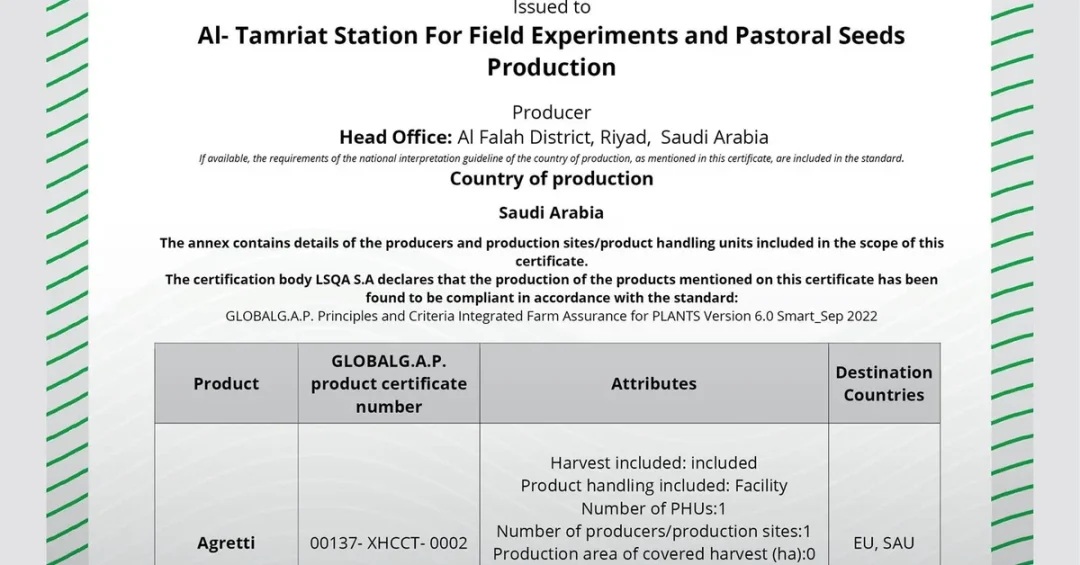
The National Center for Vegetation Cover and Combating Desertification (NCVC) has announced that its Al-Tamariyat Wild Seed Production Station in Al-Jouf has been awarded the prestigious Global Good Agricultural Practices (GLOBAL G.A.P.) certification. The certification, issued by the GLOBAL G.A.P. organization in Germany through an Italian certification body, recognizes the station’s adherence to strict agricultural production standards, ensuring food safety, worker welfare, and sustainable farming practices.
Context and Background
The NCVC is a Saudi government entity dedicated to the development, protection, and rehabilitation of vegetation cover across the Kingdom. Its Al-Tamariyat station, located in the Al-Jouf region, focuses on producing wild seeds native to Saudi Arabia’s environment. These seeds are crucial for reforestation, combating desertification, and stabilizing sand dunes.
GLOBAL G.A.P. is an internationally recognized certification program that sets stringent standards for agricultural production. It covers food safety, environmental sustainability, worker health and safety, and animal welfare. The certification includes a unique GGN reference number, which serves as a consumer label for responsible farming and transparency.
The certification was granted after a comprehensive audit by an Italian certification body on behalf of GLOBAL G.A.P. Germany. It underscores the station’s compliance with criteria such as biodiversity, integrated crop and pest management, quality control systems, and hazard analysis.
Key Details
The Al-Tamariyat Wild Seed Production Station has implemented GLOBAL G.A.P. standards to ensure sustainable environmental management and promote the well-being of its workforce. The certification covers a wide range of criteria, including worker health, safety, and welfare, as well as integrated crop and pest management.
By achieving this certification, the station demonstrates its commitment to quality management systems and continuous improvement. This aligns with NCVC’s broader efforts to enhance service efficiency, increase productivity, and ensure excellence in operations.
The NCVC is actively involved in planting green belts to stabilize sand dunes and rehabilitate vegetation cover. These initiatives reflect Saudi Arabia’s national commitment to sustainability and preserving environmental heritage for future generations.
Implications and Impact
The GLOBAL G.A.P. certification of the Al-Tamariyat station has significant implications for Saudi Arabia’s agricultural and environmental sectors. It showcases the Kingdom’s ability to meet international standards in sustainable farming, which can enhance the credibility and marketability of Saudi agricultural products globally.
Furthermore, this achievement supports Saudi Arabia’s efforts to combat desertification and climate change, aligning with global environmental goals. It also sets a precedent for other agricultural stations in the Kingdom to adopt best practices, potentially leading to broader adoption of sustainable agriculture.
On a regional level, the certification could inspire neighboring countries to pursue similar certifications, fostering a culture of environmental responsibility and cooperation in the Middle East.
Vision 2030 Alignment
This certification is a testament to Saudi Arabia’s Vision 2030, which aims to diversify the economy, promote sustainability, and improve the quality of life. By adhering to international standards, the NCVC contributes to the Kingdom’s environmental goals, including the Saudi Green Initiative, which seeks to plant 10 billion trees and restore 40 million hectares of land.
Such initiatives not only combat desertification but also create green jobs, enhance food security, and promote eco-tourism. The Al-Tamariyat station’s achievement exemplifies how Vision 2030 is being realized on the ground, driving progress towards a sustainable and prosperous future for Saudi Arabia.
20 Questions
Q1. What is the National Center for Vegetation Cover and Combating Desertification (NCVC)?
A1. The NCVC is a Saudi government body responsible for developing, protecting, and rehabilitating vegetation cover, combating desertification, and promoting sustainable land management across the Kingdom.
Q2. Where is the Al-Tamariyat Wild Seed Production Station located?
A2. The station is located in the Al-Jouf region of Saudi Arabia, an area known for its agricultural potential and native plant species.
Q3. What is GLOBAL G.A.P. certification?
A3. GLOBAL G.A.P. is an internationally recognized certification for agricultural practices, ensuring food safety, worker welfare, environmental sustainability, and transparent farming.
Q4. Which organizations issued the certification?
A4. The certification was issued by the GLOBAL G.A.P. organization in Germany through an Italian certification body, following a comprehensive audit.
Q5. What does the GGN reference number signify?
A5. The GGN is a unique identifier that allows consumers to trace the product back to a certified farm, ensuring responsible farming and transparency.
Q6. What criteria does the certification cover?
A6. It covers biodiversity, worker health and safety, integrated crop and pest management, quality control systems, and hazard analysis.
Q7. How does the certification benefit the station’s workforce?
A7. It ensures improved health, safety, and welfare standards for workers, promoting a better working environment.
Q8. What is the significance of this certification for Saudi Arabia?
A8. It demonstrates Saudi Arabia’s commitment to sustainable agriculture and environmental stewardship, enhancing its global reputation.
Q9. How does the NCVC contribute to combating desertification?
A9. The NCVC develops vegetation cover, plants green belts to stabilize sand dunes, and rehabilitates degraded lands, directly fighting desertification.
Q10. What role does the Al-Tamariyat station play in seed production?
A10. It produces wild seeds native to Saudi Arabia, which are used for reforestation and land restoration projects across the Kingdom.
Q11. How does this certification align with Saudi Vision 2030?
A11. It supports Vision 2030’s environmental sustainability goals, including the Saudi Green Initiative, by adopting international best practices.
Q12. What is the Saudi Green Initiative?
A12. The Saudi Green Initiative aims to plant 10 billion trees and restore 40 million hectares of land to combat climate change and desertification.
Q13. Will this certification lead to economic benefits?
A13. Yes, it can enhance the marketability of Saudi agricultural products and promote eco-tourism, contributing to economic diversification.
Q14. How does the certification impact local communities?
A14. It promotes sustainable practices that can create green jobs and improve local livelihoods through better land management.
Q15. What are integrated crop and pest management practices?
A15. These are environmentally friendly methods that minimize chemical use, protect biodiversity, and ensure sustainable crop production.
Q16. Does the certification cover food safety?
A16. Yes, GLOBAL G.A.P. certification includes strict food safety standards, ensuring that products are safe for consumption.
Q17. How does the NCVC ensure continuous improvement?
A17. By implementing quality management systems, regular audits, and adopting international standards like GLOBAL G.A.P., the NCVC ensures ongoing improvement.
Q18. What other initiatives does the NCVC undertake?
A18. The NCVC engages in vegetation development, protection, rehabilitation, and planting green belts to stabilize sand dunes and preserve environmental heritage.
Q19. How does this certification affect Saudi Arabia’s international standing?
A19. It showcases the Kingdom’s ability to meet global standards, enhancing its reputation as a responsible environmental steward.
Q20. What future plans does the NCVC have?
A20. The NCVC aims to expand its efforts in vegetation cover, combat desertification, and contribute to Vision 2030’s sustainability goals through continued innovation and international collaboration.
Reader Feedback
We value your thoughts. Please share your feedback on this article.
Your feedback helps us improve our coverage.