


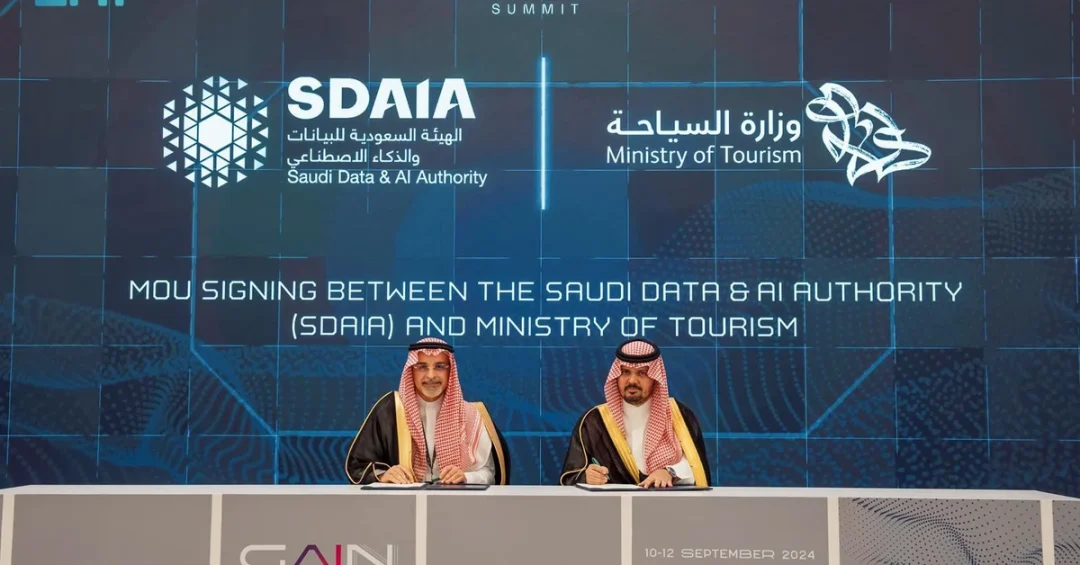
The Saudi Data and AI Authority (SDAIA) and the Ministry of Tourism signed a memorandum of understanding (MoU) in Riyadh on September 10, 2024, to establish an artificial intelligence (AI) center of excellence dedicated to enhancing operational processes in the tourism sector. The agreement, announced on the sidelines of the third Global AI Summit (GAIN Summit), aligns with Saudi Vision 2030 and aims to integrate advanced data and AI technologies to elevate the quality and efficiency of tourism services across the Kingdom.
Context and Background
The MoU reflects Saudi Arabia’s ongoing commitment to leveraging cutting-edge technology for economic diversification and public service improvement. SDAIA, established in 2019, is the national authority responsible for driving the Kingdom’s data and AI agenda. The Ministry of Tourism, under the leadership of Minister Ahmed Al-Khateeb, has been instrumental in expanding the tourism sector as part of Vision 2030’s goal to increase tourism’s contribution to GDP to 10% by 2030. The collaboration is part of a broader national effort to position Saudi Arabia as a global leader in AI adoption and smart governance. The GAIN Summit, a major international event hosted in Riyadh, underscores the Kingdom’s role as a hub for AI innovation and dialogue.
Key Details
The MoU was signed by Alrebdi bin Fahd Alrebd, Head of the National Data Management Office, and Anas bin Abdullah Al-Sulaie, Assistant Minister of Tourism. The agreement focuses on developing a methodology to integrate data and AI applications for evaluating activities and projects within the tourism sector. This will involve creating frameworks for data sharing, analysis, and the deployment of AI tools to optimize operations such as visitor management, resource allocation, and service personalization. The center of excellence will also serve as a platform for training and knowledge exchange, building local capacity in AI and data science specifically for tourism. The initiative is expected to enhance decision-making, improve tourist experiences, and drive sustainable growth in the sector.
Implications and Impact
The establishment of an AI center of excellence for tourism has significant implications for Saudi Arabia’s economy and international standing. By harnessing AI, the Kingdom can offer more seamless and personalized experiences to the millions of pilgrims and tourists visiting annually, particularly for Hajj and Umrah. This can lead to higher visitor satisfaction, increased repeat visits, and positive word-of-mouth, boosting tourism revenue. Furthermore, the center will generate valuable data insights that can inform infrastructure development, marketing strategies, and crisis management. On a global scale, this move reinforces Saudi Arabia’s reputation as a forward-thinking nation investing in technology to solve real-world challenges, potentially attracting international partnerships and investments in AI and tourism tech.
Vision 2030 Alignment
This MoU directly supports Saudi Vision 2030’s objectives of economic diversification, digital transformation, and enhancing the quality of life. Tourism is a key pillar of the Vision, with targets to attract 100 million visitors annually by 2030. By integrating AI into tourism operations, the Kingdom not only improves efficiency but also creates new opportunities for innovation and entrepreneurship. The collaboration between SDAIA and the Ministry of Tourism exemplifies the cross-sector synergy needed to achieve these ambitious goals, ensuring that Saudi Arabia remains at the forefront of the global tourism and technology landscape.
20 Questions
Q1. What is the purpose of the MoU signed between SDAIA and the Ministry of Tourism?
A1. The MoU aims to establish an AI center of excellence to develop and integrate AI technologies into tourism operational processes, enhancing the sector’s quality and aligning with Saudi Vision 2030.
Q2. Who signed the MoU on behalf of SDAIA and the Ministry of Tourism?
A2. The MoU was signed by Alrebdi bin Fahd Alrebd, Head of the National Data Management Office, and Anas bin Abdullah Al-Sulaie, Assistant Minister of Tourism.
Q3. When and where was the MoU signed?
A3. The MoU was signed in Riyadh on September 10, 2024, on the sidelines of the third Global AI Summit (GAIN Summit).
Q4. What is SDAIA and what is its role?
A4. SDAIA is the Saudi Data and AI Authority, established in 2019 to drive the Kingdom’s data and AI agenda, promoting innovation and digital transformation across sectors.
Q5. How does this MoU align with Saudi Vision 2030?
A5. It supports Vision 2030 goals of economic diversification, digital transformation, and tourism growth by leveraging AI to improve efficiency and visitor experiences.
Q6. What specific areas will the AI center of excellence focus on?
A6. The center will focus on integrating data and AI applications to evaluate tourism activities and projects, optimize operations, and enhance service personalization and resource management.
Q7. What is the GAIN Summit?
A7. The Global AI Summit (GAIN) is a major international event hosted in Riyadh, bringing together experts to discuss AI advancements and collaborations, showcasing Saudi Arabia’s leadership in AI.
Q8. How will the AI center benefit tourists visiting Saudi Arabia?
A8. It will enable more seamless, personalized experiences, efficient visitor management, and improved services, particularly for Hajj and Umrah pilgrims, enhancing overall satisfaction.
Q9. What economic benefits are expected from this initiative?
A9. The initiative is expected to boost tourism revenue, attract investments, create jobs in tech and tourism, and support economic diversification goals under Vision 2030.
Q10. Will the center collaborate with international partners?
A10. The MoU focuses on national collaboration, but it may pave the way for international partnerships in AI and tourism technology, given Saudi Arabia’s global engagement.
Q11. How does this MoU enhance Saudi Arabia’s global standing in AI?
A11. It reinforces the Kingdom’s reputation as a forward-thinking nation investing in AI for practical applications, potentially attracting global partnerships and positioning Saudi Arabia as an AI leader.
Q12. What role does data play in this initiative?
A12. Data is central; the center will develop methodologies for data integration and analysis to inform decision-making, evaluate projects, and optimize tourism operations.
Q13. How will the center support small and medium enterprises in tourism?
A13. By providing AI tools and insights, the center can help SMEs improve services, target customers better, and operate more efficiently, fostering entrepreneurship in the tourism sector.
Q14. What training or capacity-building components are included?
A14. The center will likely offer training and knowledge exchange to build local capacity in AI and data science, empowering Saudi professionals in tourism and technology.
Q15. How does this initiative impact Hajj and Umrah operations?
A15. AI can streamline crowd management, resource allocation, and service delivery during Hajj and Umrah, improving safety and experience for millions of pilgrims.
Q16. What are the next steps after signing the MoU?
A16. Next steps include establishing the center, developing frameworks, and launching pilot projects to integrate AI into tourism operations, with timelines to be announced.
Q17. How does this MoU reflect Saudi Arabia’s commitment to innovation?
A17. It demonstrates the Kingdom’s proactive approach to adopting advanced technologies, fostering innovation, and creating a knowledge-based economy as outlined in Vision 2030.
Q18. Will the center’s work be limited to tourism or extend to other sectors?
A18. While focused on tourism, the center’s methodologies and insights could be adapted to other sectors, promoting cross-sector AI adoption and collaboration.
Q19. What is the expected timeline for the center’s establishment?
A19. Specific timelines were not disclosed, but implementation is expected to commence promptly, with progress aligned with Vision 2030 milestones and ongoing digital transformation efforts.
Q20. How can the public learn more about this initiative?
A20. Updates will be available through official channels such as SDAIA, the Ministry of Tourism, and the Saudi Press Agency (SPA), which reported the MoU signing.
Reader Feedback
We value your thoughts. Please share your feedback on this article.
Your feedback helps us improve our coverage.