


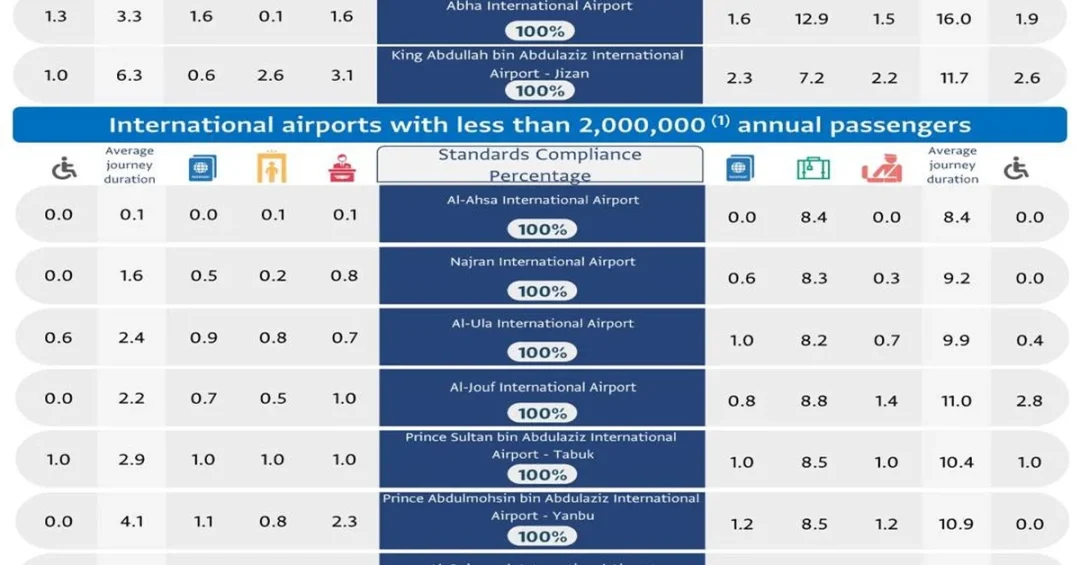
The General Authority of Civil Aviation (GACA) issued its August 2024 performance report for domestic and international airports across Saudi Arabia, highlighting significant achievements in operational efficiency and passenger service standards. The report, released on September 20, 2024, evaluates airports based on 11 operational performance standards aligned with strategic objectives to enhance services and ensure a seamless traveler experience at Kingdom airports.
Context and Background
GACA, the regulatory body overseeing civil aviation in Saudi Arabia, regularly assesses airport performance to drive continuous improvement in line with Vision 2030 goals. The August report categorizes airports by annual passenger numbers to ensure a transparent and fair evaluation process. This approach allows for targeted enhancements and benchmarks against international best practices.
The evaluation focuses on critical passenger touchpoints including check-in, security, passport control, customs, baggage claim, and assistance for passengers with reduced mobility (PRM). These metrics are designed to optimize traveler experiences and support the Kingdom’s broader ambitions to become a global aviation hub.
Key Details
King Khalid International Airport in Riyadh secured the top spot in the category of airports with more than 15 million passengers annually, achieving an 82% compliance rate. King Abdulaziz International Airport in Jeddah followed closely with the same compliance rate, demonstrating strong performance across major hubs.
Prince Mohammed bin Abdulaziz International Airport in Madinah tied for first place in the category of international airports serving 5 to 15 million passengers annually, with a 91% compliance rate. King Fahad International Airport in Dammam also performed well, recording an 82% compliance rate.
In the 2 to 5 million annual passenger category, Abha International Airport and King Abdullah bin Abdulaziz Airport in Jizan both achieved a 100% compliance rate. Abha International Airport outperformed Jizan by surpassing higher targets in the specified evaluation criteria.
Al-Ahsa International Airport achieved a 100% compliance rate in the category of less than 2 million passengers annually, excelling in average waiting times for departing and arriving flights. Gurayat Airport came first in the domestic airport category, also with a 100% compliance rate, outperforming competitors in average waiting times.
Implications and Impact
This report underscores Saudi Arabia’s commitment to elevating its aviation sector, which is a key pillar of Vision 2030. The high compliance rates reflect the effectiveness of ongoing investments in infrastructure and service quality. Improved airport performance enhances passenger satisfaction, boosts tourism, and strengthens the Kingdom’s position as a leading global destination.
Furthermore, these achievements contribute to economic diversification by facilitating smoother business travel and logistics. The focus on operational excellence aligns with international standards, ensuring that Saudi airports remain competitive and attractive to airlines and travelers worldwide.
Vision 2030 Alignment
The August 2024 airport performance report directly supports Vision 2030’s objectives to transform Saudi Arabia into a global logistics and tourism hub. By prioritizing seamless passenger experiences and operational efficiency, GACA is helping to realize the Kingdom’s aspirations for sustainable growth and international connectivity.
20 Questions
Q1. What is the main purpose of GACA’s August 2024 report?
A1. The report evaluates airport performance based on 11 operational standards to enhance services and ensure a seamless traveler experience, aligning with Vision 2030 goals for aviation excellence.
Q2. Which airport topped the category for more than 15 million passengers?
A2. King Khalid International Airport in Riyadh secured the top spot in this category with an 82% compliance rate, showcasing strong operational efficiency.
Q3. How did Prince Mohammed bin Abdulaziz International Airport perform?
A3. It tied for first place in the 5 to 15 million passenger category with a 91% compliance rate, reflecting high service standards.
Q4. What compliance rate did Abha International Airport achieve?
A4. Abha International Airport achieved a 100% compliance rate in the 2 to 5 million passenger category, outperforming others by surpassing higher targets.
Q5. Which airport won in the domestic category?
A5. Gurayat Airport came first in the domestic airport category with a 100% compliance rate, excelling in average waiting times for flights.
Q6. What are the 11 operational performance standards based on?
A6. They focus on critical passenger touchpoints like check-in, security, passport control, customs, baggage claim, and assistance for passengers with reduced mobility.
Q7. Why does GACA categorize airports by passenger numbers?
A7. Categorization ensures a transparent and fair evaluation approach, allowing airports of similar sizes to be compared effectively and targets to be set appropriately.
Q8. How does this report support Vision 2030?
A8. It aligns with Vision 2030 by improving airport services, boosting tourism, and enhancing Saudi Arabia’s position as a global aviation and logistics hub.
Q9. What was King Abdulaziz International Airport’s compliance rate?
A9. King Abdulaziz International Airport in Jeddah recorded an 82% compliance rate, placing it closely behind the top performer in its category.
Q10. Which airport achieved 100% compliance in the less than 2 million category?
A10. Al-Ahsa International Airport achieved a 100% compliance rate, outperforming competitors in average waiting times for departing and arriving flights.
Q11. What is the significance of the 100% compliance rates?
A11. They indicate exceptional operational efficiency and service quality, setting benchmarks for other airports and demonstrating commitment to excellence.
Q12. How does GACA ensure transparency in its evaluations?
A12. GACA uses clear categorization by passenger numbers and publishes detailed reports, allowing for open comparison and accountability across all airports.
Q13. What role do these evaluations play in passenger experience?
A13. They drive improvements in key areas, ensuring smoother processes, reduced waiting times, and better assistance, ultimately enhancing overall traveler satisfaction.
Q14. Which airport tied with Prince Mohammed bin Abdulaziz International Airport?
A14. No airport tied; it secured first place alone in its category with a 91% compliance rate, surpassing King Fahad International Airport’s 82%.
Q15. What are the key metrics for airport performance assessment?
A15. Metrics include check-in efficiency, security screening, passport control, customs processing, baggage claim, and support for passengers with reduced mobility.
Q16. How does this report impact Saudi Arabia’s aviation sector?
A16. It highlights strengths and areas for improvement, fostering healthy competition and driving investments to elevate service standards across the Kingdom.
Q17. What is the frequency of such performance reports?
A17. GACA issues these reports monthly, providing regular updates on airport performance to ensure continuous monitoring and enhancement.
Q18. Which airport excelled in average waiting times?
A18. Gurayat Airport and Al-Ahsa International Airport excelled in average waiting times for departing and arriving flights in their respective categories.
Q19. How do these standards align with international best practices?
A19. They are designed to meet global benchmarks, ensuring Saudi airports remain competitive and provide world-class services to international travelers.
Q20. What future improvements can be expected from this report?
A20. Airports will use the findings to address gaps, enhance infrastructure, and adopt innovative solutions, further advancing Vision 2030 objectives.
Reader Feedback
We value your thoughts. Please share your feedback on this article.
Your feedback helps us improve our coverage.