


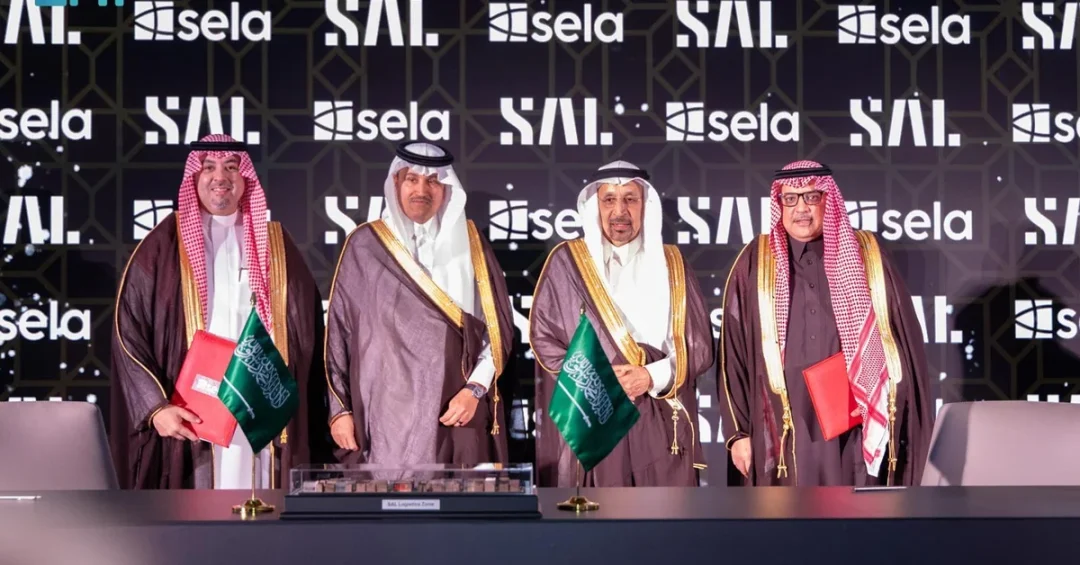
SAL Saudi Logistics Services Company and Sela Company have signed a SAR4-billion agreement to establish the SAL Logistics Zone, a major new logistics hub spanning over 1.5 million square meters within the Falcons City project north of Riyadh. The signing ceremony, held in Riyadh on March 18, 2025, was attended by Minister of Investment Khalid Al-Falih, Minister of Transport and Logistic Services Saleh Al-Jasser, General Authority of Civil Aviation President Abdulaziz Al-Duailej, Saudi Falcons Club CEO Talal bin Abdulaziz Al-Shamaisi, and several other officials, investors, and business leaders. The initiative supports Saudi Arabia’s Vision 2030 and the National Transport and Logistics Strategy, reinforcing the Kingdom’s position as a global logistics hub.
Context and Background
The agreement reflects Saudi Arabia’s ongoing efforts to diversify its economy and strengthen strategic sectors, particularly logistics and transportation. The National Transport and Logistics Strategy, a key component of Vision 2030, aims to position the Kingdom as a global logistics hub connecting Asia, Europe, and Africa. Falcons City, a 14.4-million-square-meter integrated development in the Malham area north of Riyadh, serves as the backdrop for this project. Home to the Saudi Falcons Club, a prominent cultural and heritage landmark, the area is evolving into a comprehensive destination that blends modern economic projects with cultural preservation. The new logistics zone will benefit from its strategic location near King Khalid International Airport, major highways, and rail networks, enhancing connectivity across the Kingdom.
Key Details
The SAL Logistics Zone represents a SAR4-billion investment aimed at developing a model logistics hub with high-quality, Category A warehouses and storage spaces designed to meet diverse requirements. The agreement was signed by SAL CEO Omar bin Talal Hariri and Sela Managing Director Rakan Al-Harthy. Hariri emphasized that the zone will significantly enhance SAL’s capabilities, solidifying its position as a comprehensive hub for shipping and distribution operations and supporting Saudi Arabia’s role as a key global trade center. Falcons City itself features the Riyadh Exhibition and Convention Center, an aviation runway, an aircraft maintenance area, and economic, commercial, residential, hospitality, and entertainment zones, all designed to attract global companies and investors.
Implications and Impact
This development is expected to have far-reaching implications for Saudi Arabia’s logistics sector, boosting its capacity to handle increasing cargo and shipping demands. By integrating logistics infrastructure with cultural and tourism attractions, the project enhances the appeal of the Malham area, attracting both visitors and investors. It also aligns with broader efforts to increase non-oil revenues and create jobs, contributing to the Kingdom’s economic diversification goals. Regionally, the logistics zone will strengthen Saudi Arabia’s competitiveness as a trade gateway, facilitating smoother movement of goods and reinforcing its strategic position in global supply chains.
Vision 2030 Alignment
The SAL Logistics Zone directly supports Vision 2030 by advancing the National Transport and Logistics Strategy’s objectives to expand logistics infrastructure, enhance connectivity, and elevate Saudi Arabia’s ranking in international logistics indices. This project exemplifies how integrating economic development with heritage and tourism can drive sustainable growth, attract foreign investment, and diversify the economy away from oil dependency. As the Kingdom continues to invest in world-class infrastructure, initiatives like this will play a crucial role in transforming Saudi Arabia into a leading global logistics hub and a destination for business and culture.
20 Questions
Q1. What is the SAL Logistics Zone?
A1. The SAL Logistics Zone is a SAR4-billion logistics hub to be established within Falcons City north of Riyadh, spanning over 1.5 million square meters. It aims to enhance Saudi Arabia’s logistics capabilities and support its Vision 2030 goals.
Q2. Who signed the agreement to establish the logistics zone?
A2. The agreement was signed by SAL CEO Omar bin Talal Hariri and Sela Managing Director Rakan Al-Harthy. The signing ceremony was attended by several high-ranking officials, including Minister of Investment Khalid Al-Falih.
Q3. Where is Falcons City located?
A3. Falcons City is located in the Malham area north of Riyadh. It spans 14.4 million square meters and is home to the Saudi Falcons Club, a cultural and heritage landmark.
Q4. What is the total investment for the SAL Logistics Zone?
A4. The total investment for the SAL Logistics Zone is SAR4 billion. This investment will develop a model logistics zone with high-quality warehouses and storage spaces to meet diverse logistical needs.
Q5. How does the project align with Vision 2030?
A5. The project aligns with Vision 2030 by supporting the National Transport and Logistics Strategy, which aims to position Saudi Arabia as a global logistics hub. It also contributes to economic diversification and job creation.
Q6. What facilities will the SAL Logistics Zone feature?
A6. The zone will feature Category A warehouses and storage spaces designed to meet various requirements. It will also benefit from nearby infrastructure like King Khalid International Airport, major highways, and rail networks.
Q7. Who attended the signing ceremony?
A7. The ceremony was attended by Minister of Investment Khalid Al-Falih, Minister of Transport and Logistic Services Saleh Al-Jasser, GACA President Abdulaziz Al-Duailej, Saudi Falcons Club CEO Talal bin Abdulaziz Al-Shamaisi, and other officials and investors.
Q8. What is the significance of the location near King Khalid International Airport?
A8. The proximity to King Khalid International Airport enhances connectivity and efficiency for shipping and distribution operations. It supports the zone’s role as a comprehensive hub for logistics and trade.
Q9. What is the National Transport and Logistics Strategy?
A9. The National Transport and Logistics Strategy is a key component of Vision 2030. It aims to develop Saudi Arabia’s transport and logistics sectors to diversify the economy and establish the Kingdom as a global logistics hub.
Q10. How will the local community benefit from this project?
A10. The project will create jobs, attract investors, and stimulate economic activity in the region. It also integrates with cultural and tourism attractions, enhancing the area’s appeal and quality of life.
Q11. What role does Sela Company play in this project?
A11. Sela Company is a partner in the agreement, contributing to the development of the logistics zone. Sela is known for managing large-scale projects and destinations in Saudi Arabia.
Q12. What are Category A warehouses?
A12. Category A warehouses are high-quality, modern storage facilities that meet international standards. They are designed to accommodate various types of goods and logistical requirements efficiently.
Q13. How does this project support Saudi Arabia’s economic diversification?
A13. By boosting the logistics sector, the project helps reduce dependence on oil revenues. It attracts foreign investment, enhances trade, and creates employment opportunities, aligning with Vision 2030’s economic goals.
Q14. What is the Saudi Falcons Club?
A14. The Saudi Falcons Club is a cultural and heritage organization dedicated to preserving falconry traditions. It hosts events and initiatives that promote tourism and cultural activities in the region.
Q15. What other facilities are part of Falcons City?
A15. Falcons City includes the Riyadh Exhibition and Convention Center, an aviation runway, an aircraft maintenance area, and zones for economic, commercial, residential, hospitality, and entertainment purposes.
Q16. How will the logistics zone enhance Saudi Arabia’s global trade position?
A16. The zone will improve shipping and distribution efficiency, making Saudi Arabia a more attractive trade gateway. It will facilitate smoother movement of goods and strengthen the Kingdom’s role in global supply chains.
Q17. What is the expected timeline for the project?
A17. The specific timeline for completion has not been announced. However, the agreement marks the launch of the project, and development is expected to proceed in phases in line with strategic plans.
Q18. How does this project integrate with tourism and culture?
A18. The logistics zone is part of Falcons City, which blends modern economy with cultural heritage. The presence of the Saudi Falcons Club and other attractions draws visitors and investors, creating a comprehensive destination.
Q19. What government ministries are involved in supporting this initiative?
A19. The Ministry of Investment and the Ministry of Transport and Logistic Services are key supporters. The General Authority of Civil Aviation is also involved, reflecting a coordinated government effort to advance the project.
Q20. How does this project contribute to job creation?
A20. The construction and operation of the logistics zone will create numerous jobs in logistics, construction, and related sectors. It will also stimulate ancillary businesses, further boosting employment in the region.
Reader Feedback
We value your thoughts. Please share your feedback on this article.
Your feedback helps us improve our coverage.
Related articles
 NHC Launches SAR271M Power Substation at Sadayem Jeddah
 ICD Hosts Uzbek Delegation for Islamic Finance Talks
 Saudi Arabia Awards Exploration Licenses for First Mineralized Belts
 Al-Baha’s Agricultural Riches Enhance Ramadan Feasts
 Japanese Stocks Mixed: Nikkei Down, TOPIX Up
 Saudi Arabia Achieves 100% Self-Sufficiency in Table Eggs