


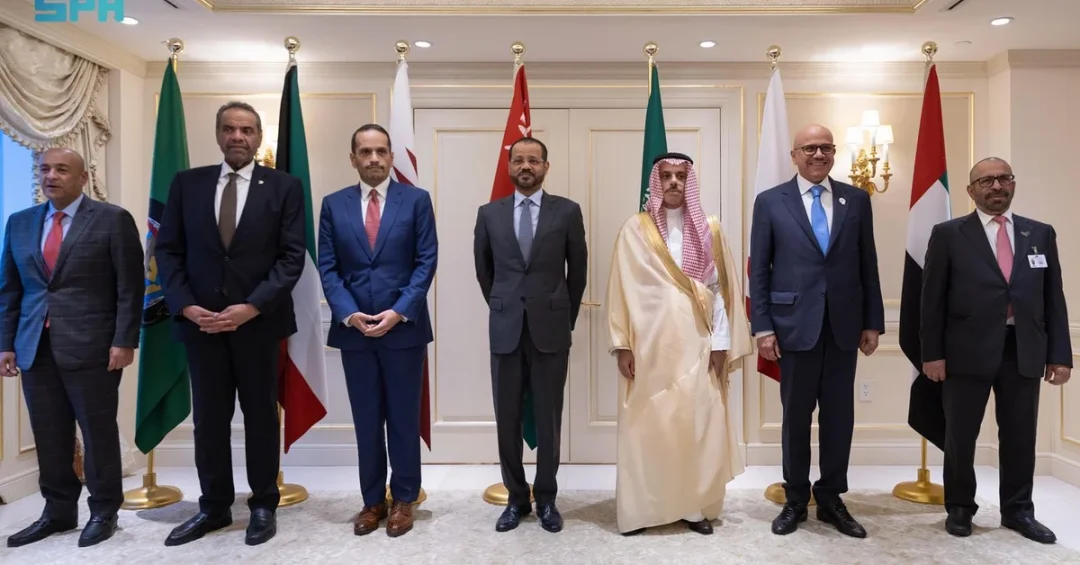
Minister of Foreign Affairs Prince Faisal bin Farhan bin Abdullah participated in the GCC Coordinating Ministerial Meeting on September 22, 2024, in New York, on the sidelines of the 79th United Nations General Assembly high-level week. The meeting brought together foreign ministers from the Gulf Cooperation Council (GCC) member states to discuss regional and international developments, with a particular focus on the humanitarian crisis in Gaza. According to the Saudi Press Agency (SPA), the discussions emphasized the need for an immediate ceasefire and the securing of corridors for delivering humanitarian aid to the affected population. The meeting underscores Saudi Arabia’s active role in fostering Gulf unity and addressing pressing regional challenges through diplomacy.
Context and Background
The GCC Coordinating Ministerial Meeting is a regular gathering of foreign ministers from the six member states—Saudi Arabia, the United Arab Emirates, Bahrain, Kuwait, Oman, and Qatar—held alongside major international events like the UN General Assembly. These meetings provide a platform for coordinating positions on key issues and enhancing collective action. This year’s meeting comes amid heightened tensions in the Middle East, particularly the ongoing conflict in Gaza, which has resulted in a severe humanitarian crisis. Saudi Arabia has consistently advocated for peaceful resolutions and has been at the forefront of diplomatic efforts to address the situation, including calling for ceasefires and facilitating aid delivery. The Kingdom’s participation reflects its commitment to regional stability and its leadership within the Gulf and broader Arab world.
Key Details
During the meeting, Prince Faisal bin Farhan highlighted the importance of unified Gulf action to address the crisis in Gaza. The ministers discussed strategies to secure humanitarian corridors and ensure that aid reaches those in need. The Saudi delegation included Deputy Minister for International Multilateral Affairs and General Supervisor of the Public Diplomacy Deputyship Ambassador Dr. Abdulrahman Al-Rassi, the Kingdom’s Permanent Representative to the UN Ambassador Dr. Abdulaziz AlWasil, Director-General of the Foreign Minister’s Office Abdulrahman Aldawood, and Director of the GCC Department Anas Alwasedy. Their presence underscores the Kingdom’s coordinated approach to multilateral diplomacy. The meeting also addressed broader regional security and cooperation, aligning with GCC goals of promoting peace and prosperity in the region.
Implications and Impact
The outcomes of this meeting are expected to bolster joint Gulf efforts in mediating conflicts and providing humanitarian assistance. By aligning their positions, GCC member states can present a united front in international forums, increasing pressure for ceasefires and unhindered aid access. Saudi Arabia’s active engagement reinforces its role as a regional leader and a reliable partner in global diplomacy. This coordination also strengthens the GCC’s collective influence, enabling it to play a more effective role in addressing crises. Furthermore, the meeting signals to the international community the Gulf’s commitment to stability and humanitarian principles, which can enhance diplomatic and economic ties with other nations.
Vision 2030 Alignment
Saudi Arabia’s participation in the GCC Coordinating Ministerial Meeting directly supports the goals of Vision 2030, which seeks to elevate the Kingdom’s global standing and promote international cooperation. By fostering Gulf unity and addressing regional challenges, Saudi Arabia demonstrates its commitment to a secure and prosperous Middle East. This aligns with Vision 2030’s emphasis on diplomacy, economic diversification, and humanitarian outreach. As the Kingdom continues to play a pivotal role in regional affairs, its leadership contributes to a stable environment conducive to investment and development, further advancing Vision 2030’s objectives.
20 Questions
Q1. What was the main purpose of the GCC Coordinating Ministerial Meeting?
A1. The meeting aimed to coordinate Gulf positions on regional and international developments, focusing on the situation in Gaza, the need for an immediate ceasefire, and securing humanitarian aid corridors.
Q2. When and where did the meeting take place?
A2. The meeting took place on September 22, 2024, in New York, on the sidelines of the 79th session of the United Nations General Assembly high-level week.
Q3. Who represented Saudi Arabia at the meeting?
A3. Minister of Foreign Affairs Prince Faisal bin Farhan bin Abdullah represented Saudi Arabia, supported by senior officials including Ambassador Dr. Abdulrahman Al-Rassi and Ambassador Dr. Abdulaziz AlWasil.
Q4. What GCC member states attended the meeting?
A4. All six GCC member states attended: Saudi Arabia, the United Arab Emirates, Bahrain, Kuwait, Oman, and Qatar, represented by their respective foreign ministers.
Q5. What was the key focus regarding Gaza?
A5. The key focus was on achieving an immediate ceasefire and ensuring the delivery of humanitarian aid through secure corridors to alleviate the suffering of civilians in Gaza.
Q6. How does this meeting align with Saudi Arabia’s foreign policy?
A6. It aligns with Saudi Arabia’s foreign policy of promoting peace, stability, and humanitarian assistance, and reinforces its leadership role in the Gulf and the broader region.
Q7. What is the significance of holding the meeting during the UN General Assembly?
A7. It allows Gulf ministers to coordinate positions and engage with global leaders on pressing issues, maximizing diplomatic impact and visibility on the international stage.
Q8. What role did Saudi Arabia play in the discussions?
A8. Saudi Arabia played a leading role, advocating for unified Gulf action, emphasizing the need for a ceasefire, and pushing for humanitarian access in Gaza.
Q9. Who else was part of the Saudi delegation?
A9. The delegation included Ambassador Dr. Abdulrahman Al-Rassi, Ambassador Dr. Abdulaziz AlWasil, Abdulrahman Aldawood, and Anas Alwasedy, among others.
Q10. What are the expected outcomes of the meeting?
A10. Expected outcomes include a unified GCC stance on Gaza, increased pressure for a ceasefire, and enhanced coordination on humanitarian aid delivery and regional security.
Q11. How does this meeting support Vision 2030?
A11. It supports Vision 2030 by enhancing Saudi Arabia’s global standing, promoting regional stability, and fostering international cooperation, all of which are key pillars of the vision.
Q12. What is the GCC’s role in regional diplomacy?
A12. The GCC plays a crucial role in mediating conflicts, coordinating economic and security policies, and presenting a unified voice in international forums to advance member states’ interests.
Q13. How has Saudi Arabia contributed to humanitarian efforts in Gaza?
A13. Saudi Arabia has provided substantial humanitarian aid, called for ceasefires, and worked diplomatically to secure aid corridors, demonstrating its commitment to alleviating the crisis.
Q14. What other topics were discussed at the meeting?
A14. Besides Gaza, the ministers discussed broader regional and international developments, including security cooperation and economic coordination among GCC states.
Q15. What is the significance of the GCC Coordinating Ministerial Meeting?
A15. It serves as a vital platform for GCC foreign ministers to align positions, address common challenges, and enhance collective action on issues of mutual concern.
Q16. How does Saudi Arabia’s participation reflect its regional leadership?
A16. It demonstrates Saudi Arabia’s proactive approach to regional diplomacy, its commitment to Gulf unity, and its role as a key mediator and peacebroker in the Middle East.
Q17. What message does the meeting send to the international community?
A17. It sends a message of Gulf unity and determination to address regional crises peacefully, and a call for international support for humanitarian efforts and ceasefires.
Q18. What are the next steps following the meeting?
A18. Next steps include continued coordination among GCC states, diplomatic engagement with international partners, and efforts to implement ceasefire and aid delivery mechanisms on the ground.
Q19. How does the meeting impact GCC relations with other countries?
A19. It strengthens the GCC’s collective diplomatic leverage, potentially leading to enhanced partnerships and support from other nations for regional peace and stability initiatives.
Q20. What is Saudi Arabia’s stance on the humanitarian situation in Gaza?
A20. Saudi Arabia advocates for an immediate ceasefire, unimpeded humanitarian access, and a peaceful resolution to the conflict, consistent with its commitment to justice and stability in the region.
Reader Feedback
We value your thoughts. Please share your feedback on this article.
Your feedback helps us improve our coverage.