


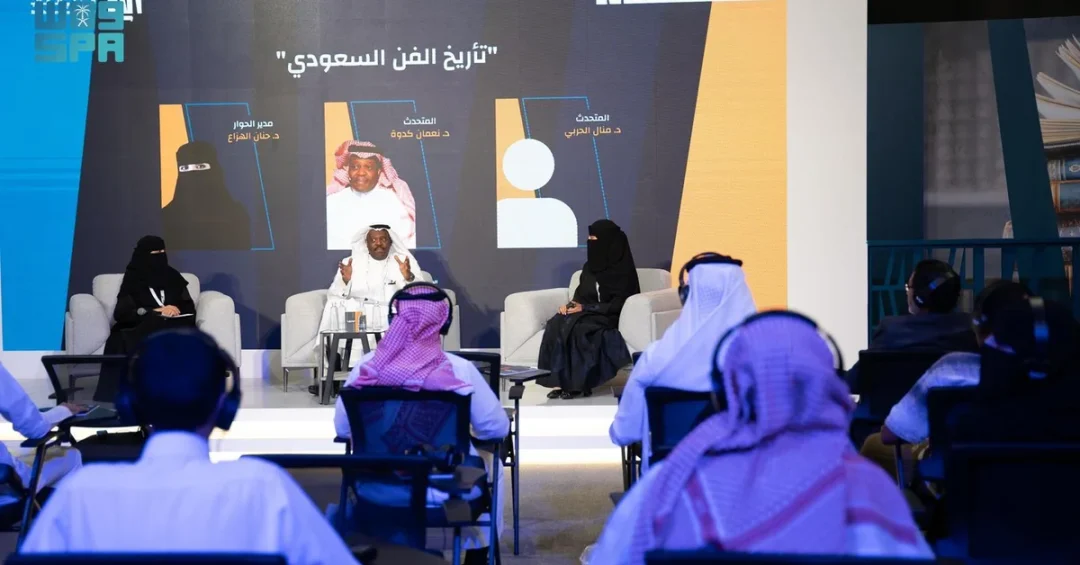
Riyadh, October 05, 2024 — Participants in a session titled “History of Saudi Art” at the 2024 Riyadh International Book Fair emphasized that Saudi art has a global presence, with the Saudi orchestra today representing the voices of all Saudi artists who have shaped Saudi music into a significant artistic achievement. The session, organized by the Literature, Publishing, and Translation Commission, brought together academic Dr. Nauman Kadowa and Saudi researcher Dr. Manal Al-Harbi, and was moderated by researcher and visual artist Dr. Hanan Al-Hazza. The discussion shed light on the evolution of Saudi art and its growing international influence.
Context and Background
The Riyadh International Book Fair, one of the region’s premier cultural events, serves as a platform for intellectual exchange and cultural dialogue. This year’s session on the history of Saudi art highlighted the deep-rooted artistic heritage of the Kingdom, tracing its origins from prehistoric times to contemporary expressions. The Literature, Publishing, and Translation Commission, a key entity under the Ministry of Culture, organized the event to foster a deeper understanding of Saudi Arabia’s artistic legacy and its role in shaping national identity.
Saudi art has undergone multiple transformations, particularly with the establishment of the Theater and Performing Arts Commission and the Music Commission. These organizations have enhanced national identity and provided bridges for Saudi arts to connect with the world, reflecting both the Kingdom’s rich past and promising future.
Key Details
Dr. Nauman Kadowa explained that Saudi art has historically evolved through various phases, with the recent establishment of dedicated commissions marking a significant milestone. He proposed including art in institutional projects that gather reliable information to produce contemporary art rooted in the Kingdom’s past, present, and future. He emphasized the necessity of establishing an informational center for Saudi art that collects sources and references through collaborative efforts among cultural and artistic bodies and relevant entities.
Dr. Manal Al-Harbi highlighted the reciprocal relationship between art and society, noting that art reflects the community. “If we look back at the history of the Kingdom of Saudi Arabia, we find that the arts present on our land date back to prehistoric times,” she said. She also emphasized the contributions of the late Saudi artist Safeya Binzagr, who illustrated Saudi customs and traditions through her artworks. “Many Saudi artists have similarly reflected their homeland’s customs and traditions during their studies and international scholarships, underscoring the significant responsibility that Saudi artists have historically committed to and must continue to uphold,” Al-Harbi added.
Al-Harbi also pointed out the challenges facing researchers and scholars of Saudi art history, primarily the scarcity of references, which complicates the acquisition of information needed to form a comprehensive system. She suggested that the efforts of municipal authorities, through their preserved documents, could help address this issue.
Implications and Impact
The insights shared at the Riyadh International Book Fair underscore the growing recognition of Saudi art on the global stage. The Saudi orchestra, representing the voices of all Saudi artists, symbolizes the Kingdom’s musical achievements and its ability to connect with international audiences. As Saudi Arabia continues to invest in its cultural sector, the arts are poised to play a pivotal role in fostering cross-cultural dialogue and enhancing the Kingdom’s soft power.
The session also highlighted the need for a centralized repository of information on Saudi art history. Such an initiative would support researchers, scholars, and artists in documenting and preserving the Kingdom’s artistic heritage for future generations. By addressing the scarcity of references, Saudi Arabia can ensure that its rich artistic legacy is accurately represented and accessible to a global audience.
Vision 2030 Alignment
This focus on art and culture aligns with Saudi Vision 2030, which aims to diversify the economy and promote cultural enrichment. The establishment of the Theater and Performing Arts Commission and the Music Commission are direct outcomes of Vision 2030’s cultural objectives, designed to nurture talent and preserve heritage. As Saudi Arabia continues to open up to the world, its artistic community is set to thrive, contributing to the Kingdom’s global presence and cultural diplomacy. The Riyadh International Book Fair serves as a testament to Saudi Arabia’s commitment to celebrating its artistic history while embracing a future of creative excellence.
20 Questions
Q1. What was the title of the session held at the 2024 Riyadh International Book Fair?
A1. The session was titled “History of Saudi Art.” It focused on the evolution of Saudi art and its global presence. The session was organized by the Literature, Publishing, and Translation Commission. It featured Dr. Nauman Kadowa and Dr. Manal Al-Harbi, moderated by Dr. Hanan Al-Hazza. The discussion highlighted the significance of Saudi artistic heritage.
Q2. Who organized the session on the history of Saudi art?
A2. The session was organized by the Literature, Publishing, and Translation Commission, a key entity under the Saudi Ministry of Culture. This commission supports literary and artistic activities in the Kingdom. It plays a vital role in promoting Saudi culture globally. The event was part of the Riyadh International Book Fair, a major cultural gathering.
Q3. Who were the speakers at the session?
A3. The speakers were academic Dr. Nauman Kadowa and Saudi researcher Dr. Manal Al-Harbi. The session was moderated by researcher and visual artist Dr. Hanan Al-Hazza. Each brought unique insights into the history and evolution of Saudi art. Their contributions enriched the discussion on the global presence of Saudi art.
Q4. What did Dr. Nauman Kadowa say about Saudi art transformations?
A4. Dr. Kadowa explained that Saudi art has undergone multiple transformations, notably with the establishment of the Theater and Performing Arts Commission and the Music Commission. These organizations have enhanced national identity and provided bridges for Saudi arts to connect with the world. They reflect both the Kingdom’s rich past and promising future.
Q5. What did Dr. Manal Al-Harbi emphasize about art and society?
A5. Dr. Al-Harbi highlighted the reciprocal relationship between art and society, noting that art reflects the community. She pointed out that the arts in Saudi Arabia date back to prehistoric times. She also emphasized the contributions of Saudi artists in preserving customs and traditions. This underscores the significant responsibility of Saudi artists.
Q6. Which late Saudi artist was mentioned for illustrating Saudi customs?
A6. The late Saudi artist Safeya Binzagr was mentioned for illustrating Saudi customs and traditions through her artworks. Her work has been influential in documenting Saudi heritage. She is remembered for her contributions to Saudi art. Her legacy continues to inspire contemporary artists.
Q7. What challenges did Dr. Al-Harbi mention regarding Saudi art history research?
A7. Dr. Al-Harbi mentioned the scarcity of references as a primary challenge in researching Saudi art history. This scarcity complicates the acquisition of information needed to form a comprehensive system. She suggested that municipal authorities’ preserved documents could help address this issue. Collaborative efforts are needed to overcome these challenges.
Q8. What solution did Dr. Kadowa propose for documenting Saudi art?
A8. Dr. Kadowa proposed including art in institutional projects that gather reliable information to produce contemporary art rooted in the Kingdom’s past, present, and future. He emphasized establishing an informational center for Saudi art. This center would collect sources and references through collaborative efforts. Such an initiative would support researchers and artists.
Q9. How does the Saudi orchestra represent Saudi artists?
A9. The Saudi orchestra represents the voices of all Saudi artists who have shaped Saudi music into a significant artistic achievement. It symbolizes the unity and diversity of Saudi musical talent. The orchestra showcases the Kingdom’s musical heritage on a global stage. It is a testament to the progress of Saudi art.
Q10. What is the significance of the Theater and Performing Arts Commission?
A10. The Theater and Performing Arts Commission, established as part of Saudi Arabia’s cultural reforms, aims to enhance national identity and provide bridges for Saudi arts to connect with the world. It supports theatrical productions and performing arts. It reflects the Kingdom’s commitment to cultural development. It is a key player in the artistic landscape.
Q11. What role does the Music Commission play in Saudi art?
A11. The Music Commission supports and promotes Saudi music, contributing to the enhancement of national identity. It provides platforms for Saudi musicians to showcase their talents. It also facilitates international collaborations. The commission is instrumental in the growth of Saudi musical heritage.
Q12. How does Saudi art reflect the Kingdom’s past and future?
A12. Saudi art reflects the Kingdom’s rich past through traditional motifs and historical themes, while also embracing contemporary expressions. It bridges heritage and modernity. Artists draw inspiration from prehistoric times to the present. This duality showcases the dynamic nature of Saudi culture.
Q13. What is the Riyadh International Book Fair?
A13. The Riyadh International Book Fair is a major cultural event held annually in Riyadh, Saudi Arabia. It brings together publishers, authors, and artists from around the world. It serves as a platform for intellectual exchange and cultural dialogue. The fair is organized by the Literature, Publishing, and Translation Commission.
Q14. Why is the history of Saudi art important to document?
A14. Documenting the history of Saudi art is important to preserve the Kingdom’s cultural heritage for future generations. It provides insights into the evolution of artistic expressions. It also helps in understanding the societal changes over time. Accurate documentation supports academic research and cultural appreciation.
Q15. How can municipal authorities contribute to preserving Saudi art history?
A15. Municipal authorities can contribute by providing access to their preserved documents, which contain valuable historical information. These documents can help fill gaps in references. They can support researchers in compiling comprehensive art histories. Collaboration with cultural bodies is essential.
Q16. What is the relationship between art and society in Saudi Arabia?
A16. In Saudi Arabia, art and society have a reciprocal relationship; art reflects the community’s values, traditions, and aspirations. It serves as a mirror to societal changes. Artists often draw inspiration from their surroundings. This dynamic interaction enriches both art and society.
Q17. How do Saudi artists on international scholarships contribute to art?
A17. Saudi artists on international scholarships reflect their homeland’s customs and traditions in their work, showcasing Saudi culture globally. They bring back new techniques and perspectives. They also uphold the responsibility of representing their country. Their contributions enhance the global presence of Saudi art.
Q18. What is the role of the Literature, Publishing, and Translation Commission?
A18. The Literature, Publishing, and Translation Commission supports literary and artistic activities in Saudi Arabia. It organizes events like the Riyadh International Book Fair. It promotes Saudi culture internationally. It is a key entity under the Ministry of Culture.
<h3
Reader Feedback
We value your thoughts. Please share your feedback on this article.
Your feedback helps us improve our coverage.
Related articles
 Media Minister Visits Riyadh International Book Fair 2024
 LPTC Honors Sponsors and Winners of Riyadh Book Fair Awards
 Arab Publishers Hail Riyadh International Book Fair Impact
 Saudi Woman Creates Arabic Learning Game ‘Akwan’
 Saudi Falcons Club, King Khalid University Sign Falconry Research MoU
 Saudi Falcons Club, Quality of Life Program Sign MoU to Support Falconry