


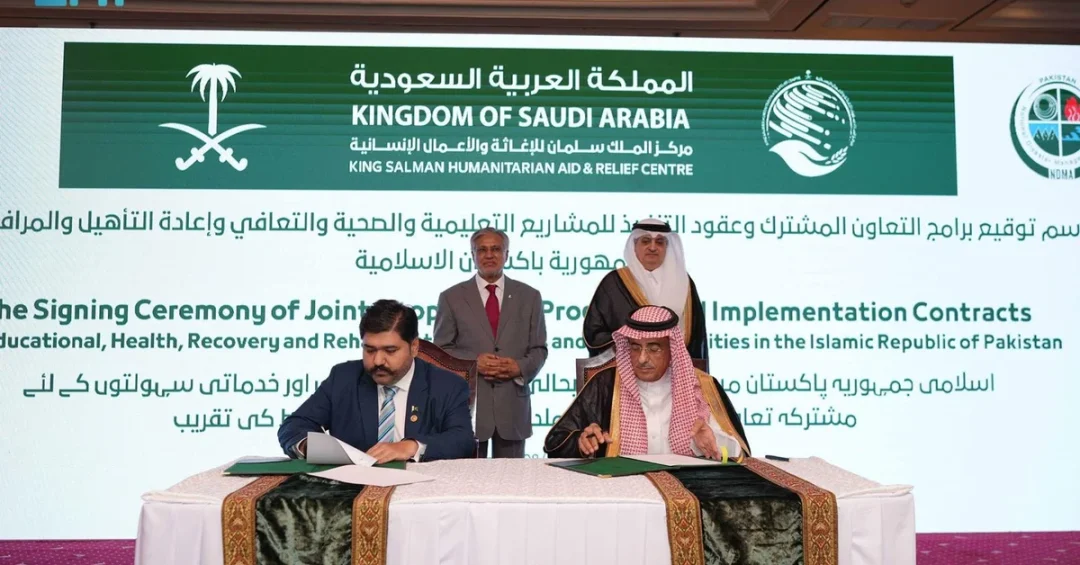
The King Salman Humanitarian Aid and Relief Center (KSrelief) signed four cooperation programs on Tuesday with Pakistani and international organizations to rebuild communities affected by natural disasters in the Islamic Republic of Pakistan, with a total value of $14,223,762. The agreements, signed in Islamabad by KSrelief’s Assistant Supervisor General for Operations and Programs Eng. Ahmed bin Ali Al-Baiz, aim to directly benefit around 360,000 individuals and indirectly benefit 690,000 others through housing, education, and infrastructure projects. The signing ceremony was attended by Pakistan’s Deputy Prime Minister and Minister of Foreign Affairs, Mohammad Ishaq Dar, Saudi Ambassador to Pakistan Nawaf bin Said Al-Malki, and representatives from the National Disaster Management Authority (NDMA), the National Commission for Human Development (NCHD), the Pakistan Red Crescent Society, the Earthquake Reconstruction and Rehabilitation Authority (ERRA), and various UN organizations.
Context and Background
Pakistan has faced significant challenges from natural disasters, particularly the devastating 2022 floods that displaced millions and destroyed infrastructure. In response, Saudi Arabia, through KSrelief, has been at the forefront of humanitarian efforts, providing aid and supporting long-term recovery. The four programs signed this week are part of Saudi Arabia’s ongoing commitment to enhance community resilience in Pakistan, in line with the directives of the Custodian of the Two Holy Mosques, King Salman bin Abdulaziz Al Saud, and His Royal Highness Prince Mohammed bin Salman bin Abdulaziz Al Saud, Crown Prince and Prime Minister. These initiatives focus on sustainable development, education, and healthcare, aligning with Saudi Arabia’s broader humanitarian mission and Vision 2030 goals of global engagement and partnership.
Key Details
The agreements encompass several critical projects. First, 1,000 permanent housing units will be constructed for families affected by the 2022 floods in Khyber Pakhtunkhwa and Punjab provinces, providing safe shelter for approximately 7,000 individuals. Each house will include two bedrooms, a kitchen, and a bathroom, ensuring a dignified living environment. Second, KSrelief will establish 300 community schools equipped with solar power and clean drinking water facilities across Pakistan, serving around 15,000 children directly and over 100,000 individuals indirectly. These schools will be handed over to the National Commission for Human Development for long-term sustainability. Third, four secondary schools will be built in Kashmir, providing a safe learning environment for 3,400 students. Fourth, a national logistics warehouse will be established for the NDMA in Islamabad to enhance emergency relief storage and distribution. Additionally, 22 service facilities, including schools, health centers, and water projects previously established by Saudi Arabia, will be rehabilitated to improve access to education, healthcare, and clean water in disaster-affected regions.
Implications and Impact
These programs will have a transformative impact on disaster-affected communities in Pakistan. The housing units will provide secure and dignified living spaces for flood victims, while the schools will ensure access to quality education for thousands of children, breaking the cycle of poverty. The logistics warehouse will significantly boost Pakistan’s capacity to respond to future emergencies, saving lives and reducing suffering. The rehabilitation of service facilities will restore essential services, improving health and well-being. Beyond the immediate benefits, these initiatives strengthen the bond between Saudi Arabia and Pakistan, demonstrating Saudi Arabia’s leadership in humanitarian aid and its commitment to supporting Muslim communities worldwide. The programs also contribute to the United Nations Sustainable Development Goals, particularly in education, health, and infrastructure.
Vision 2030 Alignment
This initiative reflects Saudi Arabia’s Vision 2030, which emphasizes global engagement, humanitarian leadership, and sustainable development. By investing in Pakistan’s recovery and resilience, Saudi Arabia is not only fulfilling its humanitarian obligations but also building bridges of cooperation and goodwill. The Kingdom’s efforts under KSrelief are a cornerstone of its foreign policy, showcasing its role as a responsible global actor. As Saudi Arabia continues to advance its Vision 2030 goals, such partnerships will further solidify its position as a leader in international humanitarian efforts, promoting stability and prosperity in the region and beyond.
20 Questions
Q1. What is KSrelief?
A1. KSrelief is the King Salman Humanitarian Aid and Relief Center, a Saudi Arabian humanitarian organization that provides aid and relief to countries in need, reflecting Saudi Arabia’s commitment to global humanitarian efforts.
Q2. What programs were signed?
A2. Four cooperation programs were signed with Pakistan’s NDMA, NCHD, Pakistan Red Crescent Society, and ERRA to rebuild disaster-affected communities, focusing on housing, education, and infrastructure.
Q3. What is the total value of the programs?
A3. The total value of the programs is $14,223,762, funded by the Saudi government through KSrelief.
Q4. Who signed the agreements?
A4. The agreements were signed by Eng. Ahmed bin Ali Al-Baiz, KSrelief’s Assistant Supervisor General for Operations and Programs, in Islamabad.
Q5. Who attended the signing ceremony?
A5. Attendees included Pakistan’s Deputy Prime Minister and Foreign Minister Mohammad Ishaq Dar, Saudi Ambassador Nawaf bin Said Al-Malki, and representatives from NDMA, NCHD, Pakistan Red Crescent Society, ERRA, and UN organizations.
Q6. How many people will directly benefit?
A6. Approximately 360,000 individuals will directly benefit from the programs, with an additional 690,000 indirectly benefiting.
Q7. What housing projects are included?
A7. 1,000 permanent housing units will be built for families affected by the 2022 floods in Khyber Pakhtunkhwa and Punjab, providing shelter for about 7,000 individuals.
Q8. What are the specifications of the houses?
A8. Each house will include two bedrooms, a kitchen, and a bathroom, ensuring a dignified living environment for the families.
Q9. How many community schools will be established?
A9. 300 community schools equipped with solar power and clean drinking water facilities will be established across Pakistan.
Q10. How many children will benefit from these schools?
A10. Around 15,000 children will directly benefit, and over 100,000 individuals indirectly, including local communities.
Q11. Who will manage the community schools?
A11. Upon completion, the schools will be handed over to the National Commission for Human Development for long-term sustainability and management.
Q12. What is planned for Kashmir?
A12. Four secondary schools will be constructed in Kashmir, providing a safe learning environment for 3,400 students.
Q13. What is the purpose of the logistics warehouse?
A13. A national logistics warehouse will be established for the NDMA in Islamabad to enhance capacity for storing and distributing relief supplies during emergencies.
Q14. How many service facilities will be rehabilitated?
A14. 22 service facilities, including schools, health centers, and water projects, will be rehabilitated to improve access to education, healthcare, and clean water.
Q15. Why is this initiative important for Pakistan?
A15. It supports early recovery, enhances community resilience, and provides essential services to disaster-affected regions, contributing to long-term development.
Q16. How does this reflect Saudi Arabia’s humanitarian commitment?
A16. It demonstrates Saudi Arabia’s ongoing dedication to helping Muslim communities and aligns with its leadership’s directives to support global humanitarian causes.
Q17. What is the link to Vision 2030?
A17. The initiative aligns with Vision 2030 by promoting global engagement, sustainable development, and humanitarian leadership, strengthening Saudi Arabia’s international role.
Q18. When were the agreements signed?
A18. The agreements were signed on Tuesday, October 8, 2024, in Islamabad.
Q19. Which Saudi leaders are behind this initiative?
A19. The initiative is under the leadership of King Salman bin Abdulaziz Al Saud and Crown Prince Mohammed bin Salman bin Abdulaziz Al Saud.
Q20. What organizations partnered with KSrelief?
A20. Partners include NDMA, NCHD, Pakistan Red Crescent Society, and ERRA, with support from UN organizations.
Reader Feedback
We value your thoughts. Please share your feedback on this article.
Your feedback helps us improve our coverage.