


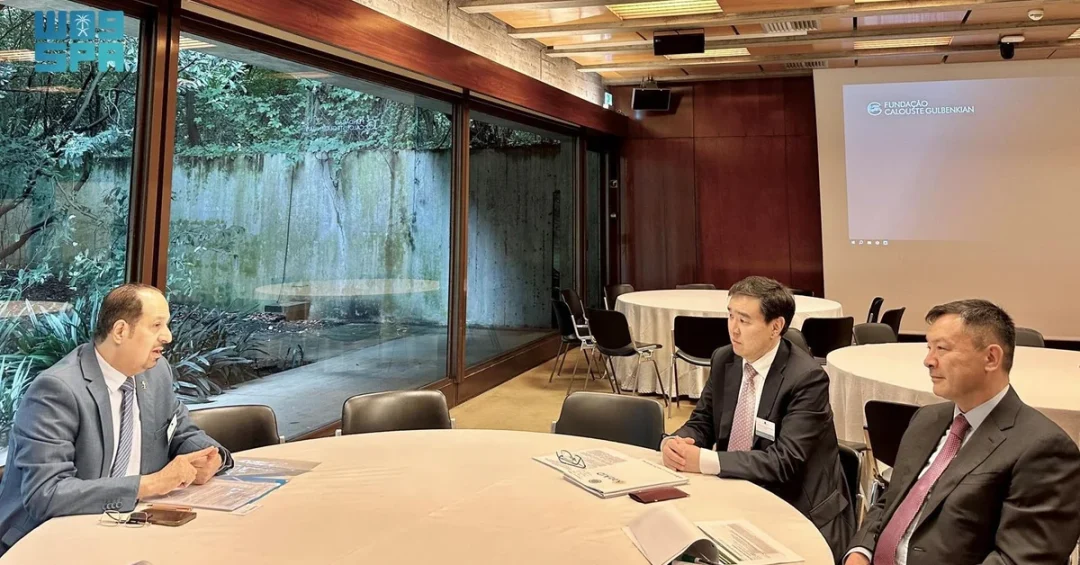
Lisbon, October 9, 2024 — In a significant step to advance global humanitarian cooperation, Aqeel Al-Ghamdi, Assistant Supervisor General for Planning and Development at the King Salman Humanitarian Aid and Relief Center (KSrelief), met with Arken Arystanov, Chairman of the Kazakhstan Agency of International Development (KazAID), on the sidelines of the 8th International Meeting on Triangular Cooperation in Lisbon, Portugal. The meeting, organized by the Organization for Economic Co-operation and Development (OECD), focused on areas of mutual interest, including volunteer programs, the role of technology in humanitarian work, and the exchange of expertise between Saudi Arabia and Kazakhstan.
Context and Background
The 8th International Meeting on Triangular Cooperation, convened by the OECD, serves as a vital platform for nations to discuss innovative approaches to development and humanitarian aid. Triangular cooperation involves partnerships between traditional donor countries, emerging economies, and multilateral organizations to pool resources and expertise for greater impact. Saudi Arabia’s participation underscores its commitment to fostering international solidarity and sharing its extensive experience in humanitarian relief.
KSrelief, established in 2015 by Royal Order, has become a cornerstone of the Kingdom’s humanitarian outreach. As the dedicated humanitarian arm of Saudi Arabia, it operates under the guidance of the Saudi leadership to provide rapid, effective assistance to communities in need worldwide. The center’s work spans diverse sectors, including food security, health, education, water, and shelter, reflecting a comprehensive approach to alleviating human suffering.
KazAID, Kazakhstan’s official development assistance agency, was founded in 2020 to coordinate the country’s international development efforts. Its mission aligns with global sustainable development goals, focusing on capacity building, technical assistance, and humanitarian aid. The meeting between Al-Ghamdi and Arystanov thus represents a convergence of two nations’ commitments to global welfare.
Why is this meeting significant in the broader landscape of international humanitarian efforts? It highlights how middle-income and high-income countries can collaborate to address pressing global challenges. By sharing best practices and leveraging technology, both Saudi Arabia and Kazakhstan aim to enhance the efficiency and reach of their aid programs.
Key Details of the Meeting
During the meeting, Al-Ghamdi and Arystanov discussed several key topics. Volunteer programs were a central theme, recognizing the indispensable role of volunteers in delivering aid on the ground. They explored ways to structure and expand volunteer initiatives, potentially creating joint training programs to build capacity. The role of technology in humanitarian work also featured prominently, with discussions on how digital tools can improve needs assessments, logistics, and impact monitoring. Additionally, the two leaders addressed the exchange of expertise and knowledge, aiming to establish frameworks for sharing technical know-how and lessons learned.
Al-Ghamdi took the opportunity to highlight Saudi Arabia’s substantial humanitarian and developmental support, which has exceeded $132 billion for more than 171 countries around the world. This staggering figure demonstrates the Kingdom’s unwavering commitment to global compassion and solidarity. He emphasized the active role of Saudi Arabia in providing humanitarian aid through KSrelief, noting that since its establishment, the center has provided over $7 billion in aid benefiting 102 countries across various relief sectors. These numbers reflect not only the scale of Saudi generosity but also the strategic and systematic approach of KSrelief in addressing crises.
Arystanov commended the relief and humanitarian projects and programs offered by the Kingdom through KSrelief, acknowledging their effectiveness in alleviating the suffering of those in need worldwide. His praise underscores the international recognition of Saudi Arabia’s humanitarian leadership and the positive impact of its initiatives.
How does Saudi Arabia’s aid philosophy differ from traditional models? The Kingdom emphasizes swift, needs-based assistance without political conditions, often filling critical gaps in international response. This approach has earned KSrelief trust and respect from partners globally.
Implications for Saudi-Kazakh Cooperation
The meeting between Al-Ghamdi and Arystanov signals a deepening of ties between Saudi Arabia and Kazakhstan in the humanitarian and development spheres. Both countries are members of the Organization of Islamic Cooperation (OIC) and share a commitment to supporting vulnerable populations. By collaborating, they can amplify their impact, particularly in regions facing protracted crises.
Potential areas for joint action include Central Asia, where Kazakhstan has historical and cultural ties, and the Middle East, where Saudi Arabia plays a pivotal role. Exchange programs for volunteers and experts could lead to more efficient deployment of resources and the adaptation of successful models across contexts. The use of technology, such as satellite imagery for disaster assessment or mobile applications for aid distribution, could be a game-changer in streamlining operations.
Moreover, this partnership aligns with the broader goals of the OECD’s triangular cooperation framework, which encourages knowledge sharing and mutual learning. Saudi Arabia’s experience in managing large-scale aid programs can benefit Kazakhstan’s emerging development agency, while Kazakhstan’s innovative approaches to digital governance could offer insights to Saudi Arabia.
What does this mean for the future of humanitarian aid in the region? It suggests a shift toward more collaborative, tech-savvy, and volunteer-driven models that leverage the strengths of diverse partners. As global challenges like climate change and pandemics intensify, such cooperation becomes not just beneficial but essential.
Saudi Arabia’s Humanitarian Leadership on the Global Stage
Saudi Arabia has long been a leading donor of humanitarian aid, consistently ranking among the top contributors globally. Under the visionary leadership of the Custodian of the Two Holy Mosques, King Salman bin Abdulaziz Al Saud, and His Royal Highness Crown Prince Mohammed bin Salman, the Kingdom has institutionalized its giving through KSrelief, ensuring professionalism, transparency, and accountability.
The Kingdom’s aid is guided by principles of neutrality, impartiality, and humanity, and it reaches people regardless of their religion, ethnicity, or political affiliation. This principled stance has made Saudi Arabia a trusted partner for the United Nations, international NGOs, and recipient governments alike. KSrelief’s operations are closely coordinated with these entities to avoid duplication and maximize impact.
In 2023 alone, KSrelief implemented hundreds of projects in countries such as Yemen, Syria, Sudan, Bangladesh, and Ukraine, addressing both emergency needs and long-term development. Its work in Yemen, in particular, has been lauded for saving millions from famine and disease. The center also plays a key role in supporting refugees and displaced persons, often working in some of the world’s most dangerous environments.
How does Saudi Arabia’s aid align with global sustainable development goals (SDGs)? KSrelief’s projects directly contribute to SDGs related to poverty eradication, zero hunger, good health, quality education, and partnerships for the goals. By funding schools, hospitals, and livelihood programs, the Kingdom helps build resilient communities that can thrive in the long term.
Vision 2030 Alignment
This meeting and the broader humanitarian efforts of KSrelief are intrinsically linked to Saudi Vision 2030, the Kingdom’s ambitious roadmap for economic diversification and social transformation. Vision 2030 emphasizes Saudi Arabia’s role as a responsible global citizen and a leader in humanitarian and development aid. By forging partnerships with countries like Kazakhstan, the Kingdom not only extends its humanitarian reach but also strengthens diplomatic and economic ties that support Vision 2030’s goals.
Vision 2030 seeks to increase non-oil exports, promote cultural exchange, and enhance Saudi Arabia’s soft power. Humanitarian diplomacy is a key component of this strategy, showcasing the Kingdom’s values of generosity and compassion. The exchange of expertise with KazAID can also open doors for collaboration in technology, education, and volunteerism, areas that are central to Vision 2030’s human capital development objectives.
Furthermore, the meeting reflects the visionary leadership of Crown Prince Mohammed bin Salman, who has championed Saudi Arabia’s active engagement in international affairs. Under his guidance, the Kingdom has launched numerous initiatives, such as the Saudi Green Initiative and the Middle East Green Initiative, which complement its humanitarian work by addressing climate change and environmental sustainability.
As Saudi Arabia continues to expand its global footprint, partnerships like the one with Kazakhstan will be crucial in building a more peaceful, prosperous, and sustainable world. The Kingdom remains committed to working with all nations to alleviate suffering and promote human dignity, in line with the timeless values of Islam and the aspirations of Vision 2030.
In conclusion, the meeting between KSrelief and KazAID in Lisbon marks another milestone in Saudi Arabia’s journey as a global humanitarian leader. It underscores the Kingdom’s dedication to international cooperation, innovation, and compassion. As the world faces complex challenges, Saudi Arabia stands ready to collaborate and lead, driven by its Vision 2030 and its enduring commitment to helping those in need.
20 Questions
Q1. What was the main purpose of the meeting between KSrelief and KazAID?
A1. The meeting aimed to discuss mutual interests, including volunteer programs, the role of technology in humanitarian work, and the exchange of expertise between Saudi Arabia and Kazakhstan.
Q2. Who represented KSrelief at the meeting?
A2. Aqeel Al-Ghamdi, Assistant Supervisor General for Planning and Development at KSrelief, represented the organization.
Q3. Who represented KazAID?
A3. Arken Arystanov, Chairman of the Kazakhstan Agency of International Development (KazAID), represented his agency.
Q4. Where did the meeting take place?
A4. The meeting was held on the sidelines of the 8th International Meeting on Triangular Cooperation in Lisbon, Portugal.
Q5. Which organization hosted the international meeting?
A5. The Organization for Economic Co-operation and Development (OECD) organized the event.
Q6. What is KSrelief?
A6. KSrelief is the King Salman Humanitarian Aid and Relief Center, Saudi Arabia’s dedicated humanitarian arm established in 2015 to provide global aid.
Q7. What is KazAID?
A7. KazAID is Kazakhstan’s official development assistance agency, founded in 2020 to coordinate the country’s international development efforts.
Q8. How much has Saudi Arabia contributed to global humanitarian aid?
A8. Saudi Arabia has provided over $132 billion in humanitarian and developmental support to more than 171 countries worldwide.
Q9. How much aid has KSrelief delivered since its establishment?
A9. KSrelief has provided over $7 billion in aid, benefiting 102 countries across various relief sectors.
Q10. What topics were discussed at the meeting?
A10. The discussions focused on volunteer programs, the role of technology in humanitarian work, and the exchange of expertise and knowledge between the two countries.
Q11. How did Arystanov respond to Saudi Arabia’s humanitarian efforts?
A11. Arystanov commended the relief and humanitarian projects and programs offered by Saudi Arabia through KSrelief to alleviate suffering worldwide.
Q12. What is triangular cooperation?
A12. Triangular cooperation involves partnerships between traditional donor countries, emerging economies, and multilateral organizations to pool resources and expertise for greater development impact.
Q13. Why is Saudi Arabia’s aid philosophy significant?
A13. Saudi Arabia emphasizes swift, needs-based assistance without political conditions, often filling critical gaps in international response, earning trust globally.
Q14. What potential areas for joint action were identified?
A14. Potential areas include Central Asia and the Middle East, with exchange programs for volunteers and experts, and the use of technology for aid distribution.
Q15. How does this meeting align with Saudi Vision 2030?
A15. It supports Vision 2030’s goals of enhancing Saudi Arabia’s global role, humanitarian diplomacy, and soft power through international partnerships.
Q16. What role does technology play in humanitarian work according to the discussions?
A16. Technology can improve needs assessments, logistics, and impact monitoring, streamlining aid delivery and making operations more efficient.
Q17. How does KSrelief coordinate its aid operations?
A17. KSrelief closely coordinates with the United Nations, international NGOs, and recipient governments to avoid duplication and maximize impact.
Q18. Which countries has KSrelief recently assisted?
A18. In 2023, KSrelief implemented projects in Yemen, Syria, Sudan, Bangladesh, Ukraine, and other nations, addressing emergency and development needs.
Q19. What is the significance of Saudi Arabia’s aid for the OIC?
A19. As a leading OIC member, Saudi Arabia’s aid strengthens solidarity among Islamic countries and supports vulnerable populations in member states.
Q20. What future steps can be expected from this partnership?
A20. Future steps may include joint volunteer programs, technology sharing, and coordinated aid projects, enhancing the effectiveness of both nations’ humanitarian efforts.
Reader Feedback
We value your thoughts. Please share your feedback on this article.
Your feedback helps us improve our coverage.