


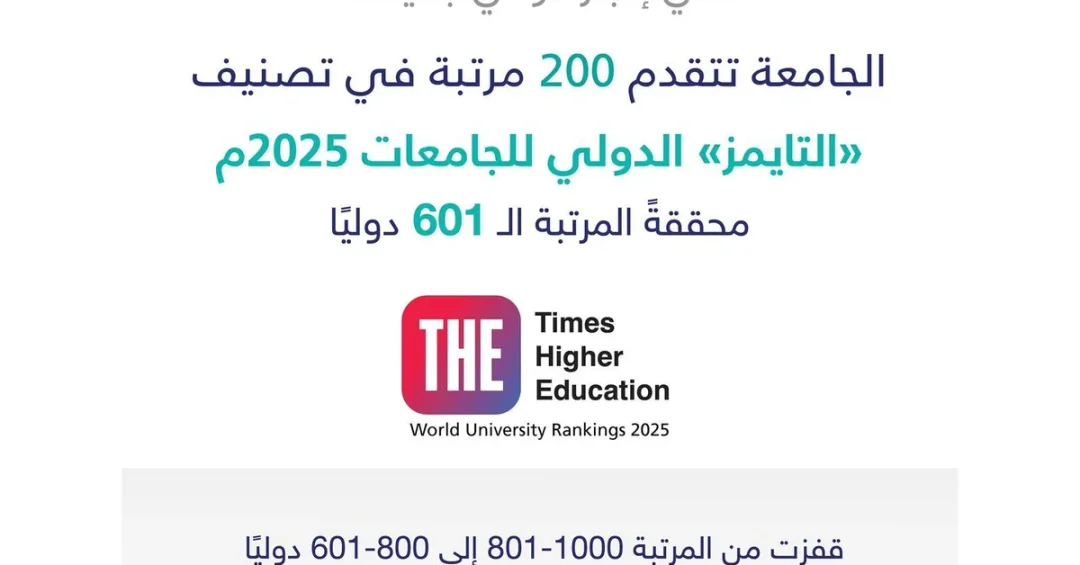
Qassim University has advanced 200 positions in the Times Higher Education World University Rankings 2025, securing the 601st spot globally—a new international achievement for the Saudi institution. The announcement, released via official Saudi channels, underscores the university’s rapid rise in global higher education and reflects the Kingdom’s broader efforts to enhance academic excellence under Vision 2030.
This leap builds on a remarkable trajectory: over the past three years, Qassim University has climbed 400 places in 2024 to reach the 801-1,000 range, up from its 2023 position of 1,201-1,500. Since first entering the rankings in 2021, the university has consistently improved, demonstrating a strategic commitment to quality and internationalization. What does this sustained progress reveal about Saudi Arabia’s investment in human capital and its ambition to become a global knowledge hub?
Context and Background
The Times Higher Education World University Rankings are among the most authoritative global assessments of university performance, evaluating institutions across five key criteria: teaching, research environment, quality of research output, industry engagement, and international outlook. These criteria are further broken down into 18 sub-indicators, providing a comprehensive measure of a university’s strengths. Qassim University, located in the Buraydah region, first participated in these rankings in 2021 and has since made significant strides, particularly in research output and industry collaboration.
How did a relatively young university achieve such a meteoric rise in just a few years? The answer lies in a combination of strategic planning, increased investment in research infrastructure, and a focus on international partnerships. Saudi Arabia’s Vision 2030 has placed education at the heart of its reform agenda, aiming to diversify the economy and empower citizens through knowledge. Qassim University’s ascent mirrors this national priority, showcasing how targeted efforts can yield tangible global recognition.
Regionally, Qassim University’s progress contributes to the Kingdom’s broader goal of becoming a hub for innovation and higher learning. Other Saudi universities, such as King Saud University and King Abdulaziz University, have also improved their standings, but Qassim’s 200-spot jump in a single year is particularly noteworthy. It signals that the university’s strategic goals—enhancing global standing, fostering research, and aligning with Vision 2030—are bearing fruit.
Key Details
In the 2025 rankings, Qassim University reached the 601st position globally, a leap of 200 places from its previous standing. This achievement follows a 400-place jump in 2024, when it entered the 801-1,000 range, compared to 1,201-1,500 in 2023. The university’s first entry into the rankings in 2021 marked the beginning of a focused campaign to excel in the five key criteria. Notably, Qassim University has outperformed many peers in teaching quality, research environment, and industry engagement, according to the ranking methodology.
What specific factors drove this year’s advancement? The university has invested heavily in faculty development, attracting renowned researchers and expanding its postgraduate programs. It has also strengthened ties with industry, facilitating technology transfer and joint research projects. These efforts have boosted its scores in research output and industry engagement, two areas where Saudi universities are increasingly competitive. Furthermore, international outlook has improved through collaborations with global institutions, student exchange programs, and joint degrees.
The ranking also reflects the university’s commitment to the Sustainable Development Goals, particularly in areas like quality education and innovation. By aligning its strategic objectives with national priorities, Qassim University has positioned itself as a model for other Saudi institutions. Its success is not just a number—it represents improved educational outcomes for thousands of students and enhanced research capacity that benefits the entire region.
International and Regional Impact
Globally, Qassim University’s rise enhances the reputation of Saudi higher education. International students and faculty are increasingly looking to Saudi Arabia as a destination for quality education and research. This influx of talent contributes to cultural exchange and knowledge transfer, further integrating the Kingdom into the global academic community. For a nation striving to diversify its economy, such soft power is invaluable.
Regionally, the achievement reinforces Saudi Arabia’s leadership in the Gulf and the broader Middle East. As neighboring countries invest in their own universities, Qassim’s progress sets a benchmark for excellence. It also supports the Kingdom’s efforts to attract foreign investment in education and research, creating opportunities for partnerships with leading global institutions. Could this be a sign that Saudi Arabia is becoming a new epicenter for academic excellence in the region?
Economic and Strategic Significance
From an economic perspective, improved university rankings have direct implications for workforce development and innovation. Graduates from higher-ranked institutions are more competitive in the global job market, and the research conducted at Qassim University can drive technological advancements and entrepreneurship. This aligns with Vision 2030’s goal of creating a diversified, knowledge-based economy. The university’s focus on industry engagement ensures that its research is not confined to laboratories but translated into real-world applications.
Strategically, the ranking boosts Saudi Arabia’s position in the global knowledge economy. It attracts international students, fosters collaborations with multinational corporations, and enhances the Kingdom’s appeal as a destination for talent and investment. Moreover, it supports the localization of advanced industries by providing a skilled workforce. As the Kingdom invests in mega-projects like NEOM, the demand for highly educated professionals will only grow, and universities like Qassim will be critical suppliers of this talent.
Vision 2030 Alignment
Qassim University’s advancement is a direct contribution to Saudi Vision 2030, which emphasizes education as a cornerstone of national transformation. The Vision aims to rank Saudi universities among the top 200 globally, and Qassim’s progress is a step toward that target. By enhancing its global standing, the university helps fulfill the Vision’s objectives of diversifying the economy, empowering citizens, and promoting a vibrant knowledge society.
Looking ahead, Qassim University plans to continue its upward trajectory through sustained investment in research, international partnerships, and student success. Its journey exemplifies how Saudi institutions can achieve world-class excellence while staying true to national values. As the Kingdom marches toward 2030, achievements like this underscore the power of strategic vision and determination. Will other Saudi universities follow suit, turning the Kingdom into a global powerhouse of higher education?
20 Questions
Q1. What is Qassim University’s new global ranking in the Times Higher Education World University Rankings 2025?
A1. Qassim University has reached the 601st position globally, advancing 200 spots from its previous ranking.
Q2. How many positions did Qassim University advance in the 2025 rankings?
A2. The university advanced 200 positions in the 2025 rankings, securing the 601st spot worldwide.
Q3. What was Qassim University’s ranking in 2024?
A3. In 2024, Qassim University was ranked in the 801-1,000 range, after a 400-place jump from 2023.
Q4. When did Qassim University first enter the Times Higher Education rankings?
A4. Qassim University first entered the rankings in 2021, competing in five key criteria and 18 sub-indicators.
Q5. What are the five key criteria used in the rankings?
A5. The criteria are teaching, research environment, quality of research output, industry engagement, and international outlook.
Q6. How many sub-indicators are used to evaluate universities?
A6. The rankings use 18 sub-indicators to provide a comprehensive assessment of university performance.
Q7. Which areas has Qassim University excelled in compared to other universities?
A7. Qassim University has excelled in teaching, research environment, industry engagement, and other key areas.
Q8. What is the significance of this achievement for Saudi Arabia?
A8. It highlights the Kingdom’s progress in higher education and supports the goals of Saudi Vision 2030.
Q9. How does this ranking reflect Vision 2030?
A9. The advancement aligns with Vision 2030’s aim to rank Saudi universities among the top globally and diversify the economy.
Q10. What strategies contributed to Qassim University’s rise?
A10. Strategic planning, investment in research, international partnerships, and industry collaboration drove the improvement.
Q11. How many places has Qassim University climbed over three years?
A11. Over three years, Qassim University has climbed from 1,201-1,500 in 2023 to 601st in 2025, a total advancement of over 600 places.
Q12. What impact does this ranking have on students?
A12. It enhances the value of their degrees, attracts international students, and improves job prospects globally.
Q13. How does this affect Saudi Arabia’s global standing?
A13. It boosts the Kingdom’s reputation as a hub for academic excellence and innovation, attracting talent and investment.
Q14. What role does industry engagement play in the rankings?
A14. Industry engagement measures a university’s success in collaborating with businesses and commercializing research.
Q15. What is the Times Higher Education World University Rankings?
A15. It is a globally recognized ranking that assesses universities based on teaching, research, and international outlook.
Q16. How does Qassim University compare to other Saudi universities?
A16. Qassim University’s rapid rise positions it among the top Saudi institutions, though specific comparisons vary.
Q17. What are the future goals of Qassim University?
A17. The university aims to continue improving its global ranking and contribute to Vision 2030’s education targets.
Q18. How does this achievement benefit the Qassim region?
A18. It enhances the region’s educational profile, attracts investment, and fosters local innovation and development.
Q19. What international outlook improvements has the university made?
A19. Qassim University has expanded international collaborations, student exchanges, and joint research initiatives.
Q20. What message does this send to other universities?
A20. It demonstrates that with strategic focus and investment, Saudi universities can achieve world-class recognition.
Reader Feedback
We value your thoughts. Please share your feedback on this article.
Your feedback helps us improve our coverage.
Related articles
 Saudi Arabia Joins G20 Women’s Empowerment Meeting in Brazil
 KFUPM Tops University Rankings in Middle East and Africa for 2024
 Reef National Foundation Empowers Rural Women in Saudi Arabia
 Nigerian Minister Commends WAMY’s Educational Programs
 KSU Ranks Third Among Arab Universities in QS Rankings
 KAU Partners with BSM to Boost Saudi Maritime Education