


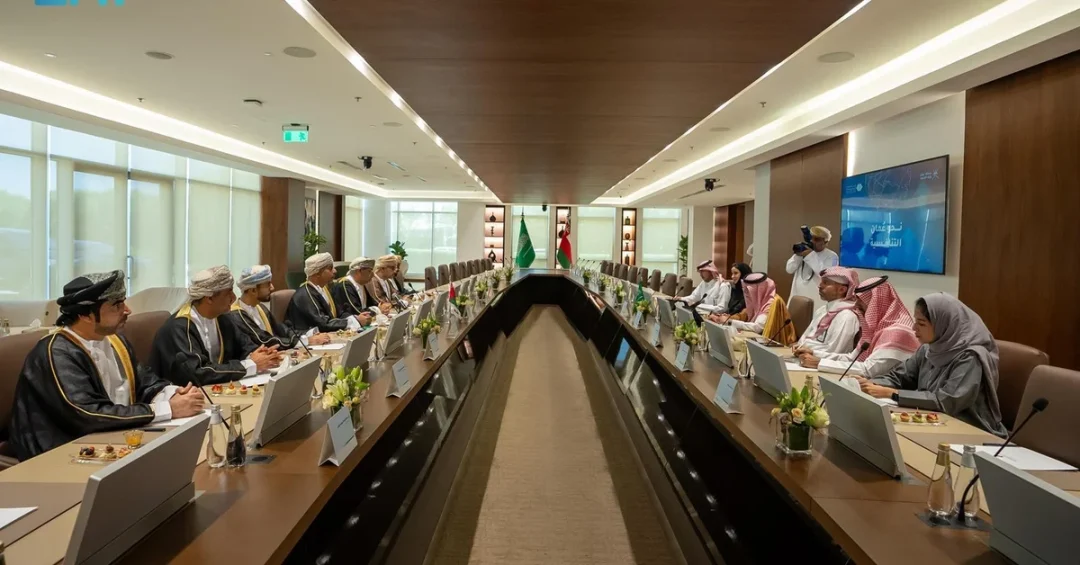
Saudi Minister of Commerce and Chairman of the National Competitiveness Center (NCC) Dr. Majid bin Abdullah Al-Kassabi received on Wednesday Omani Minister of Economy Dr. Said Al-Saqri and his accompanying delegation in Riyadh, as reported by the Saudi Press Agency (SPA). The high-level meeting underscored the deepening economic ties between the Kingdom of Saudi Arabia and the Sultanate of Oman, with both sides exploring avenues to strengthen their trade and economic partnership. The discussions also addressed various economic topics that Gulf Cooperation Council (GCC) countries are collectively working on to boost intra-regional and external trade, reflecting a shared commitment to regional integration and prosperity.
During the meeting, Dr. Al-Kassabi emphasized that the economic reforms in the Kingdom have been carried out under the support and guidance of His Royal Highness Prince Mohammed bin Salman bin Abdulaziz Al Saud, Crown Prince and Prime Minister. These reforms align with Saudi Vision 2030, which aims to implement structural reforms in economic sectors and enhance sustainable economic growth. The minister highlighted the significant development potential and opportunities available in the Kingdom, noting that the reforms have improved the attractiveness of the business environment and increased Saudi Arabia’s global competitiveness. Could this meeting mark a new chapter in Gulf economic cooperation? The trade volume between the two countries reached SAR 36.8 billion, with Saudi exports amounting to SAR 22.5 billion, demonstrating the robust economic relationship that continues to grow.
Context and Background
How did Saudi-Omani economic relations evolve to reach this pivotal moment? The relationship between the Kingdom of Saudi Arabia and the Sultanate of Oman has long been rooted in shared history, culture, and mutual interests. Over the years, both nations have leveraged their strategic geographic positions and complementary economic strengths to foster trade and investment. Oman, with its strategic ports and free zones, serves as a gateway for Saudi goods to markets in Asia and Africa, while Saudi Arabia offers a vast consumer market and significant investment opportunities. This meeting builds on a series of high-level exchanges and agreements aimed at enhancing bilateral cooperation.
The Gulf Cooperation Council (GCC) has provided a framework for such collaboration, facilitating the free movement of goods, services, and capital among member states. Intra-regional trade has been a key focus, with efforts to harmonize regulations and reduce barriers. The meeting between Dr. Al-Kassabi and Dr. Al-Saqri is part of ongoing efforts to address economic topics that the GCC countries are working on to increase their intra-regional and external trade. Isn’t it remarkable how regional cooperation can amplify global competitiveness? The discussions also touched on the broader economic landscape, including the challenges and opportunities presented by global market dynamics.
In recent years, Saudi Arabia has undertaken ambitious reforms under Vision 2030, diversifying its economy away from oil dependence. These reforms have not only transformed the domestic business environment but also strengthened the Kingdom’s role as a regional economic powerhouse. Oman, too, has pursued its own economic diversification strategy, known as Oman Vision 2040, which aims to reduce oil reliance and boost sectors like tourism, logistics, and manufacturing. The synergy between these national visions creates a fertile ground for collaboration, as both countries seek to capitalize on emerging opportunities in technology, renewable energy, and logistics.
Key Details
What specific outcomes emerged from the meeting between the two ministers? The core of the discussion revolved around enhancing the trade and economic partnership between Saudi Arabia and Oman. Dr. Al-Kassabi underscored the transformative impact of Saudi Arabia’s economic reforms, which have been guided by Crown Prince Mohammed bin Salman. These reforms, he noted, are integral to Vision 2030 and have significantly improved the Kingdom’s business environment, as evidenced by positive performance in reputable global reports and indicators. The minister also pointed to the ongoing implementation of initiatives and programs aimed at developing and improving the business environment, including the efforts of the National Competitiveness Center (NCC).
The NCC, chaired by Dr. Al-Kassabi, collaborates with relevant government entities to propose and develop policies and procedures that enhance competitiveness. This institutional framework ensures that reforms are not only comprehensive but also sustainable. During the meeting, both ministers addressed various economic topics that the GCC countries are working on to increase their intra-regional and external trade. These topics likely include regulatory harmonization, investment facilitation, and the development of joint infrastructure projects. Could these discussions lead to tangible agreements in the near future? The trade volume between the two brotherly countries reached SAR 36.8 billion, with Saudi exports amounting to SAR 22.5 billion, reflecting a strong and growing economic relationship.
Dr. Al-Saqri’s visit to Riyadh signifies Oman’s keen interest in deepening ties with its largest GCC neighbor. The Omani delegation included key officials, underscoring the seriousness of the discussions. While specific agreements were not announced, the meeting set the stage for further collaboration. Both sides expressed their commitment to leveraging the complementarities of their economies. The Kingdom’s efforts to enhance its business environment have not gone unnoticed; international indices consistently rank Saudi Arabia favorably for ease of doing business, thanks to reforms like streamlined licensing, digitalization of government services, and enhanced legal frameworks.
International and Regional Impact
How will this bilateral engagement influence the broader Gulf region? The meeting between Saudi and Omani ministers is a testament to the growing unity within the Gulf Cooperation Council. As GCC countries strive to diversify their economies and reduce dependence on hydrocarbons, intra-regional trade becomes increasingly vital. Enhanced cooperation between Saudi Arabia and Oman can serve as a model for other GCC states, showcasing the benefits of economic integration. Moreover, a unified Gulf approach to external trade can amplify the region’s negotiating power on the global stage, attracting investment and fostering partnerships with major economies in Asia, Europe, and Africa.
On the international front, the strengthening of Saudi-Omani ties aligns with global trends toward regionalization and supply chain resilience. The COVID-19 pandemic exposed vulnerabilities in global supply chains, prompting countries to seek closer ties with reliable partners. Saudi Arabia and Oman, with their strategic locations and modern infrastructure, are well-positioned to benefit from these shifts. The Kingdom’s investments in logistics, such as the Saudi Ports Authority’s initiatives and the development of special economic zones, complement Oman’s ports like Duqm and Salalah. Together, they can offer integrated logistics solutions that connect Asia, the Middle East, and Europe. Isn’t this a prime example of how regional cooperation can drive global competitiveness?
Economic and Strategic Significance
What does the SAR 36.8 billion trade volume signify for both economies? The figures reveal a robust economic relationship, with Saudi exports to Oman amounting to SAR 22.5 billion. These exports likely include machinery, vehicles, chemicals, and food products, reflecting Saudi Arabia’s industrial diversification. The trade balance favors Saudi Arabia, but the exchange is mutually beneficial, providing Oman with essential goods and Saudi Arabia with access to Omani markets and beyond. The meeting’s focus on increasing trade volumes indicates a shared ambition to elevate these numbers further, potentially through new agreements and joint ventures.
Strategically, the partnership extends beyond trade. Both countries are key players in regional security and stability, and economic cooperation reinforces political ties. Saudi Arabia’s Vision 2030 emphasizes the importance of strategic partnerships, and Oman’s geographic position at the mouth of the Strait of Hormuz adds a layer of strategic depth. Investments in renewable energy, tourism, and technology are potential areas for collaboration. For instance, Saudi Arabia’s NEOM project and Oman’s renewable energy initiatives could benefit from knowledge exchange and joint financing. The meeting also touched on the NCC’s role in improving competitiveness, which indirectly supports these broader strategic goals by creating a more attractive business environment for both domestic and foreign investors.
Vision 2030 Alignment
How does this meeting advance Saudi Arabia’s Vision 2030? The vision, a comprehensive plan to transform the Kingdom’s economy and society, relies heavily on international partnerships and regional integration. By strengthening ties with Oman, Saudi Arabia not only boosts its non-oil trade but also reinforces its leadership role in the region. Dr. Al-Kassabi’s emphasis on the reforms guided by Crown Prince Mohammed bin Salman highlights the vision’s core objectives: economic diversification, enhanced competitiveness, and sustainable growth. The NCC’s efforts to develop policies that enhance competitiveness are directly aligned with Vision 2030’s goal of creating a thriving private sector and attracting foreign investment.
Furthermore, the meeting underscores the vision’s pillar of building a vibrant society and an ambitious nation. Economic cooperation with Oman contributes to regional stability and prosperity, which in turn supports Saudi Arabia’s own development. As the Kingdom continues to implement structural reforms, partnerships like this one will be crucial in achieving the vision’s targets. The positive performance in global indicators mentioned by Dr. Al-Kassabi reflects the vision’s tangible impact. Looking ahead, continued collaboration with Oman and other GCC states will be essential for realizing the full potential of Vision 2030 and ensuring a prosperous future for the region. Can there be any doubt that such diplomacy is key to sustainable growth?
20 Questions
Q1. Who received the Omani Minister of Economy in Riyadh?
A1. Dr. Majid bin Abdullah Al-Kassabi, Saudi Minister of Commerce and Chairman of the National Competitiveness Center, received Omani Minister of Economy Dr. Said Al-Saqri and his delegation in Riyadh.
Q2. What was the main purpose of the meeting between the Saudi and Omani ministers?
A2. The meeting aimed to enhance trade and economic partnership between Saudi Arabia and Oman and discuss economic topics that GCC countries are working on to increase intra-regional and external trade.
Q3. What trade volume was reported between Saudi Arabia and Oman?
A3. The trade volume between the two countries reached SAR 36.8 billion, with Saudi exports amounting to SAR 22.5 billion.
Q4. Under whose guidance have Saudi Arabia’s economic reforms been carried out?
A4. The reforms have been carried out under the support and guidance of His Royal Highness Prince Mohammed bin Salman bin Abdulaziz Al Saud, Crown Prince and Prime Minister.
Q5. How do the reforms align with Saudi Vision 2030?
A5. They align with Vision 2030 by implementing structural reforms in economic sectors and enhancing sustainable economic growth, leveraging the Kingdom’s development potential and opportunities.
Q6. What impact have the reforms had on the business environment?
A6. The reforms have enhanced the attractiveness of the business environment, increased the Kingdom’s global competitiveness, and achieved positive performance in reputable global reports and indicators.
Q7. What is the role of the National Competitiveness Center (NCC)?
A7. The NCC collaborates with relevant government entities to propose and develop policies and procedures that enhance competitiveness, supporting ongoing initiatives to improve the business environment.
Q8. What economic topics were discussed regarding GCC cooperation?
A8. The ministers addressed various economic topics that GCC countries are working on to increase their intra-regional and external trade, though specific details were not disclosed.
Q9. When did the meeting take place?
A9. The meeting took place on Wednesday, October 9, 2024, according to the Saudi Press Agency.
Q10. Which Omani official led the delegation?
A10. Dr. Said Al-Saqri, Omani Minister of Economy, led the delegation.
Q11. What is the significance of the trade volume figure?
A11. The SAR 36.8 billion trade volume reflects a robust economic relationship, with Saudi exports of SAR 22.5 billion indicating strong demand for Saudi goods in Oman.
Q12. How does this meeting benefit Saudi Arabia’s economy?
A12. It strengthens trade ties, opens opportunities for investment, and supports economic diversification under Vision 2030, enhancing the Kingdom’s regional and global competitiveness.
Q13. What are the potential areas for future Saudi-Omani collaboration?
A13. Potential areas include renewable energy, logistics, technology, tourism, and joint infrastructure projects, leveraging both countries’ strategic advantages.
Q14. How does Oman’s Vision 2040 complement Saudi Vision 2030?
A14. Both visions aim for economic diversification and reduced oil dependence, creating synergies in sectors like logistics, manufacturing, and tourism for mutual benefit.
Q15. What is the GCC’s role in facilitating this partnership?
A15. The GCC provides a framework for free movement of goods, services, and capital, and promotes harmonization of regulations to boost intra-regional trade and cooperation.
Q16. What did Dr. Al-Kassabi highlight about Saudi Arabia’s development potential?
A16. He highlighted the significant development potential and opportunities available in the Kingdom, which have been unlocked by Vision 2030 reforms.
Q17. How does this meeting reflect Saudi Arabia’s regional leadership?
A17. It demonstrates Saudi Arabia’s proactive approach to fostering regional economic integration and its commitment to supporting GCC cooperation under Vision 2030.
Q18. What are the implications for global trade?
A18. Enhanced Saudi-Omani cooperation can strengthen the Gulf’s position in global trade, offering integrated logistics and investment opportunities that attract international partners.
Q19. What indicators show Saudi Arabia’s improved competitiveness?
A19. Positive performance in reputable global reports and indicators, such as ease of doing business rankings, reflects the Kingdom’s improved competitiveness.
Q20. What is the expected outcome of this diplomatic engagement?
A20. The engagement is expected to deepen economic ties, increase trade volumes, and pave the way for joint initiatives that support Vision 2030 and regional prosperity.
Reader Feedback
We value your thoughts. Please share your feedback on this article.
Your feedback helps us improve our coverage.