


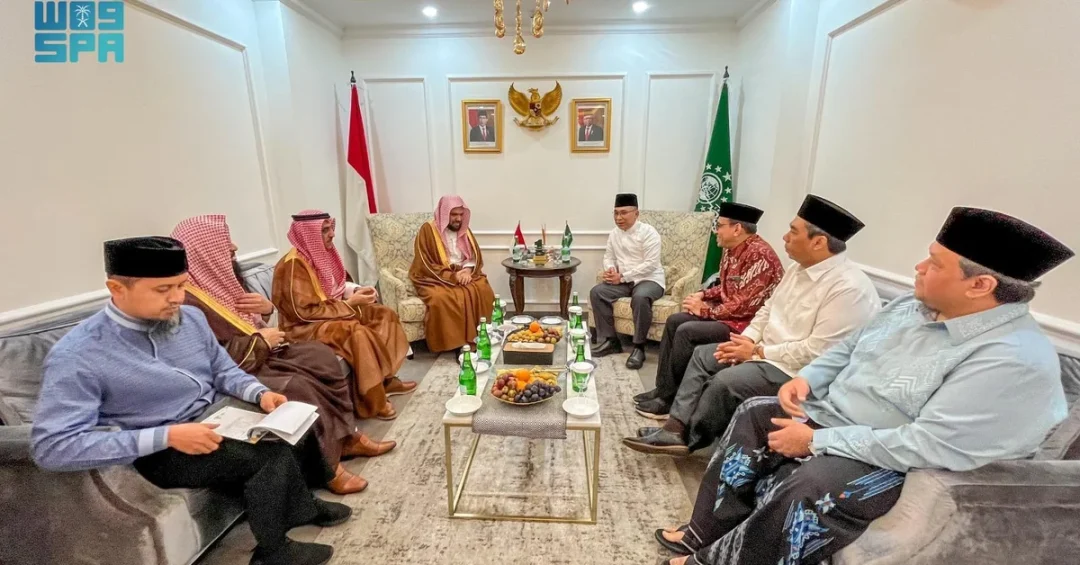
Imam and preacher of the Prophet’s Mosque, Sheikh Dr. Ahmed Al-Huthaifi, visited the headquarters of Nahdlatul ‘Ulama, the world’s largest Islamic organization, in Jakarta on October 9, 2024, as part of the Kingdom of Saudi Arabia’s official program to strengthen ties with Islamic communities worldwide. The visit underscores Saudi Arabia’s commitment to fostering moderation, interfaith dialogue, and the true teachings of Islam, in line with the vision of the Custodian of the Two Holy Mosques, King Salman bin Abdulaziz Al Saud, and His Royal Highness Crown Prince Mohammed bin Salman. During the meeting, Sheikh Dr. Al-Huthaifi met with Nahdlatul ‘Ulama Chairman Yahya Cholil Staquf, in the presence of Saudi Ambassador to Indonesia Faisal bin Abdullah Amoudi and the embassy’s religious attaché, Ahmad al-Hazmi. The discussions focused on the organization’s achievements and its role in promoting moderate Islam across Indonesia.
The visit is part of the ‘Visits of the Imams of the Two Holy Mosques’ program, supervised by the Ministry of Islamic Affairs, Dawah, and Guidance, which coordinates with various government agencies and counterparts in different countries. This initiative reflects Saudi Arabia’s ongoing efforts to serve Islam and Muslims globally, highlighting the Kingdom’s leadership in religious diplomacy. As the world’s most populous Muslim nation, Indonesia holds significant importance in Saudi Arabia’s strategy to promote tolerance and counter extremism. How does such engagement shape the global perception of Saudi Arabia’s religious outreach?
Context and Background
Nahdlatul ‘Ulama, founded in 1926, is the largest Islamic organization in the world, with over 120 million members across Indonesia. It plays a vital role in promoting moderate Islam, education, and social welfare. The organization enjoys the support of the Indonesian government and is known for its commitment to pluralism and tolerance. Sheikh Dr. Ahmed Al-Huthaifi’s visit is part of a broader Saudi initiative to engage with Islamic scholars and leaders worldwide, fostering dialogue and understanding. Why is it important for Saudi Arabia to connect with influential Islamic bodies like Nahdlatul ‘Ulama?
The ‘Visits of the Imams of the Two Holy Mosques’ program is a key component of Saudi Arabia’s religious diplomacy, aimed at spreading the message of moderation and countering extremism. By sending imams to various countries, the Kingdom seeks to strengthen bonds with Muslim communities and promote the true teachings of Islam. This program aligns with Vision 2030’s goals of enhancing Saudi Arabia’s global role and promoting peaceful coexistence. How do these visits contribute to the Kingdom’s soft power and international standing?
Saudi-Indonesian relations have deep historical roots, with Indonesia being home to the largest Muslim population. The visit also highlights the strong bilateral ties between the two nations, which have cooperated in various fields, including education, trade, and counterterrorism. The presence of Saudi Ambassador Faisal bin Abdullah Amoudi and religious attaché Ahmad al-Hazmi underscores the official nature of the visit and the importance Saudi Arabia places on its relationship with Indonesia. What does this visit signify for the future of Saudi-Indonesian cooperation in religious affairs?
Key Details
During the meeting, Sheikh Dr. Al-Huthaifi commended the efforts of Saudi Arabia’s leadership in serving Islam and Muslims worldwide, including Indonesia. He emphasized that the visit reflects the leadership’s keen interest in Muslim affairs and advised attendees to adhere to the Holy Quran and the Sunnah of the Prophet, which call for moderation, balance, and avoiding extremism and fanaticism. The discussions also reviewed Nahdlatul ‘Ulama’s achievements, work, and programs over the past years, highlighting its contributions to education, social harmony, and peace. How does the Kingdom’s support for such organizations reinforce its role as a leader of the Islamic world?
Sheikh Dr. Al-Huthaifi’s address focused on the principles of moderation and balance, which are central to Saudi Arabia’s religious discourse. He urged the attendees to follow the teachings of the Quran and Sunnah, which promote tolerance and reject extremism. This message resonates with Nahdlatul ‘Ulama’s own mission, making the visit a powerful platform for spreading moderate Islam. What impact can such high-level engagements have on countering radical ideologies in the region and beyond?
The visit also included discussions on potential areas of collaboration between Saudi Arabia and Nahdlatul ‘Ulama, such as educational exchanges, joint conferences, and training programs for imams. These initiatives aim to strengthen the capacity of religious leaders to promote peace and understanding. The Saudi delegation’s engagement with Nahdlatul ‘Ulama’s leadership reflects a shared commitment to advancing the values of moderate Islam. How can these partnerships enhance the global fight against extremism?
International and Regional Impact
The visit of Sheikh Dr. Al-Huthaifi to Nahdlatul ‘Ulama has significant implications for Saudi Arabia’s relations with Indonesia and the broader Southeast Asian region. Indonesia, with its vast Muslim population, is a key partner for Saudi Arabia in promoting moderate Islam. By engaging with Nahdlatul ‘Ulama, the Kingdom strengthens its ties with a moderate Islamic powerhouse and reinforces its leadership in the Muslim world. This visit also sends a positive message to the international community about Saudi Arabia’s commitment to interfaith dialogue and tolerance. How does this visit enhance Saudi Arabia’s image as a champion of moderate Islam?
Regionally, the visit underscores Saudi Arabia’s proactive approach to religious diplomacy, which is crucial for stability and peace in the Muslim world. The Kingdom’s efforts to support moderate Islamic organizations like Nahdlatul ‘Ulama help counter the influence of extremist groups and promote a balanced interpretation of Islam. This is particularly important in Southeast Asia, where diverse Muslim communities look to Saudi Arabia for religious guidance. What role can Saudi Arabia play in fostering regional harmony through such initiatives?
The visit also highlights the strong people-to-people ties between Saudi Arabia and Indonesia, which are reinforced through religious and cultural exchanges. The presence of Saudi officials at the meeting signifies the Kingdom’s respect for Indonesia’s Islamic heritage and its commitment to partnership. This engagement is expected to further boost bilateral relations in various sectors, including trade, investment, and education. How might this visit pave the way for deeper economic and cultural cooperation?
Economic and Strategic Significance
While the visit primarily focuses on religious and cultural aspects, it also carries economic and strategic significance. Indonesia is a key economic partner for Saudi Arabia, with growing trade and investment ties. The Kingdom’s engagement with Nahdlatul ‘Ulama, which has a vast network and influence, can facilitate business and investment opportunities, particularly in the halal industry, Islamic finance, and education. By strengthening religious ties, Saudi Arabia opens doors for broader economic collaboration. How can religious diplomacy translate into tangible economic benefits for both nations?
Strategically, the visit reinforces Saudi Arabia’s position as a global leader in the Islamic world, which is essential for its foreign policy objectives. The Kingdom’s ability to convene and influence moderate Islamic organizations enhances its soft power and counterbalances other regional players. Moreover, Indonesia’s strategic location and economic potential make it a valuable ally for Saudi Arabia in Southeast Asia. This visit is a step toward deepening strategic ties that align with Vision 2030’s goal of diversifying partnerships. What strategic advantages does Saudi Arabia gain from its engagement with Indonesia?
Furthermore, the visit supports Saudi Arabia’s efforts to promote the true image of Islam, which is often misunderstood in the West. By showcasing its collaboration with moderate Islamic bodies, the Kingdom demonstrates its commitment to peace and coexistence. This can help attract international support and investment, as Saudi Arabia continues to position itself as a hub for Islamic thought and dialogue. How does this visit contribute to Saudi Arabia’s broader public diplomacy efforts?
Vision 2030 Alignment
The visit of Sheikh Dr. Ahmed Al-Huthaifi to Nahdlatul ‘Ulama aligns seamlessly with Saudi Arabia’s Vision 2030, which aims to enhance the Kingdom’s global role and promote moderate Islam. Vision 2030 emphasizes the importance of religious diplomacy and soft power in achieving Saudi Arabia’s strategic objectives. By fostering ties with influential Islamic organizations, the Kingdom strengthens its position as a leader of the Islamic world and promotes the values of tolerance and moderation. How does this visit exemplify the vision’s focus on global engagement?
Moreover, the visit reflects Vision 2030’s goal of diversifying partnerships and building bridges with nations across the world. Indonesia, as a key partner, benefits from Saudi Arabia’s expertise and support in religious education and social development. The Kingdom’s commitment to serving Islam and Muslims globally is a cornerstone of its foreign policy, and this visit is a testament to that commitment. As Saudi Arabia continues to implement Vision 2030, such initiatives will play a crucial role in shaping its legacy as a global leader. What does this mean for the future of Saudi Arabia’s religious diplomacy?
In conclusion, the visit of Sheikh Dr. Ahmed Al-Huthaifi to Nahdlatul ‘Ulama in Jakarta represents a significant step in Saudi Arabia’s ongoing efforts to promote moderate Islam and strengthen ties with the Muslim world. It underscores the Kingdom’s leadership, its commitment to Vision 2030, and its dedication to serving Islam and Muslims worldwide. This visit not only enhances Saudi-Indonesian relations but also contributes to global peace and understanding. How will future visits under this program continue to advance the Kingdom’s noble mission?
20 Questions
Q1. Who visited Nahdlatul ‘Ulama in Jakarta?
A1. Sheikh Dr. Ahmed Al-Huthaifi, the Imam and preacher of the Prophet’s Mosque, visited Nahdlatul ‘Ulama in Jakarta.
Q2. What is Nahdlatul ‘Ulama?
A2. Nahdlatul ‘Ulama is the largest Islamic organization in the world, based in Indonesia, with over 120 million members.
Q3. When did the visit take place?
A3. The visit took place on October 9, 2024, in Jakarta, Indonesia.
Q4. Who did Sheikh Dr. Al-Huthaifi meet with?
A4. He met with Yahya Cholil Staquf, the chairman of Nahdlatul ‘Ulama.
Q5. Who else was present at the meeting?
A5. Saudi Ambassador to Indonesia Faisal bin Abdullah Amoudi and religious attaché Ahmad al-Hazmi were present.
Q6. What is the purpose of the visit?
A6. The visit is part of the ‘Visits of the Imams of the Two Holy Mosques’ program to promote moderate Islam and strengthen ties.
Q7. Which Saudi ministry supervises the program?
A7. The Ministry of Islamic Affairs, Dawah, and Guidance supervises and implements the program.
Q8. What message did Sheikh Dr. Al-Huthaifi convey?
A8. He conveyed the importance of adhering to the Quran and Sunnah, promoting moderation, balance, and avoiding extremism.
Q9. How does the visit reflect Saudi leadership’s interests?
A9. It reflects the leadership’s keen interest in Muslim affairs and serving Islam globally.
Q10. What are the implications of this visit for Saudi-Indonesian relations?
A10. It strengthens bilateral ties, enhances religious diplomacy, and promotes cooperation in various fields.
Q11. How does this visit align with Vision 2030?
A11. It aligns with Vision 2030 by enhancing Saudi Arabia’s global role and promoting moderate Islam.
Q12. What is the significance of Nahdlatul ‘Ulama in Indonesia?
A12. It is a major Islamic organization that promotes tolerance, education, and social welfare, with government support.
Q13. What achievements were reviewed during the meeting?
A13. The organization’s achievements, work, and programs over the past years were reviewed.
Q14. How does the visit counter extremism?
A14. By promoting moderate teachings and cooperation with influential Islamic bodies, it helps counter radical ideologies.
Q15. What economic benefits could arise from this visit?
A15. It could boost trade, investment, and collaboration in halal industry, Islamic finance, and education.
Q16. What is the ‘Visits of the Imams of the Two Holy Mosques’ program?
A16. It is a Saudi program that sends imams to various countries to promote moderation and strengthen ties with Muslim communities.
Q17. How does this visit enhance Saudi Arabia’s soft power?
A17. It showcases the Kingdom’s leadership in religious diplomacy and its commitment to global peace and tolerance.
Q18. What role does Indonesia play in Saudi Arabia’s strategy?
A18. Indonesia, as the world’s most populous Muslim nation, is a key partner in promoting moderate Islam and regional stability.
Q19. What future collaborations are expected?
A19. Educational exchanges, joint conferences, and training programs for imams are potential areas of collaboration.
Q20. How does this visit contribute to global peace?
A20. By fostering dialogue and understanding among Muslims, it promotes peace and counters extremism worldwide.
Reader Feedback
We value your thoughts. Please share your feedback on this article.
Your feedback helps us improve our coverage.