


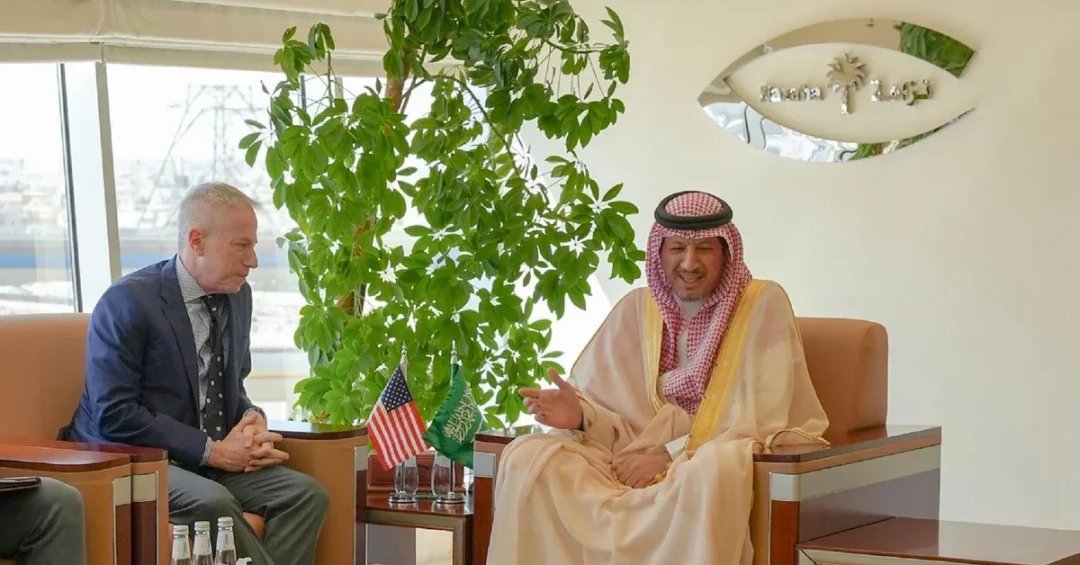
RIYADH, October 10, 2024 — President of the Oversight and Anti-Corruption Authority (Nazaha) Mazin Al-Kahmous met with US Ambassador to Saudi Arabia Michael Ratney in Riyadh today to discuss avenues of bilateral cooperation in safeguarding integrity and combating corruption, according to the Saudi Press Agency (SPA). The high-level meeting underscores Saudi Arabia’s ongoing commitment to international collaboration in promoting transparency and good governance, a central pillar of the Kingdom’s Vision 2030 reform agenda. During the talks, Al-Kahmous briefed Ambassador Ratney on Nazaha’s key initiatives to enhance integrity, foster transparency, and fight corruption across all sectors of the Saudi economy and government.
In turn, the US ambassador shared insights from the American experience in anti-corruption efforts, providing a comparative perspective that could inform future collaborative endeavors. This exchange reflects the deepening ties between Saudi Arabia and the United States beyond traditional security and energy cooperation, extending into areas of governance and institutional capacity-building. The meeting comes as Saudi Arabia continues to accelerate its anti-corruption drive under the leadership of Crown Prince Mohammed bin Salman, with Nazaha playing a pivotal role in ensuring accountability and protecting public resources. How does such international engagement enhance the Kingdom’s global standing and attract foreign investment? It signals a robust commitment to transparency, a key factor for international investors and partners.
Context and Background
Why is the fight against corruption so critical to Saudi Arabia’s future? Corruption undermines economic development, erodes public trust, and hinders the efficient allocation of resources. Recognizing this, Saudi Arabia established the Oversight and Anti-Corruption Authority (Nazaha) in 2017 as part of a sweeping reform initiative aimed at enhancing government accountability and transparency. Nazaha operates under the direct supervision of the Prime Minister and is tasked with investigating corruption allegations, promoting integrity, and ensuring that public officials adhere to the highest ethical standards. Since its inception, Nazaha has undertaken numerous high-profile cases, recovering billions of riyals in misappropriated funds and reinforcing the principle that no one is above the law.
The meeting between Al-Kahmous and Ambassador Ratney is not an isolated event but part of a broader pattern of international cooperation. Saudi Arabia has actively sought to share best practices and learn from other nations’ experiences in combating corruption. The United States, with its established legal frameworks and institutions like the Department of Justice and the Securities and Exchange Commission, offers valuable lessons in enforcement, prevention, and corporate governance. Such exchanges are mutually beneficial, allowing both countries to refine their approaches to a global challenge that transcends borders. What can other nations learn from Saudi Arabia’s anti-corruption journey? The Kingdom’s rapid progress in a short time serves as a model for emerging economies seeking to bolster integrity.
Moreover, this dialogue aligns with Saudi Arabia’s Vision 2030, which aims to diversify the economy, improve public services, and create a business-friendly environment. Transparency and accountability are essential to achieving these goals, as they build confidence among investors, entrepreneurs, and the public. By engaging with international partners like the United States, Nazaha demonstrates that Saudi Arabia is open to collaboration and committed to continuous improvement in governance practices.
Key Details of the Meeting
The meeting, held in Riyadh, focused on ways to enhance cooperation between Nazaha and relevant US agencies. President Al-Kahmous provided a comprehensive overview of Nazaha’s mandate, highlighting its role in investigating corruption, raising awareness about integrity, and implementing preventive measures. He emphasized the authority’s use of advanced technologies, including data analytics and artificial intelligence, to detect and prevent corrupt practices. Ambassador Ratney expressed appreciation for Nazaha’s efforts and shared insights from the US experience, particularly in the areas of whistleblower protection, asset recovery, and public procurement reform.
Both parties discussed potential areas for future collaboration, such as joint training programs, information exchange, and capacity-building initiatives. They also explored ways to enhance international legal cooperation, including mutual legal assistance in cross-border corruption cases. The ambassador commended Saudi Arabia’s progress in anti-corruption and reiterated the US commitment to supporting the Kingdom’s reform efforts. How might this cooperation translate into tangible outcomes for both nations? It could lead to more effective enforcement, improved legal frameworks, and a stronger global network against corruption.
The meeting also touched on the importance of promoting a culture of integrity in both the public and private sectors. Al-Kahmous highlighted Nazaha’s awareness campaigns and educational programs aimed at youth and government employees. Ambassador Ratney noted similar initiatives in the US and suggested opportunities for sharing best practices in ethics training and corporate compliance. The discussions were described as productive and forward-looking, setting the stage for continued engagement.
International and Regional Impact
Saudi Arabia’s anti-corruption efforts have significant implications beyond its borders. As the largest economy in the Middle East and a key player in global energy markets, the Kingdom’s stability and governance practices affect regional and international stakeholders. By demonstrating a strong commitment to transparency, Saudi Arabia enhances its attractiveness as a destination for foreign direct investment (FDI). International businesses are more likely to invest in countries where the rule of law is upheld and corruption is effectively controlled. This meeting with the US ambassador sends a positive signal to the global business community that Saudi Arabia is serious about creating a fair and transparent business environment.
Regionally, Saudi Arabia’s leadership in anti-corruption can inspire neighboring countries to adopt similar measures. The Kingdom’s experience shows that political will and institutional reforms can lead to tangible results. Moreover, cooperation with the United States on governance issues strengthens bilateral ties and contributes to global efforts against corruption. The meeting underscores the shared values between the two nations in promoting accountability and integrity, which are essential for sustainable development and peace. What role can Saudi Arabia play in promoting anti-corruption across the Middle East? As a regional powerhouse, it can lead by example and foster dialogue among Gulf Cooperation Council (GCC) states and beyond.
Economic and Strategic Significance
From an economic perspective, combating corruption is integral to Saudi Arabia’s Vision 2030 goals of economic diversification and private sector growth. Corruption diverts resources, distorts markets, and deters investment. By strengthening integrity, Nazaha helps create a level playing field for businesses, ensuring that contracts are awarded based on merit and that public funds are used efficiently. This, in turn, boosts investor confidence and supports the development of new industries, such as tourism, entertainment, and technology. The meeting between Al-Kahmous and Ambassador Ratney reinforces these efforts by facilitating knowledge transfer and aligning Saudi practices with international standards.
Strategically, the exchange also highlights the multifaceted nature of the Saudi-US relationship. While security and energy remain foundational, cooperation on governance and anti-corruption adds a new dimension that reflects shared interests in stability and prosperity. The United States has long supported Saudi Arabia’s reform agenda, and this meeting further cements that partnership. By working together, both countries can address common challenges, such as money laundering, terrorist financing, and illicit financial flows, which require coordinated international responses. How does anti-corruption cooperation benefit global security? It disrupts criminal networks and reinforces the rule of law, contributing to a more stable world order.
Vision 2030 Alignment
The meeting between President Al-Kahmous and Ambassador Ratney is a clear manifestation of Saudi Arabia’s Vision 2030 objective to build a transparent, accountable, and efficient government. Vision 2030 emphasizes the importance of good governance as a foundation for economic and social development. Nazaha’s work directly supports several Vision 2030 themes, including a vibrant society, a thriving economy, and an ambitious nation. By combating corruption, Nazaha helps ensure that the benefits of economic growth are shared equitably and that public services are delivered effectively. The exchange with the US ambassador enhances these efforts by bringing international expertise and fostering a culture of continuous improvement.
Looking ahead, Saudi Arabia remains committed to deepening international cooperation in the fight against corruption. Under the leadership of Custodian of the Two Holy Mosques King Salman bin Abdulaziz Al Saud and Crown Prince Mohammed bin Salman, the Kingdom will continue to strengthen its institutions, promote transparency, and uphold the rule of law. The partnership with the United States serves as a model for constructive engagement on global challenges. As Saudi Arabia advances its Vision 2030 journey, such collaborations will be instrumental in achieving sustainable development and enhancing the Kingdom’s role as a responsible global leader. The meeting between Nazaha and the US ambassador not only advances bilateral ties but also contributes to a more just and prosperous world.
20 Questions
Q1. Who met with US Ambassador to Saudi Arabia Michael Ratney?
A1. President of the Oversight and Anti-Corruption Authority (Nazaha) Mazin Al-Kahmous met with US Ambassador Michael Ratney in Riyadh on October 10, 2024, as reported by the Saudi Press Agency.
Q2. What was the main purpose of the meeting?
A2. The meeting aimed to discuss ways for cooperation between Saudi Arabia and the United States in the fields of safeguarding integrity, promoting transparency, and combating corruption.
Q3. What did the US ambassador learn about during the meeting?
A3. Ambassador Ratney was briefed on Nazaha’s key initiatives to safeguard integrity, promote transparency, and combat corruption, gaining insight into Saudi Arabia’s efforts.
Q4. What did President Al-Kahmous learn from the US ambassador?
A4. Al-Kahmous listened to the US experience in the field of anti-corruption, which provided valuable insights into American practices and strategies for combating corruption.
Q5. When and where did the meeting take place?
A5. The meeting took place in Riyadh on October 10, 2024, according to the Saudi Press Agency (SPA), which reported on the event.
Q6. What is the Oversight and Anti-Corruption Authority (Nazaha)?
A6. Nazaha is Saudi Arabia’s anti-corruption authority established in 2017 to investigate corruption, promote integrity, and enhance transparency across government and public sectors.
Q7. Why is international cooperation important in fighting corruption?
A7. International cooperation is crucial because corruption often crosses borders, requiring coordinated efforts for investigation, asset recovery, and enforcement, as well as sharing best practices.
Q8. How does this meeting align with Saudi Vision 2030?
A8. It aligns with Vision 2030’s emphasis on good governance, transparency, and accountability, which are essential for economic diversification and attracting foreign investment.
Q9. What are some key initiatives of Nazaha?
A9. Nazaha’s initiatives include investigating corruption cases, raising awareness, implementing preventive measures, and using advanced technologies like data analytics to detect corruption.
Q10. How has Nazaha contributed to Saudi Arabia’s reform efforts?
A10. Nazaha has recovered billions of riyals in misappropriated funds, held officials accountable, and reinforced the principle of rule of law, supporting broader reform efforts.
Q11. What can the US learn from Saudi Arabia’s anti-corruption efforts?
A11. The US can learn from Saudi Arabia’s rapid institutional development, political will, and use of technology in anti-corruption, as well as its centralized authority model.
Q12. What are potential areas for future Saudi-US collaboration?
A12. Potential areas include joint training programs, information exchange, capacity building, mutual legal assistance, and cooperation on asset recovery and whistleblower protection.
Q13. How does anti-corruption affect foreign investment?
A13. Effective anti-corruption measures create a transparent and predictable business environment, boosting investor confidence and attracting foreign direct investment.
Q14. What role does Nazaha play in Saudi Arabia’s economy?
A14. Nazaha ensures efficient use of public funds, levels the playing field for businesses, and supports economic diversification by promoting fair competition and reducing corruption risks.
Q15. How does the meeting reflect Saudi-US relations?
A15. It highlights the multifaceted partnership beyond security and energy, showcasing cooperation on governance and shared values of accountability and integrity.
Q16. What are the implications for regional stability?
A16. Saudi Arabia’s anti-corruption leadership can inspire neighboring countries, promote good governance, and contribute to regional stability and economic prosperity.
Q17. How does Nazaha use technology in its work?
A17. Nazaha employs data analytics, artificial intelligence, and digital platforms to detect corruption, monitor public procurement, and enhance transparency in government operations.
Q18. What is the significance of the US ambassador’s briefing?
A18. It demonstrates US interest in Saudi Arabia’s reform progress and willingness to share expertise, strengthening bilateral ties and mutual understanding on anti-corruption.
Q19. How does Vision 2030 address corruption?
A19. Vision 2030 includes objectives to enhance government effectiveness, transparency, and accountability, with Nazaha as a key institution to achieve these goals.
Q20. What is the expected outcome of this meeting?
A20. The meeting is expected to lead to enhanced cooperation, potential joint initiatives, and continued exchange of best practices between Saudi Arabia and the United States in anti-corruption.
Reader Feedback
We value your thoughts. Please share your feedback on this article.
Your feedback helps us improve our coverage.