


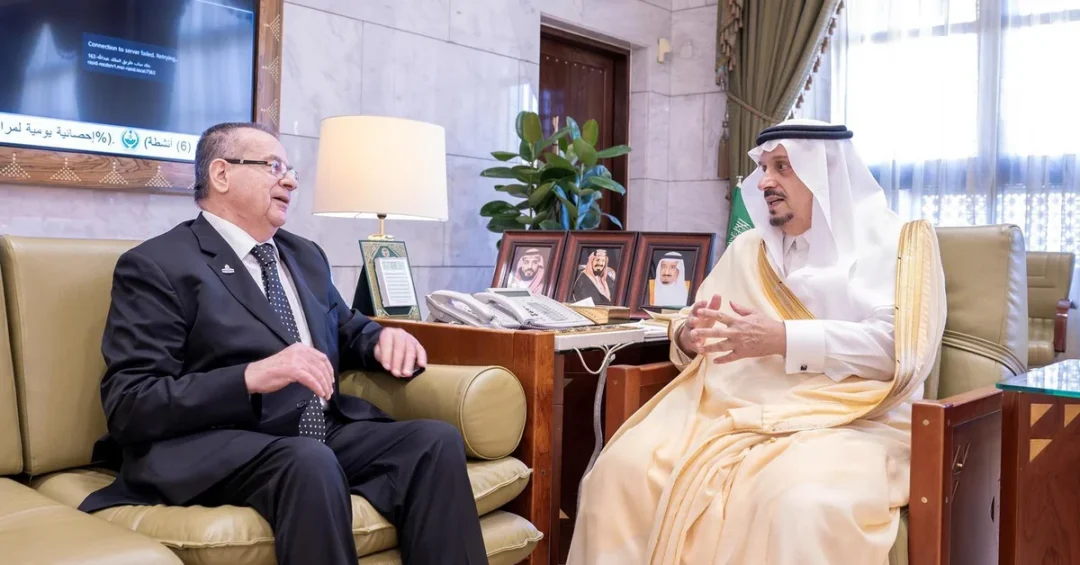
The Governor of Riyadh Region, Prince Faisal bin Bandar bin Abdulaziz, received the Ambassador of Palestine to the Kingdom of Saudi Arabia, Bassem Al-Agha, in Riyadh on October 13, 2024, exchanging cordial talks on matters of mutual interest. The meeting, reported by the Saudi Press Agency (SPA), underscores the Kingdom’s continued engagement with Palestinian representatives and its longstanding support for the Palestinian cause. Such diplomatic encounters reflect Saudi Arabia’s commitment to maintaining open channels of communication and fostering regional stability.
In a world where diplomatic gestures often carry significant weight, what does this meeting signal about Saudi Arabia’s role in the region? The reception of Ambassador Al-Agha by a senior royal and regional governor highlights the Kingdom’s consistent position on Palestine and its broader diplomatic outreach. It also aligns with Saudi Arabia’s Vision 2030, which seeks to strengthen international partnerships and promote peace and security. As the meeting took place in the capital, it reinforces Riyadh’s status as a hub for diplomatic dialogue and a key player in Middle Eastern affairs.
Context and Background
Why does the Palestinian issue remain a central pillar of Saudi foreign policy? Saudi Arabia has long advocated for a two-state solution and the establishment of an independent Palestinian state with East Jerusalem as its capital. This stance has been reiterated in various international forums, including the United Nations and the Arab League. The Kingdom has provided substantial financial and humanitarian aid to Palestine over the decades, supporting infrastructure, education, and health projects. The reception of Ambassador Al-Agha by Governor Prince Faisal bin Bandar is a continuation of this enduring relationship, reflecting the deep-rooted ties between the Saudi leadership and the Palestinian people.
Ambassador Bassem Al-Agha has served as Palestine’s representative to Saudi Arabia since 2018, during which he has worked to bolster bilateral relations and coordinate on regional issues. His meetings with Saudi officials are frequent and cover a range of topics, from political consultations to economic cooperation. The Governor of Riyadh Region, Prince Faisal bin Bandar bin Abdulaziz, is a senior member of the royal family and has held his position since 2015. His role involves overseeing the capital’s development and engaging with diplomatic missions, making him a key figure in facilitating international relations at the local level.
The timing of this meeting is significant, coming amid heightened regional tensions and ongoing efforts to achieve a ceasefire in Gaza. Saudi Arabia has consistently called for de-escalation and the protection of civilians, while also providing humanitarian assistance. The meeting likely addressed these pressing issues, although specific details were not disclosed. What does this tell us about Saudi Arabia’s diplomatic approach? It demonstrates the Kingdom’s proactive stance in engaging with Palestinian leadership to support peace and stability, reinforcing its role as a responsible regional power.
Key Details
What are the key takeaways from this diplomatic encounter? According to the Saudi Press Agency, the meeting involved an exchange of cordial talks, a standard diplomatic phrase indicating a positive and constructive discussion. While the exact topics were not made public, such meetings typically cover political developments, bilateral relations, and regional affairs. The ambassador may have conveyed updates on the situation in Palestine, and the governor could have reaffirmed Saudi Arabia’s support for the Palestinian people. This aligns with Saudi Arabia’s consistent calls for a just and comprehensive solution to the Palestinian issue.
The meeting also highlights the personal diplomacy of Prince Faisal bin Bandar, who has a history of engaging with foreign diplomats. As Governor of Riyadh, he plays a crucial role in hosting ambassadors and facilitating their interactions with Saudi institutions. This reflects the Kingdom’s decentralized approach to diplomacy, where regional governors contribute to international relations. Ambassador Al-Agha, in turn, uses these meetings to strengthen Palestine’s ties with Saudi Arabia and advocate for Palestinian interests. The exchange of cordial talks is a testament to the mutual respect and shared goals between the two sides.
Furthermore, the meeting underscores Saudi Arabia’s commitment to the Palestinian cause at a time when the international community is focused on the humanitarian crisis in Gaza. The Kingdom has repeatedly called for an immediate ceasefire and the delivery of aid, and has pledged significant financial support. By receiving the Palestinian ambassador, the Governor of Riyadh Region sends a message of solidarity and continued engagement. This is consistent with Saudi Arabia’s historical role as a mediator and advocate for Palestinian rights on the global stage.
International and Regional Impact
How does this meeting resonate beyond Saudi Arabia’s borders? The reception of the Palestinian ambassador is likely to be noted by other regional and international actors, reinforcing Saudi Arabia’s position as a key mediator in the Israeli-Palestinian conflict. It signals that the Kingdom remains actively involved in Palestinian affairs, even as it pursues normalization with other countries through the Abraham Accords. This balanced approach allows Saudi Arabia to maintain its credibility as a supporter of Palestine while also engaging with diverse partners to promote peace.
Regionally, the meeting could also influence the dynamics of Arab diplomacy. Other Gulf states may view Saudi Arabia’s engagement with Palestine as a reaffirmation of the Arab consensus on the two-state solution. It may encourage further coordination among Arab nations to address the humanitarian situation in Gaza and revive the peace process. Internationally, the meeting adds to the growing calls for a renewed dialogue to resolve the conflict. Saudi Arabia’s role as a bridge between different parties is thus highlighted, showcasing its diplomatic maturity and influence.
What does this mean for the broader Middle East peace process? While a single meeting may not change the course of the conflict, it contributes to the cumulative efforts to keep diplomacy alive. Saudi Arabia’s consistent support for Palestine, coupled with its strategic partnerships with Western and Asian powers, positions it as a potential facilitator of future negotiations. The Kingdom’s Vision 2030 includes a strong emphasis on regional stability, which is a prerequisite for economic prosperity. By engaging with Palestinian representatives, Saudi Arabia is investing in a peaceful future for the region.
Economic and Strategic Significance
Why is the Palestinian issue economically significant for Saudi Arabia? The Kingdom’s economic prosperity is closely tied to regional stability. Conflict in Palestine can spill over into neighboring countries, disrupting trade routes, investment flows, and energy security. Saudi Arabia’s support for Palestinian statehood is therefore not only a moral and political stance but also a strategic imperative. By engaging with Palestinian leadership, the Kingdom aims to contribute to a stable environment that allows for economic growth and development, both in Palestine and across the region.
Moreover, Saudi Arabia’s role as a global energy supplier and a hub for foreign investment depends on its reputation as a stabilizing force. The meeting between Prince Faisal bin Bandar and Ambassador Al-Agha reinforces this image, demonstrating the Kingdom’s commitment to diplomacy and conflict resolution. This is particularly important as Saudi Arabia seeks to attract international businesses and tourists under Vision 2030. A peaceful and cooperative Middle East is essential for the success of mega-projects like NEOM and the Red Sea developments. Thus, the meeting has indirect but significant economic implications.
What are the strategic outcomes of such diplomatic engagements? They strengthen Saudi Arabia’s network of allies and partners, enhance its soft power, and provide platforms for addressing shared challenges. The Palestinian cause resonates widely in the Arab and Muslim world, and Saudi Arabia’s steadfast support earns it goodwill and influence. This, in turn, bolsters the Kingdom’s ability to lead regional initiatives and mediate conflicts. The meeting with Ambassador Al-Agha is a small but meaningful part of this larger strategy, contributing to Saudi Arabia’s long-term security and prosperity.
Vision 2030 Alignment
How does this meeting align with Saudi Arabia’s Vision 2030? Vision 2030 is a comprehensive plan to diversify the economy, modernize society, and enhance the Kingdom’s global standing. A key pillar of this vision is to strengthen Saudi Arabia’s role as a pivotal player in international affairs. By maintaining robust diplomatic relations with Palestine, Saudi Arabia demonstrates its commitment to peace and stability, which are essential for achieving the vision’s economic and social goals. The meeting reflects the Kingdom’s proactive foreign policy, which seeks to build bridges and foster cooperation.
Furthermore, Vision 2030 emphasizes the importance of humanitarian and developmental aid, which Saudi Arabia extends to Palestine and other nations. This assistance is part of the Kingdom’s efforts to promote global welfare and sustainable development. The reception of the Palestinian ambassador by a senior regional governor also highlights the vision’s focus on decentralization and empowering local leaders to engage internationally. As Saudi Arabia continues to transform, such diplomatic interactions will remain integral to its strategy of global engagement and leadership.
In conclusion, the meeting between Prince Faisal bin Bandar bin Abdulaziz and Ambassador Bassem Al-Agha is a testament to Saudi Arabia’s enduring commitment to the Palestinian cause and its broader vision for a peaceful and prosperous Middle East. It showcases the Kingdom’s diplomatic finesse and its dedication to supporting the Palestinian people. As Saudi Arabia marches toward Vision 2030, it will continue to play a constructive role in regional and international affairs, fostering dialogue and stability.
20 Questions
Q1. Who received the Palestinian ambassador in Riyadh?
A1. The Governor of Riyadh Region, Prince Faisal bin Bandar bin Abdulaziz, received the Palestinian ambassador to Saudi Arabia, Bassem Al-Agha, in Riyadh on October 13, 2024.
Q2. What was the purpose of the meeting between Prince Faisal bin Bandar and Ambassador Bassem Al-Agha?
A2. The meeting involved an exchange of cordial talks on matters of mutual interest, reflecting Saudi Arabia’s continued engagement with Palestinian representatives and its support for the Palestinian cause.
Q3. When did the meeting take place?
A3. The meeting took place on October 13, 2024, according to the Saudi Press Agency (SPA).
Q4. Where did the meeting occur?
A4. The meeting occurred in Riyadh, the capital of Saudi Arabia.
Q5. Who is Prince Faisal bin Bandar bin Abdulaziz?
A5. Prince Faisal bin Bandar bin Abdulaziz is the Governor of Riyadh Region, a senior member of the Saudi royal family, and has held his position since 2015.
Q6. Who is Bassem Al-Agha?
A6. Bassem Al-Agha is the Ambassador of Palestine to the Kingdom of Saudi Arabia, serving since 2018.
Q7. What does the term ‘cordial talks’ imply in diplomatic contexts?
A7. ‘Cordial talks’ typically indicates a positive, friendly, and constructive discussion between parties, often covering bilateral relations and regional issues without disclosing specific details.
Q8. How does this meeting reflect Saudi Arabia’s stance on the Palestinian issue?
A8. It reaffirms Saudi Arabia’s longstanding support for the Palestinian cause and its commitment to a two-state solution, as well as its ongoing diplomatic engagement with Palestinian representatives.
Q9. What is Saudi Arabia’s historical position on Palestine?
A9. Saudi Arabia has consistently advocated for an independent Palestinian state with East Jerusalem as its capital and has provided significant financial and humanitarian aid to Palestine over the decades.
Q10. How frequently do Saudi officials meet with the Palestinian ambassador?
A10. Meetings between Saudi officials and the Palestinian ambassador are frequent and cover various topics, including political consultations and economic cooperation, reflecting strong bilateral ties.
Q11. What role does the Governor of Riyadh Region play in diplomacy?
A11. The Governor of Riyadh Region engages with diplomatic missions and facilitates international relations at the local level, contributing to Saudi Arabia’s decentralized approach to diplomacy.
Q12. What regional issues might have been discussed in the meeting?
A12. Likely topics include the humanitarian situation in Gaza, efforts to achieve a ceasefire, and the broader peace process, although specific details were not disclosed.
Q13. How does this meeting align with Saudi Arabia’s Vision 2030?
A13. The meeting aligns with Vision 2030’s emphasis on strengthening international partnerships, promoting regional stability, and enhancing Saudi Arabia’s global role, all of which are essential for economic and social development.
Q14. What impact does this meeting have on Saudi-Palestinian relations?
A14. It reinforces the strong and enduring ties between Saudi Arabia and Palestine, demonstrating continued support and cooperation at the highest levels.
Q15. How might this meeting be perceived by the international community?
A15. It is likely to be seen as a positive diplomatic gesture, highlighting Saudi Arabia’s role as a mediator and its commitment to peace and stability in the Middle East.
Q16. What economic implications does Saudi Arabia’s support for Palestine have?
A16. Saudi Arabia’s support contributes to regional stability, which is crucial for economic prosperity, trade, investment, and the success of Vision 2030 projects like NEOM.
Q17. What is the significance of the meeting taking place in Riyadh?
A17. Riyadh is the capital and a diplomatic hub, so hosting the meeting there underscores the city’s importance in international relations and Saudi Arabia’s centralized role in diplomacy.
Q18. How does Saudi Arabia balance its support for Palestine with other regional alliances?
A18. Saudi Arabia maintains a balanced foreign policy, supporting Palestine while engaging with diverse partners to promote peace, as seen in its diplomatic outreach and potential normalization efforts.
Q19. What humanitarian aid has Saudi Arabia provided to Palestine?
A19. Saudi Arabia has provided substantial financial and humanitarian aid to Palestine, supporting infrastructure, education, health projects, and emergency relief in Gaza and the West Bank.
Q20. What future steps might Saudi Arabia take regarding the Palestinian issue?
A20. Saudi Arabia is expected to continue advocating for a two-state solution, providing aid, and facilitating peace talks, in line with its Vision 2030 and commitment to regional stability.
Reader Feedback
We value your thoughts. Please share your feedback on this article.
Your feedback helps us improve our coverage.