


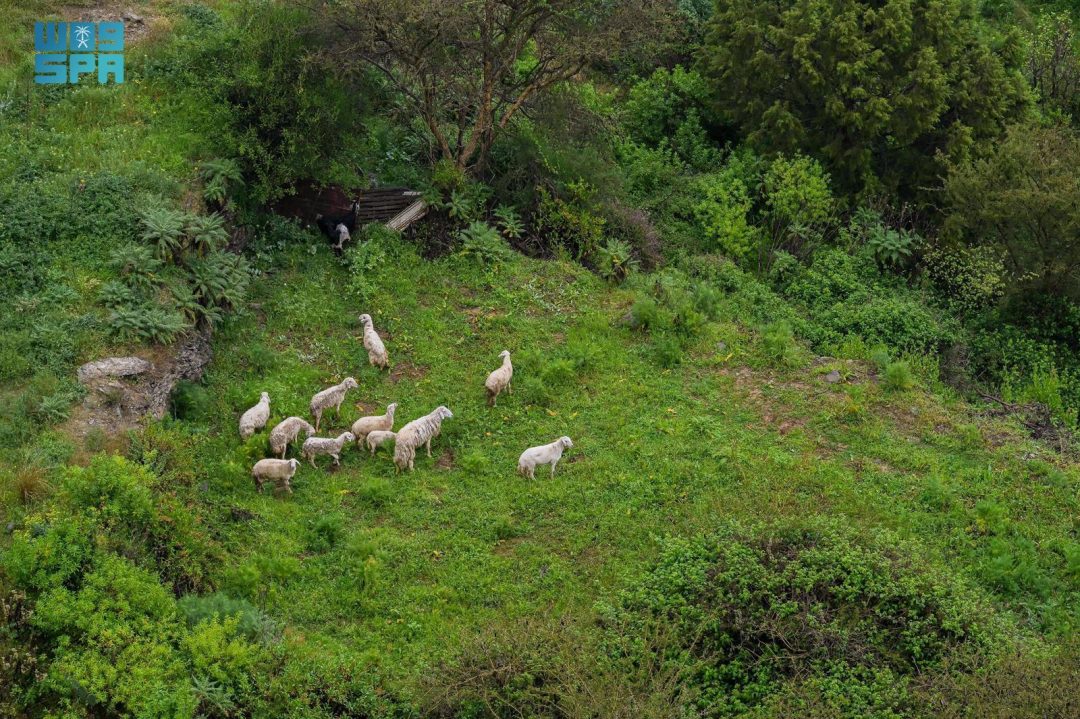
Al-Baha Region has been painted in a lush green palette after recent heavy rains transformed its mountains and valleys into a natural spectacle of beauty and vitality, SPA reported on March 20, 2025.
According to SPA, the landscape of Al-Baha, described as a place of soft winds and striking heights, has come alive with botanical richness. Wild flora and trees, their leaves shimmering in the sunlight, paint the area with an enchanting glow, while an emerald carpet of herbs stretches across the slopes. The air, filled with the sweet scent of blossoms, offers a sense of peace.
What does it take for a region to shift so completely from its usual face to this vivid green? The answer, as SPA frames it, lies in the recent heavy rains that have swept the area, feeding the soil and waking the wild plants that define Al-Baha’s character.
The transformation is not limited to a single slope or valley. SPA describes mountains and valleys across the region as part of the same captivating natural spectacle. The wild flora and trees are not isolated patches but a broad botanical richness that covers the terrain, with leaves catching the sunlight and herbs forming a continuous carpet across the slopes.
Why do these brief green seasons draw so much attention in a region known for its heights and open air? The answer may lie in how rare and how complete the change appears when the rains arrive. SPA’s account emphasizes beauty and vitality, two qualities that residents and visitors can observe directly in the landscape.
The sensory details in the SPA report are specific. The air carries the sweet scent of blossoms. The winds are soft. The heights are striking. Together these elements create what SPA calls a sense of peace, a description that goes beyond simple scenery and touches on how the place feels to those who experience it.
But the green palette is not only a matter of scenery. SPA links the moment to a wider institutional effort. The National Center for Vegetation Cover Development and Combating Desertification (NCVC) will launch an awareness campaign tomorrow, March 21, 2025, coinciding with the International Day of Forests.
What does the NCVC hope to achieve with a campaign timed to the International Day of Forests? According to SPA, the campaign will highlight the vital role of Saudi Arabia’s forests and emphasize forests’ impact on ecology and climate. The timing places the Al-Baha greenery within a broader national conversation about vegetation cover and desertification.
Why does the International Day of Forests matter in a country where forests are not always the first image that comes to mind? SPA’s report does not answer that question directly, but it does state that the NCVC campaign is meant to emphasize the impact of forests on ecology and climate. That framing suggests the day is being used to draw attention to the ecological functions that forests perform.
The Al-Baha landscape itself offers a visible example of what vegetation cover can look like after rain. The mountains and valleys, the wild flora and trees, the herbs across the slopes, and the blossoms in the air all form part of the same picture. SPA presents this picture as a natural spectacle of beauty and vitality, not as a scientific survey or a set of measurements.
What happens to this green palette when the rains stop? SPA does not say. The report focuses on the present moment, when heavy rains have recently fallen and the region is lush. It does not discuss how long the greenery will last, how often such rains occur, or how the landscape changes across seasons.
What is clear from the SPA account is the sequence of events. First, recent heavy rains. Second, a green transformation across mountains and valleys. Third, an NCVC awareness campaign launching tomorrow, March 21, 2025, to coincide with the International Day of Forests. The report connects the visible landscape to the institutional campaign without claiming that one caused the other.
The NCVC’s full name, the National Center for Vegetation Cover Development and Combating Desertification, indicates the scope of its work. SPA states that the center will launch the campaign to highlight the vital role of Saudi Arabia’s forests. The campaign is described as an awareness effort, not a planting program or a policy announcement.
Why focus on awareness rather than direct action? SPA does not explain the center’s reasoning. The report simply notes that the campaign will emphasize forests’ impact on ecology and climate. That emphasis aligns with the International Day of Forests, which SPA identifies as the occasion for the launch.
For readers in Al-Baha, the campaign arrives while the local landscape is still green. The mountains and valleys that SPA describes are the same terrain that residents know in drier conditions. The contrast between the usual appearance of the region and its current state may be part of what makes the moment notable.
What role do wild flora and trees play in the ecology that the NCVC campaign will highlight? SPA does not provide a detailed ecological breakdown. It describes the leaves shimmering in the sunlight and the herbs stretching across the slopes, but it does not list species, measure coverage, or quantify the change. The report stays with the visual and sensory impression.
That impression is vivid. An emerald carpet of herbs. Wild flora and trees with leaves that shimmer. Air filled with the sweet scent of blossoms. Soft winds. Striking heights. These are the elements SPA uses to convey the transformation. They are presented as a coherent scene rather than a series of separate observations.
Why does SPA call Al-Baha a green masterpiece in its headline? The body of the report supports that framing with the language of palette, carpet, glow, and spectacle. The headline and the text work together to present the region as a place where rain produces a striking visual and sensory result.
The report also places Al-Baha within Saudi Arabia as a whole. The NCVC is described as a national center, and the campaign concerns Saudi Arabia’s forests generally. Al-Baha’s greenery becomes one local expression of a national subject: vegetation cover and its relationship to desertification.
What does combating desertification mean in practice? SPA does not define the term or describe specific methods. It names the center and its mandate, then moves to the awareness campaign and the International Day of Forests. The report does not include project details, funding figures, or target areas.
Readers who want to know more about the NCVC campaign will find only the basic facts in this SPA report: the center’s name, the launch date of March 21, 2025, the link to the International Day of Forests, and the campaign’s focus on forests’ impact on ecology and climate. The report does not include the campaign’s duration, its activities, or its geographic reach.
Similarly, readers who want to know more about the rains will find only that they were recent and heavy. SPA does not provide rainfall totals, dates of specific storms, or comparisons with previous years. The report treats the rains as the backdrop for the green transformation rather than as a separate news event.
What remains is the image of Al-Baha in its green state. Mountains and valleys covered in vegetation. Wild flora and trees catching the light. Herbs forming a carpet across the slopes. Blossoms scenting the air. SPA presents this as a natural spectacle of beauty and vitality, and it links the moment to a national campaign about forests and climate.
The International Day of Forests on March 21, 2025, provides the calendar anchor. The NCVC campaign launches tomorrow, according to SPA. The Al-Baha rains have already done their work on the landscape. The report brings these threads together without claiming more than it can support.
For KSA.com readers, the story is both local and national. Locally, Al-Baha’s mountains and valleys are green after heavy rains. Nationally, the NCVC is using the International Day of Forests to launch an awareness campaign about forests’ impact on ecology and climate. The two facts sit side by side in the SPA report.
What the report does not include is any statement from an official, any specific location within Al-Baha, any measurement of the greenery, or any detail about the campaign beyond its launch date and focus. Those elements are absent, and this article does not add them.
The green palette over Al-Baha, as SPA describes it, is a temporary and visible result of recent weather. The NCVC campaign, by contrast, is a planned awareness effort tied to an international observance. Together they frame a moment when a Saudi region’s landscape and a national vegetation initiative appear in the same report.
What caused the green transformation in Al-Baha Region? According to SPA, recent heavy rains painted Al-Baha Region in a lush green palette, transforming its mountains and valleys into a natural spectacle of beauty and vitality. The report describes wild flora and trees with leaves shimmering in the sunlight, an emerald carpet of herbs stretching across the slopes, and air filled with the sweet scent of blossoms. SPA presents the change as a visible result of the recent rains, without providing rainfall totals or specific dates for the storms.
What is the NCVC and what campaign is it launching? SPA identifies the National Center for Vegetation Cover Development and Combating Desertification (NCVC) as the body launching an awareness campaign tomorrow, March 21, 2025. The campaign coincides with the International Day of Forests. According to SPA, it will highlight the vital role of Saudi Arabia’s forests and emphasize forests’ impact on ecology and climate. The report describes the effort as an awareness campaign and does not list specific activities, duration, or geographic reach.
When does the NCVC campaign launch and why that date? SPA states the NCVC campaign will launch tomorrow, March 21, 2025, coinciding with the International Day of Forests. The report links the launch date directly to that international observance. SPA does not explain why the center chose an awareness campaign rather than another type of initiative, nor does it describe events planned for the day. The date and the occasion are the only timing details provided in the source material.
What does SPA say about the landscape and atmosphere of Al-Baha? SPA describes Al-Baha as a place of soft winds and striking heights that has come alive with botanical richness. Wild flora and trees have leaves shimmering in the sunlight, painting the area with an enchanting glow. An emerald carpet of herbs stretches across the slopes, and the air is filled with the sweet scent of blossoms, offering a sense of peace. These sensory details form the core of the report’s description of the region.
Does the SPA report include rainfall totals or campaign details? No. SPA says only that recent heavy rains transformed the region. It does not provide rainfall totals, dates of specific storms, or comparisons with previous years. For the NCVC campaign, the report gives the center’s name, the launch date of March 21, 2025, the link to the International Day of Forests, and the focus on forests’ impact on ecology and climate. It does not include funding figures, target areas, or official statements.