


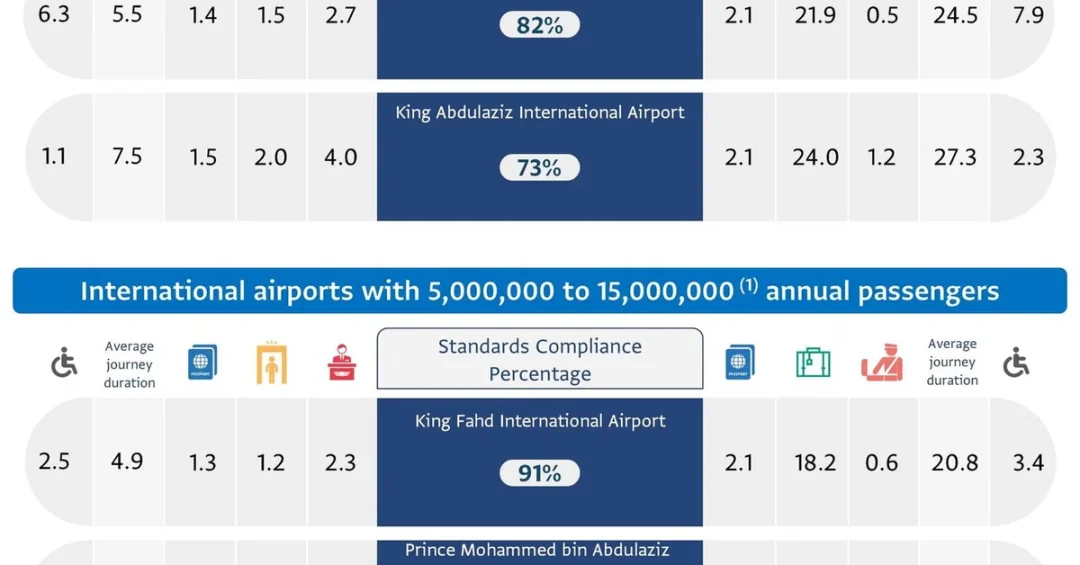
The General Authority of Civil Aviation (GACA) released its September 2024 performance report for Saudi Arabia’s domestic and international airports on October 21, 2024, ranking King Khalid International Airport in Riyadh first among airports handling more than 15 million passengers annually with an 82% compliance rate. The monthly assessment, issued through the Saudi Press Agency, evaluates airports against 11 operational performance standards designed to enhance services and ensure a seamless traveler experience across the Kingdom. The report reflects Saudi Arabia’s ongoing commitment to elevating its aviation infrastructure as part of the broader transformation envisioned under Vision 2030. How does such rigorous, transparent evaluation reshape the global perception of Saudi aviation?
The September report highlights significant achievements across multiple airport categories, with several facilities reaching full compliance rates. King Fahd International Airport in Dammam and Prince Mohammed bin Abdulaziz International Airport in Madinah tied for first place in the category of international airports serving 5 to 15 million passengers annually, each achieving a 91% compliance rate. In the 2 to 5 million annual passenger category, King Abdullah bin Abdulaziz Airport in Jizan and Abha International Airport both demonstrated a 100% compliance rate, with Jizan outperforming Abha by reaching higher targets in the specified evaluation criteria. These results underscore the Kingdom’s systematic approach to aviation excellence.
Context and Background
Why has GACA’s monthly performance reporting become such a critical tool for Saudi Arabia’s aviation strategy? The General Authority of Civil Aviation, the Kingdom’s regulatory body for civil aviation affairs, has institutionalized a transparent evaluation framework that categorizes airports based on annual passenger numbers. This categorization ensures fair and objective assessment across facilities of varying sizes and traffic volumes. The September 2024 report follows a series of monthly assessments that have progressively raised service standards at airports throughout the Kingdom. By publishing these results through official channels such as the Saudi Press Agency, GACA reinforces its commitment to accountability and continuous improvement.
The 11 operational performance standards used in the evaluation focus on critical passenger touchpoints, including check-in, security, passport control, customs, baggage claim, and assistance to passengers with reduced mobility (PRM). These metrics are aligned with international best practices and are designed to ensure a seamless and efficient travel experience for all passengers. The selection of these specific standards reflects a deep understanding of where travelers experience the most friction and where targeted improvements can yield the greatest satisfaction gains. This approach positions Saudi airports to compete with leading global hubs.
GACA’s evaluation methodology has evolved over time to incorporate increasingly granular data, enabling airport operators to identify precise areas for enhancement. The monthly publication of results creates a culture of healthy competition among airport management teams, driving innovation and service upgrades. This systematic approach is a cornerstone of the Kingdom’s strategy to become a global aviation leader and a preferred destination for business and leisure travelers alike.
Key Details
What specific achievements stand out in the September 2024 report? King Khalid International Airport in Riyadh secured the top spot in the category of airports with more than 15 million passengers annually, achieving an 82% compliance rate. Following closely was King Abdulaziz International Airport in Jeddah with 73%. While these figures indicate room for further improvement, they also demonstrate the scale of operations at these mega-hubs and the complexity of maintaining high service standards amid massive passenger volumes. The report acknowledges the efforts of airport teams while setting a clear benchmark for future performance.
In the 2 to 5 million annual passenger category, King Abdullah bin Abdulaziz Airport in Jizan and Abha International Airport both achieved a 100% compliance rate. However, King Abdullah bin Abdulaziz Airport outperformed Abha International Airport by reaching higher targets in the specified evaluation criteria. This distinction highlights GACA’s nuanced approach, recognizing that compliance alone does not capture the full picture of operational excellence. The airport in Jizan demonstrated superior performance in areas such as average waiting times and passenger throughput, setting a new standard for regional airports.
Al-Ahsa International Airport achieved a 100% compliance rate in the category of less than 2 million passengers annually, outperforming its competitors with regard to average waiting time for departing and arriving flights. Similarly, Gurayat Airport came first in the domestic airport category, also with a 100% compliance rate, excelling in average waiting times. These results illustrate that smaller airports are not merely keeping pace but are often leading in efficiency and passenger-centric service. The recognition of Gurayat and Al-Ahsa underscores GACA’s commitment to supporting aviation infrastructure across all regions of the Kingdom.
International and Regional Impact
How do these airport performance improvements influence Saudi Arabia’s standing in the global aviation landscape? The Kingdom’s strategic location at the crossroads of Europe, Asia, and Africa makes its airports vital nodes in international travel. Enhanced performance at facilities like King Khalid International Airport and King Fahd International Airport directly contributes to smoother connections for transit passengers and cargo, bolstering trade and tourism. As global aviation recovers and expands, Saudi Arabia’s focus on operational excellence positions it as a reliable and attractive partner for airlines and logistics companies.
Regionally, the report sends a strong signal that Saudi Arabia is investing heavily in passenger experience, which is essential for attracting visitors from neighboring Gulf countries and beyond. The consistent high compliance rates at airports such as Madinah’s Prince Mohammed bin Abdulaziz International Airport, which serves a significant number of religious travelers, reflect a deep respect for the needs of diverse passenger groups. This attention to service quality enhances the Kingdom’s reputation as a welcoming destination and supports its goals of increasing religious tourism and international visitation.
Furthermore, the transparency of GACA’s reporting sets a benchmark for the region, encouraging other countries to adopt similar evaluation frameworks. By sharing results publicly, Saudi Arabia demonstrates leadership in aviation governance and fosters a culture of accountability that benefits the entire Middle East. The September report thus contributes to a broader narrative of progress and modernization that resonates well beyond the Kingdom’s borders.
Economic and Strategic Significance
What economic benefits flow from these airport performance enhancements? Saudi Arabia’s aviation sector is a key pillar of the national economy, contributing to GDP, employment, and foreign investment. Efficient airports facilitate the movement of goods and people, reducing costs for businesses and enhancing the Kingdom’s competitiveness as a logistics hub. The September report’s findings, particularly the 100% compliance rates at several airports, indicate that infrastructure investments are yielding tangible returns in terms of operational efficiency. This, in turn, attracts more airlines to establish routes to Saudi Arabia, expanding connectivity and trade links.
Strategically, the performance report supports the objectives of Vision 2030 by aligning airport operations with global best practices and passenger expectations. The Kingdom aims to increase annual passenger traffic to 330 million by 2030, and achieving high compliance rates across all airport categories is essential to meeting that target. The recognition of airports like Gurayat and Al-Ahsa demonstrates that the strategy encompasses all regions, ensuring that economic benefits are distributed widely. This inclusive approach is vital for sustainable development and social cohesion.
In addition, the report highlights the importance of human capital in aviation. The staff at these airports—from check-in agents to security personnel—are the frontline ambassadors of Saudi hospitality. Their performance, measured through metrics like waiting times and PRM assistance, directly impacts passenger satisfaction. GACA’s focus on these touchpoints reflects an understanding that technology and infrastructure must be complemented by skilled, motivated people. Investments in training and development are therefore integral to the Kingdom’s aviation success.
Vision 2030 Alignment
How does GACA’s September 2024 performance report advance the goals of Vision 2030? Vision 2030, Saudi Arabia’s ambitious blueprint for economic diversification and social transformation, places the aviation sector at the heart of its strategy to become a global hub for tourism, business, and logistics. The report’s emphasis on transparency, competition, and passenger-centric service aligns perfectly with the Vision’s principles of accountability and excellence. By publicly recognizing top-performing airports and identifying areas for improvement, GACA fosters a culture of continuous enhancement that is essential for achieving the Vision’s targets.
Moreover, the report contributes to the Vision’s objective of enhancing the quality of life for citizens and residents by ensuring that travel through Saudi airports is smooth, efficient, and pleasant. The Kingdom’s airports are often the first and last impression for visitors, and their performance shapes perceptions of the entire country. The September results, with multiple airports achieving 100% compliance, signal that Saudi Arabia is well on its way to offering a world-class travel experience. As the Kingdom prepares to host major international events and welcome millions of tourists, the relentless focus on airport performance will remain a cornerstone of its success.
In conclusion, the General Authority of Civil Aviation’s September 2024 report not only celebrates achievements but also sets the stage for future progress. By holding airports to rigorous standards and sharing results openly, Saudi Arabia demonstrates its commitment to excellence and its readiness to lead in global aviation. The Kingdom’s journey toward Vision 2030 is marked by such milestones, each bringing it closer to a future where Saudi airports are synonymous with efficiency, hospitality, and innovation. How will the world benefit from Saudi Arabia’s continued aviation ascent? The answer lies in the skies above the Kingdom, where every flight tells a story of progress.
20 Questions
Q1. What is the GACA September 2024 airports performance report?
A1. The General Authority of Civil Aviation (GACA) issued its September 2024 report on the performance of domestic and international airports in Saudi Arabia, assessing them against 11 operational performance standards to enhance services and ensure a seamless traveler experience.
Q2. Which airport ranked first in the category of more than 15 million passengers annually?
A2. King Khalid International Airport in Riyadh secured the top spot with an 82% compliance rate, followed by King Abdulaziz International Airport in Jeddah with 73%.
Q3. How did King Fahd International Airport perform in the report?
A3. King Fahd International Airport in Dammam tied for first place with Prince Mohammed bin Abdulaziz International Airport in Madinah in the category of international airports serving 5 to 15 million passengers annually, each achieving a 91% compliance rate.
Q4. What was the compliance rate for airports in the 2 to 5 million passenger category?
A4. King Abdullah bin Abdulaziz Airport in Jizan and Abha International Airport both demonstrated a 100% compliance rate, with Jizan outperforming Abha by reaching higher targets in the evaluation criteria.
Q5. Which airport led in the less than 2 million passengers category?
A5. Al-Ahsa International Airport achieved a 100% compliance rate, outperforming its competitors with regard to average waiting time for departing and arriving flights.
Q6. Which airport came first in the domestic airport category?
A6. Gurayat Airport came first in the domestic airport category with a 100% compliance rate, excelling in average waiting times for departing and arriving flights.
Q7. What are the 11 operational performance standards?
A7. The standards focus on critical passenger touchpoints including check-in, security, passport control, customs, baggage claim, and assistance to passengers with reduced mobility (PRM), ensuring a seamless travel experience aligned with international best practices.
Q8. How does GACA categorize airports for performance evaluation?
A8. GACA categorizes airports based on annual passenger numbers, ensuring a transparent approach that allows fair comparison among facilities of different sizes.
Q9. Why is the September 2024 report significant for Saudi Arabia?
A9. It demonstrates the Kingdom’s commitment to transparency, accountability, and continuous improvement in aviation services, supporting Vision 2030 goals to enhance quality of life and become a global aviation hub.
Q10. What does a 100% compliance rate indicate?
A10. A 100% compliance rate indicates that an airport has fully met all evaluated operational performance standards, reflecting excellence in passenger service and operational efficiency.
Q11. How does the report impact international travelers?
A11. The report drives improvements in airport services, leading to smoother connections, reduced waiting times, and a more pleasant experience for international travelers transiting through or visiting Saudi Arabia.
Q12. What is the role of GACA in Saudi aviation?
A12. GACA is the regulatory body responsible for civil aviation in Saudi Arabia, overseeing airport performance, safety, and service standards to ensure the Kingdom’s aviation sector meets global benchmarks.
Q13. How does the report align with Vision 2030?
A13. The report supports Vision 2030 by promoting excellence, transparency, and passenger-centric service, which are essential for achieving the goal of 330 million annual passengers by 2030.
Q14. What are the implications for regional airports?
A14. Regional airports like Jizan, Abha, Al-Ahsa, and Gurayat are recognized for high performance, encouraging further investment and development across all regions of the Kingdom.
Q15. How does GACA ensure fairness in its evaluations?
A15. GACA uses a transparent categorization system based on annual passenger numbers and applies consistent operational performance standards across all airports, ensuring fair and objective assessments.
Q16. What is the significance of the 91% compliance rate for Dammam and Madinah airports?
A16. It reflects strong performance in serving 5 to 15 million passengers annually, showcasing the airports’ ability to handle significant traffic while maintaining high service standards.
Q17. How does the report benefit airlines operating in Saudi Arabia?
A17. Airlines benefit from improved airport efficiency, which reduces turnaround times, enhances punctuality, and improves passenger satisfaction, making Saudi routes more attractive.
Q18. What steps can airports take to improve their compliance rates?
A18. Airports can analyze GACA’s detailed feedback, invest in staff training, upgrade infrastructure, and adopt technology to streamline processes at key passenger touchpoints.
Q19. How does the report reflect Saudi Arabia’s leadership in aviation?
A19. By publishing detailed performance data, Saudi Arabia demonstrates leadership in aviation governance, setting a benchmark for transparency and accountability in the region.
Q20. What is the outlook for Saudi airports following this report?
A20. The report sets a foundation for continuous improvement, with airports expected to build on their performance to meet Vision 2030 targets and elevate Saudi Arabia’s status as a global aviation leader.
Reader Feedback
We value your thoughts. Please share your feedback on this article.
Your feedback helps us improve our coverage.