


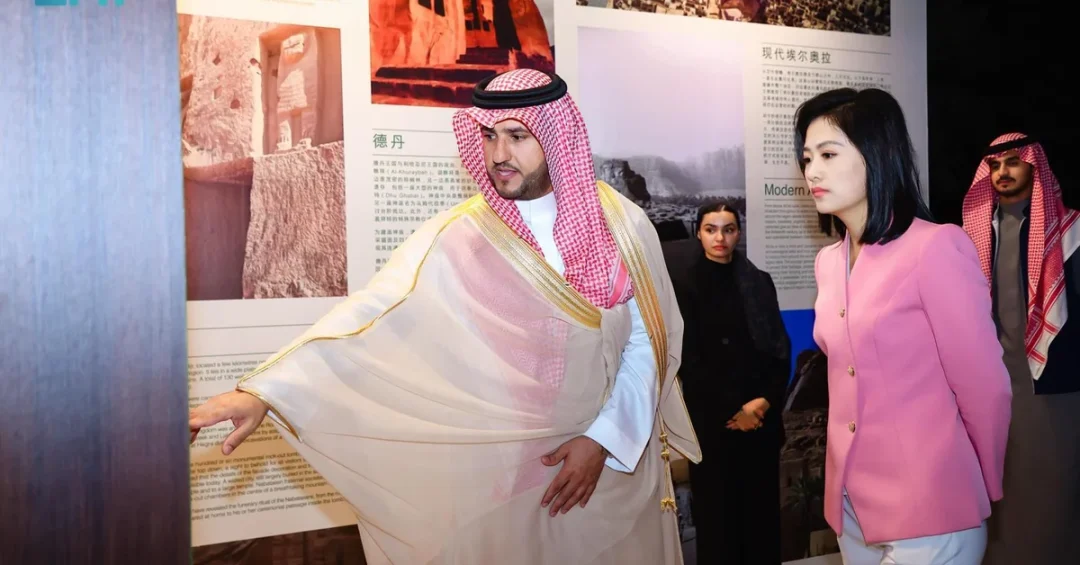
The Royal Commission for AlUla (RCU) is participating in the Saudi Travel Expo in Beijing, China, following the signing of an agreement between the Saudi Ministry of Culture and the Chinese Ministry of Culture and Tourism. The exhibition, held at Tiantan Park in Beijing until October 26, 2024, displays a selection of antiquities and presents an overview of AlUla’s cultural and natural heritage, contributing to strengthening the cultural relationship between the Kingdom of Saudi Arabia and the People’s Republic of China. The participation reflects Saudi Arabia’s expanding global engagement in tourism and cultural diplomacy, and it underscores the growing appeal of AlUla as one of the Kingdom’s leading tourist destinations. With international tourist numbers to AlUla rising by 44% in 2023, the Saudi Travel Expo offers a timely platform to showcase the diverse cultural and heritage experiences that AlUla offers to visitors from China and beyond.
Why does a single exhibition in Beijing matter for the future of Saudi tourism? Because it signals a strategic convergence: China is one of the world’s largest outbound tourism markets, and Saudi Arabia is investing heavily in cultural heritage destinations that appeal to travelers seeking authentic, meaningful experiences. The RCU’s presence at the Saudi Travel Expo is not merely a promotional exercise; it is part of a broader effort to build people-to-people ties and position AlUla as a must-visit destination on the global cultural map. The event also follows a formal cultural agreement between the two countries, giving the exhibition a foundation of official cooperation and mutual respect.
Context and Background
What is the Saudi Travel Expo, and why is it being held in China? The Saudi Travel Expo is a prominent platform organized to showcase the Kingdom’s diverse cultural and heritage destinations to international audiences. This edition, held at Tiantan Park in Beijing until October 26, 2024, comes on the heels of an agreement signed between the Saudi Ministry of Culture and the Chinese Ministry of Culture and Tourism. That agreement provides a framework for cultural exchange and cooperation, and it reflects the deepening ties between Saudi Arabia and China across multiple sectors, including tourism, heritage preservation, and the arts. The expo is therefore both a celebration of Saudi heritage and a practical tool for attracting Chinese visitors to the Kingdom.
The Royal Commission for AlUla, established to preserve and develop the AlUla region, has been at the forefront of Saudi Arabia’s efforts to promote cultural tourism. AlUla is home to the Hegra (Mada’in Saleh) archaeological site, Saudi Arabia’s first UNESCO World Heritage Site, and it is renowned for its stunning desert landscapes, ancient tombs, and rock formations. The RCU’s participation in the Beijing expo is part of a strategic push to raise international awareness of AlUla’s unique offerings. By bringing antiquities, photographs, and videos to China, the RCU is not just advertising a destination; it is sharing a story of civilizations that once flourished along the Incense Route and left behind monuments that continue to inspire awe.
The timing of this expo is significant. Saudi Arabia has set ambitious targets for tourism under Vision 2030, aiming to attract 150 million visits annually by 2030 and to increase the tourism sector’s contribution to GDP. China, with its vast middle class and growing appetite for outbound travel, is a key source market. The Saudi Travel Expo in Beijing is thus a strategic move to tap into that potential, using culture as the bridge. It also complements other Saudi initiatives in China, such as roadshows and promotional campaigns, and it demonstrates the Kingdom’s commitment to diversifying its visitor base beyond traditional markets.
Key Details
What exactly is on display at the Saudi Travel Expo? The RCU’s exhibition at Tiantan Park features a curated selection of antiquities that highlight the rich history of AlUla, alongside photographs and videos that capture the region’s cultural richness and historical sites. Visitors to the expo can learn about Hegra, where monumental tombs carved into sandstone outcrops testify to the Nabataean civilization’s architectural genius. They can also explore the natural wonders of AlUla, from the towering rock formations of Elephant Rock to the lush oasis of AlUla Old Town. The exhibition is designed to provide a comprehensive overview of AlUla’s cultural and natural heritage, making it accessible and engaging for Chinese audiences who may be less familiar with Saudi Arabia’s pre-Islamic history.
The expo also highlights the connection between AlUla and Diriyah, another Saudi destination that is home to a UNESCO World Heritage Site, the At-Turaif District. Together, these two sites represent the depth and diversity of Saudi Arabia’s cultural legacy, from the Nabataean kingdom to the first Saudi state. By presenting both AlUla and Diriyah, the RCU is showcasing the Kingdom’s broader commitment to preserving and promoting its heritage. The inclusion of Diriyah in the exhibition is particularly relevant because it underscores the interconnectedness of Saudi history and the importance of these sites in the formation of civilizations. For Chinese visitors, this offers a window into a part of the world that has been a crossroads of cultures for millennia.
The RCU’s participation is also an opportunity to engage with Chinese travel trade professionals, media, and potential tourists. The Saudi Travel Expo is attended by key stakeholders in the tourism industry, and the RCU is using the platform to build relationships and explore partnership opportunities. This could lead to increased Chinese visitation to AlUla, which in turn would support local businesses, create jobs, and contribute to the region’s sustainable development. The exhibition is thus not just a static display but a dynamic tool for economic and cultural exchange.
International and Regional Impact
How does this exhibition fit into the broader picture of Saudi-China relations? The Saudi Travel Expo in China is part of a wider strengthening of ties between the two countries, which have been expanding cooperation in areas such as energy, trade, investment, and technology. Cultural and tourism exchanges are an increasingly important pillar of this relationship, as they foster mutual understanding and goodwill. The agreement between the Saudi Ministry of Culture and the Chinese Ministry of Culture and Tourism provides a formal basis for such exchanges, and the RCU’s participation is an early outcome of that agreement. It signals that Saudi Arabia views China not only as an economic partner but also as a cultural partner, and that the Kingdom is serious about attracting Chinese tourists.
Regionally, the exhibition reinforces Saudi Arabia’s position as a leading cultural destination in the Middle East. AlUla has been gaining international recognition, with its inclusion in global travel lists and its hosting of high-profile events such as the AlUla Arts Festival and the Desert X AlUla exhibition. The RCU’s presence in Beijing extends this reach into East Asia, a region with a growing interest in experiential travel. For China, the exhibition offers an opportunity to learn about a destination that is both exotic and accessible, thanks to Saudi Arabia’s visa reforms and improved air connectivity. The impact is mutual: Saudi Arabia gains visibility and visitor interest, while China’s travelers gain a new, enriching destination to explore.
Economic and Strategic Significance
What economic benefits can Saudi Arabia expect from engaging Chinese tourists? International tourists to AlUla recorded a 44% increase in 2023, and Chinese visitors are a key demographic for future growth. Chinese outbound tourism is recovering and is expected to reach new heights, with travelers increasingly seeking unique cultural experiences. By targeting this market, Saudi Arabia can diversify its tourism revenue and reduce reliance on traditional source markets. The RCU’s exhibition is a strategic investment in brand awareness that could yield significant returns in terms of visitor numbers and spending. Moreover, increased tourism to AlUla supports the local economy, creating opportunities for hospitality, retail, and cultural enterprises.
From a strategic perspective, the exhibition aligns with Saudi Arabia’s Vision 2030 goal of transforming the Kingdom into a global tourism hub. Tourism is a key pillar of the Vision, and culture is a major driver of tourism. By showcasing AlUla’s heritage in China, the RCU is helping to build the Kingdom’s soft power and to position Saudi Arabia as a welcoming, modern nation with a rich history. This complements other Vision 2030 initiatives, such as the development of NEOM, the Red Sea Project, and Diriyah Gate, all of which aim to attract international visitors. The Beijing expo is thus a small but meaningful step toward achieving the ambitious tourism targets set by the Saudi leadership.
Vision 2030 Alignment
How does the RCU’s participation in the Saudi Travel Expo in China connect to Vision 2030? Vision 2030 seeks to diversify the Saudi economy away from oil, and tourism is one of the key sectors identified for growth. The Royal Commission for AlUla is a vital part of this strategy, as it develops AlUla into a world-class cultural and heritage destination. By promoting AlUla to Chinese audiences, the RCU is directly contributing to the Vision’s objectives of increasing international visitation, creating jobs, and preserving cultural heritage. The exhibition also reflects the Vision’s emphasis on international partnerships and cultural exchange, which are essential for building a vibrant and open society.
Looking ahead, the RCU’s efforts in China are likely to be followed by further collaborations, including joint exhibitions, cultural festivals, and tourism promotion campaigns. The agreement between the Saudi and Chinese ministries provides a solid foundation for such activities, and the positive reception of the Saudi Travel Expo will encourage more initiatives. As Saudi Arabia continues to open up to the world, AlUla stands as a shining example of how heritage can be a bridge between nations. The Kingdom’s leadership, under the guidance of Vision 2030, is committed to sharing its cultural treasures with the world, and the Beijing expo is a testament to that commitment. In the years to come, more Chinese travelers will discover the wonders of AlUla, and in doing so, they will become part of a growing global community that appreciates Saudi Arabia’s unique heritage and its forward-looking vision.
20 Questions
Q1. What is the Royal Commission for AlUla (RCU)?
A1. The Royal Commission for AlUla is a Saudi government body established to preserve and develop the AlUla region, promoting it as a world-class cultural and heritage destination while supporting economic growth and community development.
Q2. Where is the Saudi Travel Expo being held?
A2. The Saudi Travel Expo is being held at Tiantan Park in Beijing, China, and it runs until October 26, 2024, showcasing Saudi cultural and heritage destinations to Chinese audiences.
Q3. What agreement preceded the RCU’s participation?
A3. The participation follows an agreement signed between the Saudi Ministry of Culture and the Chinese Ministry of Culture and Tourism, which provides a framework for cultural exchange and cooperation between the two countries.
Q4. What is on display at the RCU exhibition?
A4. The exhibition displays a selection of antiquities from AlUla, along with photographs and videos that highlight the region’s cultural richness, historical sites, and natural heritage.
Q5. Why is AlUla significant to Saudi Arabia’s tourism?
A5. AlUla is one of Saudi Arabia’s leading tourist destinations, home to the UNESCO World Heritage Site of Hegra, and it attracts a growing number of international visitors seeking cultural and natural experiences.
Q6. How much did international tourism to AlUla increase in 2023?
A6. International tourists to AlUla recorded a 44% increase in 2023, reflecting the region’s rising popularity and the effectiveness of Saudi Arabia’s tourism promotion efforts.
Q7. What are the two UNESCO World Heritage Sites mentioned?
A7. The two UNESCO World Heritage Sites are the Hegra (Mada’in Saleh) archaeological site in AlUla and the At-Turaif District in Diriyah, both of which contributed to the formation of civilizations.
Q8. How does this exhibition strengthen Saudi-China relations?
A8. The exhibition fosters cultural exchange and people-to-people ties, building on a formal agreement between the two countries and enhancing mutual understanding through shared appreciation of heritage.
Q9. What is the Saudi Travel Expo’s purpose?
A9. The Saudi Travel Expo serves as a prominent platform to showcase the Kingdom’s diverse cultural and heritage destinations to international audiences, with a focus on attracting visitors from China.
Q10. Why is China a key market for Saudi tourism?
A10. China has one of the world’s largest outbound tourism markets, with travelers increasingly seeking unique cultural experiences, making it a strategic source market for Saudi Arabia’s tourism growth.
Q11. What role does the RCU play in Vision 2030?
A11. The RCU contributes to Vision 2030 by developing AlUla as a cultural and heritage destination, attracting international visitors, creating jobs, and diversifying the Saudi economy away from oil.
Q12. How does the exhibition promote AlUla’s natural heritage?
A12. Through photographs and videos, the exhibition showcases AlUla’s stunning desert landscapes, rock formations, and oasis, highlighting the region’s unique natural beauty alongside its historical sites.
Q13. What is Hegra, and why is it important?
A13. Hegra, also known as Mada’in Saleh, is an archaeological site featuring monumental Nabataean tombs carved into sandstone. It is Saudi Arabia’s first UNESCO World Heritage Site and a key attraction in AlUla.
Q14. What is the At-Turaif District?
A14. The At-Turaif District in Diriyah is a UNESCO World Heritage Site that was the first capital of the Saudi state. It represents a significant period in Saudi history and is being developed as a cultural tourism destination.
Q15. How does the expo benefit the local economy of AlUla?
A15. By attracting Chinese tourists, the expo can boost local businesses, hospitality, retail, and cultural enterprises, creating jobs and supporting sustainable development in the AlUla region.
Q16. What other Saudi destinations are being promoted alongside AlUla?
A16. Diriyah is being promoted alongside AlUla, as both are home to UNESCO World Heritage Sites and represent the depth and diversity of Saudi Arabia’s cultural legacy.
Q17. How does the exhibition reflect Saudi Arabia’s cultural diplomacy?
A17. The exhibition demonstrates Saudi Arabia’s commitment to sharing its heritage with the world, building bridges through culture, and presenting a modern, open image of the Kingdom.
Q18. What are the future prospects for Saudi-China tourism cooperation?
A18. Future prospects include joint exhibitions, cultural festivals, and tourism campaigns, building on the existing agreement and the positive reception of the Saudi Travel Expo in Beijing.
Q19. How does the RCU’s participation align with Saudi Vision 2030?
A19. It aligns with Vision 2030 by promoting tourism as a key economic sector, increasing international visitation, preserving heritage, and fostering global partnerships, all of which are central to the Vision’s goals.
Q20. What message does the RCU’s presence in China send to the world?
A20. It sends a message that Saudi Arabia is open, welcoming, and proud of its heritage, and that it is actively engaging with the global community to share its cultural treasures and achieve its Vision 2030 ambitions.
Reader Feedback
We value your thoughts. Please share your feedback on this article.
Your feedback helps us improve our coverage.
Related articles
 RCU and Slow Food Partner to Promote Sustainable Agriculture in AlUla
 Riyadh to Host Second European Food Festival 2024
 Ethiopian Coffee Shines at Africa Zone in Riyadh Season 2024
 Al-Hasaki Valley: A New Ecotourism Gem in Saudi Arabia
 Boulevard Riyadh City Expands Entertainment for Riyadh Season 2024
 A New Life’ Documentary Reveals Reserve History, Biodiversity