


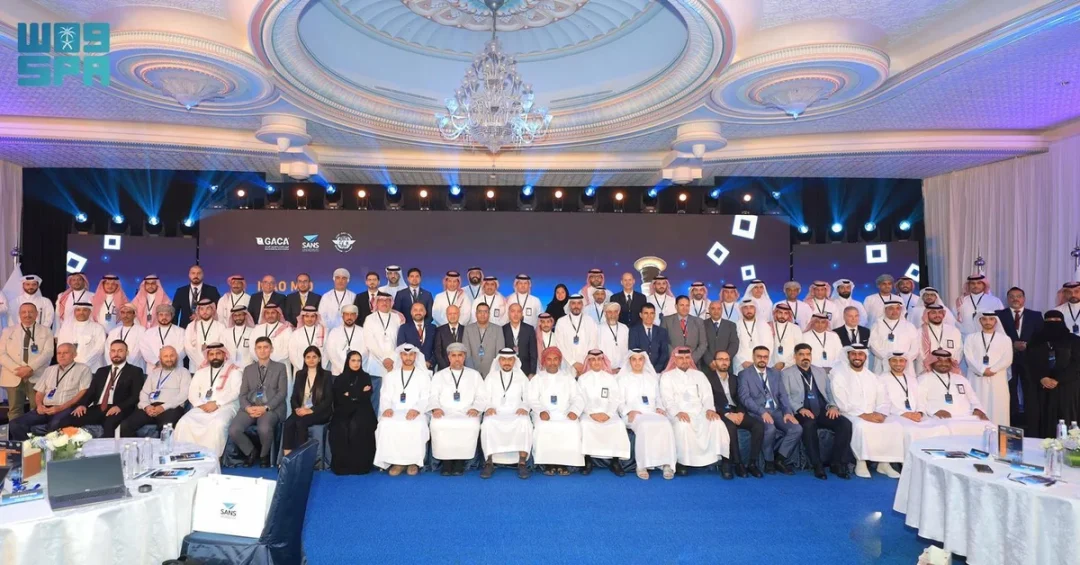
Saudi Air Navigation Services Company (SANS) hosted the 13th meeting of the MIDANPIRG Communication, Navigation and Surveillance Sub-Group (CNS SG/13) and the 10th Meeting of the MIDANPIRG Air Traffic Management Sub-Group in Jeddah, marking the first time the Kingdom of Saudi Arabia has welcomed these ICAO Middle East regional meetings. The landmark event, held under the supervision of the General Authority of Civil Aviation (GACA), brought together more than 80 participants from 18 countries, alongside representatives from the International Air Transport Association (IATA), the International Civil Aviation Organization (ICAO), and PCCW Global. The meetings underscore Saudi Arabia’s growing leadership in regional aviation governance and its commitment to advancing air navigation standards across the Middle East.
The gathering also included a meeting of the working group on Flight and Flow Information for a Collaborative Environment (FF-ICE), convened under the umbrella of the Secretariat General of the Gulf Cooperation Council. This session focused on practical solutions and effective strategies to achieve common regional goals in air traffic management. The timing of the event was particularly significant, falling just ahead of the International Day of the Air Traffic Controller, observed annually on October 20 to recognize the critical role these professionals play in ensuring safe and efficient air navigation worldwide.
Context and Background
Why does the location of a technical aviation meeting matter so much in the broader story of regional cooperation? The answer lies in the symbolic and practical weight of Saudi Arabia serving as host for the first time. The MIDANPIRG — the Middle East Air Navigation Planning and Implementation Regional Group — operates under the framework of the International Civil Aviation Organization, the United Nations specialized agency responsible for setting global aviation standards. Its sub-groups on communication, navigation, surveillance, and air traffic management are essential forums where experts from across the region negotiate technical protocols, share best practices, and align their systems to ensure seamless and safe air travel.
For years, these meetings rotated among various Middle Eastern states. Saudi Arabia’s successful bid to host them reflects the Kingdom’s expanding influence in global aviation affairs and its recognition by international bodies as a capable and reliable partner. The General Authority of Civil Aviation, Saudi Arabia’s civil aviation regulator, has worked diligently to modernize the sector in line with Vision 2030, the national transformation blueprint launched by Crown Prince Mohammed bin Salman. Hosting the CNS SG/13 and ATM Sub-Group meetings represents a tangible milestone in that modernization journey, signaling that Saudi Arabia is not merely participating in global aviation discussions but actively shaping them.
The presence of over 80 delegates from 18 countries, representing diverse aviation authorities and industry stakeholders, highlights the collaborative spirit that defines modern air navigation. In an era when airspace is increasingly congested and technological demands are rapidly evolving, such gatherings are indispensable for maintaining the safety and efficiency of the region’s aviation network. The participation of IATA, which represents the global airline industry, and PCCW Global, a leading communications technology provider, further underscores the multi-stakeholder nature of contemporary aviation governance.
Key Details and Meeting Outcomes
What exactly was discussed during these high-level technical sessions? According to information released via official Saudi channels, the CNS Sub-Group focused on advancing communication, navigation, and surveillance systems that are foundational to modern air traffic management. These systems include radar, satellite-based navigation, and digital communication networks that allow controllers to track and guide aircraft with precision. The ATM Sub-Group, meanwhile, addressed air traffic management strategies, including route optimization, capacity enhancement, and the integration of new technologies to handle growing air traffic volumes across the Middle East.
The FF-ICE working group meeting, held under the GCC Secretariat General’s umbrella, examined the practical implementation of flight and flow information sharing for a collaborative environment. FF-ICE is an ICAO concept designed to enable more efficient air traffic flow management by allowing stakeholders — airlines, air navigation service providers, and airports — to share real-time information about flight intentions and constraints. This collaborative approach is expected to reduce delays, optimize fuel consumption, and enhance overall operational efficiency, benefiting both carriers and passengers across the region.
SANS, as the host organization, demonstrated its technical expertise and organizational capacity by facilitating these complex discussions. The company, which manages Saudi Arabia’s air navigation infrastructure, has invested heavily in state-of-the-art technologies and workforce development. Its ability to convene and lead such a diverse group of international experts reflects the Kingdom’s broader ambition to be a hub for aviation excellence. The event also provided a platform for Saudi professionals to exchange knowledge with counterparts from other nations, fostering relationships that will pay dividends in future collaborations.
International and Regional Impact
How will these meetings influence aviation beyond Saudi Arabia’s borders? The outcomes of the CNS and ATM sub-group discussions are expected to inform ICAO’s regional plans for the Middle East, which in turn guide national aviation authorities in their infrastructure investments and regulatory frameworks. When 18 countries agree on technical standards and operational procedures, the result is a more harmonized airspace where aircraft can move more freely and safely across borders. This is particularly important for the Middle East, a region that serves as a vital crossroads for long-haul international flights connecting Europe, Asia, Africa, and the Americas.
The participation of IATA and PCCW Global adds another layer of significance. IATA’s involvement ensures that airline operational perspectives are integrated into technical decisions, while PCCW Global’s expertise in communications infrastructure highlights the growing intersection between aviation and digital technology. Together, these stakeholders help bridge the gap between regulatory frameworks and real-world implementation. For Saudi Arabia, hosting such a diverse group reinforces its position as a convening power in the region — a nation capable of bringing together competing interests and fostering consensus around shared goals.
Regionally, the meetings contribute to the broader objectives of the Gulf Cooperation Council, which seeks to deepen integration among its member states. The FF-ICE working group, held under the GCC umbrella, is a concrete example of how regional cooperation can advance technical harmonization. By aligning their air traffic management systems, GCC countries can create a more seamless travel experience for passengers and more efficient operations for airlines, ultimately boosting the region’s competitiveness as a global aviation hub.
Economic and Strategic Significance
Why should the global business community pay attention to a technical aviation meeting in Jeddah? The answer lies in the direct link between air navigation efficiency and economic growth. Aviation is a critical enabler of trade, tourism, and investment. Saudi Arabia’s Vision 2030 aims to diversify the economy away from oil dependence, and a robust aviation sector is central to that goal. The Kingdom has set ambitious targets to increase passenger traffic, expand airport capacity, and attract millions of international visitors. Efficient air traffic management is not just a technical nicety — it is a prerequisite for achieving these economic objectives.
By hosting and leading these ICAO meetings, SANS and GACA are signaling to global investors and partners that Saudi Arabia is serious about building world-class aviation infrastructure. The discussions on communication, navigation, and surveillance directly support the modernization of Saudi airspace, which in turn enables airlines to operate more routes, reduce fuel costs, and improve on-time performance. For a country positioning itself as a tourism and logistics hub, these improvements translate into tangible economic benefits, from increased visitor spending to expanded cargo operations.
Moreover, the event showcased Saudi Arabia’s human capital. The presence of over 700 Saudi air traffic controllers at the International Day of the Air Traffic Controller commemoration, held alongside the meetings, highlights the Kingdom’s investment in its workforce. These professionals are the backbone of safe air travel, and their skills are increasingly recognized on the international stage. By celebrating their contributions and facilitating their engagement with global experts, SANS is nurturing a cadre of aviation leaders who will drive the sector forward for years to come.
Vision 2030 Alignment
How does hosting an ICAO regional meeting connect to the sweeping ambitions of Vision 2030? At its core, Vision 2030 is about transforming Saudi Arabia into a global leader — not just in energy, but in tourism, logistics, technology, and international cooperation. Aviation sits at the intersection of all these sectors. The Kingdom’s National Aviation Strategy, launched in 2023, aims to triple passenger traffic by 2030, connect Saudi Arabia to 250 international destinations, and increase air cargo capacity to 4.5 million tons annually. Achieving these targets requires not only new airports and airlines but also a sophisticated air navigation system that meets the highest global standards.
Hosting the MIDANPIRG sub-group meetings for the first time demonstrates Saudi Arabia’s proactive approach to regional and global engagement. It shows that the Kingdom is not waiting for others to set the agenda but is instead stepping forward to lead. This aligns with the Vision 2030 goal of strengthening Saudi Arabia’s position as a pivotal player in international affairs. The event also reinforces the Kingdom’s commitment to sustainable development, as modern air traffic management systems reduce fuel burn and emissions — a key consideration for the global aviation industry’s net-zero ambitions.
As the meetings concluded, the message was clear: Saudi Arabia is open for business, open for collaboration, and open to the world. The Kingdom’s aviation sector is on an upward trajectory, powered by strategic investments, visionary leadership, and a talented workforce. By hosting these ICAO meetings and commemorating the International Day of the Air Traffic Controller with over 700 Saudi professionals, SANS and GACA have demonstrated that Saudi Arabia is ready to shape the future of air navigation in the Middle East and beyond. The event was not just a logistical success; it was a statement of intent — a declaration that the Kingdom intends to be a global aviation leader in the decades ahead.
20 Questions
Q1. What did Saudi Air Navigation Services Company host for the first time?
A1. SANS hosted the 13th meeting of the MIDANPIRG Communication, Navigation and Surveillance Sub-Group (CNS SG/13) and the 10th Meeting of the MIDANPIRG Air Traffic Management Sub-Group for the first time in Saudi Arabia.
Q2. Under whose supervision were these meetings held?
A2. The meetings were held under the supervision of the General Authority of Civil Aviation (GACA), Saudi Arabia’s civil aviation regulator responsible for overseeing the Kingdom’s aviation sector and its modernization.
Q3. How many participants attended the meetings?
A3. More than 80 participants from 18 countries attended the event, along with representatives from the International Air Transport Association (IATA), the International Civil Aviation Organization (ICAO), and PCCW Global.
Q4. Where were the meetings held?
A4. The meetings were held in Jeddah, Saudi Arabia, marking the first time the Kingdom hosted these ICAO Middle East regional meetings for communication, navigation, surveillance, and air traffic management.
Q5. What is MIDANPIRG?
A5. MIDANPIRG stands for the Middle East Air Navigation Planning and Implementation Regional Group, operating under ICAO to coordinate air navigation planning and implementation among Middle Eastern states.
Q6. What does CNS stand for in the context of these meetings?
A6. CNS stands for Communication, Navigation, and Surveillance, which are foundational systems in air traffic management that enable controllers to track and guide aircraft safely and efficiently.
Q7. What was the focus of the FF-ICE working group meeting?
A7. The FF-ICE working group, held under the GCC Secretariat General’s umbrella, discussed practical solutions and effective strategies for Flight and Flow Information for a Collaborative Environment to achieve common regional goals.
Q8. What is FF-ICE?
A8. FF-ICE is an ICAO concept designed to enable more efficient air traffic flow management by allowing stakeholders to share real-time information about flight intentions and constraints, reducing delays and optimizing fuel use.
Q9. Which organizations participated in the meetings?
A9. Participants included representatives from IATA, ICAO, PCCW Global, and over 80 delegates from 18 countries, reflecting broad international and regional engagement in the discussions.
Q10. What is the significance of Saudi Arabia hosting these meetings?
A10. Hosting these meetings underscores SANS’s role in fostering effective participation and adopting innovative solutions to improve air traffic management in the Middle East, and reflects Saudi Arabia’s growing leadership in regional aviation.
Q11. When is the International Day of the Air Traffic Controller observed?
A11. The International Day of the Air Traffic Controller is observed annually on October 20 to celebrate air traffic controllers for their critical role in ensuring safe air navigation worldwide.
Q12. How did SANS commemorate the International Day of the Air Traffic Controller?
A12. SANS commemorated the day with representatives from international and regional civil aviation organizations and over 700 Saudi air traffic controllers, recognizing their contributions to aviation safety.
Q13. What is the role of the General Authority of Civil Aviation (GACA)?
A13. GACA is Saudi Arabia’s civil aviation regulator responsible for overseeing the Kingdom’s aviation sector, ensuring safety, and driving modernization in line with Vision 2030 objectives.
Q14. What is the Gulf Cooperation Council’s role in the FF-ICE meeting?
A14. The Secretariat General of the Gulf Cooperation Council hosted the FF-ICE working group meeting, facilitating regional cooperation on flight and flow information sharing among GCC member states.
Q15. What are the expected benefits of the meetings for regional aviation?
A15. The meetings are expected to harmonize air traffic management standards across the Middle East, leading to safer, more efficient airspace, reduced delays, and improved operational efficiency for airlines.
Q16. How does hosting these meetings align with Saudi Vision 2030?
A16. Hosting these meetings aligns with Vision 2030 by strengthening Saudi Arabia’s global leadership, advancing aviation infrastructure, and supporting economic diversification through tourism and logistics growth.
Q17. What is the National Aviation Strategy of Saudi Arabia?
A17. The National Aviation Strategy, launched in 2023, aims to triple passenger traffic by 2030, connect Saudi Arabia to 250 international destinations, and increase air cargo capacity to 4.5 million tons annually.
Q18. How many Saudi air traffic controllers participated in the commemoration?
A18. Over 700 Saudi air traffic controllers participated in the commemoration of the International Day of the Air Traffic Controller, held alongside the ICAO meetings in Jeddah.
Q19. What is the role of SANS in Saudi Arabia’s aviation sector?
A19. SANS, the Saudi Air Navigation Services Company, manages Saudi Arabia’s air navigation infrastructure, invests in state-of-the-art technologies, and develops the workforce needed for safe and efficient air traffic management.
Q20. What does the future hold for Saudi Arabia’s aviation sector?
A20. Saudi Arabia’s aviation sector is on an upward trajectory, powered by strategic investments, visionary leadership, and a talented workforce, positioning the Kingdom as a global aviation leader in the decades ahead.
Reader Feedback
We value your thoughts. Please share your feedback on this article.
Your feedback helps us improve our coverage.
Related articles
 Saudi Vice Foreign Minister Meets Sudanese Ambassador
 ARCO Joins MENA Meeting to Prepare for Red Crescent Statutory Meetings
 Saudi Defense Minister Arrives in Rome for Official Visit
 King Abdullah II Departs Riyadh After High-Level Visit
 HRH the Crown Prince Receives King of Jordan
 OIC Warns UN of Israeli Threat to UNRWA, Urges Pressure