


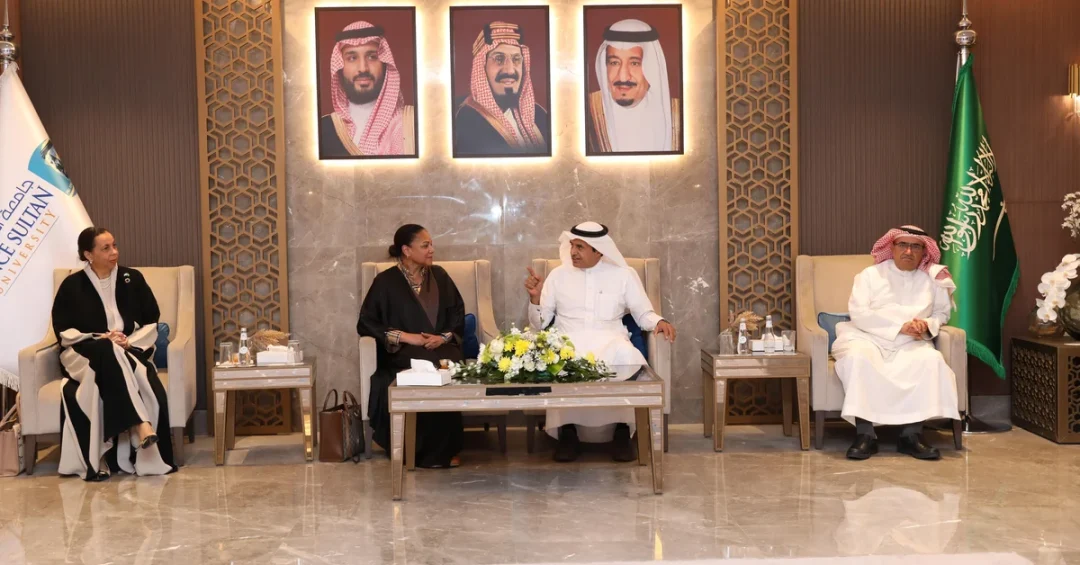
Prince Sultan University (PSU) and the United Nations Development Programme (UNDP) have signed a multiphase project agreement to establish a specialized Saudi think tank dedicated to public diplomacy, according to an official announcement released via the Saudi Press Agency (SPA). The agreement was formalized at the university’s headquarters in Riyadh in the presence of Ahmed bin Saleh Al-Yamani, President of Prince Sultan University, and Nahid Hussein, UNDP Resident Representative for the Kingdom of Saudi Arabia. The initiative represents a significant step in the Kingdom’s efforts to develop a uniquely Saudi approach to public diplomacy, one grounded in academic rigor, international collaboration, and the strategic objectives of Saudi Vision 2030.
The project aims to create a center of excellence and leadership in creative and innovative thinking within the Kingdom, building local capabilities in public diplomacy and fostering positive engagement with foreign communities. The think tank is expected to serve as a platform for analyzing global experiences, developing specialized partnerships, and supporting the ongoing efforts of national public diplomacy institutions. This development comes at a time when public diplomacy is gaining increasing importance in building partnerships with foreign communities and helping countries achieve their international aspirations in alignment with their values and principles. Could this new think tank become a model for how nations approach global engagement in the twenty-first century?
Context and Background
Public diplomacy has evolved significantly over the past two decades, moving beyond traditional government-to-government communication to encompass a broader range of actors, including academic institutions, cultural organizations, and private sector entities. For Saudi Arabia, this evolution aligns closely with the Kingdom’s broader transformation under Vision 2030, which seeks to diversify the economy, strengthen international partnerships, and project a forward-looking national image. The establishment of a dedicated think tank on public diplomacy reflects a strategic recognition that soft power and intellectual engagement are essential components of modern statecraft. The partnership between Prince Sultan University and the UNDP brings together academic expertise and international development experience, creating a foundation for research and innovation that could inform Saudi Arabia’s public diplomacy strategies for years to come.
The agreement is described as multiphase, with the initial phase focusing on conducting studies to establish the center and support the university’s strategy in public diplomacy by creating an innovative national academic environment. This phase also includes providing a platform to discuss key developments and trends in the field, thereby supporting the ongoing positive efforts of national public diplomacy institutions. By leveraging the UNDP’s extensive international expertise, Prince Sultan University aims to collaborate with experts and practitioners in public diplomacy to analyze global experiences and build specialized partnerships. The think tank is expected to establish internal and regional partnerships with other think tanks and institutions specializing in public diplomacy, contributing to a more coordinated and effective approach to international engagement. How might this collaboration reshape the way Saudi Arabia communicates with the world?
The timing of this initiative is notable, as Saudi Arabia continues to expand its global footprint through initiatives such as the Saudi Green Initiative, the Middle East Green Initiative, and various cultural and sporting events that attract international attention. These efforts are complemented by the Kingdom’s growing role in multilateral forums and its increasing engagement with international organizations. A specialized think tank focused on public diplomacy would provide a dedicated intellectual hub for analyzing these activities, identifying best practices, and developing innovative approaches that resonate with diverse international audiences. The partnership with UNDP also signals Saudi Arabia’s commitment to working within established international frameworks and benefiting from global expertise while maintaining a distinctly Saudi identity and approach.
Key Details of the Agreement
The agreement was signed at Prince Sultan University’s headquarters in Riyadh, with the presence of President Ahmed bin Saleh Al-Yamani and UNDP Resident Representative Nahid Hussein underscoring the high-level commitment to the project. The multiphase nature of the agreement suggests a structured, long-term approach to building the think tank, beginning with foundational studies and gradually expanding into research, partnerships, and thought leadership. The initial phase is designed to support the university’s strategy in public diplomacy by creating an innovative national academic environment, which could include new curricula, research programs, and opportunities for students and faculty to engage in public diplomacy scholarship. This academic dimension is crucial, as it ensures that the think tank is not merely a policy shop but also a training ground for the next generation of Saudi public diplomacy practitioners.
The think tank seeks to establish internal and regional partnerships with other think tanks and institutions specializing in public diplomacy. These partnerships could facilitate the exchange of ideas, joint research projects, and collaborative events that enhance the Kingdom’s understanding of global public opinion and effective communication strategies. By aligning with Saudi Vision 2030, the initiative supports the broader goal of fostering positive engagement with foreign communities and promoting mutual understanding. The center’s focus on becoming a center of excellence and leadership in creative and innovative thinking within the Kingdom highlights the ambition to not only catch up with global best practices but to set new standards in the field. What role will Saudi scholars and researchers play in shaping this emerging field?
Public diplomacy is gaining increasing importance in building partnerships with foreign communities, helping countries achieve their international aspirations in alignment with their values and principles. For Saudi Arabia, this means communicating the Kingdom’s cultural heritage, economic opportunities, and reform agenda to international audiences in a way that is authentic, engaging, and effective. The think tank will likely address a range of topics, including digital diplomacy, cultural exchange, educational partnerships, and strategic communication. The collaboration with UNDP provides access to a global network of experts and practitioners, enabling the think tank to analyze global experiences and adapt them to the Saudi context. This blend of local insight and international expertise is a hallmark of Vision 2030 initiatives, which often seek to localize global best practices while preserving Saudi identity and values.
International and Regional Impact
The establishment of a Saudi think tank on public diplomacy could have significant implications for the Kingdom’s relationships with countries around the world. By investing in research and innovation in this field, Saudi Arabia signals its intention to engage with the international community in a more sophisticated and strategic manner. This could enhance the effectiveness of Saudi cultural, educational, and economic outreach, leading to stronger people-to-people ties and a more nuanced understanding of the Kingdom abroad. In a region where public diplomacy is increasingly recognized as a vital tool for stability and cooperation, Saudi Arabia’s initiative could serve as a model for other nations seeking to modernize their international engagement strategies. The think tank’s regional partnerships may also foster greater collaboration among Middle Eastern institutions, contributing to a more integrated approach to public diplomacy in the Arab world.
At the international level, the partnership with UNDP underscores Saudi Arabia’s commitment to multilateralism and its willingness to work with established global organizations to achieve shared goals. The UNDP’s involvement brings credibility, technical expertise, and a global perspective that can help the think tank navigate complex international environments. This collaboration also aligns with the United Nations’ Sustainable Development Goals, particularly those related to partnerships, education, and peaceful societies. By working together, PSU and UNDP are demonstrating how academic institutions and international organizations can join forces to address contemporary challenges and promote mutual understanding. How will this partnership influence Saudi Arabia’s standing in global forums and its ability to shape international narratives?
Economic and Strategic Significance
While public diplomacy is often associated with soft power and cultural influence, it also has direct economic and strategic benefits. A well-crafted public diplomacy strategy can attract foreign investment, boost tourism, and create opportunities for Saudi businesses to expand internationally. By enhancing the Kingdom’s image and building trust with foreign communities, the think tank’s work could indirectly support economic diversification efforts under Vision 2030. Moreover, the think tank itself represents an investment in human capital, developing a cadre of skilled professionals who can contribute to various sectors, including government, media, academia, and the private sector. The research and insights generated by the center could inform policies that make Saudi Arabia a more attractive destination for talent, investment, and partnership.
Strategically, the think tank will help Saudi Arabia better understand global perceptions and trends, enabling more effective communication and engagement. In an era of rapid information flows and shifting geopolitical dynamics, the ability to analyze and respond to international public opinion is a critical asset. The center’s focus on creative and innovative thinking suggests it will explore new methods and technologies for public diplomacy, potentially including digital platforms, data analytics, and virtual exchange programs. By staying at the forefront of these developments, Saudi Arabia can ensure that its public diplomacy remains relevant and impactful. The partnership with UNDP also provides a platform for sharing Saudi perspectives with the international community, contributing to a more balanced global dialogue. What innovative approaches might emerge from this Saudi-led initiative?
Vision 2030 Alignment
The establishment of a specialized think tank on public diplomacy is closely aligned with the objectives of Saudi Vision 2030, the Kingdom’s comprehensive reform plan launched in 2016. Vision 2030 aims to diversify the economy, strengthen national identity, and enhance Saudi Arabia’s global standing through increased international engagement. Public diplomacy is a key enabler of these goals, as it helps build the international partnerships and positive perceptions necessary for economic and cultural exchange. The think tank will support the Vision’s emphasis on education, innovation, and knowledge transfer by creating an innovative national academic environment and fostering research in emerging fields. This initiative also reflects the Vision’s commitment to empowering Saudi youth and institutions to take a leading role in shaping the Kingdom’s future.
As Saudi Arabia continues to implement Vision 2030, initiatives like this think tank demonstrate the Kingdom’s proactive approach to international relations and its willingness to invest in long-term strategic capabilities. The collaboration with UNDP highlights the importance of international cooperation in achieving national goals, a principle that runs throughout Vision 2030. By building local capabilities in public diplomacy and establishing a center of excellence, Prince Sultan University and its partners are contributing to a more confident, connected, and influential Saudi Arabia. The think tank is poised to become a vital asset for the Kingdom, helping to articulate Saudi Arabia’s story to the world and fostering the mutual understanding that underpins lasting partnerships. In doing so, it will play a part in realizing the Vision’s ultimate aim: a thriving, diversified, and globally engaged nation.
20 Questions
Q1. What is the purpose of the agreement signed between Prince Sultan University and UNDP?
A1. The agreement establishes a multiphase project to create a specialized Saudi think tank focused on public diplomacy, aiming to build local capabilities, foster innovation, and support Saudi Vision 2030 through research and international partnerships.
Q2. Who signed the agreement on behalf of Prince Sultan University and UNDP?
A2. The agreement was signed in the presence of Ahmed bin Saleh Al-Yamani, President of Prince Sultan University, and Nahid Hussein, UNDP Resident Representative for the Kingdom of Saudi Arabia, at the university’s headquarters in Riyadh.
Q3. Where was the agreement signed?
A3. The agreement was signed at Prince Sultan University’s headquarters in Riyadh, Saudi Arabia, according to the official announcement released via the Saudi Press Agency.
Q4. What is the main focus of the new think tank?
A4. The think tank will focus on developing a uniquely Saudi approach to public diplomacy, building local capabilities, and becoming a center of excellence and leadership in creative and innovative thinking within the Kingdom.
Q5. How does the think tank aim to contribute to Saudi Vision 2030?
A5. By fostering positive engagement with foreign communities, establishing regional partnerships, and enhancing research and innovation in public diplomacy, the think tank supports Vision 2030’s goals of global engagement and economic diversification.
Q6. What does the initial phase of the agreement involve?
A6. The initial phase involves conducting studies to establish the center, supporting the university’s public diplomacy strategy, creating an innovative academic environment, and providing a platform to discuss key developments and trends in the field.
Q7. How will the UNDP contribute to the project?
A7. The UNDP will provide extensive international expertise, collaborate with experts and practitioners in public diplomacy, and help analyze global experiences to build specialized partnerships for the think tank.
Q8. What kind of partnerships will the think tank seek to establish?
A8. The think tank will seek internal and regional partnerships with other think tanks and institutions specializing in public diplomacy, contributing to positive engagement with foreign communities.
Q9. Why is public diplomacy gaining importance globally?
A9. Public diplomacy is increasingly important for building partnerships with foreign communities, helping countries achieve international aspirations in alignment with their values and principles, and fostering mutual understanding.
Q10. How will the think tank support Prince Sultan University’s strategy?
A10. It will support the university’s strategy by creating an innovative national academic environment, strengthening research efforts, and fostering innovation in emerging fields related to public diplomacy.
Q11. What is the significance of this agreement for Saudi Arabia’s international engagement?
A11. The agreement enhances Saudi Arabia’s ability to engage with the international community strategically, improving cultural, educational, and economic outreach while building stronger people-to-people ties and a nuanced global understanding of the Kingdom.
Q12. Will the think tank collaborate with other Saudi institutions?
A12. Yes, the think tank aims to establish internal and regional partnerships with think tanks and institutions specializing in public diplomacy, supporting the ongoing positive efforts of national public diplomacy institutions.
Q13. What role will Saudi scholars and researchers play in the think tank?
A13. Saudi scholars and researchers will contribute to developing a uniquely Saudi approach to public diplomacy, conducting studies, analyzing global experiences, and fostering innovation in emerging fields at Prince Sultan University.
Q14. How does the think tank align with Saudi Arabia’s values and principles?
A14. The think tank will help the Kingdom achieve its international aspirations in alignment with its values and principles, promoting authentic and effective communication with foreign communities while preserving Saudi identity.
Q15. What are the expected outcomes of the multiphase project?
A15. Expected outcomes include a fully established think tank, enhanced local capabilities in public diplomacy, strengthened research and innovation, and a platform for discussing key developments and trends in the field.
Q16. How might the think tank influence Saudi Arabia’s global image?
A16. By conducting research and fostering positive engagement, the think tank can help project a forward-looking, culturally rich, and economically dynamic image of Saudi Arabia, enhancing its global standing and attracting partnerships.
Q17. What is the role of UNDP in supporting Saudi Vision 2030 through this project?
A17. UNDP supports Vision 2030 by providing international expertise, facilitating global partnerships, and helping build local capabilities in public diplomacy, contributing to the Kingdom’s sustainable development and global engagement goals.
Q18. How will the think tank address emerging trends in public diplomacy?
A18. The think tank will provide a platform to discuss key developments and trends, analyze global experiences, and foster creative and innovative thinking, ensuring Saudi public diplomacy remains relevant and effective.
Q19. What makes this think tank a center of excellence and leadership?
A19. Its focus on creative and innovative thinking, collaboration with UNDP experts, establishment of regional partnerships, and alignment with Vision 2030 position it as a center of excellence and leadership in public diplomacy within the Kingdom.
Q20. How can the international community benefit from this Saudi think tank?
A20. The international community can benefit from enhanced mutual understanding, stronger partnerships with Saudi institutions, and access to innovative research and perspectives on public diplomacy, fostering more effective global cooperation.
Reader Feedback
We value your thoughts. Please share your feedback on this article.
Your feedback helps us improve our coverage.
Related articles
 KSrelief Distributes 2,500 Shelter Bags in Pakistan
 Saudi FM Meets Ukraine President’s Office Head in Riyadh
 KSrelief Distributes 401 Food Baskets in Chad’s N’Djamena
 Commander of Joint Forces Receives Yemeni Council Member
 Saudi, Italian Defense Ministers Discuss Cooperation in Rome
 SCEGA Highlights Saudi Arabia’s Growing Exhibition and Conference Industry at ICCA Summit