


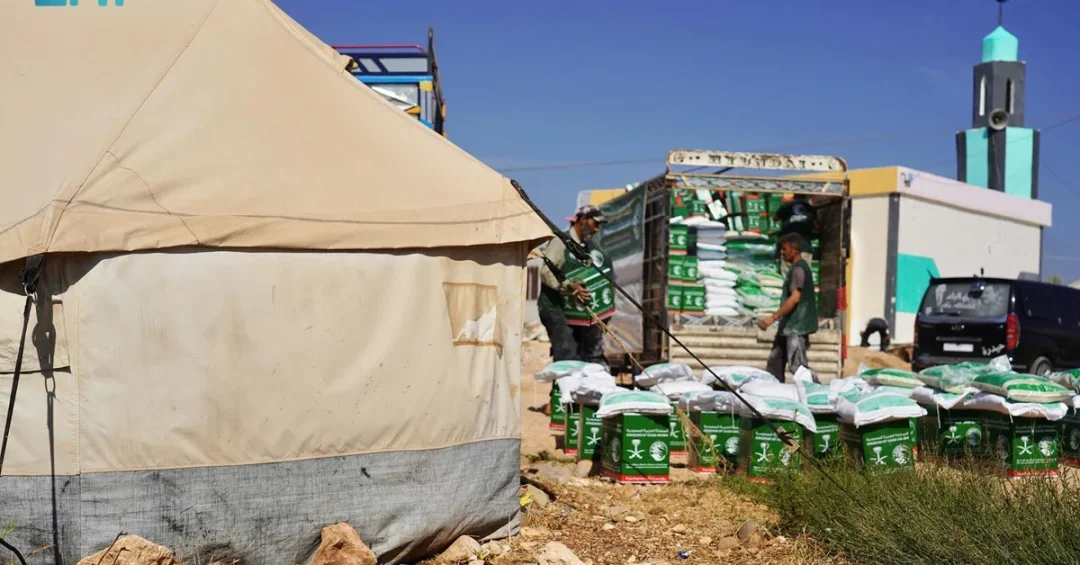
The King Salman Humanitarian Aid and Relief Center (KSrelief) distributed 1,321 food baskets and 1,321 health kits in the Afrin and Aleppo Governorates of Syria on Sunday, benefiting 7,926 individuals affected by the 2024 earthquake in northern Syria. The distribution is part of the second phase of a project aimed at providing essential food aid and health supplies to communities still recovering from the disaster. According to the Saudi Press Agency (SPA), the aid reached families in some of the most severely impacted areas, offering critical relief as the region continues to rebuild.
The operation reflects the Kingdom of Saudi Arabia’s ongoing commitment to humanitarian assistance through its dedicated relief agency, KSrelief. For an international audience, this development underscores Saudi Arabia’s expanding role as a global humanitarian leader, one that responds swiftly and systematically to crises beyond its borders. It also highlights the Kingdom’s adherence to the principles of compassion and solidarity that guide its foreign policy and its Vision 2030 goal of fostering a more stable and prosperous world.
Context and Background
Why does this aid matter so much, and what circumstances led to the need for such relief? In February 2024, a powerful earthquake struck northern Syria and southern Turkey, leaving widespread destruction in its wake. Thousands of families lost their homes, livelihoods, and access to basic services. The Afrin and Aleppo Governorates were among the hardest-hit areas, with many residents still living in temporary shelters or damaged buildings months after the disaster. The earthquake compounded an already dire humanitarian situation, making international assistance essential for survival and recovery.
KSrelief has been at the forefront of Saudi Arabia’s response to this crisis since the earliest days. The Center launched a multi-phase project to deliver food and health aid to earthquake-affected populations in northern Syria, with the first phase focusing on emergency relief and the second phase, currently underway, emphasizing sustained support. The distribution of 1,321 food baskets and 1,321 health kits on Sunday is a direct continuation of that effort. Each food basket typically contains staples such as rice, flour, oil, and canned goods, while the health kits include hygiene supplies, first-aid materials, and basic medicines. Together, they address two of the most urgent needs: nutrition and disease prevention.
The operation was carried out in close coordination with local authorities and humanitarian partners on the ground, ensuring that aid reaches those most in need. The Saudi Press Agency reported that the distribution benefited 7,926 individuals, a figure that reflects the scale of the operation and the number of families still struggling to recover. For many recipients, this assistance represents a lifeline, particularly as winter approaches and temperatures drop in the region. The timing of the aid is critical, as it helps bridge the gap until longer-term reconstruction efforts can take hold.
Key Details of the Distribution
What exactly does this aid package include, and how was it delivered? The 1,321 food baskets and 1,321 health kits were distributed in Afrin and Aleppo Governorates, two areas that suffered extensive damage during the 2024 earthquake. The food baskets are designed to provide a family with enough nutritious staples to last for several weeks, reducing the immediate risk of hunger and malnutrition. The health kits, meanwhile, contain items such as soap, disinfectants, bandages, and over-the-counter medications, which are vital for preventing the spread of disease in crowded or unsanitary living conditions.
The distribution was supervised by KSrelief teams in collaboration with local partners, ensuring transparency and efficiency. According to SPA, the project is now in its second phase, which means it builds on lessons learned from the initial emergency response. The first phase focused on rapid delivery of essential items, while the second phase aims to provide more comprehensive support, including regular distributions and follow-up assessments. This phased approach allows KSrelief to adapt to evolving needs on the ground and to ensure that aid is both timely and effective.
The number of beneficiaries, 7,926 individuals, is a testament to the scale of the operation. It also highlights the ongoing vulnerability of communities in northern Syria, where many families remain displaced and dependent on humanitarian assistance. By targeting both food and health needs, KSrelief is addressing the immediate symptoms of the crisis while also helping to build resilience. The aid is not just about survival; it is about restoring dignity and hope to people who have endured unimaginable loss.
International and Regional Impact
How does this distribution fit into the broader landscape of international humanitarian efforts? Saudi Arabia, through KSrelief, has become one of the world’s leading donors of humanitarian aid, operating in dozens of countries across Asia, Africa, and the Middle East. The Kingdom’s assistance to Syria is part of a wider strategy to promote stability and alleviate suffering in conflict-affected regions. By providing aid directly to those in need, Saudi Arabia demonstrates its commitment to the principles of international solidarity and its willingness to shoulder responsibility for global challenges.
The operation also has significant regional implications. Northern Syria remains a complex environment, with multiple actors and ongoing security concerns. Saudi Arabia’s humanitarian engagement helps to fill critical gaps left by other donors and international agencies, ensuring that aid reaches areas that might otherwise be neglected. This not only saves lives but also contributes to long-term stability by reducing the drivers of extremism and migration. For neighboring countries, including Turkey and Jordan, Saudi aid helps to ease the burden of hosting refugees and supports efforts to create conditions for voluntary return.
From a diplomatic perspective, the distribution reinforces Saudi Arabia’s image as a responsible global power. It aligns with the Kingdom’s Vision 2030 objectives, which include enhancing international cooperation and portraying Saudi Arabia as a force for good in the world. By responding swiftly to the earthquake in Syria, Saudi Arabia has shown that it is not only a regional leader but also a reliable partner in times of crisis. This soft power approach is increasingly central to Saudi foreign policy, complementing its economic and security engagements.
Economic and Strategic Significance
What does this aid effort reveal about Saudi Arabia’s strategic priorities? At its core, the distribution of food and health kits is a humanitarian act, but it also carries strategic weight. Saudi Arabia’s investment in relief operations helps to build goodwill and strengthen relationships with beneficiary communities and their governments. In the case of Syria, this could translate into greater influence in post-conflict reconstruction and political processes. By demonstrating its commitment to the Syrian people, the Kingdom positions itself as a constructive actor in a region where stability is paramount.
Economically, the aid is part of Saudi Arabia’s broader portfolio of development assistance, which is funded through its national budget and managed by KSrelief. While the immediate cost of the distribution is not disclosed, such operations are considered an investment in regional security and human capital. They also align with Vision 2030’s emphasis on social responsibility and global engagement. By supporting communities in need, Saudi Arabia helps to create the conditions for economic recovery and trade, which ultimately benefits the entire region.
Furthermore, the operation showcases the efficiency and professionalism of KSrelief, which has become a model for humanitarian agencies worldwide. Its ability to deliver aid quickly and transparently has earned it recognition from the United Nations and other international bodies. This reputation enhances Saudi Arabia’s standing in multilateral forums and opens doors for further cooperation. For a Kingdom undergoing rapid transformation, such soft power assets are invaluable.
Vision 2030 Alignment
How does this humanitarian effort connect to Saudi Arabia’s long-term vision? Vision 2030, the Kingdom’s ambitious blueprint for economic and social transformation, includes a strong commitment to international humanitarian work. One of its key pillars is to strengthen Saudi Arabia’s role as a global leader and to promote peace and prosperity beyond its borders. KSrelief is a direct expression of this pillar, operating under the guidance of the Saudi leadership to deliver aid to those in need, regardless of nationality or creed.
The distribution in Afrin and Aleppo is a concrete example of Vision 2030 in action. It demonstrates the Kingdom’s belief that humanitarian assistance is not only a moral duty but also a strategic investment in a more stable and interconnected world. As Saudi Arabia continues to diversify its economy and open up to the world, its humanitarian diplomacy will remain a cornerstone of its foreign policy. By helping earthquake victims in Syria, the Kingdom is not only saving lives but also building bridges of trust and friendship that will endure for years to come.
20 Questions
Q1. What did KSrelief distribute in Syria?
A1. KSrelief distributed 1,321 food baskets and 1,321 health kits in the Afrin and Aleppo Governorates of Syria, benefiting 7,926 individuals affected by the 2024 earthquake.
Q2. When did the distribution take place?
A2. The distribution took place on Sunday, as reported by the Saudi Press Agency (SPA) on October 22, 2024.
Q3. Which areas in Syria received the aid?
A3. The aid was distributed in the Afrin and Aleppo Governorates, two regions severely impacted by the 2024 earthquake in northern Syria.
Q4. How many people benefited from the aid?
A4. A total of 7,926 individuals benefited from the food baskets and health kits provided by KSrelief.
Q5. What is KSrelief?
A5. KSrelief is the King Salman Humanitarian Aid and Relief Center, the humanitarian arm of Saudi Arabia that provides relief assistance worldwide.
Q6. What phase is the project in?
A6. The distribution is part of the second phase of a project aimed at providing food aid and health kits to earthquake-affected people in northern Syria.
Q7. What do the food baskets contain?
A7. The food baskets typically include staples such as rice, flour, oil, and canned goods, providing families with enough nutritious food for several weeks.
Q8. What do the health kits include?
A8. The health kits contain hygiene supplies, first-aid materials, and basic medicines to help prevent disease and address minor health issues.
Q9. Why is this aid important now?
A9. The aid is critical as many families remain displaced and vulnerable after the earthquake, and the approaching winter makes access to food and health supplies even more urgent.
Q10. How does this reflect Saudi Arabia’s humanitarian role?
A10. It demonstrates Saudi Arabia’s ongoing commitment to global humanitarian assistance through KSrelief, reinforcing its role as a leading donor and compassionate actor.
Q11. What was the cause of the need for aid?
A11. A powerful earthquake struck northern Syria and southern Turkey in February 2024, causing widespread destruction and leaving thousands of families in need of emergency relief.
Q12. Who coordinated the distribution?
A12. KSrelief coordinated the distribution with local authorities and humanitarian partners on the ground to ensure aid reached those most in need.
Q13. How does this aid align with Vision 2030?
A13. It aligns with Vision 2030’s pillar of enhancing Saudi Arabia’s global role and promoting peace and prosperity through humanitarian diplomacy and international cooperation.
Q14. What is the significance of the second phase?
A14. The second phase focuses on sustained support and comprehensive aid, building on the emergency response of the first phase to address ongoing needs.
Q15. How many food baskets were distributed?
A15. Exactly 1,321 food baskets were distributed to families in Afrin and Aleppo.
Q16. How many health kits were distributed?
A16. Exactly 1,321 health kits were distributed alongside the food baskets.
Q17. What is the source of this information?
A17. The information was released by the Saudi Press Agency (SPA), the official news agency of Saudi Arabia.
Q18. What impact does this aid have on regional stability?
A18. By addressing urgent needs and reducing suffering, the aid contributes to stability in northern Syria and supports broader regional efforts to prevent extremism and migration.
Q19. Does KSrelief operate in other countries?
A19. Yes, KSrelief operates in dozens of countries worldwide, providing humanitarian aid in Asia, Africa, and the Middle East, among other regions.
Q20. What is the ultimate goal of this distribution?
A20. The ultimate goal is to alleviate the suffering of earthquake-affected Syrians, restore dignity, and support their recovery, reflecting Saudi Arabia’s humanitarian values and global leadership.
Reader Feedback
We value your thoughts. Please share your feedback on this article.
Your feedback helps us improve our coverage.
Related articles
 Saudi Arabia to Host Donor Conference for Sahel, Lake Chad Refugees
 GCCIA to Host International Forum on Carbon Neutrality
 PSU, UNDP Sign Project to Establish Saudi Think Tank on Public Diplomacy
 KSrelief Distributes 2,500 Shelter Bags in Pakistan
 Saudi FM Meets Ukraine President’s Office Head in Riyadh
 KSrelief Distributes 401 Food Baskets in Chad’s N’Djamena