


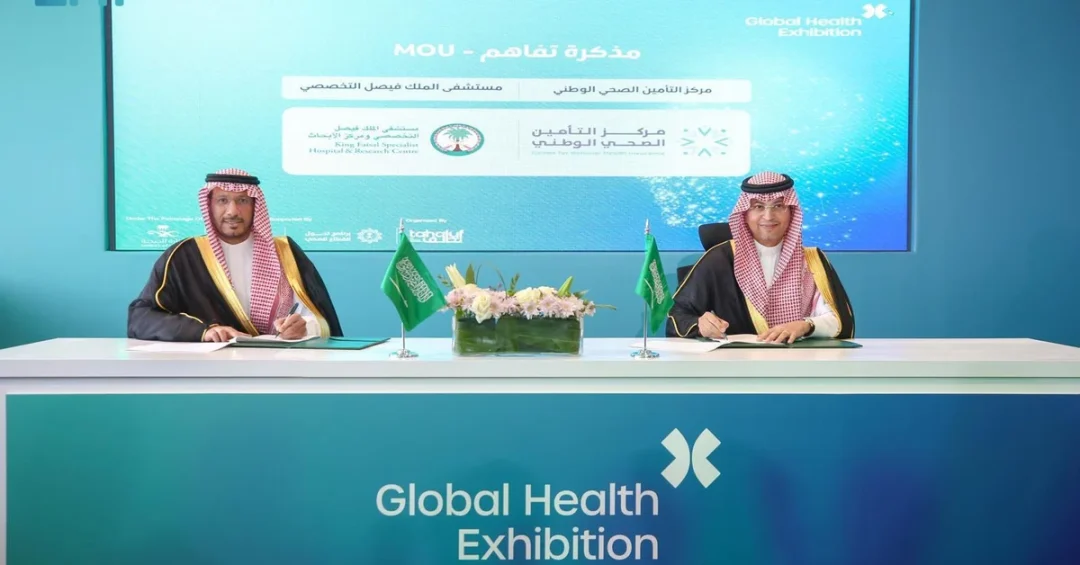
King Faisal Specialist Hospital & Research Centre (KFSHRC) signed three strategic memoranda of understanding (MoUs) with King Abdulaziz City for Science and Technology (KACST), the Centre for National Health Insurance (CNHI), and the Saudi Patient Safety Center (SPSC) on the sidelines of the second day of the Global Health Exhibition in Riyadh. The agreements, announced via the Saudi Press Agency, establish a formal framework for cooperation in biomedical research, technology localization, patient safety, and healthcare coordination, reinforcing the Kingdom’s commitment to elevating its health sector to international standards. The MoUs were signed by KFSHRC Chief Executive Officer Dr. Majid Alfayyadh, KACST President Dr. Munir bin Mahmoud Eldesouki, and CNHI Chief Executive Officer Yasser Al-Qhaidan.
Could this tripartite collaboration mark a turning point in how Saudi Arabia integrates cutting-edge science with patient-centered care? The agreements arrive at a time when the Kingdom is rapidly transforming its healthcare infrastructure under Vision 2030, seeking not only to meet domestic needs but also to position itself as a global hub for medical innovation. By aligning research institutions, insurance frameworks, and patient safety mechanisms, the MoUs represent a holistic approach to healthcare development that could serve as a model for other nations in the region.
Context and Background
Why has Saudi Arabia chosen this moment to deepen institutional ties across its healthcare ecosystem? The Global Health Exhibition, held in Riyadh, has become a premier platform for showcasing the Kingdom’s ambitious health transformation agenda. It brings together policymakers, industry leaders, and international experts to explore solutions for some of the most pressing challenges in modern medicine. Against this backdrop, KFSHRC’s agreements signal a deliberate move to operationalize the strategic objectives outlined in the Health Sector Transformation Program, a key pillar of Vision 2030.
King Faisal Specialist Hospital & Research Centre has long been a flagship institution in Saudi Arabia’s medical landscape, renowned for its specialized care and research output. King Abdulaziz City for Science and Technology, meanwhile, serves as the Kingdom’s national laboratory for advanced research and development, with a growing focus on biotechnology and digital health. The Centre for National Health Insurance is tasked with designing and implementing a sustainable insurance model that ensures quality care for all citizens, while the Saudi Patient Safety Center leads national efforts to reduce medical errors and promote a culture of safety. Each entity brings a distinct but complementary capability to the table.
The timing of these MoUs is significant. Saudi Arabia is investing heavily in biotechnology, artificial intelligence, and precision medicine as part of its broader economic diversification strategy. The National Biotechnology Strategy, launched in 2023, aims to position the Kingdom as a regional leader in biomanufacturing and vaccine production. By formalizing partnerships between research, insurance, and safety organizations, KFSHRC is helping to create an integrated ecosystem where scientific breakthroughs can be rapidly translated into clinical practice and policy.
Key Details of the Agreements
What specific areas will these partnerships target, and how will they translate into tangible benefits for patients? The MoU with KACST focuses on strengthening collaboration in biomedical research to address national health priorities. It emphasizes the development of vaccines, biomanufacturing capabilities, preventive medicine, and gene therapies. The partnership also aims to promote innovation in digital health and artificial intelligence, aligning with national research, development, and innovation priorities. This collaboration is expected to accelerate the translation of laboratory discoveries into clinical applications, particularly in areas where Saudi Arabia seeks self-sufficiency, such as vaccine production.
The MoU with the Saudi Patient Safety Center encompasses a wide range of cooperative activities. It includes the exchange of scientific and practical expertise to promote a culture of patient empowerment, making patients active partners in decisions related to their health. Drug safety is another key focus, alongside knowledge exchange and training in the use of AI to enhance patient safety. The two organizations will also organize specialized seminars and conferences to disseminate best practices. This agreement reflects a growing recognition that patient safety is not merely a clinical issue but a systemic one that requires continuous education, technological innovation, and patient engagement.
The third MoU, signed with the Centre for National Health Insurance, stipulates enhancing coordination and integration between the two parties. It includes the development of a future contractual relationship that meets the needs of both sides and contributes to improving healthcare performance and delivering high-quality services to patients. This agreement is particularly important as Saudi Arabia moves toward a more unified and efficient health insurance system. By aligning KFSHRC’s service delivery with CNHI’s insurance frameworks, the partnership aims to reduce administrative friction, optimize resource allocation, and ensure that patients receive seamless care across providers.
International and Regional Impact
How might these agreements influence Saudi Arabia’s standing in the global healthcare community? The Kingdom has increasingly positioned itself as a leader in health innovation, hosting major international conferences and attracting top-tier talent and investment. The KFSHRC-KACST collaboration on vaccines and biomanufacturing, for instance, could contribute to regional health security by reducing dependence on imported pharmaceuticals. In a post-pandemic world, the ability to produce vaccines and biologics domestically is a strategic asset, and Saudi Arabia’s investments in this area are being closely watched by neighboring countries and global partners alike.
Moreover, the emphasis on AI in patient safety and digital health aligns with a worldwide trend toward data-driven medicine. By integrating AI tools into patient safety protocols, Saudi Arabia could set benchmarks for other nations seeking to harness technology for better health outcomes. The partnerships also create opportunities for international collaboration, as KFSHRC and its partners are likely to engage with global research institutions, technology companies, and regulatory bodies. This openness to cooperation enhances the Kingdom’s reputation as a forward-looking and reliable partner in global health.
Economic and Strategic Significance
What does this mean for Saudi Arabia’s economy beyond the health sector? The MoUs support the broader goals of economic diversification by fostering a knowledge-based economy. Biomedical research and biomanufacturing are high-value industries that create skilled jobs, attract foreign investment, and generate intellectual property. By localizing technology and building domestic capabilities, Saudi Arabia reduces its reliance on oil revenues and strengthens its resilience against global supply chain disruptions. The partnership with CNHI also has economic implications, as a more efficient insurance system can lower overall healthcare costs while improving outcomes.
Strategically, these agreements reinforce the Kingdom’s sovereignty in health matters. The COVID-19 pandemic exposed vulnerabilities in global supply chains for medical products, prompting many nations to rethink their dependence on external sources. Saudi Arabia’s proactive approach—investing in local vaccine production, gene therapies, and AI-driven safety—demonstrates a commitment to self-reliance and regional leadership. This aligns with the Vision 2030 objective of building a robust and diversified economy that can withstand future shocks.
Vision 2030 Alignment
How do these MoUs fit into the grand vision of a transformed Saudi Arabia? Vision 2030 envisions a vibrant society, a thriving economy, and an ambitious nation. Health is a cornerstone of all three. The Health Sector Transformation Program aims to improve access, quality, and efficiency of healthcare services. By linking research, insurance, and patient safety, KFSHRC’s agreements directly support these goals. They also contribute to the National Biotechnology Strategy and the National Industrial Development and Logistics Program, which seek to localize advanced industries and create sustainable jobs.
Ultimately, the success of these partnerships will be measured by their impact on patients and society. If they lead to new vaccines, safer treatments, and more responsive insurance systems, they will have fulfilled their promise. As Saudi Arabia continues its journey toward a healthier and more prosperous future, collaborations like these demonstrate the power of collective action. With strong leadership, clear strategic direction, and a commitment to innovation, the Kingdom is well on its way to becoming a global model for healthcare excellence.
20 Questions
Q1. What is the main purpose of the three MoUs signed by KFSHRC?
A1. The MoUs aim to develop cooperation in research, technology localization, patient safety, and enhance coordination and integration to improve healthcare quality in Saudi Arabia.
Q2. Which organizations signed the MoUs with KFSHRC?
A2. King Abdulaziz City for Science and Technology (KACST), the Centre for National Health Insurance (CNHI), and the Saudi Patient Safety Center (SPSC).
Q3. Where and when were the MoUs signed?
A3. They were signed on the sidelines of the second day of the Global Health Exhibition in Riyadh on October 22, 2024.
Q4. Who signed the MoUs on behalf of KFSHRC?
A4. Dr. Majid Alfayyadh, Chief Executive Officer of KFSHRC, signed the agreements.
Q5. What are the key areas of collaboration between KFSHRC and KACST?
A5. The collaboration focuses on biomedical research, vaccines, biomanufacturing, preventive medicine, gene therapies, digital health, and artificial intelligence.
Q6. How does the MoU with SPSC aim to improve patient safety?
A6. It includes exchanging expertise, promoting patient empowerment, drug safety, AI training, and organizing seminars and conferences.
Q7. What does the MoU with CNHI stipulate?
A7. It enhances coordination and integration, including developing a future contractual relationship to improve healthcare performance and service quality.
Q8. Why is the partnership with KACST important for Saudi Arabia?
A8. It supports national priorities in research, development, and innovation, and aligns with the National Biotechnology Strategy for self-sufficiency.
Q9. How does patient empowerment feature in the SPSC agreement?
A9. The agreement promotes a culture where patients are partners in decisions related to their health, enhancing engagement and safety.
Q10. What role does AI play in these agreements?
A10. AI is emphasized in digital health and patient safety, with training and knowledge exchange to leverage AI for better outcomes.
Q11. How will the CNHI partnership benefit patients?
A11. It aims to streamline insurance processes, improve healthcare performance, and ensure high-quality services for patients.
Q12. What is the significance of the Global Health Exhibition?
A12. It is a premier platform for showcasing Saudi Arabia’s health transformation agenda and fostering collaborations among stakeholders.
Q13. How do these MoUs align with Vision 2030?
A13. They support the Health Sector Transformation Program, economic diversification, and the National Biotechnology Strategy.
Q14. What economic benefits might arise from these partnerships?
A14. They can create skilled jobs, attract investment, generate intellectual property, and reduce reliance on imported pharmaceuticals.
Q15. How does biomedical research address national issues?
A15. It focuses on vaccines, biomanufacturing, preventive medicine, and gene therapies to tackle health challenges specific to the Kingdom.
Q16. What is the expected impact on regional health security?
A16. By localizing vaccine production, Saudi Arabia can contribute to regional health security and reduce dependence on imports.
Q17. How will the SPSC partnership enhance drug safety?
A17. Through exchange of scientific expertise, training, and AI tools to monitor and improve drug safety protocols.
Q18. What does technology localization mean in this context?
A18. It refers to developing and adapting advanced technologies domestically to meet local needs and build national capabilities.
Q19. How might these agreements influence international collaboration?
A19. They open doors for partnerships with global research institutions and tech companies, enhancing Saudi Arabia’s reputation.
Q20. What is the ultimate goal of these MoUs?
A20. To improve healthcare quality, safety, and innovation in Saudi Arabia, aligning with Vision 2030 for a healthier society.
Reader Feedback
We value your thoughts. Please share your feedback on this article.
Your feedback helps us improve our coverage.