


Saudi Arabia’s foreign direct investment (FDI) inflow reached SAR96 billion ($25.5 billion) in 2023, exceeding the National Investment Strategy (NIS) target of SAR83 billion ($22 billion) by 16%, according to official statistics released by the Saudi Press Agency (SPA) on October 23, 2024. The data, based on the International Monetary Fund’s Balance of Payments Manual (BPM6) methodology, confirms the Kingdom’s growing appeal as a global investment destination and underscores the success of Vision 2030 economic reforms. The figures were developed through a detailed analysis of all licensed international investors in the Kingdom, providing a comprehensive breakdown by economic activity, investor country, and administrative region.
This milestone reflects the deepening impact of Saudi Arabia’s strategic initiatives to diversify its economy and attract foreign capital. The NIS, a cornerstone of Vision 2030, has now exceeded its targets for three consecutive years—2021, 2022, and 2023—demonstrating consistent momentum. The 2023 performance is particularly notable because it was achieved despite global economic headwinds, including inflationary pressures and shifting investment flows. For international observers, these numbers signal that Saudi Arabia is not only meeting but surpassing its ambitious investment goals, reinforcing its position as a leading hub for business and innovation in the Middle East. How did the Kingdom manage to outperform its own targets in a challenging global environment? The answer lies in a combination of policy certainty, political stability, and a clear long-term vision that resonates with investors worldwide.
Context and Background
What makes Saudi Arabia’s FDI performance so remarkable in the global context? The 2023 statistics reveal that FDI inflow grew by 50% compared to 2022 after excluding the exceptional Aramco pipeline deal in 2022, a transaction that had temporarily inflated the previous year’s figures. This underlying growth highlights the durability of investor interest in the Saudi market. The Kingdom’s FDI stock increased by 13% in 2023 compared to 2022, reaching approximately SAR900 billion ($240 billion). These gains are the result of sustained efforts to create a best-in-class investment environment, as emphasized by the Ministry of Investment and the National Investment Strategy.
The new methodology, aligned with the IMF’s BPM6, provides a more accurate and transparent picture of FDI flows. By analyzing all licensed international investors, the data offers granular insights that can inform investment decisions. This transparency is a key pillar of Saudi Arabia’s strategy to build trust with the global investment community. The report, available on the Invest Saudi website, breaks down FDI by sector and source country, enabling stakeholders to identify opportunities and trends. Since the launch of Vision 2030 in 2016, FDI inflows have nearly tripled, with the average of the last three years (2021–2023) reaching SAR112 billion ($30 billion), compared to an average of SAR43 billion ($11.5 billion) from 2013–2015. This transformation is not accidental; it is the result of deliberate policies and strategic investments in infrastructure, human capital, and regulatory reform.
Between 2017 and 2023, FDI inflows (gross) increased by more than 240%, from SAR28 billion ($7.5 billion) to SAR96 billion ($25.5 billion). Over the same period, FDI outflows declined by around 60%, from SAR24 billion ($6.5 billion) to SAR10 billion ($2.7 billion). Consequently, FDI net inflows surged by more than 2,000%, from SAR4 billion ($1.1 billion) to SAR86 billion ($23 billion). The Kingdom’s FDI stock grew by approximately 80%, from SAR502 billion ($134 billion) to near SAR900 billion ($240 billion). These figures illustrate a fundamental shift in Saudi Arabia’s investment landscape, driven by Vision 2030’s sector strategies and the catalytic role of the Public Investment Fund (PIF).
Key Details
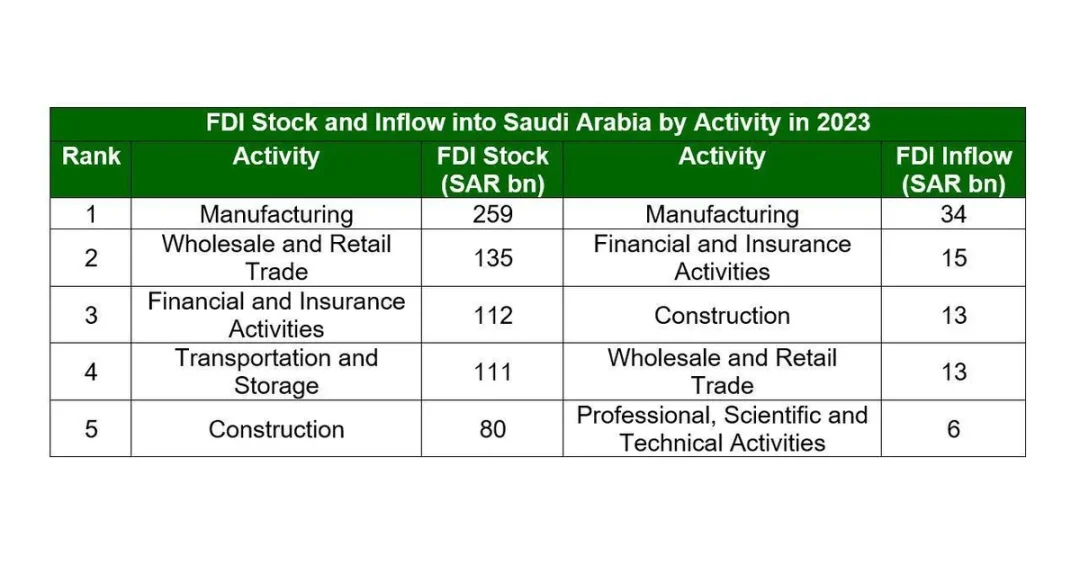
Which sectors and countries are driving this investment surge? Manufacturing emerged as the number one ranked activity in terms of FDI stock, inflow, and net inflow. This aligns with Saudi Arabia’s goals to localize industries, boost non-oil exports, and create high-value jobs. The manufacturing sector’s dominance reflects the success of initiatives such as the National Industrial Development and Logistics Program (NIDLP) and the Kingdom’s efforts to become a global logistics hub. In terms of investor countries, the United States topped the list by ultimate controlling parent (UCP) for FDI stock, with SAR202 billion ($54 billion), representing 23% of total FDI stock in the Kingdom. The United Arab Emirates ranked first for FDI inflow, with SAR13 billion ($3 billion), accounting for 14% of the total. This diversity of source countries—from North America to the Middle East and beyond—demonstrates the broad-based confidence in Saudi Arabia’s economic trajectory.
Minister of Investment Eng. Khalid A. Al-Falih commented on the data, saying: “These detailed numbers show that Vision 2030 and the National Investment Strategy are succeeding in attracting FDI across the country from numerous source countries and into a wide range of sectors.” He added: “It is positive shifts like this in FDI that I expect we will continue to see as more investors enter the fast-growing Saudi market to take advantage of our political stability, long-term economic vision, market size, policy certainty, strong economic, fiscal and monetary fundamentals, and strategic position, which provide an excellent platform to access growth opportunities across the Middle East and beyond.” Eng. Al-Falih also noted: “While there is still work to do, I am encouraged by the transformation that we are witnessing in the Kingdom, which will only continue to accelerate, underpinned by our ambitious sector strategies including the NIS, and the catalytic role of the PIF, as well as our giga projects.”
The 2023 FDI inflow represented 2.4% of GDP, achieving the NIS target. This metric is a key indicator of how deeply foreign investment is integrated into the national economy. Compared to other G20 countries, Saudi Arabia ranked 11th in terms of FDI net inflow and 16th in cumulative FDI stock in 2023. More impressively, the Kingdom ranked 2nd in FDI net inflow growth rate and 4th in FDI stock growth rate for the same year. These rankings place Saudi Arabia among the fastest-improving economies in the world for investment attractiveness. The data also show that FDI inflows as a percentage of FDI stock increased from 6% in 2017 to 11% in 2023, while FDI outflow as a percentage of FDI stock declined from 5% to 1%. This indicates that foreign investors are not only bringing capital in but also retaining and reinvesting it within the Kingdom.
International and Regional Impact
How does Saudi Arabia’s FDI performance influence the broader region and global investment flows? The Kingdom’s success serves as a beacon for the Middle East, demonstrating that with the right policies and infrastructure, countries can attract significant foreign capital even amid global uncertainty. Saudi Arabia’s strategic position—bridging Asia, Europe, and Africa—makes it an ideal gateway for companies seeking access to markets across the region. The surge in FDI also strengthens the Kingdom’s role in global supply chains, particularly in manufacturing, logistics, and technology. As multinationals diversify their operations away from traditional hubs, Saudi Arabia offers a compelling alternative with its modern infrastructure, young and skilled workforce, and pro-business regulations.
Regionally, the data highlight the UAE’s prominent role as a source of FDI, reflecting the deep economic ties between the two Gulf nations. The United States’ leading position in FDI stock underscores the enduring partnership between Riyadh and Washington, built on mutual economic interests and long-term strategic alignment. Other G20 countries are also watching closely, as Saudi Arabia’s rapid improvement in FDI growth rates signals a shift in global investment patterns. The Kingdom’s ability to attract investment from diverse sources reduces its reliance on any single market and enhances its economic resilience. For international investors, the message is clear: Saudi Arabia is open for business and offers a stable, predictable environment for long-term returns.
Economic and Strategic Significance
Why does this FDI performance matter for Saudi Arabia’s long-term economic strategy? Foreign direct investment is a critical driver of economic diversification, technology transfer, and job creation. The NIS, launched as part of Vision 2030, aims to increase FDI’s contribution to GDP and attract SAR388 billion ($103 billion) in cumulative FDI by 2030. The 2023 results show that the Kingdom is well on its way to achieving this goal. The manufacturing sector’s leadership in FDI stock and inflows is particularly significant, as it supports the development of non-oil industries and reduces dependence on hydrocarbon revenues. The growth in FDI net inflows—from SAR4 billion in 2017 to SAR86 billion in 2023—demonstrates that investors are not only bringing capital but also committing to long-term projects that generate value within the Kingdom.
The strategic significance extends beyond numbers. FDI brings with it advanced technologies, management expertise, and global market access, all of which are essential for Saudi Arabia’s transition to a knowledge-based economy. The PIF plays a catalytic role by co-investing in giga projects and sector initiatives, de-risking opportunities for foreign partners. The Kingdom’s political stability, policy certainty, and strong fiscal and monetary fundamentals provide a solid foundation for investors. As Eng. Al-Falih noted, these factors create an excellent platform to access growth opportunities across the Middle East and beyond. The 2023 FDI data also reflect the success of regulatory reforms, such as the introduction of new investment laws, the expansion of foreign ownership limits, and the streamlining of licensing procedures. These measures have made it easier for international companies to establish and expand operations in Saudi Arabia.
Vision 2030 Alignment
How does the FDI milestone directly advance the goals of Vision 2030? Vision 2030 seeks to transform Saudi Arabia into a diversified, innovative, and globally competitive economy. Attracting foreign investment is a cornerstone of this transformation, as it accelerates the development of new sectors, creates jobs for Saudi youth, and enhances the Kingdom’s integration into the global economy. The NIS, with its ambitious targets, is a key enabler of Vision 2030, and the 2023 data confirm that the strategy is delivering results. The surge in FDI inflows—nearly tripling since the launch of Vision 2030—demonstrates that the Kingdom’s reform agenda is resonating with investors worldwide. The manufacturing sector’s dominance aligns with the goals of the National Industrial Development and Logistics Program, while the diversity of source countries reflects the global confidence in Saudi Arabia’s future.
Looking ahead, the Kingdom is poised to build on this momentum. The continued implementation of sector strategies, the expansion of giga projects such as NEOM and the Red Sea Project, and the ongoing enhancements to the investment climate will likely attract even more foreign capital. The Ministry of Investment, under the leadership of Eng. Khalid A. Al-Falih, remains committed to facilitating investment and removing barriers. As the data show, Saudi Arabia is not just meeting its targets but exceeding them, setting a new benchmark for economic transformation. For international audiences, this is a clear signal that the Kingdom is a reliable partner and a prime destination for investment. The FDI report, available on Invest Saudi, provides the transparency and detail that global investors need to make informed decisions. With Vision 2030 as its roadmap, Saudi Arabia is well on its way to becoming a global investment powerhouse, driving growth and prosperity for the region and beyond.
20 Questions
Q1. What was Saudi Arabia’s FDI inflow in 2023?
A1. Saudi Arabia’s FDI inflow reached SAR96 billion ($25.5 billion) in 2023, exceeding the National Investment Strategy target of SAR83 billion ($22 billion) by 16%.
Q2. What methodology was used for the 2023 FDI statistics?
A2. The statistics were based on the International Monetary Fund’s Balance of Payments Manual (BPM6) methodology, developed through a detailed analysis of all licensed international investors in the Kingdom.
Q3. How much did FDI inflow grow in 2023 compared to 2022?
A3. FDI inflow grew by 50% in 2023 compared to 2022 after excluding the exceptional Aramco pipeline deal in 2022, which had temporarily inflated the previous year’s figures.
Q4. What was Saudi Arabia’s FDI stock in 2023?
A4. The Kingdom’s FDI stock increased by 13% in 2023 compared to 2022, amounting to approximately SAR900 billion ($240 billion).
Q5. How did Saudi Arabia rank among G20 countries for FDI in 2023?
A5. Saudi Arabia ranked 11th in FDI net inflow and 16th in cumulative FDI stock, 2nd in FDI net inflow growth rate, and 4th in FDI stock growth rate among G20 countries.
Q6. Which sector ranked first for FDI stock, inflow, and net inflow?
A6. Manufacturing was the number one ranked activity in terms of FDI stock, inflow, and net inflow, reflecting the success of industrial development initiatives.
Q7. Which country topped the list for FDI stock by ultimate controlling parent?
A7. The United States topped the list with SAR202 billion ($54 billion), representing 23% of total FDI stock in the Kingdom.
Q8. Which country ranked first for FDI inflow in 2023?
A8. The United Arab Emirates ranked first for FDI inflow with SAR13 billion ($3 billion), accounting for 14% of the total.
Q9. What did Minister of Investment Eng. Khalid A. Al-Falih say about the data?
A9. He said the data demonstrate the success of Vision 2030 in diversifying the economy, creating a best-in-class investment environment, and providing unprecedented opportunities for investors.
Q10. How has FDI inflow changed since the launch of Vision 2030?
A10. FDI inflow nearly tripled, with the average of 2021–2023 reaching SAR112 billion ($30 billion), compared to an average of SAR43 billion ($11.5 billion) from 2013–2015.
Q11. By how much did FDI gross inflows increase between 2017 and 2023?
A11. FDI gross inflows increased by more than 240%, from SAR28 billion ($7.5 billion) in 2017 to SAR96 billion ($25.5 billion) in 2023.
Q12. What happened to FDI outflows between 2017 and 2023?
A12. FDI outflows declined by around 60%, from SAR24 billion ($6.5 billion) in 2017 to SAR10 billion ($2.7 billion) in 2023.
Q13. How did FDI net inflows change between 2017 and 2023?
A13. FDI net inflows increased by more than 2,000%, from SAR4 billion ($1.1 billion) in 2017 to SAR86 billion ($23 billion) in 2023.
Q14. What was the FDI inflow as a percentage of GDP in 2023?
A14. FDI inflow reached 2.4% of GDP in 2023, achieving the National Investment Strategy target.
Q15. How did FDI inflows as a percentage of FDI stock change from 2017 to 2023?
A15. FDI inflows as a percentage of FDI stock increased from 6% in 2017 to 11% in 2023, indicating higher reinvestment and retention.
Q16. What role does the Public Investment Fund (PIF) play in attracting FDI?
A16. The PIF plays a catalytic role by co-investing in giga projects and sector initiatives, de-risking opportunities for foreign partners and supporting Vision 2030 goals.
Q17. Where can the full FDI report be accessed?
A17. The full Saudi Arabia Foreign Direct Investment Report is available on the Invest Saudi website, providing detailed breakdowns by activity, country, and region.
Q18. How does Saudi Arabia’s FDI performance compare to other G20 countries?
A18. Saudi Arabia ranked 2nd in FDI net inflow growth rate and 4th in FDI stock growth rate in 2023, placing it among the fastest-improving economies globally.
Q19. What are the key factors attracting foreign investors to Saudi Arabia?
A19. Key factors include political stability, long-term economic vision, market size, policy certainty, strong economic fundamentals, and strategic position as a gateway to the Middle East.
Q20. How does the FDI milestone align with Vision 2030?
A20. The milestone advances Vision 2030 by accelerating economic diversification, creating jobs, enhancing global integration, and confirming the success of the National Investment Strategy.
Reader Feedback
We value your thoughts. Please share your feedback on this article.
Your feedback helps us improve our coverage.
Related articles
 NDMC Closes October Sukuk Issuance Worth SAR7.83B
 Saudi Technologies Shine at 41st Agriculture Exhibition
 GAC Records 60 Economic Concentration Approvals in Q3 2024
 Jazan’s Jasmine: A Cultural and Economic Treasure
 Saudi Arabia Secures SAR37 Billion in Private Investment for Sustainable Agriculture
 Leaders Discuss Future of Industry at MIPF in Riyadh