


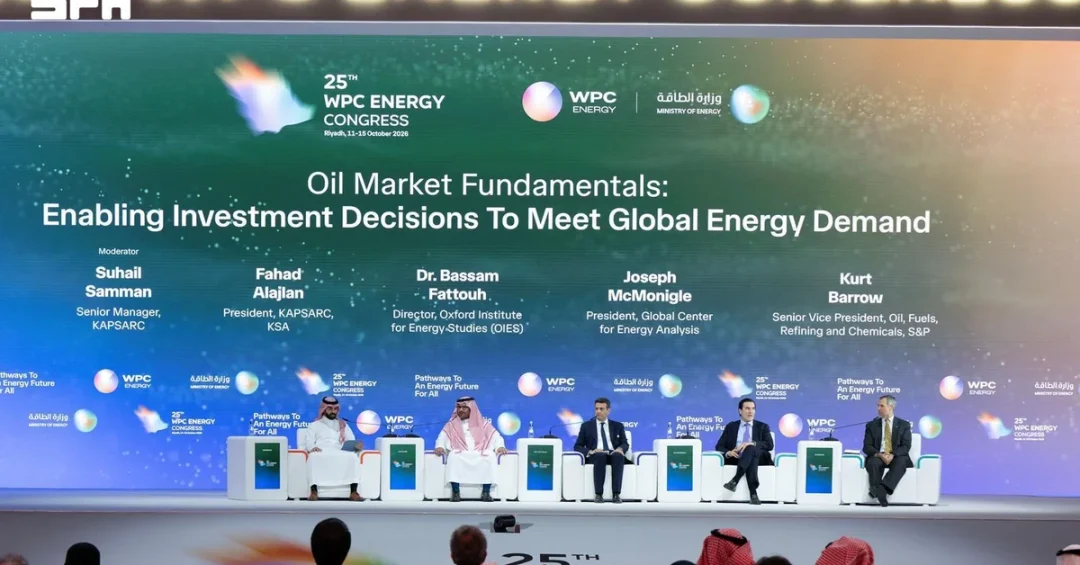
The 25th World Petroleum Congress convened in Riyadh and delivered a clear message to the global energy industry: investment decisions in the oil sector must be approached with long-term vision, strategic foresight, and a commitment to market stability. According to the Saudi Press Agency, an extensive panel discussion at the Congress focused on the priorities and fundamentals of the global oil market, supply and demand dynamics, and ways to facilitate sustainable investment decisions capable of meeting future energy needs.
Held in the Saudi capital, the Congress brought together energy ministers, industry executives, and policy experts from around the world at a time when global energy markets continue to navigate a period of significant uncertainty. The timing of the gathering underscores Saudi Arabia’s central role in shaping the international energy dialogue, particularly as the Kingdom advances its Vision 2030 objectives of economic diversification while maintaining its position as a reliable supplier of global energy. But what does the Riyadh Congress reveal about the direction of global energy investment at this critical juncture?
Context and Background
The 25th World Petroleum Congress represents one of the most significant gatherings of the global petroleum industry, held periodically to address the most pressing challenges and opportunities facing the sector. This year’s edition in Riyadh carried particular weight, as it took place against a backdrop of geopolitical tensions, shifting supply chains, and evolving demand patterns that have reshaped energy markets since early 2022. According to information released via official Saudi channels, panel participants highlighted the structural challenges facing investment decisions in the oil sector, noting that uncertainty and high volatility are not new phenomena but rather stem from geopolitical crises and structural changes the world has witnessed since February 2022.
This assessment reflects a broader recognition within the industry that the current period of market turbulence is not merely cyclical but rooted in deeper geopolitical and structural transformations. The Congress provided a platform for experts to examine how these forces interact and what they mean for the future of energy investment. Saudi Arabia’s decision to host the event in Riyadh signals the Kingdom’s continued commitment to facilitating international dialogue on energy security and market stability, a role it has played consistently through both OPEC and broader multilateral frameworks.
The discussions in Riyadh also reflect the growing consensus that energy investment decisions cannot be made in isolation from broader geopolitical and economic considerations. As global demand for energy continues to rise, particularly in emerging economies, the need for predictable and stable investment frameworks becomes increasingly urgent. The Congress served as a timely reminder that without sustained investment, the world risks facing supply shortfalls that could undermine economic growth and development across multiple regions.
Key Details from the Riyadh Sessions
The panel discussion at the 25th World Petroleum Congress produced several key recommendations and observations that are likely to shape industry thinking in the months ahead. Experts urged companies to mitigate risks by expanding investment partnerships and diversifying their customer base across the supply chain. These measures, according to participants, aim to ensure stable financial flows and greater flexibility in responding to market fluctuations. The emphasis on partnership and diversification represents a pragmatic approach to managing risk in an environment where traditional investment models are increasingly challenged by geopolitical uncertainty and rapid technological change.
Participants also commended Saudi Arabia’s experience in supporting market stability and developing energy infrastructure, stressing that balanced, long-term policies are essential to ensuring energy supply security and preventing future investment shortfalls. This recognition of the Kingdom’s role reflects decades of consistent policy and substantial investment in both upstream and downstream energy infrastructure. Saudi Arabia has long advocated for a balanced approach to energy markets, one that considers the interests of both producers and consumers while ensuring adequate investment in future supply capacity.
The Congress discussions also touched on the importance of facilitating sustainable investment decisions to meet future energy needs. This includes not only traditional oil and gas investments but also the integration of cleaner technologies and more efficient production methods. The panel’s focus on sustainability reflects the industry’s evolving understanding that long-term viability depends on balancing economic returns with environmental responsibility and social license to operate. What specific mechanisms did the experts propose to achieve these dual objectives of stability and sustainability?
International and Regional Impact
The outcomes of the 25th World Petroleum Congress carry significant implications for international energy markets and regional stability. The panel’s emphasis on expanding investment partnerships and diversifying customer bases speaks directly to the challenges facing both national oil companies and international energy firms as they navigate an increasingly complex global landscape. For oil-producing nations in the Middle East and beyond, the Congress reinforced the importance of maintaining stable production policies and avoiding the kind of volatility that can deter long-term investment.
From a regional perspective, Saudi Arabia’s leadership in hosting the Congress and its consistent advocacy for market stability position the Kingdom as a stabilizing force in global energy markets. This role is particularly important at a time when geopolitical tensions continue to affect supply routes and production decisions. The Congress provided an opportunity for regional producers to align their approaches and present a unified message on the importance of predictable investment frameworks. How might these discussions influence the investment strategies of both producing and consuming nations in the coming years?
The international dimension of the Congress also highlighted the interconnected nature of global energy markets. Decisions made in one region inevitably affect supply and demand dynamics in others, making international cooperation essential to ensuring stable and affordable energy supplies. The Riyadh discussions underscored that no single country or company can address these challenges alone, and that sustained dialogue and partnership are essential components of a resilient global energy system.
Economic and Strategic Significance
The economic significance of the Congress discussions extends well beyond the oil sector itself. Energy investment decisions have profound implications for global economic growth, as reliable and affordable energy is a prerequisite for industrial development, transportation, and modern living standards. The panel’s warning about potential investment shortfalls serves as a reminder that underinvestment in energy infrastructure can lead to supply constraints, price volatility, and ultimately slower economic growth in both developed and developing economies.
For Saudi Arabia specifically, the Congress reinforced the Kingdom’s strategic position as both a major energy producer and a thought leader in global energy policy. The recognition of Saudi Arabia’s experience in supporting market stability and developing energy infrastructure reflects the Kingdom’s substantial investments in maintaining and expanding its production capacity, as well as its role in coordinating global energy policy through OPEC and other multilateral forums. These efforts are closely tied to Vision 2030, which seeks to diversify the Saudi economy while maintaining its energy leadership.
The strategic significance of the Riyadh discussions also lies in their potential to influence corporate investment decisions. By providing a platform for experts to share insights and recommendations, the Congress helps companies make more informed decisions about where and how to allocate capital. The emphasis on partnership and diversification offers a practical framework for risk management that can be applied across different segments of the energy supply chain. What does this mean for the future of energy investment in an era of rapid technological change and shifting geopolitical alliances?
Vision 2030 Alignment
The 25th World Petroleum Congress in Riyadh aligns closely with Saudi Arabia’s Vision 2030 objectives, which seek to transform the Kingdom’s economy while maintaining its central role in global energy markets. The Congress showcased Saudi Arabia’s commitment to fostering international dialogue, promoting sustainable investment, and ensuring energy security for the benefit of both producers and consumers. These priorities are consistent with Vision 2030’s broader goals of economic diversification, technological innovation, and enhanced global engagement.
As the Kingdom continues to implement Vision 2030, its energy sector remains a cornerstone of both national prosperity and global stability. The Riyadh Congress demonstrated that Saudi Arabia is not only a reliable supplier of energy but also a constructive partner in addressing the challenges facing the global energy industry. By convening experts from around the world and facilitating discussions on critical issues such as investment, stability, and sustainability, the Kingdom is helping to shape a more resilient and forward-looking global energy landscape. The outcomes of this Congress will likely inform policy and investment decisions for years to come, reinforcing Saudi Arabia’s position as a leader in the global energy transition and a catalyst for sustainable economic growth.
20 Questions
Q1. What was the main focus of the 25th World Petroleum Congress panel discussion?
A1. The panel focused on priorities and fundamentals of the global oil market, supply and demand dynamics, and ways to facilitate sustainable investment decisions to meet future energy needs.
Q2. Where was the 25th World Petroleum Congress held?
A2. The 25th World Petroleum Congress was held in Riyadh, Saudi Arabia, according to the Saudi Press Agency.
Q3. What did participants identify as the root causes of uncertainty in oil sector investment?
A3. Participants noted that uncertainty and high volatility stem from geopolitical crises and structural changes the world has witnessed since February 2022, rather than being new phenomena.
Q4. What measures did experts urge companies to take to mitigate risks?
A4. Experts urged companies to expand investment partnerships and diversify their customer base across the supply chain to ensure stable financial flows and greater flexibility.
Q5. How did participants describe Saudi Arabia’s role in energy markets?
A5. Participants commended Saudi Arabia’s experience in supporting market stability and developing energy infrastructure, stressing that balanced, long-term policies are essential for energy supply security.
Q6. What is the significance of the Congress being held in Riyadh?
A6. It underscores Saudi Arabia’s central role in shaping international energy dialogue and its commitment to facilitating global discussions on energy security and market stability.
Q7. What did experts say about preventing future investment shortfalls?
A7. They stressed that balanced, long-term policies are essential to ensuring energy supply security and preventing future investment shortfalls in the oil sector.
Q8. How do geopolitical crises affect oil market investment decisions?
A8. Geopolitical crises create uncertainty and volatility, making it more difficult for companies to make long-term investment decisions and plan for future supply capacity.
Q9. What does the Congress recommend for ensuring stable financial flows in the oil sector?
A9. The Congress recommends expanding investment partnerships and diversifying customer bases across the supply chain to ensure stable financial flows and flexibility.
Q10. How does Saudi Arabia’s Vision 2030 relate to the Congress discussions?
A10. Vision 2030 aligns with the Congress by promoting economic diversification, technological innovation, and enhanced global engagement while maintaining Saudi Arabia’s energy leadership.
Q11. What role does OPEC play in the context of the Congress discussions?
A11. OPEC serves as a key multilateral forum through which Saudi Arabia and other producers coordinate energy policy and support market stability.
Q12. Why is sustainable investment important for the global energy market?
A12. Sustainable investment ensures that future energy needs are met without causing supply shortfalls, price volatility, or undermining long-term economic growth.
Q13. What did participants say about the nature of market volatility?
A13. Participants noted that uncertainty and high volatility are not new phenomena but stem from geopolitical crises and structural changes since February 2022.
Q14. How can companies achieve greater flexibility in responding to market fluctuations?
A14. Companies can achieve greater flexibility by diversifying their customer base across the supply chain and expanding investment partnerships.
Q15. What is the expected impact of the Congress on future energy investment?
A15. The Congress is expected to inform policy and investment decisions by providing a platform for experts to share insights and recommendations on stability and sustainability.
Q16. How does Saudi Arabia support energy supply security?
A16. Saudi Arabia supports energy supply security through balanced, long-term policies, substantial infrastructure investment, and consistent advocacy for market stability.
Q17. What makes the 25th World Petroleum Congress significant for the industry?
A17. It addresses pressing challenges and opportunities facing the global petroleum industry, including investment, supply and demand, and sustainable energy development.
Q18. What did experts emphasize about investment partnerships?
A18. Experts emphasized that expanding investment partnerships helps mitigate risks, ensure stable financial flows, and provide greater flexibility in responding to market fluctuations.
Q19. How does the Congress reflect Saudi Arabia’s global energy leadership?
A19. By hosting the Congress and facilitating international dialogue, Saudi Arabia demonstrates its role as a stabilizing force and thought leader in global energy policy.
Q20. What is the forward-looking message of the 25th World Petroleum Congress?
A20. The message is that sustainable investment, balanced policies, and international cooperation are essential to ensuring energy security and meeting future global energy needs.
Reader Feedback
We value your thoughts. Please share your feedback on this article.
Your feedback helps us improve our coverage.