


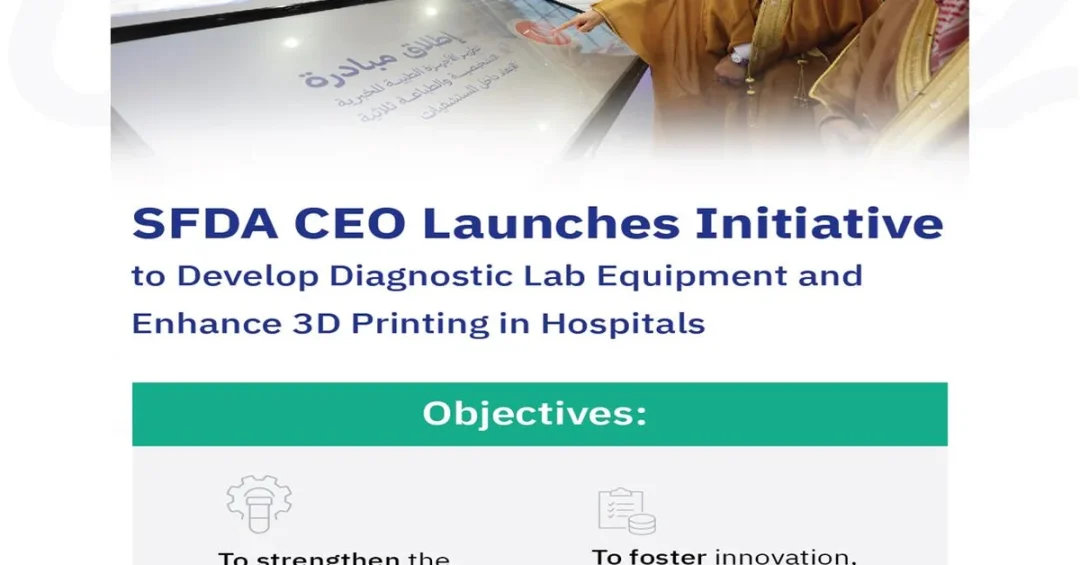
The Chief Executive Officer of the Saudi Food and Drug Authority (SFDA), Hisham bin Saad Aljadhey, launched a new national initiative on Wednesday to develop medical diagnostic laboratory devices and advance 3D printing capabilities within hospitals and medical laboratories across the Kingdom. The announcement was made at the SFDA pavilion during the Global Health Exhibition, which concluded today at the Riyadh Exhibition and Convention Center in Malham. The initiative represents a significant step forward in Saudi Arabia’s efforts to localize advanced healthcare manufacturing, support innovation, and reduce operational costs for medical institutions, all while aligning with the broader objectives of Saudi Vision 2030. The launch underscores the Kingdom’s commitment to building a resilient, self-sufficient healthcare ecosystem that leverages cutting-edge technology for the benefit of patients and providers alike.
The initiative is designed to support innovation, research, and development in the medical diagnostics and 3D printing sectors, while simultaneously reducing costs for hospitals and medical laboratories. It also seeks to promote the national industry and enhance the availability of in vitro diagnostic medical devices for therapeutic and diagnostic purposes within hospitals, excluding commercial use. This aligns with the SFDA’s ongoing commitment to encourage innovators and researchers, support national industries, and empower investors concerning products under its supervision. The launch event drew attention from healthcare professionals, industry leaders, and policymakers, highlighting the importance of public-private collaboration in achieving the Kingdom’s healthcare transformation goals.
Context and Background
Why has the SFDA chosen this particular moment to champion the localization of diagnostic devices and 3D printing in hospitals? The answer lies in the rapid evolution of Saudi Arabia’s healthcare landscape, driven by Vision 2030 and the Health Sector Transformation Program. Over the past decade, the Kingdom has invested heavily in modernizing its healthcare infrastructure, expanding access to quality care, and fostering a culture of innovation. The SFDA, as the national regulatory authority for food and drug safety, has played a pivotal role in this transformation by streamlining regulatory pathways, encouraging local manufacturing, and ensuring that medical products meet the highest standards of safety and efficacy. The new initiative builds on this foundation by targeting two critical areas: in vitro diagnostic (IVD) devices and 3D printing technologies, both of which have the potential to revolutionize patient care and operational efficiency in Saudi hospitals.
The global IVD market has grown exponentially in recent years, fueled by advances in molecular diagnostics, point-of-care testing, and personalized medicine. However, Saudi Arabia has historically relied on imported diagnostic devices, which can be costly and subject to supply chain disruptions. By promoting local development and manufacturing of IVD devices, the SFDA aims to reduce dependency on foreign suppliers, lower costs, and ensure timely access to essential diagnostic tools. Similarly, 3D printing—also known as additive manufacturing—has emerged as a transformative technology in healthcare, enabling the production of custom implants, prosthetics, surgical instruments, and even anatomical models for pre-surgical planning. Hospitals and medical laboratories that adopt 3D printing can achieve greater precision, faster turnaround times, and significant cost savings. The SFDA’s initiative is therefore a strategic response to both global trends and local needs.
Moreover, the initiative reflects the SFDA’s proactive approach to regulatory science and innovation. By engaging with innovators, researchers, and investors early in the product development cycle, the authority can provide guidance on regulatory requirements, facilitate clinical evaluations, and accelerate market access for promising technologies. This collaborative model is essential for building a vibrant ecosystem where Saudi-made medical devices can compete globally. The Global Health Exhibition provided an ideal platform to announce the initiative, as it brought together key stakeholders from across the healthcare spectrum, including government agencies, hospitals, universities, and private companies. The presence of Hisham bin Saad Aljadhey, the SFDA’s CEO, underscored the authority’s high-level commitment to this endeavor.
Key Details of the Initiative
What specific components make this initiative a game-changer for Saudi healthcare? The SFDA’s plan focuses on several core pillars: supporting research and development, fostering national industry, empowering investors, and enhancing the availability of IVD devices for therapeutic and diagnostic purposes within hospitals. Importantly, the initiative excludes commercial use, meaning that the devices developed under this framework are intended primarily for internal hospital and laboratory use, rather than for sale on the open market. This distinction ensures that the initiative directly benefits patient care and clinical outcomes, while still allowing for future commercialization opportunities as the ecosystem matures. The SFDA will provide regulatory support, including guidance on product classification, pre-market evaluation, and post-market surveillance, to help innovators navigate the approval process efficiently.
In terms of 3D printing, the initiative aims to integrate additive manufacturing into hospital workflows for applications such as custom surgical guides, dental implants, orthopedic prosthetics, and bioprinted tissues for research. The SFDA recognizes that 3D printing at the point of care raises unique regulatory questions, particularly regarding quality control, material safety, and device traceability. To address these challenges, the authority is developing tailored regulatory frameworks that balance innovation with patient safety. For example, hospitals that use 3D printing to produce patient-specific devices may be required to adhere to specific standards for design validation, sterilization, and documentation. The SFDA is also encouraging collaboration between hospitals, universities, and technology providers to share best practices and accelerate the adoption of 3D printing in clinical settings.
Furthermore, the initiative includes provisions to empower investors by providing clarity on regulatory pathways and market opportunities. The SFDA has a track record of supporting local manufacturers through incentives such as reduced fees, fast-track reviews, and technical assistance. By extending these benefits to the diagnostic and 3D printing sectors, the authority hopes to attract domestic and foreign investment, create high-skilled jobs, and stimulate economic growth. The initiative also aligns with the National Industrial Development and Logistics Program (NIDLP), which aims to transform Saudi Arabia into a leading industrial power and logistics hub. By localizing the production of advanced medical devices, the Kingdom can reduce its trade deficit, enhance export potential, and build resilience against global supply chain shocks.
International and Regional Impact
How will this initiative influence Saudi Arabia’s standing in the global healthcare community? The Kingdom’s move to develop diagnostic devices and 3D printing capabilities positions it as a regional leader in medical technology innovation. Neighboring countries in the Gulf Cooperation Council (GCC) and the broader Middle East are likely to look to Saudi Arabia as a model for regulatory modernization and industry development. The SFDA’s collaborative approach, which involves engaging with international experts and aligning with global standards, ensures that Saudi-made devices will be compatible with international requirements, opening doors for export to other markets. This could enhance the Kingdom’s soft power and foster greater scientific and commercial ties with countries in Asia, Europe, and the Americas.
At the same time, the initiative supports the localization of critical healthcare supply chains, a priority that has gained urgency in the post-pandemic era. By reducing reliance on imported diagnostic devices, Saudi Arabia can better manage public health emergencies and ensure continuity of care during global disruptions. The 3D printing component further strengthens this resilience by enabling hospitals to produce essential items on-site, such as spare parts for medical equipment or custom-fit patient devices. These capabilities are particularly valuable for remote or underserved areas, where traditional supply chains may be slow or unreliable. The initiative therefore contributes to health equity and national security, while also showcasing Saudi Arabia’s capacity for technological self-reliance.
Economic and Strategic Significance
What economic benefits will flow from localizing diagnostic device production and 3D printing? The initiative is expected to generate cost savings for hospitals and laboratories by reducing procurement expenses, inventory costs, and waste. For instance, 3D printing allows for on-demand production of customized devices, eliminating the need for large inventories of pre-made implants in various sizes. This lean approach can significantly lower operational budgets, freeing up resources for other priorities such as patient care and staff training. Similarly, locally produced IVD devices can be priced more competitively than imported alternatives, making diagnostic testing more accessible to a wider population. These savings can be reinvested into research, infrastructure, and workforce development, creating a virtuous cycle of innovation and growth.
Strategically, the initiative reinforces Saudi Arabia’s commitment to diversifying its economy away from oil dependency. The medical device and 3D printing sectors are high-value, knowledge-intensive industries that align with Vision 2030’s goals of economic diversification and private sector growth. By nurturing these sectors, the Kingdom can create new revenue streams, attract foreign direct investment, and develop a skilled workforce in engineering, materials science, and regulatory affairs. The SFDA’s role as a facilitator and regulator is crucial in this regard, as it provides the necessary oversight to ensure quality and safety while removing unnecessary barriers to entry. The initiative also complements other national programs, such as the Health Sector Transformation Program and the National Biotechnology Strategy, which aim to position Saudi Arabia as a hub for life sciences innovation.
Vision 2030 Alignment
How does this initiative fit into the broader vision for Saudi Arabia’s future? Vision 2030 envisions a nation that is not only economically prosperous but also a global leader in healthcare, technology, and innovation. The SFDA’s initiative directly supports several Vision 2030 objectives, including improving healthcare quality and efficiency, localizing advanced industries, and fostering a culture of research and development. By enabling hospitals and laboratories to produce their own diagnostic devices and 3D-printed medical products, the Kingdom is taking a concrete step toward a more self-reliant and resilient healthcare system. This aligns with the Health Sector Transformation Program’s goal of shifting from a predominantly curative model to a preventive and personalized one, where technology plays a central role in early diagnosis and tailored treatment.
Looking ahead, the SFDA’s initiative is poised to catalyze a new wave of innovation in Saudi healthcare. As more hospitals adopt 3D printing and local IVD production, the Kingdom will build a repository of clinical data and best practices that can inform future regulations and product development. This virtuous cycle will attract talent, investment, and partnerships, further accelerating the pace of innovation. The SFDA’s leadership, exemplified by CEO Hisham bin Saad Aljadhey’s personal launch of the initiative, signals that the authority is committed to being a proactive partner in this journey. Ultimately, the success of this initiative will be measured not only in economic terms but also in improved patient outcomes, enhanced national resilience, and a stronger position for Saudi Arabia on the global stage. The Kingdom’s healthcare future is being built today, one diagnostic device and one 3D-printed component at a time.
20 Questions
Q1. What is the main goal of the SFDA’s new initiative?
A1. The initiative aims to develop medical diagnostic laboratory devices and 3D printing within hospitals and medical laboratories to support innovation, reduce costs, and promote national industry.
Q2. Who launched the initiative and where?
A2. Hisham bin Saad Aljadhey, CEO of the Saudi Food and Drug Authority, launched it at the SFDA pavilion during the Global Health Exhibition in Riyadh.
Q3. When was the initiative announced?
A3. It was announced on Wednesday, October 23, 2024, at the Global Health Exhibition, which concluded the same day.
Q4. What are in vitro diagnostic (IVD) medical devices?
A4. IVD devices are tests used to diagnose diseases or conditions by analyzing samples such as blood or tissue outside the living body, essential for therapeutic and diagnostic decisions.
Q5. Does the initiative cover commercial use of the devices?
A5. No, the initiative focuses on devices for therapeutic and diagnostic purposes within hospitals, excluding commercial use, to directly benefit patient care.
Q6. How does 3D printing benefit hospitals?
A6. 3D printing enables on-demand production of custom implants, surgical guides, and prosthetics, reducing costs, improving precision, and speeding up treatment.
Q7. What role does the SFDA play in this initiative?
A7. The SFDA provides regulatory support, guidance on approvals, and oversight to ensure safety and efficacy while encouraging innovation and investment.
Q8. How does the initiative support national industry?
A8. It promotes local manufacturing of medical devices, reduces reliance on imports, and empowers Saudi companies to compete in advanced healthcare markets.
Q9. What are the expected cost reductions for hospitals?
A9. Hospitals can save on procurement, inventory, and waste by producing devices locally and using 3D printing for customized, on-demand items.
Q10. How does this initiative align with Vision 2030?
A10. It supports economic diversification, healthcare transformation, and localization of advanced industries, key pillars of Vision 2030.
Q11. Which sectors will benefit most from this initiative?
A11. Hospitals, medical laboratories, research institutions, and local manufacturers of diagnostic devices and 3D printing materials will benefit significantly.
Q12. Will the initiative create new jobs?
A12. Yes, it is expected to generate high-skilled jobs in engineering, regulatory affairs, research, and advanced manufacturing, boosting the Saudi workforce.
Q13. How does 3D printing enhance patient care?
A13. It allows for personalized medical devices tailored to individual patients, improving surgical outcomes, recovery times, and overall treatment effectiveness.
Q14. What challenges does the SFDA need to address?
A14. Challenges include ensuring quality control, material safety, and regulatory compliance for point-of-care 3D printing and local IVD production.
Q15. Can other countries benefit from this initiative?
A15. Yes, Saudi-made devices could be exported, and the regulatory model could serve as a benchmark for other nations seeking to localize healthcare manufacturing.
Q16. How does the initiative affect medical research in Saudi Arabia?
A16. It fosters research by providing regulatory clarity, funding opportunities, and collaboration platforms for innovators to develop and test new devices.
Q17. What is the Global Health Exhibition?
A17. It is a major healthcare event in Riyadh that brings together professionals, companies, and policymakers to showcase innovations and discuss industry trends.
Q18. Will patients see immediate benefits?
A18. Benefits will accrue over time as hospitals adopt new technologies, leading to more accessible, affordable, and personalized diagnostic and treatment options.
Q19. How does the initiative support investors?
A19. It provides clear regulatory pathways, incentives, and market opportunities for investors in the medical device and 3D printing sectors.
Q20. What is the long-term vision for this initiative?
A20. The long-term vision is a self-reliant Saudi healthcare system that innovates globally, improves patient outcomes, and contributes to economic diversification.
Reader Feedback
We value your thoughts. Please share your feedback on this article.
Your feedback helps us improve our coverage.