


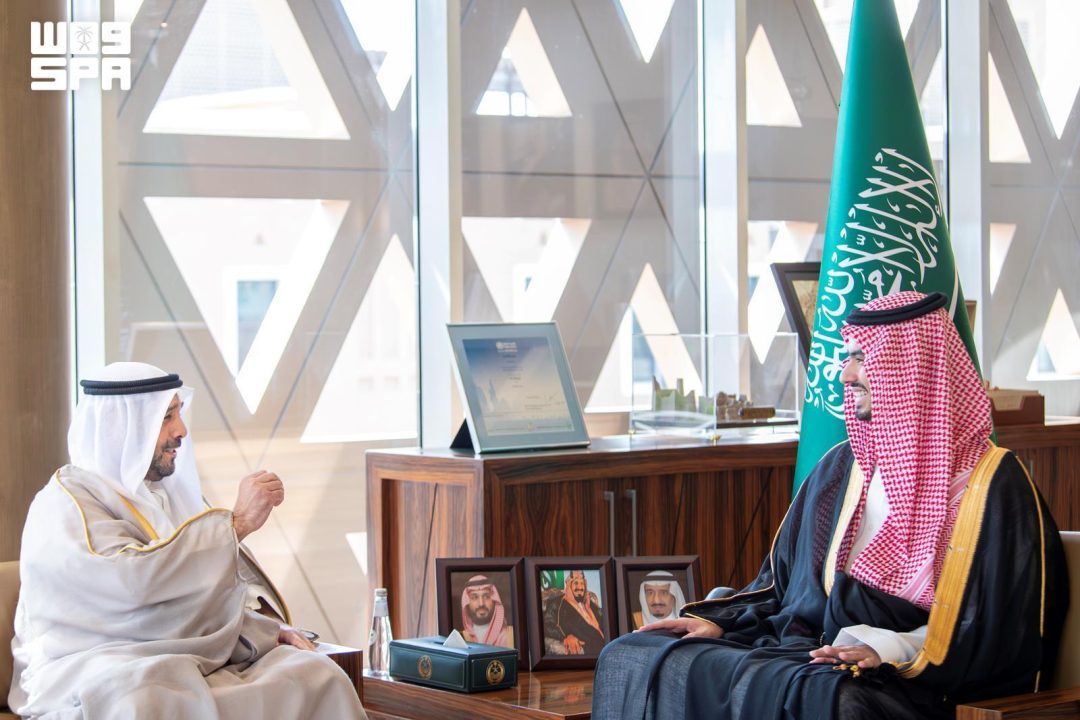
Prince Rakan bin Salman bin Abdulaziz, Governor of Diriyah, received Ambassador of the State of Kuwait to the Kingdom Sheikh Sabah Nasser Sabah Al-Ahmad Al-Sabah on Tuesday, according to the Saudi Press Agency (SPA). The meeting took place in Diriyah, the governorate whose name the governor’s title carries and whose historical and heritage assets formed part of the discussion between the two officials.
SPA reported that the governor and the ambassador discussed several topics of mutual interest. Among those topics, the agency said, was the development of Diriyah’s cultural and tourism sectors, alongside its rich historical and heritage assets. The exchange placed the governorate’s ongoing cultural and tourism trajectory at the center of a diplomatic meeting between a Saudi regional governor and the Kuwaiti ambassador accredited to the Kingdom.
The ambassador thanked the governor for the reception, SPA reported. He also commended the governorate’s development and the attention given to its historical and cultural legacy, according to the agency’s account of the meeting.
What does a courtesy meeting between a regional governor and a foreign ambassador actually signal about the depth of bilateral ties? In the Gulf context, such receptions are routine diplomatic practice, yet the specific agenda items mentioned by SPA — cultural and tourism development, historical and heritage assets — point to a conversation that went beyond protocol. Why would the cultural and tourism file of a single governorate feature in a meeting with Kuwait’s top diplomat in the Kingdom?
Diriyah’s identity rests on its historical and heritage assets, which SPA cited as part of the discussion. The governorate’s cultural and tourism sectors were described as under development, a process the Kuwaiti ambassador acknowledged by commending both the development itself and the care given to the area’s historical and cultural legacy. The meeting therefore linked a diplomatic engagement to the ongoing work on Diriyah’s heritage and visitor-facing sectors.
Who benefits when a neighboring state’s ambassador publicly recognizes the stewardship of a Saudi heritage site? The ambassador’s remarks, as carried by SPA, included thanks for the reception and praise for the governorate’s development and the attention to its historical and cultural legacy. That formulation ties the diplomatic gesture to the substantive file of heritage preservation and cultural promotion in Diriyah.
The meeting covered several topics of mutual interest, per SPA, with the development of Diriyah’s cultural and tourism sectors and its historical and heritage assets named among them. The agency did not specify which other topics were raised, nor did it detail any agreements, projects, or timelines connected to the discussion. What remains unstated may be as telling as what was disclosed: no memoranda, no announced initiatives, no figures.
Diriyah’s historical and heritage assets are the through-line of the SPA report. The governorate’s cultural and tourism sectors were framed as areas of development, and the Kuwaiti ambassador’s commendation focused on that development and on the attention given to the historical and cultural legacy. For readers tracking Gulf diplomacy, the meeting offers a snapshot of how heritage and tourism files can surface in bilateral receptions.
Could the emphasis on cultural and tourism development in Diriyah reflect a broader pattern in how Saudi governorates present themselves to foreign diplomats? The SPA account does not say. It records a reception, a discussion of mutual-interest topics, and an expression of thanks and praise. The rest — context, follow-up, outcomes — is left to the reader’s understanding of how such meetings typically function.
Prince Rakan bin Salman bin Abdulaziz received Sheikh Sabah Nasser Sabah Al-Ahmad Al-Sabah on Tuesday, SPA reported from Diriyah. The agency’s dispatch carried a local time of 17:28 and a GMT time of 14:28, placing the meeting on the record for October 13, 2026. The report identified the ambassador by his full name and title as Ambassador of the State of Kuwait to the Kingdom.
The topics of mutual interest were described in general terms: the development of Diriyah’s cultural and tourism sectors and its rich historical and heritage assets. The ambassador’s response was likewise summarized: thanks for the reception and commendation of the governorate’s development and the attention given to its historical and cultural legacy. No further specifics were provided by the agency.
What does the absence of announced projects or agreements suggest about the nature of this particular meeting? SPA’s report does not characterize it beyond the reception and the discussion. It does not quote either official directly, nor does it list attendees beyond the governor and the ambassador. The dispatch is brief and factual, leaving the reader with the named participants, the named topics, and the named commendation.
Diriyah, as the location and the subject of the governor’s title, anchors the story. The governorate’s cultural and tourism sectors and its historical and heritage assets were the substantive elements SPA chose to highlight from the conversation. The Kuwaiti ambassador’s praise for the governorate’s development and its historical and cultural legacy closed the agency’s account.
For readers in the Kingdom and across the Gulf, the meeting is one of many diplomatic receptions that occur regularly. Yet each such reception carries its own emphasis. Here, the emphasis fell on Diriyah’s heritage and its cultural and tourism trajectory, as recorded by SPA. Whether that emphasis signals anything beyond the meeting itself is not something the agency’s report addresses.
SPA did not include the duration of the meeting, the venue within Diriyah, any statements from other officials, or any follow-up plans. It did not mention agreements, investments, or specific projects. The report consists of the reception, the topics discussed, and the ambassador’s thanks and commendation. Those are the sourced facts, and they stand as the complete public record of the meeting as carried by the Saudi Press Agency.
Who received the Kuwaiti ambassador in Diriyah? Prince Rakan bin Salman bin Abdulaziz, Governor of Diriyah, received Ambassador of the State of Kuwait to the Kingdom Sheikh Sabah Nasser Sabah Al-Ahmad Al-Sabah on Tuesday, according to the Saudi Press Agency. The reception took place in Diriyah, the governorate tied to the governor’s title. SPA reported the meeting as a diplomatic reception between the two officials, with the ambassador identified by his full name and diplomatic post. The agency’s dispatch carried a local time of 17:28 and a GMT time of 14:28.
What topics were discussed at the meeting? SPA reported that the governor and the ambassador discussed several topics of mutual interest. Among them, the agency said, was the development of Diriyah’s cultural and tourism sectors and its rich historical and heritage assets. The report did not specify which other topics were raised, nor did it detail any agreements, projects, or timelines. The named subjects centered on the governorate’s cultural and tourism trajectory and its historical and heritage assets, as recorded by the Saudi Press Agency in its account of the Tuesday reception.
What did the Kuwaiti ambassador say about Diriyah? According to SPA, the ambassador thanked the governor for the reception. He also commended the governorate’s development and the attention given to its historical and cultural legacy. The agency summarized his remarks in those terms without providing a direct quotation. His commendation focused on two elements: the development of the governorate and the care directed at its historical and cultural legacy. The reception and the ambassador’s response were both carried in the SPA dispatch from Diriyah.
Did the meeting produce any announced agreements or projects? SPA did not report any agreements, memoranda, projects, or timelines resulting from the meeting. The agency’s account described a reception, a discussion of several topics of mutual interest, and the ambassador’s thanks and commendation. The topics named were the development of Diriyah’s cultural and tourism sectors and its historical and heritage assets. Beyond those elements, the dispatch did not include statements from other officials, venue details within Diriyah, the duration of the meeting, or any follow-up plans.