


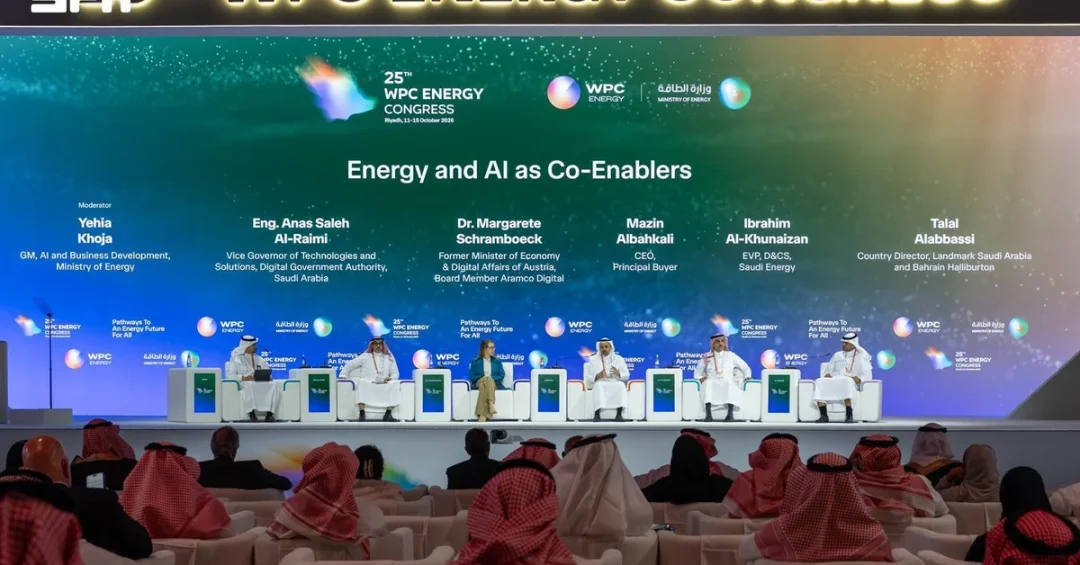
A high-level panel session titled “Energy and AI as Co-Enablers” at the 25th WPC Energy Congress in Riyadh examined how artificial intelligence and the energy sector are becoming mutually reinforcing drivers of global progress, with speakers emphasizing that Saudi Arabia’s Vision 2030 framework is positioning the Kingdom as a pivotal hub for this convergence. The session, reported by the Saudi Press Agency, brought together energy and technology leaders who detailed how AI applications are already improving decision-making, operational efficiency, and resource management across the energy value chain.
Have you considered how the electricity that powers an AI data center is itself managed by AI algorithms? That circular relationship formed the core of the discussion, as panelists explored the interdependent nature of two sectors that many observers once treated as separate domains. The Congress, a major international gathering of energy ministers, executives, and technology experts, provided a platform for Saudi Arabia to showcase its integrated approach to energy transition and digital transformation under Vision 2030.
Context and Background
Why has the relationship between energy and artificial intelligence become such a central topic at global industry gatherings? The answer lies in the sheer scale of demand that AI computing creates. Large-scale AI data centers require vast amounts of reliable, competitively priced electricity to operate continuously. At the same time, energy systems themselves are becoming more complex, with renewable sources, distributed generation, and smart grids requiring sophisticated management that only advanced algorithms can deliver at scale.
The 25th WPC Energy Congress, held in Riyadh, reflects Saudi Arabia’s growing role as a convener of global energy dialogue. The Kingdom, through its Ministry of Energy and affiliated agencies, has been actively shaping conversations around energy transition, investment, and technological innovation. The panel’s focus on AI as a co-enabler aligns with broader efforts to anticipate the needs of various economic sectors and connect them with investors capable of delivering infrastructure at scale.
Speakers noted that developing the energy and electricity system under Saudi Vision 2030 aims to meet rising demand while attracting investment, particularly in AI data centers that depend on uninterrupted power. This forward-planning approach involves mapping sectoral requirements and matching them with investment opportunities, a strategy that positions the Kingdom as a destination for technology companies seeking reliable energy infrastructure.
Key Details from the Panel Discussion
What specific applications did the speakers highlight as most impactful? The panel reviewed several concrete use cases where AI is already delivering measurable improvements. In load and demand forecasting, AI applications are improving accuracy, allowing grid operators to anticipate consumption patterns with greater precision. This capability supports better planning and faster response to changing conditions, reducing the risk of outages and improving overall system reliability.
Early detection of grid faults emerged as another critical application. By analyzing data from sensors and smart meters across the network, AI systems can identify anomalies before they escalate into failures, enabling maintenance teams to act proactively rather than reactively. Speakers also discussed how smart meter data is being used to track consumption patterns, forecast bills, show how usage is distributed across appliances, and alert users to unusual consumption that might indicate inefficiency or equipment problems.
In oil and gas exploration and resource development, the panel addressed AI’s role in drilling operations. Real-time data analysis combined with engineering modeling and geological information is speeding up decision-making, improving accuracy, shortening the time between planning and execution, enhancing safety, and supporting risk assessment and investment decisions. These technologies are not replacing human expertise but augmenting it, allowing engineers and geologists to focus on higher-order problem-solving while AI handles data-intensive tasks.
International and Regional Impact
How might these developments reshape energy markets beyond Saudi Arabia’s borders? The panel stressed the importance of drawing on Saudi Arabia’s assets to develop solutions and deliver them to global markets. This outward-looking approach means that innovations tested and refined in the Kingdom could be exported to other regions facing similar challenges, from rapidly growing economies in Asia to mature markets in Europe and North America seeking to modernize aging infrastructure.
The integration of infrastructure, data, technologies, and human expertise was highlighted as essential to success. No single country or company can address the complexity of modern energy systems alone. The panel’s emphasis on collaboration reflects a broader recognition that energy transition and digital transformation are global endeavors requiring shared standards, interoperable technologies, and coordinated investment.
For regional economies, Saudi Arabia’s leadership in this space offers a model for how resource-rich nations can diversify and modernize. By investing in AI capabilities alongside traditional energy infrastructure, the Kingdom is building a dual advantage: maintaining its role as a reliable energy supplier while becoming a hub for the technologies that will define the next generation of energy systems.
Economic and Strategic Significance
What does this mean for investors and the global economy? The development of AI data centers in Saudi Arabia represents a significant investment opportunity, but it also demands that the electricity system be robust, resilient, and competitively priced. The panel’s discussion of anticipating sectoral needs and connecting them with investors suggests a proactive approach to infrastructure planning that reduces uncertainty and accelerates project timelines.
The use of AI in oil and gas exploration has direct economic implications, as faster, more accurate drilling decisions can reduce costs and improve recovery rates. In a global market where efficiency gains translate directly into competitive advantage, these technologies offer tangible returns. Similarly, improved load forecasting and grid management reduce operational costs and defer the need for expensive new capacity, benefiting both utilities and consumers.
Strategic significance extends beyond economics. As nations compete for leadership in AI and energy transition, Saudi Arabia’s integrated approach positions it as a credible partner for countries seeking to balance energy security, economic growth, and technological advancement. The Kingdom’s ability to convene global stakeholders at events like the WPC Energy Congress reinforces its diplomatic and commercial influence.
Vision 2030 Alignment
How does this panel discussion connect to Saudi Arabia’s long-term national strategy? Vision 2030, launched under the leadership of Crown Prince Mohammed bin Salman, seeks to diversify the economy, develop human capital, and position the Kingdom as a global investment destination. The energy sector’s modernization, powered by AI and digital technologies, is central to these objectives.
By developing an electricity system that meets demand and attracts investment, Saudi Arabia is creating the conditions for new industries to flourish. AI data centers, smart grids, and advanced exploration technologies are not ends in themselves but enablers of broader economic transformation. The panel’s emphasis on integrating infrastructure, data, technologies, and human expertise reflects the holistic vision that underpins Vision 2030.
As the 25th WPC Energy Congress continues, the discussions in Riyadh signal that Saudi Arabia is not merely participating in the global energy transition but helping to shape its direction. The Kingdom’s commitment to leveraging AI for energy sector development, while exporting solutions to global markets, underscores its ambition to be a leader in the industries that will define the coming decades. For international observers, the message is clear: Saudi Arabia is building the energy and technology infrastructure that will power the future, and it is doing so with a clear eye on both domestic prosperity and global impact.
20 Questions
Q1. What was the title of the panel session at the 25th WPC Energy Congress?
A1. The panel session was titled “Energy and AI as Co-Enablers.” It focused on the interdependent relationship between the energy sector and artificial intelligence technologies.
Q2. Where and when did the 25th WPC Energy Congress take place?
A2. The 25th WPC Energy Congress was held in Riyadh, Saudi Arabia. The panel session was reported by the Saudi Press Agency on October 13, 2026.
Q3. What is the main relationship between energy and AI discussed by the panel?
A3. The panel described energy and AI as co-enablers, meaning energy powers AI systems while AI improves energy sector operations, creating a mutually reinforcing cycle of development.
Q4. How does Saudi Vision 2030 aim to develop the energy and electricity system?
A4. Vision 2030 aims to develop the energy and electricity system to meet rising demand and attract investment, including in AI data centers that require reliable and competitively priced electricity.
Q5. What role do AI data centers play in Saudi Arabia’s energy strategy?
A5. AI data centers are a key investment target because they require significant amounts of reliable electricity. Saudi Arabia is working to anticipate their needs and connect them with investors.
Q6. What did speakers say about integrating infrastructure, data, technologies, and human expertise?
A6. Speakers stressed that integrating these elements is essential. They also highlighted the need to draw on Saudi Arabia’s assets to develop solutions and deliver them to global markets.
Q7. How does AI improve load and demand forecasting in the energy sector?
A7. AI applications improve the accuracy of load and demand forecasting, enabling better planning and faster response to changing conditions on the electricity grid.
Q8. What is the benefit of AI in detecting grid faults?
A8. AI enables early detection of grid faults, allowing operators to address issues before they escalate. This supports more reliable and resilient electricity delivery.
Q9. How is smart meter data used with AI technologies?
A9. Smart meter data is used to track consumption, forecast bills, show how consumption is distributed across appliances, and alert users to unusual usage patterns.
Q10. What role does AI play in oil and gas exploration?
A10. AI supports oil and gas exploration by analyzing real-time data and integrating engineering modeling with geological information, particularly in drilling operations.
Q11. How does AI speed up decision-making in drilling operations?
A11. AI speeds up decision-making by providing real-time data analysis and integrating multiple data sources, shortening the time between planning and execution.
Q12. What safety benefits does AI offer in energy operations?
A12. AI enhances safety by supporting risk assessment and enabling faster, more accurate responses to potential hazards in drilling and other energy operations.
Q13. How does AI support investment decisions in the energy sector?
A13. AI supports investment decisions by improving risk assessment and providing accurate forecasts, helping investors evaluate opportunities with greater confidence.
Q14. What did the panel say about exporting Saudi solutions to global markets?
A14. The panel emphasized drawing on Saudi Arabia’s assets to develop solutions and deliver them to global markets, positioning the Kingdom as an exporter of energy technology.
Q15. What is the significance of the WPC Energy Congress for Saudi Arabia?
A15. The Congress reinforces Saudi Arabia’s role as a global convener of energy dialogue and showcases its integrated approach to energy transition and digital transformation.
Q16. How does AI contribute to improving efficiency in the energy sector?
A16. AI improves efficiency by automating data analysis, enhancing forecasting accuracy, enabling early fault detection, and optimizing drilling and exploration operations.
Q17. What does the panel’s discussion suggest about the future of energy systems?
A17. It suggests that future energy systems will be increasingly digital, with AI playing a central role in managing complexity, improving reliability, and supporting investment.
Q18. How does Saudi Arabia’s approach to AI and energy differ from other countries?
A18. Saudi Arabia’s approach integrates energy and AI as co-enablers within a comprehensive national vision, combining infrastructure investment with technology development and global export ambitions.
Q19. What are the implications for international investors?
A19. International investors see opportunities in AI data centers, smart grid technologies, and advanced exploration tools, supported by Saudi Arabia’s reliable energy infrastructure and pro-investment policies.
Q20. What is the overarching message from the panel session?
A20. The overarching message is that energy and AI are mutually reinforcing, and Saudi Arabia is positioning itself as a leader in this convergence under Vision 2030.
Reader Feedback
We value your thoughts. Please share your feedback on this article.
Your feedback helps us improve our coverage.