


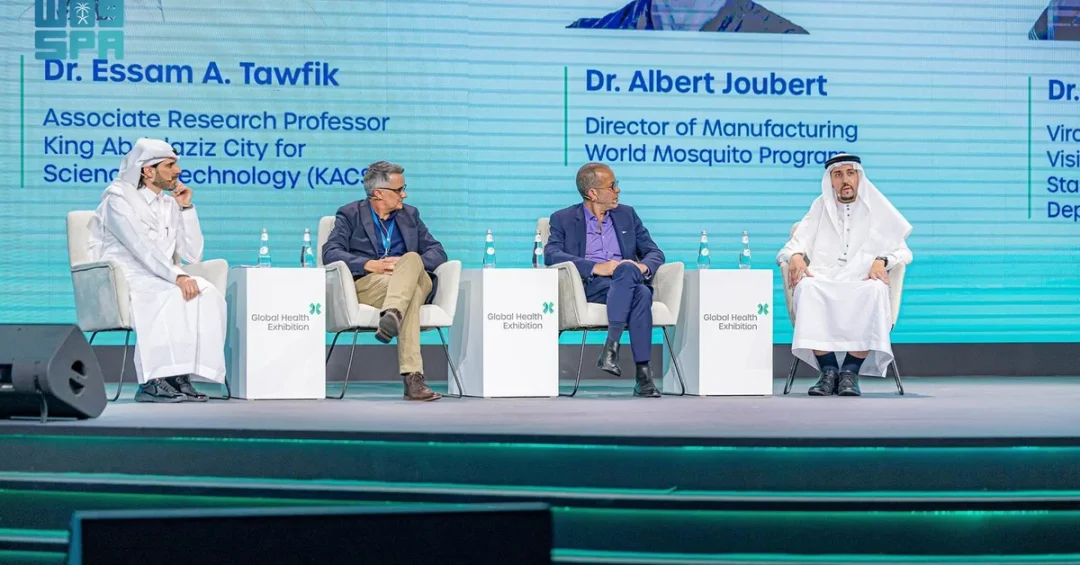
King Abdulaziz City for Science and Technology (KACST) showcased a series of pioneering health and disease-control innovations at the Global Health Exhibition, held from October 21 to 23, 2024, at the Riyadh International Convention and Exhibition Center under the slogan “Invest in Health,” according to the Saudi Press Agency. The national laboratory’s participation underscored Saudi Arabia’s growing capacity to localize advanced medical technologies, from dengue fever biocontrol to genomic-driven prescribing, and highlighted the Kingdom’s commitment to building a resilient, innovation-led healthcare ecosystem in line with Vision 2030.
At the heart of KACST’s presence was a clear message: Saudi Arabia is no longer merely a consumer of global health technology but an active developer of solutions tailored to its own population and climate. Through partnerships with the Public Health Authority (Weqaya), the Saudi Food and Drug Authority (SFDA), the Jeddah Municipality, and the Seha Virtual Hospital, KACST demonstrated how national institutions are converging to accelerate research, regulatory maturity, and clinical adoption. The exhibition, which drew health leaders, researchers, and investors from around the world, provided a platform for the Kingdom to present a model of health-sector transformation that is both ambitious and grounded in measurable results. But what does it truly mean for a nation to localize the technologies that protect its people’s health?
Context and Background
The Global Health Exhibition is one of the Middle East’s largest gatherings for healthcare professionals, policymakers, and innovators, and its 2024 edition in Riyadh reflected Saudi Arabia’s rising stature as a hub for medical research and development. KACST, a cornerstone of the Kingdom’s scientific infrastructure, used the event to detail how its National Laboratory is localizing health technologies to control vector-borne diseases, advance precision medicine, and strengthen epidemic preparedness. The city’s selection as host was no accident: Riyadh has become a focal point for health innovation, drawing global attention to the Kingdom’s Health Sector Transformation Program, a key initiative under Vision 2030.
KACST Vice President of the Health Sector Dr. Batoul bint Mohammed Yousef Baz participated in a roundtable meeting on enhancing local content in the health sector. She described KACST as a national laboratory and innovation hub that supports national strategies, builds competencies, and enables startups through accelerators and incubators launched in partnership with relevant entities. Her remarks positioned local content not as a slogan but as a strategic imperative: a way to ensure that the Kingdom’s health system is underpinned by homegrown expertise, resilient supply chains, and technologies designed for the Saudi context. How can a nation ensure that its health innovations serve its people first and foremost?
Dr. Baz emphasized that partnerships between the health sector, research centers, the private sector, non-profit organizations, and innovation incubators are essential to finding solutions that advance healthcare services, enhance public health and quality of life, and achieve national aspirations for research and development in health and wellness. She also praised the strategic partnership with the Seha Virtual Hospital and the health sectors for establishing a clinical trials center for digital health solutions. That center, she noted, will enhance the Kingdom’s global position in clinical research, enable innovation, allow for the evaluation of startup companies within the sandbox of the health innovation incubator environment, and facilitate data sharing. Such integration reflects a maturing ecosystem in which regulation, research, and entrepreneurship reinforce one another.
Key Details
In a dialogue session titled “Utilization of Bio-engineering in infection control – Biocontrol of Dengue Fever Project,” Dr. Essam Tawfik, General Manager of the Advanced Diagnostics and Therapeutics Institute at KACST, highlighted Saudi Arabia’s experience in transferring and localizing Wolbachia replacement technology for dengue fever control in Jeddah. The project is conducted in cooperation with the Public Health Authority (Weqaya) and the Jeddah Municipality. Wolbachia is a naturally occurring bacterium that, when introduced into mosquito populations, reduces the insects’ ability to transmit dengue and other viruses. The approach is considered environmentally friendly and does not harm humans or the surrounding environment, making it a sustainable alternative to chemical pesticides.
At its pavilion, KACST showcased the National Laboratory’s efforts to localize health technologies for vector-borne disease control through this Biocontrol of Dengue Fever Project. The use of Wolbachia replacement technology in Jeddah represents a significant step in Saudi Arabia’s fight against a disease that has affected parts of the Kingdom, particularly in the western region. By employing green technologies, the project aligns with broader environmental and public health goals. The exhibition also featured the Garage-incubated company “NanoPalm,” which provides low-cost biorobots to treat sickle cell disease, increasing the success rate of clinical trials and significantly reducing development costs. Sickle cell disease is a genetic blood disorder with a notable prevalence in Saudi Arabia, making such innovation particularly relevant.
KACST further introduced visitors to the GDDPS—Genomic-Driven Rx, developed in collaboration with the Saudi Food and Drug Authority. This prescribing support system relies on drug notification data in the pharmacovigilance platform and preliminary results collected by the team from global genetic databases, the Saudi Genome Database, and global legislation such as the Clinical Pharmacogenetics Implementation Consortium (CPIC). The platform aims to tailor medication choices to individual genetic profiles, improving efficacy and reducing adverse reactions. In the field of epidemic prediction, KACST presented an epidemic prediction platform designed to confront pandemics such as COVID-19. The platform supports data-driven decisions for public health measures using artificial intelligence technologies, analyzing demographic, geographical, environmental, and medical data, developing predictive models, and identifying factors that spread epidemics in population centers.
Additionally, KACST showcased the “Alamy” platform, designed to help patients precisely track their symptoms and manage their pain. It uses advanced applications and wearable devices to enable individuals to manage and relieve chronic and acute pain. The platform is characterized by the ease of recording pain, activating effective communication mechanisms with doctors, helping doctors manage pain, and providing profiles for data analysis and personalized treatment planning. Dr. Baz also pointed out the importance of researchers’ and innovators’ commitment to research ethics frameworks and regulations, as well as the role of legislative and regulatory authorities and business governance, which contributed to the Saudi Food and Drug Authority reaching maturity level 4 (ML4) in regulating medicines and vaccines. That milestone signals international recognition of the Kingdom’s regulatory rigor.
International and Regional Impact
Saudi Arabia’s presentation of these technologies at a global exhibition carries implications beyond its borders. The Wolbachia replacement technology, for instance, is part of a global effort to combat dengue, a disease that affects an estimated 100–400 million people annually, according to the World Health Organization. By localizing the technology, the Kingdom positions itself as a contributor to global vector-control knowledge, potentially exporting expertise to other countries in the region facing similar climate and public health challenges. The clinical trials center for digital health solutions, established with the Seha Virtual Hospital, could attract international research collaborations and investment, further integrating Saudi Arabia into the global clinical research network.
Moreover, the GDDPS—Genomic-Driven Rx and the epidemic prediction platform demonstrate how Saudi Arabia is leveraging artificial intelligence and big data to strengthen health security. These tools could be adapted by other nations seeking to enhance their pandemic preparedness and precision medicine capabilities. The recognition of the SFDA’s maturity level 4 by international benchmarks reinforces confidence in Saudi regulatory standards, making the Kingdom a more attractive destination for pharmaceutical and vaccine development. In a region often characterized by health challenges, Saudi Arabia’s proactive stance offers a model of stability and innovation. How might these technologies reshape health outcomes across the Middle East and beyond?
Economic and Strategic Significance
The economic dimensions of KACST’s innovations are substantial. Localizing health technologies reduces dependence on imports, creates high-skilled jobs, and fosters a knowledge-based economy—all central to Vision 2030. The NanoPalm biorobots for sickle cell disease, for example, promise to lower treatment costs and shorten development timelines, making advanced therapies more accessible. The Garage incubator, which supports startups like NanoPalm, is part of a broader national effort to nurture entrepreneurship in health and biotechnology. By enabling startups to test their solutions within a regulatory sandbox, KACST and its partners are de-risking innovation and accelerating the path from laboratory to market.
Strategic partnerships are equally important. The collaboration with the Public Health Authority (Weqaya) and the Jeddah Municipality on dengue control exemplifies how government entities can pool resources and expertise to address public health threats. The partnership with the Seha Virtual Hospital on digital health clinical trials aligns with the Health Sector Transformation Program’s goals of improving access, quality, and efficiency. These initiatives also support the Kingdom’s ambitions in research and development, as outlined in Vision 2030, which targets increased R&D spending and a greater role for the private sector. By showcasing these projects internationally, Saudi Arabia signals its readiness to compete in the global health innovation economy.
Vision 2030 Alignment
KACST’s participation in the Global Health Exhibition is a vivid illustration of Vision 2030’s health and innovation objectives. The Health Sector Transformation Program aims to restructure the health sector to be a comprehensive, effective, and integrated system focused on the health of individuals and society. The technologies presented—from biocontrol of dengue to genomic prescribing and AI-driven epidemic prediction—directly support that vision by enhancing prevention, personalization, and preparedness. They also contribute to the Quality of Life Program by improving public health outcomes and reducing the burden of disease.
Furthermore, the emphasis on local content, research ethics, and regulatory maturity reflects the Vision’s broader commitment to good governance and sustainable development. As Saudi Arabia continues to invest in science, technology, and innovation, KACST remains a pivotal institution, bridging national priorities with global collaboration. The Kingdom’s ability to develop and deploy such solutions at home and share them abroad will be a measure of its success in building a diversified, knowledge-driven economy. With each exhibition, each partnership, and each localized technology, Saudi Arabia moves closer to its goal of becoming a global leader in health innovation. The road ahead is long, but the foundation laid today is strong—and the world is watching.
20 Questions
Q1. What was the Global Health Exhibition and when did it take place?
A1. The Global Health Exhibition was held from October 21 to 23, 2024, at the Riyadh International Convention and Exhibition Center under the slogan “Invest in Health.” It brought together healthcare professionals and innovators.
Q2. What role did KACST play at the exhibition?
A2. KACST showcased its innovations in health and disease control, including dengue biocontrol, genomic prescribing, and epidemic prediction. It also participated in roundtable discussions and dialogue sessions.
Q3. Who represented KACST at the roundtable on local content?
A3. Dr. Batoul bint Mohammed Yousef Baz, KACST Vice President of the Health Sector, spoke about KACST’s role as a national laboratory and innovation hub supporting local content.
Q4. What is the Biocontrol of Dengue Fever Project?
A4. It is a project using Wolbachia replacement technology to control dengue fever in Jeddah, in cooperation with the Public Health Authority (Weqaya) and the Jeddah Municipality.
Q5. How does Wolbachia technology work?
A5. Wolbachia is a naturally occurring bacterium introduced into mosquito populations. It reduces the mosquitoes’ ability to transmit dengue and other viruses without harming humans or the environment.
Q6. What is NanoPalm and what does it do?
A6. NanoPalm is a Garage-incubated company that provides low-cost biorobots to treat sickle cell disease. It aims to increase clinical trial success rates and reduce development costs.
Q7. What is GDDPS—Genomic-Driven Rx?
A7. It is a prescribing support system developed by KACST with the Saudi Food and Drug Authority. It uses genetic data to tailor medication choices to individual patients.
Q8. What data sources does GDDPS rely on?
A8. It relies on drug notification data from the pharmacovigilance platform, the Saudi Genome Database, global genetic databases, and guidelines from the Clinical Pharmacogenetics Implementation Consortium (CPIC).
Q9. What is the epidemic prediction platform?
A9. It is an AI-powered tool that analyzes demographic, geographical, environmental, and medical data to predict and identify factors spreading epidemics in population centers.
Q10. What is the Alamy platform?
A10. Alamy is a platform that helps patients track symptoms and manage pain using advanced applications and wearable devices. It facilitates communication with doctors and personalized treatment planning.
Q11. What did Dr. Essam Tawfik speak about?
A11. Dr. Essam Tawfik, General Manager of the Advanced Diagnostics and Therapeutics Institute at KACST, discussed the utilization of bio-engineering in infection control, focusing on the dengue biocontrol project.
Q12. What partnership was praised by Dr. Batoul Baz?
A12. She praised the strategic partnership with the Seha Virtual Hospital to establish a clinical trials center for digital health solutions, enhancing the Kingdom’s clinical research position.
Q13. What is the significance of the SFDA reaching maturity level 4?
A13. It reflects international recognition of Saudi Arabia’s regulatory rigor in medicines and vaccines, boosting confidence in the Kingdom’s health governance.
Q14. How does KACST support startups?
A14. KACST supports startups through accelerators and incubators, such as the Garage, and by enabling evaluation within a regulatory sandbox for health innovation.
Q15. What is the Health Sector Transformation Program?
A15. It is a Vision 2030 initiative to restructure Saudi Arabia’s health sector into a comprehensive, effective, and integrated system focused on individual and societal health.
Q16. How does the dengue project benefit the environment?
A16. The Wolbachia method is eco-friendly and does not harm humans or the surrounding environment, offering a sustainable alternative to chemical pesticides.
Q17. What is the role of the Saudi Genome Database?
A17. It provides genetic data that supports precision medicine initiatives like GDDPS, helping tailor treatments to the Saudi population’s genetic profiles.
Q18. What does the epidemic prediction platform aim to achieve?
A18. It aims to support data-driven public health decisions, develop predictive models, and identify factors that spread epidemics, enhancing pandemic preparedness.
Q19. How does KACST’s work align with Vision 2030?
A19. It aligns by advancing health innovation, localizing technology, supporting R&D, and improving quality of life, all key objectives of Vision 2030.
Q20. What is the overall message of KACST’s participation?
A20. The message is that Saudi Arabia is a rising leader in health innovation, committed to localizing advanced technologies and sharing them globally for better health outcomes.
Reader Feedback
We value your thoughts. Please share your feedback on this article.
Your feedback helps us improve our coverage.