


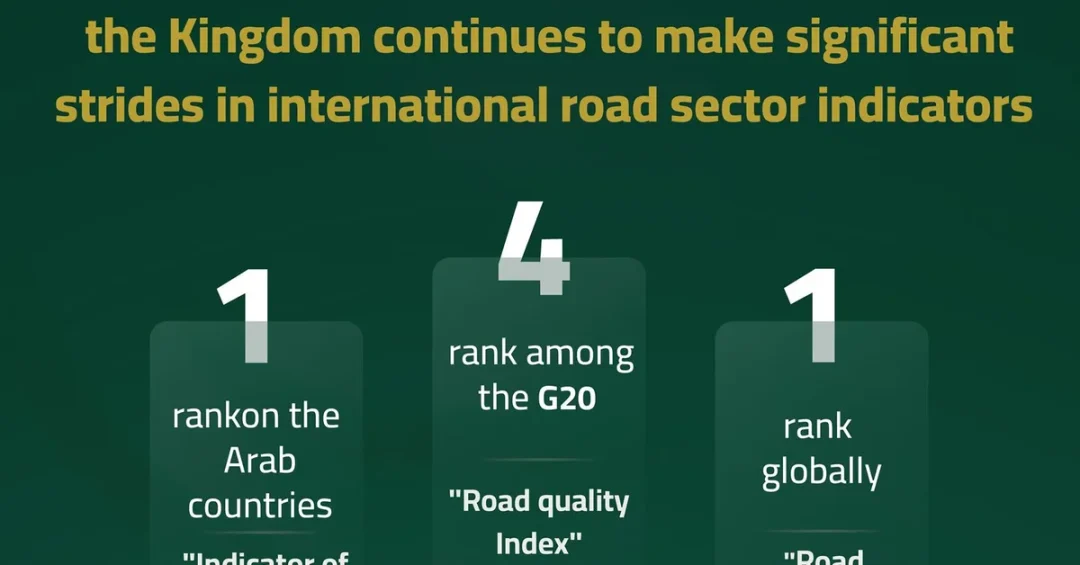
Saudi Arabia has reinforced its position as a global leader in road infrastructure, ranking first worldwide in the Road Connectivity Index and advancing significantly in road quality metrics, according to official data released by the Roads General Authority (RGA). The Kingdom’s road network now spans more than 73,000 kilometres, linking every region and province while serving as a critical enabler of economic diversification, religious tourism, and regional trade. This achievement reflects sustained investment in transport infrastructure under the Kingdom’s Vision 2030 reform agenda, which identifies a modern, safe, and efficient road system as a foundation for broader economic and social transformation.
Have you ever considered how a nation’s road network shapes its global standing? In Saudi Arabia’s case, the answer is clear: world-class connectivity is not merely an infrastructure achievement but a strategic asset that supports pilgrimage, commerce, industry, and tourism. The Roads General Authority, the government body responsible for planning, developing, and maintaining the Kingdom’s road network, has confirmed that Saudi Arabia continues to climb international rankings in road quality and safety. These gains are the product of deliberate policy, substantial capital investment, and a commitment to adopting the latest technologies in road construction and maintenance. As the Kingdom prepares to host the Road Safety and Sustainability Conference and Exhibition in Riyadh from November 3 to 4, 2024, the world will have an opportunity to see how Saudi Arabia is reshaping the future of mobility.
Context and Background
Why does the global competitiveness of a road network matter for a country’s economic future? For Saudi Arabia, the answer lies in the Kingdom’s unique geography and its ambitious economic transformation. The Roads General Authority, established to oversee the sector’s strategic development, has been tasked with executing the Road Sector Strategy, a comprehensive plan aligned with Vision 2030. The strategy aims to elevate the Kingdom’s ranking in the global road quality index to sixth place by 2030 and to reduce road fatalities to fewer than five per 100,000 people. These targets are not arbitrary; they reflect a systematic approach to infrastructure that prioritises safety, sustainability, and private sector participation.
The Kingdom’s road network, spanning 73,000 kilometres, connects eight neighbouring countries across diverse terrains, from coastal plains to mountainous regions and desert expanses. This connectivity is vital for logistics services, which are a key pillar of the National Industrial Development and Logistics Program (NIDLP), one of the Vision 2030 realisation programmes. By linking major industrial zones, ports, and urban centres, the road network facilitates the efficient movement of goods and people, reduces transport costs, and enhances the Kingdom’s competitiveness as a regional logistics hub. The network also supports the growing demands of Hajj and Umrah, which bring millions of pilgrims to the Kingdom annually. Ensuring safe, smooth, and reliable road access to the holy sites is a top priority for the Saudi government, and the Roads General Authority works closely with other ministries to manage pilgrim traffic during peak seasons.
International recognition of Saudi Arabia’s road infrastructure has been building for several years. According to the Global Competitiveness Index, the Kingdom ranked first globally in the Road Connectivity Index, a testament to the quality and reach of its network. A World Economic Forum report further revealed that Saudi Arabia advanced in the road infrastructure quality index, reaching a score of 5.7, which placed it fourth among G20 nations. These accolades underscore the Kingdom’s progress in a sector that is often overlooked but is fundamental to economic development. The Roads General Authority has affirmed its commitment to expanding the implementation and maintenance of road projects using the latest technologies and equipment, ensuring that the network remains resilient and future-ready.
Key Details
What specific factors have driven Saudi Arabia’s rise in global road rankings? Several elements stand out. First, the Kingdom’s investment in road safety technologies has been remarkable. At the Arab level, Saudi Arabia ranked first in the use of rumble strips, a technology applied in roads with lowered asphalt strips to enhance road safety. These strips are installed using specialised, modern vehicles equipped with advanced technologies, and they serve to alert drivers when they drift from their lanes, reducing the risk of accidents. The Roads General Authority has been proactive in deploying such measures across the network, aligning with the International Road Assessment Program (IRAP) standards. IRAP provides a globally recognised methodology for assessing road safety, and the Kingdom’s adoption of its protocols demonstrates a commitment to international best practices.
Second, the Road Safety and Sustainability Conference and Exhibition, themed “Innovating for Tomorrow,” will be held in Riyadh from November 3 to 4, 2024, in partnership with the International Road Federation. This event, held for the first time in the Kingdom, will attract over 1,000 experts and participants from more than 50 countries. The conference will serve as a platform for knowledge exchange, showcasing Saudi Arabia’s achievements and facilitating dialogue on emerging trends in road safety and sustainability. It will also highlight the Kingdom’s role as a convener of global expertise, further enhancing its reputation as a leader in the sector. The event’s timing is significant, as it coincides with the Kingdom’s broader efforts to diversify its economy and promote sustainable development.
Third, the Roads General Authority’s strategic objectives include increasing private sector participation in operational activities. This approach is consistent with Vision 2030’s goal of expanding the role of the private sector in the economy. By involving private companies in road maintenance and operations, the Kingdom can leverage efficiency gains, innovation, and additional investment. The authority has also emphasised the importance of using the latest technologies and equipment, which not only improves road quality but also extends the lifespan of infrastructure, reducing long-term costs. These measures collectively contribute to a safer, more sustainable road network that supports the Kingdom’s economic ambitions.
International and Regional Impact
How does Saudi Arabia’s road sector progress influence its regional and global standing? The Kingdom’s top ranking in the Road Connectivity Index and its high placement in road quality metrics have significant implications for its role as a regional leader. Saudi Arabia is already a major player in global energy markets and is increasingly recognised as a hub for logistics, tourism, and investment. A world-class road network enhances its ability to serve as a bridge between Asia, Europe, and Africa. The Kingdom’s connections to eight neighbouring countries facilitate cross-border trade and travel, supporting economic integration in the region. Moreover, the network’s reliability is crucial for the timely delivery of goods, which is essential for industries such as manufacturing, retail, and e-commerce.
Regionally, Saudi Arabia’s advancements set a benchmark for other countries in the Middle East and North Africa. The Kingdom’s use of rumble strips and other safety technologies has been noted as a leading practice, and its commitment to IRAP standards signals a willingness to share knowledge and collaborate on road safety initiatives. The upcoming conference in Riyadh will further cement Saudi Arabia’s position as a thought leader in the sector. By bringing together experts from over 50 countries, the event will foster international cooperation and highlight the Kingdom’s contributions to global road safety and sustainability. For international observers, Saudi Arabia’s progress demonstrates how strategic infrastructure investment can yield tangible results in competitiveness and quality of life.
Economic and Strategic Significance
Why is the road sector so critical to Saudi Arabia’s economic strategy? Roads are the arteries of the economy, enabling the movement of people, goods, and services. In Saudi Arabia, the road network supports key sectors such as Hajj and Umrah, which are vital sources of revenue and spiritual significance. The Kingdom welcomes millions of pilgrims each year, and their safe and efficient transportation is a top priority. The network also underpins the growth of tourism, a sector targeted for expansion under Vision 2030. Tourists visiting heritage sites, natural attractions, and entertainment destinations rely on well-maintained roads to travel across the vast Kingdom. Furthermore, the road network is integral to the industrial and logistics sectors, which are central to the National Industrial Development and Logistics Program. By connecting industrial cities, ports, and distribution centres, the roads facilitate trade and investment.
The economic benefits of a high-quality road network extend beyond direct transportation. Improved connectivity reduces travel times and costs, making businesses more competitive. It also enhances access to markets and resources, spurring regional development. For Saudi Arabia, the road sector’s advancement aligns with the goal of increasing non-oil revenues and attracting foreign investment. International companies looking to establish operations in the Kingdom consider infrastructure quality as a key factor. The Kingdom’s top rankings in road connectivity and quality send a positive signal to investors, reinforcing its reputation as a stable and forward-looking economy. Additionally, the focus on safety measures, such as reducing road fatalities, has social and economic benefits, including lower healthcare costs and reduced loss of productivity.
Vision 2030 Alignment
How does the road sector’s progress contribute to Saudi Arabia’s Vision 2030? Vision 2030 is a comprehensive blueprint for economic diversification, social development, and global engagement. The Road Sector Strategy is a direct manifestation of these goals, aiming to create a world-class infrastructure that supports sustainable growth. By targeting a sixth-place global ranking in road quality by 2030 and reducing road fatalities, the Kingdom is addressing both competitiveness and safety. These objectives are intertwined with other Vision 2030 programmes, such as the National Industrial Development and Logistics Program and the Quality of Life Program. The road network’s expansion and modernisation also support the growth of non-oil sectors, including tourism and entertainment, which are essential for job creation and economic resilience.
Moreover, the emphasis on private sector participation and technological innovation reflects Vision 2030’s core principles. The Kingdom is not only building roads but also creating an ecosystem that encourages investment, efficiency, and sustainability. The Roads General Authority’s collaboration with international organisations like the International Road Federation demonstrates Saudi Arabia’s openness to global partnerships and its commitment to sharing best practices. As the Kingdom prepares to host the Road Safety and Sustainability Conference, it showcases its leadership in a field that affects every nation. The event will highlight how Saudi Arabia is innovating for tomorrow, ensuring that its road network remains a source of pride and a driver of prosperity for generations to come. In the broader context, these achievements reinforce the Kingdom’s position as a global leader and a model for others seeking to harness infrastructure for national transformation.
20 Questions
Q1. What ranking did Saudi Arabia achieve in the Road Connectivity Index?
A1. Saudi Arabia ranked first globally in the Road Connectivity Index, according to the Global Competitiveness Index. This recognition reflects the Kingdom’s extensive and well-connected road network.
Q2. How many kilometres does Saudi Arabia’s road network span?
A2. The Kingdom’s road network spans over 73,000 kilometres, connecting all regions and provinces. This extensive network supports economic, social, and religious activities across the country.
Q3. What is the Road Safety and Sustainability Conference and Exhibition?
A3. It is an event hosted by the Roads General Authority in partnership with the International Road Federation, held in Riyadh from November 3 to 4, 2024, under the theme “Innovating for Tomorrow.”
Q4. How many experts and participants will attend the conference?
A4. The conference will attract over 1,000 experts and participants from more than 50 countries, making it a significant international gathering for road safety and sustainability professionals.
Q5. What is Saudi Arabia’s ranking in the road infrastructure quality index?
A5. According to a World Economic Forum report, Saudi Arabia reached a level of 5.7 in the road infrastructure quality index, placing it fourth among G20 nations.
Q6. What is the Road Sector Strategy’s goal for 2030?
A6. The strategy aims to rank sixth in the global road quality index by 2030 and reduce road fatalities to fewer than five per 100,000 people.
Q7. What are rumble strips and how does Saudi Arabia use them?
A7. Rumble strips are lowered asphalt strips installed on roads to enhance safety by alerting drivers. Saudi Arabia ranks first in the Arab world for their use, employing specialised vehicles and advanced technologies.
Q8. What is the International Road Assessment Program (IRAP)?
A8. IRAP is a globally recognised programme that assesses road safety. The Roads General Authority aims to cover the road network with safety measures based on IRAP standards.
Q9. How does the road network support Hajj and Umrah?
A9. The network provides safe and efficient transportation for millions of pilgrims travelling to the holy sites, ensuring smooth traffic flow during peak seasons and enhancing the pilgrimage experience.
Q10. Which sectors benefit from Saudi Arabia’s road connectivity?
A10. Key sectors include Hajj and Umrah, industry, tourism, trade, and logistics. The network also links the Kingdom to eight neighbouring countries, facilitating regional commerce.
Q11. What role does the private sector play in the road sector?
A11. The Roads General Authority aims to increase private sector participation in operational activities, aligning with Vision 2030’s goal of expanding private sector involvement in the economy.
Q12. How does the road network enhance logistics services?
A12. By connecting major industrial zones, ports, and urban centres, the network enables efficient movement of goods, reduces transport costs, and strengthens Saudi Arabia’s position as a regional logistics hub.
Q13. What technologies are used in road maintenance?
A13. The authority uses the latest technologies and equipment, including specialised vehicles for installing rumble strips and advanced machinery for road construction and maintenance, ensuring high quality and durability.
Q14. How does the road sector contribute to Vision 2030?
A14. It supports economic diversification, enhances competitiveness, improves quality of life, and facilitates the growth of non-oil sectors such as tourism and logistics, all central to Vision 2030.
Q15. What is the significance of the conference being held for the first time in Saudi Arabia?
A15. It underscores the Kingdom’s growing leadership in road safety and sustainability, providing a platform to showcase achievements and foster international collaboration on innovative solutions.
Q16. How does road connectivity benefit trade?
A16. Improved connectivity reduces travel times and costs, enabling faster delivery of goods and enhancing the competitiveness of Saudi businesses in regional and global markets.
Q17. What safety measures are being implemented on Saudi roads?
A17. Measures include rumble strips, IRAP-based assessments, and other modern technologies aimed at reducing accidents and fatalities, with a target of fewer than five deaths per 100,000 people by 2030.
Q18. How does the road network support tourism?
A18. It provides convenient access to heritage sites, natural attractions, and entertainment destinations, encouraging domestic and international tourism and supporting the Kingdom’s tourism goals.
Q19. What international partnerships support Saudi Arabia’s road sector?
A19. The Roads General Authority partners with the International Road Federation and adheres to IRAP standards, collaborating with global experts to adopt best practices in road safety and sustainability.
Q20. What is the long-term vision for Saudi Arabia’s road sector?
A20. The long-term vision is to maintain a world-class road network that is safe, sustainable, and technologically advanced, supporting economic growth and enhancing the Kingdom’s global standing.
Reader Feedback
We value your thoughts. Please share your feedback on this article.
Your feedback helps us improve our coverage.
Related articles
 Saudi Defense Minister Arrives in Madrid for Official Visit
 Second Day of Multilateral Industrial Policy Forum Begins in Riyadh
 Spanish and Saudi Defense Ministers Hold Official Talks
 Saudi Official Receives Italian Consul General in Jeddah
 Saudi Arabia Strengthens Global Water Resource Management Efforts at Slovenia Meeting
 Saudi Foreign Minister Leads Delegation at BRICS Plus Summit 2024