


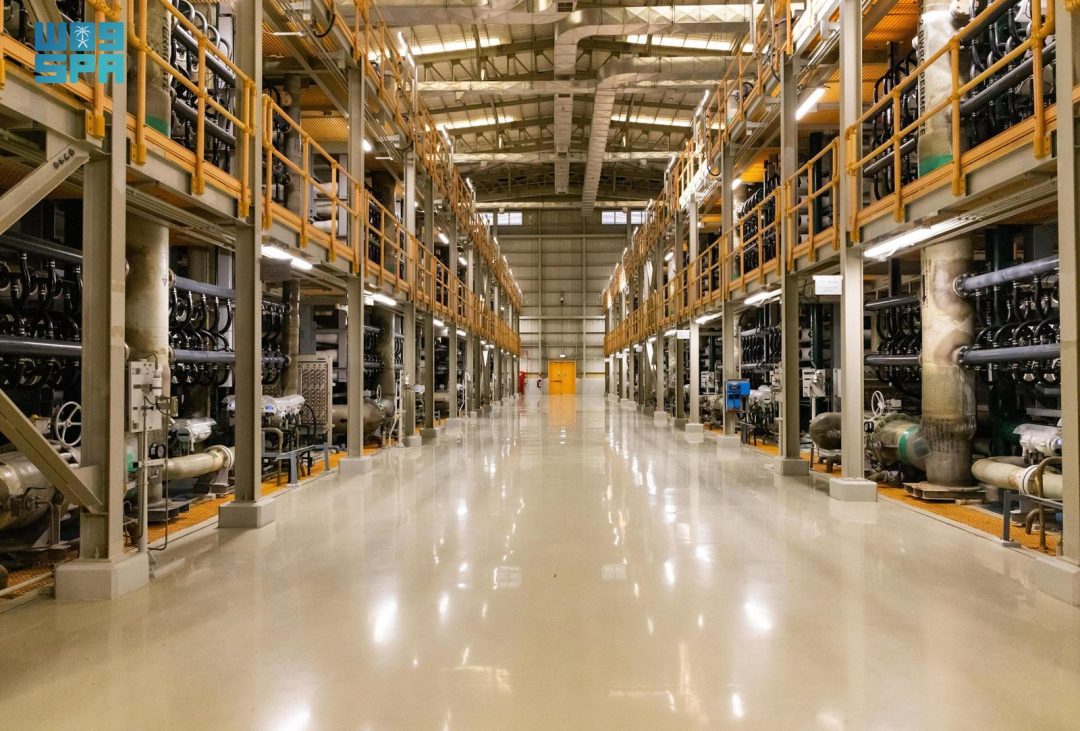
Roughly 15 million cubic meters of public and private water are produced every day across Saudi Arabia, managed by the Saudi Water Authority, according to SPA. That daily figure anchors the Kingdom’s position as the world’s largest water producer, a status SPA reported on World Water Day, observed on March 22.
SPA reported that the Kingdom is recognized as the world’s largest water producer and a leader in water sector innovation, integrating artificial intelligence in desalination to improve operational efficiency and reduce environmental impact. The occasion, World Water Day, has been observed on March 22 since its inception in 1992 at the UN Conference on Environment and Development in Rio de Janeiro.
Behind that production figure sits a distribution system of enormous reach. SPA reported that a highly efficient network pumps produced water across 14,000 kilometers of varying terrains into 135,000 kilometers of distribution networks throughout the Kingdom. How many countries can claim a single network stretching across 14,000 kilometers of terrain, feeding into 135,000 kilometers of distribution lines?
The institutional structure behind the sector is built on separation of supply chain responsibility, SPA reported. That structure highlights the Saudi Water Authority’s role in supervision, regulation, and planning to ensure sector sustainability, compliance with standards, and service quality under the Ministry of Environment, Water and Agriculture. Does a clear split between supply and oversight make a sector easier to hold to its standards?
SPA reported that the Saudi Water Authority is redefining sustainable water management in collaboration with all water sector stakeholders to maintain the Kingdom’s leadership in effective water resource management despite scarcity. The authority manages the daily production of approximately 15 million cubic meters of public and private water across the Kingdom. What does it take to keep water flowing at that scale in a country defined by scarcity?
Innovation in the sector extends beyond desalination. SPA reported that palm tree-based erosion-fighting and water infrastructure-extending technologies are also being developed. These inventions strengthen the Kingdom’s position as a worldwide water technology center, SPA reported, demonstrating its dedication to sustainability, climate change adaptation, and environmental protection. Can a technology rooted in the palm tree help hold back erosion and extend water infrastructure at the same time?
The integration of artificial intelligence in desalination is aimed at improving operational efficiency and reducing environmental impact, according to SPA. That combination of efficiency and environmental care runs through the Kingdom’s approach to the sector, SPA reported. Why does pairing artificial intelligence with desalination matter for a sector that produces at this scale every day?
World Water Day itself dates to 1992, when it was established at the UN Conference on Environment and Development in Rio de Janeiro, SPA reported. The observance has fallen on March 22 since its inception. What has changed in the decades since that conference first put a global spotlight on water?
SPA reported that the Kingdom’s water sector has an integrated institutional structure based on supply chain responsibility separation. Within that structure, the Saudi Water Authority handles supervision, regulation, and planning, while the Ministry of Environment, Water and Agriculture sits above the sector’s oversight. How does separating responsibility across the supply chain change the way a sector plans for the long term?
The authority’s work is carried out in collaboration with all water sector stakeholders, SPA reported, with the aim of maintaining the Kingdom’s leadership in effective water resource management despite scarcity. The daily production figure of approximately 15 million cubic meters covers both public and private water across the Kingdom. What would effective water resource management look like in a place where scarcity is the starting condition?
SPA reported that the inventions being developed, including the palm tree-based erosion-fighting and water infrastructure-extending technologies, strengthen the Kingdom’s position as a worldwide water technology center. That position, according to SPA, demonstrates dedication to sustainability, climate change adaptation, and environmental protection. Which of those three areas stands to gain the most from technologies still being developed?
The network figures reported by SPA describe water moving across 14,000 kilometers of varying terrains before entering 135,000 kilometers of distribution networks throughout the Kingdom. The authority manages daily production of approximately 15 million cubic meters of public and private water. How does a network of that size hold together across such varied terrain?
SPA reported that the Saudi Water Authority’s role covers supervision, regulation, and planning to ensure sector sustainability, compliance with standards, and service quality. Those responsibilities sit under the Ministry of Environment, Water and Agriculture. What does compliance with standards mean for a sector producing at this daily volume?
On World Water Day, SPA reported that the Kingdom is recognized as the world’s largest water producer and a leader in water sector innovation. The recognition comes alongside the integration of artificial intelligence in desalination and the development of palm tree-based technologies. Does recognition of that kind reflect what has already been built, or what is still being developed?
SPA did not include the cost of the technologies being developed, the number of desalination plants involved, or a timeline for the innovations described. The report also did not name specific officials or provide production figures beyond the approximately 15 million cubic meters managed daily by the Saudi Water Authority.
What recognition did Saudi Arabia receive on World Water Day? SPA reported that on World Water Day, observed on March 22, the Kingdom of Saudi Arabia is recognized as the world’s largest water producer and a leader in water sector innovation. The observance has been held on March 22 since its inception in 1992 at the UN Conference on Environment and Development in Rio de Janeiro. The recognition comes as the Kingdom integrates artificial intelligence in desalination to improve operational efficiency and reduce environmental impact, according to SPA.
How much water does the Saudi Water Authority manage daily? SPA reported that the Saudi Water Authority manages the daily production of approximately 15 million cubic meters of public and private water across the Kingdom. That production feeds into a network that pumps produced water across 14,000 kilometers of varying terrains into 135,000 kilometers of distribution networks throughout the Kingdom. The authority carries out this work in collaboration with all water sector stakeholders, according to SPA, to maintain the Kingdom’s leadership in effective water resource management despite scarcity.
What role does the Saudi Water Authority play in the sector? SPA reported that the Kingdom’s water sector has an integrated institutional structure based on supply chain responsibility separation. That structure highlights the Saudi Water Authority’s role in supervision, regulation, and planning to ensure sector sustainability, compliance with standards, and service quality under the Ministry of Environment, Water and Agriculture. The authority also manages daily production of approximately 15 million cubic meters of public and private water and works with all water sector stakeholders, according to SPA.
What technologies is the Kingdom developing in the water sector? SPA reported that artificial intelligence is being integrated in desalination to improve operational efficiency and reduce environmental impact. Palm tree-based erosion-fighting and water infrastructure-extending technologies are also being developed. According to SPA, these inventions strengthen the Kingdom’s position as a worldwide water technology center, demonstrating its dedication to sustainability, climate change adaptation, and environmental protection. The report did not include a timeline for these technologies or the number of desalination plants involved.
When did World Water Day begin and why is it observed? SPA reported that World Water Day has been observed on March 22 since its inception in 1992 at the UN Conference on Environment and Development in Rio de Janeiro. The observance falls each year on that date. This year, SPA reported that the Kingdom of Saudi Arabia is recognized as the world’s largest water producer and a leader in water sector innovation, integrating artificial intelligence in desalination and developing palm tree-based technologies for erosion fighting and water infrastructure extension.