


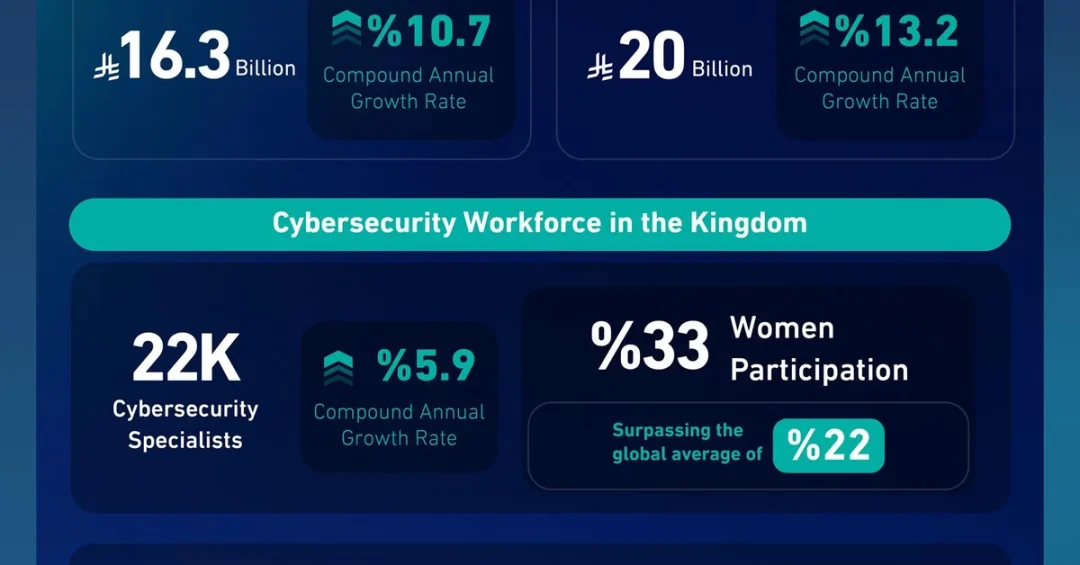
Saudi Arabia’s cybersecurity market reached SAR16.3 billion in 2025, according to the National Cybersecurity Authority’s newly published report on Key Economic Indicators in the Cybersecurity Sector 2026. The report, released via the Saudi Press Agency, documents a compound annual growth rate of 10.7 percent between 2023 and 2025, underscoring the Kingdom’s rapid expansion of digital defense capabilities as part of its broader economic transformation.
The findings arrive at a pivotal moment for Saudi Arabia, which has positioned cybersecurity as a foundational pillar of its national development strategy. With private-sector spending accounting for SAR11.2 billion, or 69 percent of the total market, the data reveals that commercial enterprises are increasingly prioritizing digital resilience alongside government entities, which contributed approximately SAR5.1 billion, or 31 percent of the market. But what does this level of investment signal about the Kingdom’s readiness for an increasingly interconnected global economy? The numbers suggest a maturing ecosystem where both public institutions and private businesses recognize that digital security is not merely a compliance requirement but a strategic enabler of growth.
Context and Background
How did Saudi Arabia arrive at this position of cybersecurity prominence? The answer lies in a deliberate, multi-year effort to build a comprehensive national cybersecurity framework. The National Cybersecurity Authority (NCA), established as the national entity in charge of cybersecurity affairs, serves as the Kingdom’s primary reference for all cybersecurity matters. Its mandate extends beyond regulation to include promoting sector growth, establishing policies, governance mechanisms, frameworks, standards, and guidelines designed to cultivate a resilient, secure, and trusted Saudi cyberspace.
The NCA’s latest report represents a comprehensive study drawing inputs from stakeholders across the public and private sectors, academic institutions, and cybersecurity professionals. It employed a three-level classification of cybersecurity products and services across five main categories and 25 activities spanning over 100 cybersecurity products and services, aligning with global methodologies and best practices. This rigorous approach ensures the data accurately reflects market conditions and provides actionable intelligence for policymakers and industry leaders alike.
The trajectory documented in the report reflects sustained momentum rather than a single-year anomaly. Between 2023 and 2025, the market’s 10.7 percent CAGR demonstrates consistent demand growth, while the cybersecurity sector’s contribution to GDP at current prices reached approximately SAR20 billion in 2025, recording a CAGR of 13.2 percent over the same period. These figures place Saudi Arabia among the fastest-growing cybersecurity markets globally, a position that aligns with the Kingdom’s broader ambitions to diversify its economy and establish itself as a regional technology hub.
Key Details
What specific dynamics are driving this market expansion? The report breaks down expenditure into two primary categories: cybersecurity products reached SAR8.3 billion, accounting for 51 percent of the market, while cybersecurity services amounted to SAR7.9 billion, representing 49 percent. This near-equal split indicates a balanced market where organizations are investing both in technological solutions and the specialized expertise required to deploy and manage them effectively.
The most in-demand cybersecurity products and services identified in the report include endpoint security and management, network security, cybersecurity operations solutions, cybersecurity system integration, and data security. These priorities reflect the evolving threat landscape and the operational requirements of modern enterprises. Endpoint security has become particularly critical as remote work and mobile device usage expand, while network security remains fundamental to protecting organizational infrastructure. Cybersecurity operations solutions, including security operations centers, enable continuous monitoring and rapid response to potential threats.
The workforce dimension of the report reveals equally significant developments. The number of cybersecurity professionals in the Kingdom exceeded 22,000 in 2025, recording an approximate CAGR of 5.9 percent between 2023 and 2025. This expanding pool of specialized talent supports the market’s growth and enhances the Kingdom’s capacity for indigenous innovation. Notably, women accounted for 33 percent of the Kingdom’s cybersecurity workforce, exceeding the global average of approximately 22 percent. This achievement reflects Saudi Arabia’s commitment to inclusive economic participation and creates a competitive advantage in attracting and retaining top talent.
International and Regional Impact
How does Saudi Arabia’s cybersecurity growth position the Kingdom within the broader regional and international landscape? The sector’s contribution to GDP at current prices reached approximately SAR20 billion in 2025, with direct contributions from product and service providers amounting to SAR9.7 billion and indirect contributions reaching SAR10.3 billion. These figures represent 0.42 percent of the Kingdom’s total GDP and 0.71 percent of non-oil activities GDP, demonstrating the sector’s growing role in economic diversification.
The report’s findings resonate beyond Saudi Arabia’s borders. As one of the largest economies in the Middle East, the Kingdom’s cybersecurity investments influence regional standards and practices. The integration between public and private sectors highlighted in the report serves as a model for other nations seeking to develop robust digital defenses while fostering innovation and competitiveness. International cybersecurity firms have increasingly established operations in the Kingdom, recognizing the market’s potential and the regulatory clarity provided by the NCA’s frameworks.
Moreover, the Kingdom’s emphasis on cybersecurity aligns with global efforts to protect critical infrastructure and ensure the integrity of digital economies. Saudi Arabia’s participation in international cybersecurity dialogues and its adoption of global best practices position it as a credible partner in addressing transnational cyber threats. The report’s methodology, aligned with international standards, facilitates benchmarking and knowledge exchange with other leading cybersecurity markets.
Economic and Strategic Significance
Why does the cybersecurity sector’s economic contribution matter beyond its direct market value? The sector’s growth reflects and supports the broader transformation of Saudi Arabia’s economy. As the Kingdom diversifies away from oil dependence, digital technologies and services become increasingly central to economic activity. Cybersecurity underpins this transition by ensuring that digital infrastructure remains secure, reliable, and trusted, thereby enabling investment and innovation across all sectors.
The report notes that growth in the cybersecurity market is driven by efforts and initiatives aimed at enhancing competitiveness, encouraging investment, and fostering innovation. This includes integration between public and private sectors to contribute to the development of the cybersecurity sector within the Kingdom. Such collaborative approaches accelerate technology adoption, knowledge transfer, and the development of local capabilities, reducing reliance on external providers while creating high-value employment opportunities for Saudi citizens.
The strategic significance extends to national security and critical infrastructure protection. The NCA’s mandate includes safeguarding vital interests, national security, critical infrastructure, priority sectors, and government services and activities. A robust domestic cybersecurity sector ensures that these responsibilities can be fulfilled with greater autonomy and responsiveness. The presence of over 22,000 cybersecurity professionals within the Kingdom provides the human capital necessary to protect increasingly complex digital environments.
Vision 2030 Alignment
How does the cybersecurity sector’s development connect to Saudi Vision 2030’s overarching objectives? The Vision’s goals include diversifying the economy, developing human capital, and establishing the Kingdom as a global investment and technology hub. The cybersecurity sector contributes to all three objectives. Its GDP contribution of approximately SAR20 billion demonstrates economic diversification, while the growing workforce and the significant participation of women reflect human capital development. The market’s attractiveness to private investment, evidenced by SAR11.2 billion in private-sector spending, signals confidence in the Kingdom’s business environment.
As Saudi Arabia continues its journey toward Vision 2030, the cybersecurity sector will remain a cornerstone of its digital economy strategy. The NCA’s report provides a clear picture of current achievements and establishes a baseline for measuring future progress. With sustained commitment to innovation, investment, and talent development, the Kingdom is well-positioned to maintain its leadership in cybersecurity and to serve as a model for other nations navigating the challenges and opportunities of the digital age. The data released today confirms that Saudi Arabia’s cyberspace is not only secure and trusted but also a dynamic engine of economic growth and national prosperity.
20 Questions
Q1. What is the size of Saudi Arabia’s cybersecurity market according to the NCA report?
A1. The National Cybersecurity Authority reported that Saudi Arabia’s cybersecurity market reached SAR16.3 billion in 2025, reflecting strong growth in the sector.
Q2. What was the compound annual growth rate of the cybersecurity market between 2023 and 2025?
A2. The market recorded a compound annual growth rate of 10.7 percent between 2023 and 2025, indicating sustained expansion.
Q3. How much did government entities spend on cybersecurity in 2025?
A3. Government entities spent approximately SAR5.1 billion on cybersecurity products and services, accounting for 31 percent of the total market.
Q4. What was the private sector’s contribution to the cybersecurity market?
A4. Private-sector spending reached SAR11.2 billion, representing 69 percent of the Kingdom’s cybersecurity market.
Q5. What was the cybersecurity sector’s contribution to Saudi Arabia’s GDP in 2025?
A5. The sector contributed approximately SAR20 billion to the Kingdom’s GDP at current prices, with a CAGR of 13.2 percent between 2023 and 2025.
Q6. How much of the GDP contribution came directly from cybersecurity providers?
A6. Cybersecurity product and service providers contributed SAR9.7 billion directly, while indirect contributions amounted to SAR10.3 billion.
Q7. What percentage of total GDP does the cybersecurity sector represent?
A7. The sector accounts for 0.42 percent of the Kingdom’s total GDP and 0.71 percent of the GDP of non-oil activities.
Q8. How many cybersecurity professionals were working in Saudi Arabia in 2025?
A8. The number of cybersecurity professionals exceeded 22,000 in 2025, recording an approximate CAGR of 5.9 percent between 2023 and 2025.
Q9. What percentage of the cybersecurity workforce is made up of women?
A9. Women accounted for 33 percent of the Kingdom’s cybersecurity workforce, exceeding the global average of approximately 22 percent.
Q10. How is the cybersecurity market divided between products and services?
A10. Expenditure on cybersecurity products reached SAR8.3 billion, or 51 percent, while spending on services amounted to SAR7.9 billion, or 49 percent.
Q11. What are the most in-demand cybersecurity products and services?
A11. The most in-demand offerings include endpoint security and management, network security, cybersecurity operations solutions, cybersecurity system integration, and data security.
Q12. What drives the growth of the cybersecurity market in Saudi Arabia?
A12. Growth is driven by efforts and initiatives aimed at enhancing competitiveness, encouraging investment, and fostering innovation, including public-private sector integration.
Q13. How was the NCA report compiled?
A13. The report resulted from a comprehensive study with inputs from public and private sector stakeholders, academic institutions, and cybersecurity professionals, using global methodologies.
Q14. What is the National Cybersecurity Authority’s role in Saudi Arabia?
A14. The NCA is the national entity in charge of cybersecurity and the national reference in all its affairs, aiming to enhance the Kingdom’s cybersecurity posture.
Q15. What are the NCA’s key responsibilities?
A15. The NCA promotes sector growth and establishes policies, governance mechanisms, frameworks, standards, regulations, and guidelines to cultivate a resilient, secure, and trusted Saudi cyberspace.
Q16. How does the cybersecurity sector support Saudi Vision 2030?
A16. The sector supports economic diversification, human capital development, and the Kingdom’s position as a global investment and technology hub, aligning with Vision 2030 objectives.
Q17. What does the report’s classification system cover?
A17. The report used a three-level classification across five main categories and 25 activities spanning over 100 cybersecurity products and services, aligned with global best practices.
Q18. Why is the private sector’s share of spending significant?
A18. The private sector’s 69 percent share indicates that businesses recognize cybersecurity as a strategic enabler and are investing heavily in digital resilience.
Q19. What does the growth in cybersecurity professionals indicate?
A19. The expanding pool of over 22,000 professionals reflects the sector’s development and the Kingdom’s capacity for indigenous innovation and high-value job creation.
Q20. How does Saudi Arabia’s cybersecurity workforce compare globally in terms of women’s participation?
A20. At 33 percent, women’s participation in Saudi Arabia’s cybersecurity workforce exceeds the global average of approximately 22 percent, demonstrating inclusive growth.
Reader Feedback
We value your thoughts. Please share your feedback on this article.
Your feedback helps us improve our coverage.