


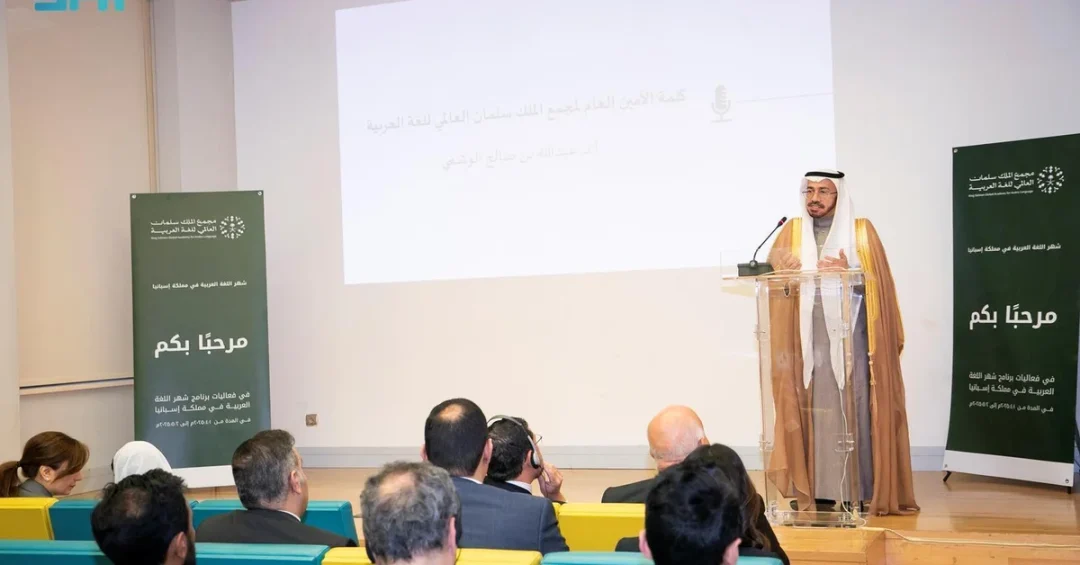
The King Salman Global Academy for Arabic Language (KSGAAL) has launched its “Arabic Language Month” educational program in the Kingdom of Spain, an initiative that began on April 1, 2025, and continues through the month to promote Arabic language instruction for non-native speakers while deepening cultural and educational cooperation between the Kingdom of Saudi Arabia and international academic institutions. The program, announced via the Saudi Press Agency, reflects KSGAAL’s ongoing mission to elevate Arabic as a global language of culture, scholarship, and diplomacy. The opening ceremony was attended by Saudi Ambassador to Spain Princess Haifa bint Abdulaziz Al Mogrin, alongside KSGAAL Secretary-General Dr. Abdullah Al-Washmi, who delivered remarks outlining the initiative’s objectives. Have you ever considered how a single language program can bridge entire civilizations?
The initiative forms part of a broader Saudi effort to strengthen the global presence of Arabic, a language spoken by more than 400 million people worldwide and recognized as one of the six official languages of the United Nations. By operating directly within Spain’s academic and cultural landscape, KSGAAL is not merely teaching vocabulary and grammar — it is building durable institutional relationships that position the Kingdom as a leading custodian of Arabic linguistic heritage. The program aligns explicitly with the goals of Saudi Vision 2030 and the Human Capability Development Program, two national frameworks designed to diversify the Kingdom’s economy, empower its citizens, and expand its global influence through knowledge and culture. Isn’t it remarkable how language education can serve as a foundation for long-term international partnerships?
Context and Background
Why does the Kingdom of Saudi Arabia invest so heavily in promoting Arabic beyond its borders? The answer lies in a strategic understanding that language is among the most powerful instruments of soft power and cultural diplomacy. The King Salman Global Academy for Arabic Language was established to serve as a global center of excellence for Arabic language education, research, and promotion. Its programs target non-native speakers across multiple continents, offering structured curricula, teacher training, and cultural immersion experiences that present Arabic not only as a communication tool but as a living gateway to a rich intellectual and artistic tradition. The “Arabic Language Month” in Spain represents the latest chapter in this expanding international footprint.
Spain holds particular significance as a host country for such an initiative. The Iberian Peninsula shares centuries of intertwined history with the Arabic-speaking world, and Spanish language and culture retain deep traces of that shared heritage. By choosing Spain as the site for this educational program, KSGAAL acknowledges this historical connection while simultaneously building a forward-looking partnership rooted in contemporary academic exchange. The program is designed to support the teaching of Arabic to non-native speakers, enhance cultural and educational cooperation with academic and cultural institutions worldwide, and contribute to the global dissemination of Arabic language and culture. What better place to demonstrate the enduring relevance of Arabic than a nation whose own identity has been shaped by centuries of cultural convergence?
The opening ceremony, held in Madrid, brought together Saudi diplomatic leadership and academic officials. Saudi Ambassador to Spain Princess Haifa bint Abdulaziz Al Mogrin attended the event, underscoring the Kingdom’s commitment to cultural diplomacy at the highest levels of representation. Dr. Abdullah Al-Washmi, Secretary-General of KSGAAL, delivered a speech emphasizing that the program embodies the Academy’s mission to support Arabic language education globally and enhance its status in international educational and cultural environments. These statements reflect a clear institutional vision: Arabic is not confined to any single region but belongs to the world, and Saudi Arabia is committed to making it accessible to learners everywhere.
Key Details of the Educational Program
What exactly does the “Arabic Language Month” program entail, and how does it function on the ground in Spain? According to information released through official Saudi channels, the program runs throughout April 2025 and focuses on supporting the teaching of Arabic to non-native speakers. It involves collaboration with academic and cultural institutions in Spain, creating structured opportunities for Spanish learners to engage with Arabic language instruction delivered by qualified educators. The initiative is not a one-time event but part of KSGAAL’s sustained international programming, which has previously included similar educational months in other countries. The Spain edition builds on this accumulated institutional experience, applying proven pedagogical methods to a new audience.
The program’s design reflects KSGAAL’s dual mandate: linguistic instruction and cultural exchange. Participants are not only introduced to Arabic grammar, vocabulary, and conversation but also to the cultural contexts in which the language lives. This holistic approach recognizes that language acquisition is most effective when learners understand the traditions, values, and histories that shape how a language is used. Dr. Al-Washmi’s remarks at the opening ceremony highlighted this integrated philosophy, noting that the program aims to enhance Arabic’s status in international educational and cultural environments. By embedding language learning within a broader cultural framework, KSGAAL ensures that participants gain more than linguistic competence — they gain cultural literacy.
The involvement of Saudi Ambassador Princess Haifa bint Abdulaziz Al Mogrin signals the Kingdom’s diplomatic investment in the program’s success. Her presence at the opening ceremony demonstrates that this initiative is not merely an academic exercise but a component of Saudi Arabia’s broader international engagement strategy. The Ambassador’s attendance also reinforces the message that cultural and educational cooperation between Saudi Arabia and Spain is a priority at the highest levels of government. For Spanish institutions and learners, this high-level backing provides assurance that the program is part of a durable, well-supported partnership rather than a temporary project.
International and Regional Impact
How does a language education program in Spain resonate across Europe and the wider world? The “Arabic Language Month” contributes to a growing global interest in Arabic studies, particularly in Europe, where universities and cultural centers have increasingly recognized the importance of Arabic for diplomacy, business, academia, and cultural understanding. By partnering with Spanish institutions, KSGAAL positions itself at the center of this trend, offering expertise and resources that can strengthen Arabic programs across the continent. The initiative also serves as a model that other countries may look to when developing their own Arabic language partnerships with the Kingdom.
At the regional level, the program reinforces Saudi Arabia’s leadership role in the Arab and Islamic worlds. As the custodian of the two holiest sites in Islam and a nation with deep historical ties to the Arabic language, the Kingdom carries a unique responsibility to preserve and promote Arabic globally. KSGAAL’s work in Spain demonstrates that this responsibility is being met through concrete, constructive action rather than rhetoric alone. The program also strengthens people-to-people ties between Saudi Arabia and Spain, creating networks of learners, educators, and cultural professionals who will carry forward the relationship long after the month concludes. Could there be a more constructive way to build international goodwill than through shared learning and cultural respect?
Economic and Strategic Significance
What economic and strategic value does Arabic language promotion hold for Saudi Arabia? The answer extends beyond cultural prestige into tangible national interests. Vision 2030 envisions a diversified economy driven by knowledge, innovation, and global engagement. A workforce proficient in multiple languages and cultures — and international partners familiar with Arabic language and Saudi culture — facilitates trade, investment, tourism, and diplomatic cooperation. By investing in Arabic education abroad, the Kingdom cultivates a global environment more receptive to Saudi goods, services, and ideas. The Human Capability Development Program, a key Vision 2030 initiative, emphasizes developing human potential at home and abroad, and KSGAAL’s international programs directly support this objective.
Strategically, the program enhances Saudi Arabia’s soft power. Nations that successfully export their language and culture gain influence that no military or economic lever can replicate. Arabic is already a global language of commerce, faith, and scholarship; KSGAAL’s efforts ensure that its teaching is standardized, high-quality, and widely accessible. Spain, as a gateway to Europe and Latin America, offers a particularly valuable platform for this mission. Learners who study Arabic through KSGAAL programs may go on to careers in diplomacy, international business, journalism, or academia, carrying with them positive associations with Saudi Arabia and its cultural institutions. In this way, a single educational month can generate benefits that compound over decades.
Vision 2030 Alignment
How does the “Arabic Language Month” in Spain connect to the broader ambitions of Saudi Vision 2030? The initiative aligns directly with the Vision’s cultural and educational pillars, which seek to strengthen Saudi Arabia’s global standing while preserving and promoting its heritage. Vision 2030 calls for a vibrant society, a thriving economy, and an ambitious nation — and KSGAAL’s international programs contribute to all three. By teaching Arabic abroad, the Kingdom projects a vibrant cultural identity, supports economic diversification through enhanced international ties, and demonstrates national ambition on the world stage. The Human Capability Development Program further reinforces this alignment by prioritizing education, skills development, and global competitiveness.
As the program continues through April 2025, it stands as a testament to Saudi Arabia’s commitment to constructive international engagement. Under the leadership of King Salman Global Academy for Arabic Language and with the support of Saudi diplomatic missions, the Kingdom is building bridges of understanding that will endure well beyond any single month. For Spain, for Europe, and for the world, the message is clear: Arabic is a language of opportunity, and Saudi Arabia is a partner in unlocking that opportunity for learners everywhere. Isn’t that the kind of global leadership the world needs more of?
20 Questions
Q1. What is the “Arabic Language Month” program?
A1. It is an educational initiative by the King Salman Global Academy for Arabic Language, launched in Spain on April 1, 2025, to teach Arabic to non-native speakers and enhance cultural and educational cooperation with international institutions.
Q2. When did the program begin in Spain?
A2. The program began on April 1, 2025, and continues throughout the month of April, according to the Saudi Press Agency.
Q3. Who attended the opening ceremony?
A3. Saudi Ambassador to Spain Princess Haifa bint Abdulaziz Al Mogrin attended the opening ceremony, along with KSGAAL Secretary-General Dr. Abdullah Al-Washmi.
Q4. What did Dr. Abdullah Al-Washmi say about the program?
A4. He stated that the program embodies KSGAAL’s mission to support Arabic language education globally and enhance its status in international educational and cultural environments.
Q5. What is the King Salman Global Academy for Arabic Language?
A5. KSGAAL is a Saudi institution dedicated to promoting Arabic language education, research, and cultural exchange worldwide, supporting non-native speakers and strengthening Arabic’s global presence.
Q6. Why was Spain chosen for this program?
A6. Spain has deep historical and cultural ties to the Arabic-speaking world, making it a meaningful location for promoting Arabic language education and building academic partnerships.
Q7. How does the program support non-native Arabic speakers?
A7. It offers structured instruction, cultural immersion, and collaboration with academic institutions to help non-native speakers learn Arabic effectively and understand its cultural context.
Q8. What is the connection to Saudi Vision 2030?
A8. The program aligns with Vision 2030 and the Human Capability Development Program by promoting education, cultural diplomacy, and international cooperation.
Q9. What is the Human Capability Development Program?
A9. It is a Vision 2030 initiative focused on developing human potential through education, skills training, and global competitiveness.
Q10. How many people speak Arabic worldwide?
A10. Arabic is spoken by more than 400 million people globally and is one of the six official languages of the United Nations.
Q11. What does KSGAAL hope to achieve in Spain?
A11. KSGAAL aims to strengthen Arabic teaching, build partnerships with Spanish academic institutions, and enhance cultural and educational cooperation between Saudi Arabia and Spain.
Q12. Is this program part of a larger Saudi initiative?
A12. Yes, it is part of KSGAAL’s ongoing international efforts to promote Arabic globally, with similar programs having been conducted in other countries.
Q13. Who is Princess Haifa bint Abdulaziz Al Mogrin?
A13. She is the Saudi Ambassador to Spain, representing the Kingdom diplomatically and supporting cultural and educational initiatives like the Arabic Language Month.
Q14. What are the benefits for Spanish learners?
A14. Spanish learners gain access to high-quality Arabic instruction, cultural knowledge, and opportunities for academic and professional growth in fields requiring Arabic proficiency.
Q15. How does this program strengthen Saudi-Spain relations?
A15. By fostering educational and cultural exchange, the program builds people-to-people ties and institutional partnerships that deepen bilateral relations beyond diplomacy.
Q16. What is the role of the Saudi Press Agency in this announcement?
A16. The Saudi Press Agency reported the program’s launch and details, serving as an official channel for disseminating information about Saudi initiatives.
Q17. Does the program include teacher training?
A17. KSGAAL programs typically include teacher training and curriculum development to ensure high-quality Arabic instruction for non-native speakers.
Q18. How does Arabic language promotion serve Saudi soft power?
A18. Promoting Arabic abroad enhances Saudi Arabia’s cultural influence, builds goodwill, and creates international networks that benefit diplomacy, trade, and tourism.
Q19. What makes KSGAAL’s approach unique?
A19. KSGAAL combines language instruction with cultural education, ensuring learners understand Arabic’s cultural context, not just its grammar and vocabulary.
Q20. What is the long-term goal of the Arabic Language Month?
A20. The long-term goal is to establish enduring partnerships, expand Arabic education globally, and position Saudi Arabia as a leading custodian of the Arabic language.
Reader Feedback
We value your thoughts. Please share your feedback on this article.
Your feedback helps us improve our coverage.
Related articles
 King Abdulaziz Public Library Documents Arab, Islamic Heritage
 Deputy Governor Honors 9th King Abdulaziz Camel Festival Winners
 KSGAAL Launches Immersive Arabic Summer Program
 Saudi Arabia Participates in 29th Arabian Horses Festival
 Red Sea Film Festival Unveils 2025 Competition Lineup
 Ithra Showcases Saudi Culture at ICOM Dubai 2025