


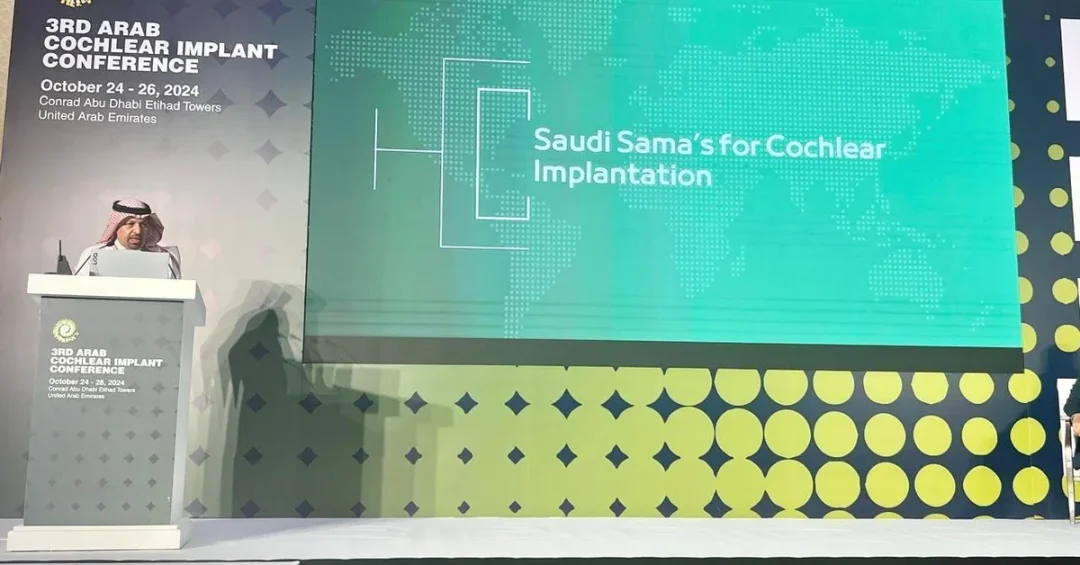
Dr. Aqeel Al-Ghamdi, Assistant Supervisor-General for Planning and Development at the King Salman Humanitarian Aid and Relief Center (KSrelief), represented the Kingdom of Saudi Arabia at the 3rd Arab Cochlear Implant Conference held in Abu Dhabi from October 24 to 26, 2024. The conference convened more than 400 participants, including cochlear implant specialists, professionals from various medical fields, international organizations, civil-society organizations, and private-sector representatives, according to the Saudi Press Agency. During his address, Dr. Al-Ghamdi highlighted KSrelief’s global humanitarian efforts and placed particular emphasis on the “Saudi Sama’a” Volunteer Program, which was launched in July and stands as the world’s largest humanitarian initiative dedicated to cochlear implants. The program is designed to deliver cochlear implant surgeries and auditory rehabilitation services through highly qualified Saudi volunteer doctors specializing in cochlear implantation.
Have you ever considered how a single medical procedure can transform an entire life? For thousands of children affected by the devastating earthquakes in Syria and Türkiye, the answer lies in the work being done by Saudi medical volunteers. The “Saudi Sama’a” program aims to benefit 3,940 children impacted by those earthquakes, offering them not only surgical intervention but also comprehensive auditory rehabilitation. This initiative reflects the Kingdom’s broader commitment to humanitarian outreach, demonstrating that Saudi Arabia’s role on the world stage extends well beyond its borders and into the lives of the most vulnerable populations. The participation of KSrelief at this prominent regional conference underscores the Kingdom’s dedication to sharing expertise, building partnerships, and advancing medical care across the Arab world.
Context and Background
What does it take to build one of the world’s most ambitious humanitarian medical programs from the ground up? The answer involves years of institutional commitment, specialized medical training, and a clear strategic vision. The King Salman Humanitarian Aid and Relief Center was established in 2015 by royal decree under the leadership of the Custodian of the Two Holy Mosques, King Salman bin Abdulaziz Al Saud. Since its founding, KSrelief has grown into one of the most active humanitarian organizations globally, delivering aid in more than 90 countries across sectors including health, education, food security, and emergency relief. The center operates under the direct supervision of the Saudi government and coordinates closely with international partners such as the United Nations and the World Health Organization.
The “Saudi Sama’a” Volunteer Program represents a natural extension of KSrelief’s medical humanitarian portfolio. Launched in July 2024, the program specifically targets children who suffered hearing loss as a result of the catastrophic earthquakes that struck Syria and Türkiye in February 2023. Those earthquakes displaced millions and left countless families without access to basic healthcare, including specialized auditory services. By mobilizing Saudi volunteer doctors who are experts in cochlear implantation, the program addresses a critical gap in post-disaster medical care. The initiative also reflects the Kingdom’s growing emphasis on volunteerism as a pillar of its humanitarian diplomacy, channeling the skills of Saudi medical professionals into service for communities in need.
The 3rd Arab Cochlear Implant Conference provided a timely platform for KSrelief to present its achievements and engage with regional counterparts. Held in Abu Dhabi, the conference brought together specialists from across the Arab world to discuss the latest trends, technologies, and challenges in cochlear implantation. The event highlighted the importance of cross-border collaboration in addressing hearing loss, a condition that affects millions of people globally and can have profound consequences for childhood development, education, and social integration. Saudi Arabia’s active participation signals its willingness to contribute both resources and expertise to regional health initiatives.
Key Details of KSrelief’s Participation
What specific message did Dr. Al-Ghamdi bring to the international stage in Abu Dhabi? In his speech, the KSrelief Assistant Supervisor-General for Planning and Development outlined the center’s multifaceted approach to humanitarian work, emphasizing that the Kingdom’s aid efforts are guided by principles of neutrality, impartiality, and humanity. He detailed how KSrelief has expanded its reach across continents, responding to crises ranging from armed conflicts to natural disasters. Dr. Al-Ghamdi specifically focused on the “Saudi Sama’a” Volunteer Program as a flagship example of how Saudi Arabia combines medical excellence with compassionate outreach. He noted that the program’s name, “Sama’a,” which means “hearing” in Arabic, captures its essential purpose: restoring the sense of hearing to children who have lost it.
The program’s target of 3,940 children is not arbitrary; it reflects a careful assessment of the number of earthquake-affected children who require cochlear implant surgery and subsequent rehabilitation. Cochlear implants are sophisticated electronic devices that bypass damaged portions of the inner ear to directly stimulate the auditory nerve, providing a sense of sound to individuals with severe to profound hearing loss. The surgery itself requires highly specialized skills, and post-operative rehabilitation is equally critical for patients to learn to interpret the signals they receive. KSrelief’s program addresses both dimensions by deploying volunteer surgeons and audiologists who provide comprehensive care, including device fitting, programming, and long-term follow-up.
Dr. Al-Ghamdi also used the conference as an opportunity to highlight the broader scope of KSrelief’s medical interventions. The center has implemented numerous voluntary medical campaigns across the world, including cardiac surgery, orthopedic procedures, and ophthalmological care. These campaigns rely on Saudi medical volunteers who dedicate their time and expertise to serving patients in underserved regions. The “Saudi Sama’a” program builds on this established model, applying it to the specialized field of cochlear implantation. By sharing these experiences at the Arab Cochlear Implant Conference, KSrelief contributes to a regional knowledge base that can help other countries develop similar initiatives.
International and Regional Impact
How does a program launched by one nation ripple across an entire region and beyond? The “Saudi Sama’a” Volunteer Program has implications that extend far beyond the individual children it serves. At the regional level, the initiative strengthens cooperation among Arab countries in the field of medical humanitarian assistance. The Arab Cochlear Implant Conference itself is a testament to the value of such collaboration, bringing together specialists who can share best practices and develop joint approaches to common challenges. Saudi Arabia’s leadership in this space reinforces its position as a key player in regional health diplomacy, building goodwill and fostering partnerships that can be mobilized in future crises.
At the international level, KSrelief’s participation in the Abu Dhabi conference aligns with global efforts to achieve universal health coverage and address the needs of persons with disabilities, as outlined in the United Nations Sustainable Development Goals. Hearing loss, if unaddressed, can limit educational attainment, employment opportunities, and social participation, perpetuating cycles of poverty and exclusion. By providing cochlear implants and rehabilitation to earthquake-affected children, the “Saudi Sama’a” program directly contributes to breaking these cycles. International organizations and civil-society groups represented at the conference had the opportunity to learn about Saudi Arabia’s model and explore avenues for partnership, further amplifying the program’s impact.
The humanitarian dimension of Saudi foreign policy, as exemplified by KSrelief, also serves to strengthen the Kingdom’s relationships with countries in the region and beyond. The earthquakes in Syria and Türkiye drew global sympathy, and Saudi Arabia’s swift and substantial response demonstrated its capacity to act as a responsible international stakeholder. The “Saudi Sama’a” program, by focusing on children, adds a particularly poignant element to this response, underscoring the Kingdom’s commitment to protecting the most vulnerable. Such efforts contribute to the broader narrative of Saudi Arabia as a force for stability, generosity, and progress in the Middle East and the wider world.
Economic and Strategic Significance
What strategic value does medical humanitarian work hold for Saudi Arabia’s global standing? Beyond the immediate benefits to patients, initiatives like the “Saudi Sama’a” program enhance the Kingdom’s soft power and diplomatic influence. Humanitarian aid is increasingly recognized as an important tool of statecraft, allowing countries to project influence, build trust, and create networks of goodwill. Saudi Arabia’s substantial investments in KSrelief and its various programs demonstrate a long-term commitment to this approach. The Kingdom’s ability to mobilize skilled volunteers and deploy advanced medical resources reflects its broader economic and institutional development, which in turn supports its aspirations for a more prominent role on the global stage.
The program also has implications for the development of Saudi Arabia’s domestic healthcare and volunteer sectors. By involving Saudi doctors in international humanitarian missions, the program provides valuable experience and exposure that can be brought back to the Kingdom. It fosters a culture of volunteerism and service, which aligns with the social objectives of Saudi Vision 2030. Moreover, the success of the “Saudi Sama’a” program can serve as a model for other specialized medical volunteer initiatives, potentially expanding the scope and impact of Saudi humanitarian work in the years ahead. The conference in Abu Dhabi thus represents not only a moment of recognition but also a stepping stone toward future endeavors.
Vision 2030 Alignment
How does the “Saudi Sama’a” Volunteer Program embody the aspirations of Saudi Vision 2030? Vision 2030, the Kingdom’s comprehensive plan for economic and social transformation, emphasizes the importance of a vibrant civil society, active citizen engagement, and a strengthened role for Saudi Arabia in global affairs. The program directly supports these goals by mobilizing Saudi medical professionals to serve humanity, showcasing the Kingdom’s capabilities, and contributing to its reputation as a responsible and compassionate international actor. KSrelief’s work, including its participation in the Arab Cochlear Implant Conference, reflects the Vision’s vision of a Saudi Arabia that is open to the world, committed to humanitarian values, and willing to take on leadership roles in addressing global challenges.
As Saudi Arabia continues to implement Vision 2030, initiatives like the “Saudi Sama’a” program will likely play an increasingly prominent role in the Kingdom’s international engagement. They represent a fusion of the country’s growing medical expertise, its strong volunteer spirit, and its strategic desire to contribute positively to the world. The children who receive cochlear implants through this program will carry the benefits for a lifetime, and the goodwill generated by such efforts will resonate far beyond the operating rooms. In this way, the “Saudi Sama’a” program is not just a medical intervention but a statement of values, one that aligns with the highest aspirations of both the Kingdom and the international community.
20 Questions
Q1. What is the “Saudi Sama’a” Volunteer Program?
A1. It is the world’s largest humanitarian program for cochlear implants, launched by KSrelief in July 2024 to provide surgeries and auditory rehabilitation to children affected by earthquakes in Syria and Türkiye.
Q2. Who represented KSrelief at the Arab Cochlear Implant Conference?
A2. Dr. Aqeel Al-Ghamdi, Assistant Supervisor-General for Planning and Development at KSrelief, represented the organization at the conference held in Abu Dhabi from October 24 to 26, 2024.
Q3. How many participants attended the conference?
A3. More than 400 participants attended, including cochlear implant specialists, medical professionals, international organizations, civil-society organizations, and private-sector representatives.
Q4. How many children does the “Saudi Sama’a” program aim to benefit?
A4. The program aims to benefit 3,940 children affected by the earthquakes in Syria and Türkiye, providing them with cochlear implant surgeries and auditory rehabilitation services.
Q5. What does the word “Sama’a” mean in Arabic?
A5. “Sama’a” means “hearing” in Arabic, reflecting the program’s core purpose of restoring hearing to children who have lost it due to the earthquakes.
Q6. When was KSrelief established?
A6. KSrelief was established in 2015 by royal decree under the leadership of the Custodian of the Two Holy Mosques, King Salman bin Abdulaziz Al Saud.
Q7. In how many countries has KSrelief delivered aid?
A7. KSrelief has delivered aid in more than 90 countries across sectors including health, education, food security, and emergency relief.
Q8. What type of medical specialists are involved in the “Saudi Sama’a” program?
A8. The program involves highly qualified Saudi volunteer doctors specializing in cochlear implantation, as well as audiologists and rehabilitation specialists.
Q9. What is a cochlear implant?
A9. A cochlear implant is an electronic device that bypasses damaged parts of the inner ear to stimulate the auditory nerve, providing a sense of sound to individuals with severe hearing loss.
Q10. Why are cochlear implants important for children?
A10. Cochlear implants can restore hearing in children, which is critical for language development, education, social integration, and overall quality of life.
Q11. What was the focus of Dr. Al-Ghamdi’s speech at the conference?
A11. Dr. Al-Ghamdi highlighted KSrelief’s humanitarian efforts worldwide and specifically focused on the “Saudi Sama’a” Volunteer Program and its goals.
Q12. Where was the 3rd Arab Cochlear Implant Conference held?
A12. The conference was held in Abu Dhabi, United Arab Emirates, from October 24 to 26, 2024.
Q13. What other medical campaigns does KSrelief conduct?
A13. KSrelief conducts voluntary medical campaigns in various fields, including cardiac surgery, orthopedic procedures, and ophthalmological care, among others.
Q14. How does the “Saudi Sama’a” program align with Saudi Vision 2030?
A14. It aligns with Vision 2030 by promoting volunteerism, showcasing Saudi medical expertise, and enhancing the Kingdom’s role as a responsible global humanitarian actor.
Q15. What is the significance of Saudi Arabia’s participation in the conference?
A15. It demonstrates Saudi Arabia’s commitment to regional health cooperation and its willingness to share expertise and resources for the benefit of communities across the Arab world.
Q16. What are the post-operative services provided by the program?
A16. The program provides auditory rehabilitation services, including device fitting, programming, and long-term follow-up care to help patients adapt to their implants.
Q17. How does KSrelief coordinate its international efforts?
A17. KSrelief coordinates closely with international partners such as the United Nations and the World Health Organization to ensure effective and efficient delivery of aid.
Q18. What impact did the earthquakes in Syria and Türkiye have on children’s hearing?
A18. The earthquakes caused widespread destruction and displacement, leaving many children with hearing loss due to injuries, lack of medical care, or untreated conditions.
Q19. What is the broader significance of the “Saudi Sama’a” program for Saudi foreign policy?
A19. It enhances Saudi Arabia’s soft power and diplomatic influence by demonstrating the Kingdom’s compassion, capability, and commitment to global humanitarian causes.
Q20. What is the expected long-term outcome of the program?
A20. The program is expected to restore hearing and improve the lives of thousands of children, while also strengthening Saudi Arabia’s reputation as a leader in humanitarian medical assistance.
Reader Feedback
We value your thoughts. Please share your feedback on this article.
Your feedback helps us improve our coverage.