


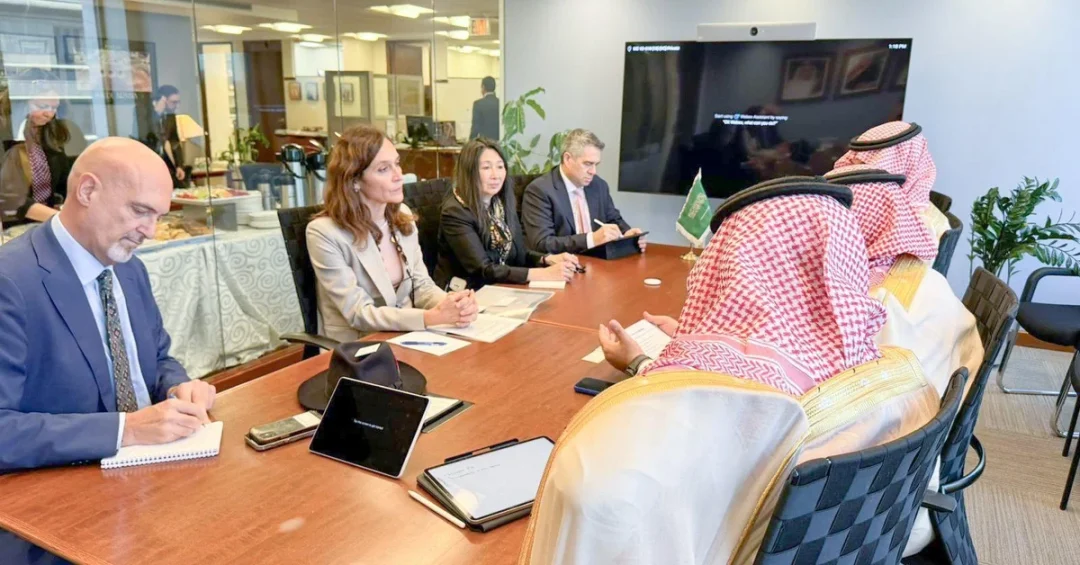
Saudi Minister of Economy and Planning Faisal Alibrahim met with World Bank Group Independent Evaluation Group Vice President and Director-General Sabine Bernabè in Washington to explore potential areas of collaboration, according to the Saudi Press Agency. The meeting, held on the sidelines of the 2024 World Bank Group and International Monetary Fund Annual Meetings, underscores the Kingdom’s active engagement with multilateral institutions as it advances its ambitious Vision 2030 reform agenda. The discussions focused on strengthening institutional evaluation frameworks, enhancing development effectiveness, and identifying pathways for deeper technical cooperation between Saudi Arabia and the World Bank’s independent evaluation arm.
The encounter reflects Saudi Arabia’s growing role as a bridge between developed and developing economies, and its commitment to evidence-based policymaking at a time when global development finance faces unprecedented demands. Minister Alibrahim, who has led the Ministry of Economy and Planning since 2021, has been a prominent voice in international forums advocating for innovative financing mechanisms and improved development outcomes. His meeting with Bernabè signals the Kingdom’s intent to leverage the World Bank’s evaluation expertise to refine its own national transformation programs, ensuring that the substantial investments being made under Vision 2030 deliver measurable and sustainable results.
Context and Background: Why Does This Meeting Matter Now?
The World Bank Group’s Independent Evaluation Group serves as an independent unit within the World Bank that assesses the effectiveness of the institution’s development programs worldwide. Its mandate is to provide objective evaluations that inform policy decisions, improve project design, and enhance accountability. Sabine Bernabè, who assumed her role as Vice President and Director-General in 2023, brings extensive experience in development economics and evaluation methodologies. Her leadership of the IEG comes at a critical juncture when international financial institutions are under pressure to demonstrate tangible impact amid constrained fiscal environments and competing global priorities.
Saudi Arabia, as the world’s largest oil exporter and a pivotal member of the G20, has increasingly positioned itself as a constructive partner in global development discussions. The Kingdom has been a significant contributor to World Bank initiatives, including through the Saudi Fund for Development, which finances infrastructure and social projects in developing countries. By engaging directly with the IEG, Saudi officials are seeking to align their national evaluation practices with international best standards, a move that reinforces the Kingdom’s commitment to transparency and results-driven governance.
What does this meeting reveal about Saudi Arabia’s approach to international cooperation? It demonstrates a deliberate strategy of learning from global institutions while simultaneously contributing Saudi expertise and resources to shared development challenges. The timing is particularly significant as the international community prepares for the final push toward the Sustainable Development Goals by 2030, and as Saudi Arabia itself undergoes the most comprehensive economic transformation in its history.
Key Details: What Was Discussed?
According to the Saudi Press Agency, the meeting between Minister Alibrahim and Vice President Bernabè explored potential areas of collaboration between the Ministry of Economy and Planning and the Independent Evaluation Group. While specific agreements were not disclosed, the discussions centered on institutional capacity building, knowledge exchange, and the application of rigorous evaluation methodologies to national development programs. Such cooperation could involve technical assistance, joint research initiatives, and the exchange of best practices in monitoring and evaluation.
The Ministry of Economy and Planning plays a central role in coordinating Saudi Arabia’s Vision 2030 programs, which span economic diversification, social reform, infrastructure development, and environmental sustainability. Effective evaluation mechanisms are essential to track progress, identify bottlenecks, and ensure that investments yield optimal returns. By partnering with the IEG, the Ministry can access a wealth of global experience in evaluating complex, multi-sectoral development interventions.
Minister Alibrahim has previously emphasized the importance of data-driven decision-making in Saudi Arabia’s reform journey. Under his leadership, the Ministry has launched several initiatives to enhance statistical capacity, improve economic forecasting, and promote evidence-based policymaking across government entities. The meeting with Bernabè builds on these efforts, potentially opening avenues for Saudi Arabia to contribute its own evaluation insights to the global knowledge pool, particularly in areas such as energy transition, digital transformation, and private sector development.
How might this collaboration shape Saudi Arabia’s future development trajectory? By adopting international evaluation standards, the Kingdom can enhance the credibility of its reform narrative, attract further foreign investment, and demonstrate that Vision 2030 is delivering concrete, measurable benefits for citizens and residents alike.
International and Regional Impact: A Signal of Saudi Leadership
Saudi Arabia’s engagement with the World Bank Group’s Independent Evaluation Group carries implications beyond bilateral cooperation. It signals the Kingdom’s willingness to subject its development programs to independent scrutiny, a stance that enhances its reputation as a responsible global stakeholder. In a region often characterized by geopolitical tensions and economic volatility, Saudi Arabia’s proactive approach to institutional learning sets a positive example for other nations seeking to modernize their governance frameworks.
The meeting also reinforces Saudi Arabia’s role as a bridge between the Global South and international financial institutions. As a major donor and investor, the Kingdom has a vested interest in ensuring that development finance is deployed effectively. By collaborating with the IEG, Saudi officials can help shape evaluation methodologies that are relevant to the unique challenges faced by emerging economies, including those in the Middle East and North Africa.
Moreover, this engagement aligns with Saudi Arabia’s broader diplomatic strategy of multilateralism. The Kingdom has hosted numerous international summits, including the G20 in 2020, and continues to play an active role in organizations such as the United Nations, the Islamic Development Bank, and the OPEC Fund for International Development. The meeting with Bernabè is another example of Saudi Arabia leveraging its convening power and financial resources to foster global cooperation.
What does this mean for the wider region? It suggests that Saudi Arabia is positioning itself not only as an economic powerhouse but also as a thought leader in development policy, capable of influencing international best practices and contributing to solutions for shared challenges such as climate change, food security, and youth unemployment.
Economic and Strategic Significance: Building Institutional Resilience
The economic significance of this meeting lies in its potential to enhance the efficiency and impact of Saudi Arabia’s public investments. Vision 2030 involves hundreds of billions of dollars in spending across sectors such as tourism, entertainment, renewable energy, and technology. Robust evaluation frameworks are critical to ensuring that these funds are allocated wisely and that projects deliver their intended outcomes. The IEG’s expertise in impact evaluation, cost-benefit analysis, and results-based management can help Saudi agencies optimize their program design and implementation.
From a strategic perspective, collaboration with the World Bank Group reinforces Saudi Arabia’s commitment to good governance and accountability. International investors and credit rating agencies closely monitor institutional quality when assessing sovereign risk. By demonstrating a willingness to learn from independent evaluation, the Kingdom can strengthen its investment climate and reduce the cost of capital for its ambitious development projects.
Furthermore, the meeting underscores the growing importance of soft power in Saudi Arabia’s foreign policy. By sharing its own experiences and contributing to global knowledge, the Kingdom can build goodwill and influence among developing countries, many of which look to Saudi Arabia as a model of rapid, state-led transformation. This soft power dividend can translate into diplomatic support, trade opportunities, and enhanced regional stability.
How can evaluation practices drive economic growth? By identifying what works and what does not, evaluation enables governments to reallocate resources toward high-impact interventions, thereby boosting productivity and fostering sustainable development.
Vision 2030 Alignment: A Commitment to Excellence and Accountability
This meeting is deeply aligned with the core objectives of Saudi Vision 2030, which seeks to transform the Kingdom into a diversified, knowledge-based economy with transparent and accountable institutions. One of the Vision’s key pillars is effective governance, which includes enhancing public sector performance, promoting evidence-based policymaking, and ensuring fiscal sustainability. The Ministry of Economy and Planning is tasked with monitoring and reporting on Vision 2030 progress, making its collaboration with the IEG particularly relevant.
By integrating international evaluation standards into its national planning processes, Saudi Arabia is signaling that Vision 2030 is not merely a set of aspirational targets but a rigorously managed program subject to continuous improvement. This approach enhances the credibility of the reform agenda and builds trust among citizens, businesses, and international partners. It also positions the Kingdom as a leader in the global movement toward more effective and accountable development cooperation.
As Saudi Arabia continues its journey toward 2030 and beyond, partnerships with institutions like the World Bank Group will remain essential. They provide access to global expertise, foster peer learning, and reinforce the Kingdom’s commitment to the highest standards of governance. The meeting between Minister Alibrahim and Vice President Bernabè is a testament to Saudi Arabia’s proactive and forward-looking approach to development, one that combines ambition with accountability and national progress with global responsibility.
20 Questions
Q1. Who met with World Bank Group official Sabine Bernabè?
A1. Saudi Minister of Economy and Planning Faisal Alibrahim met with Sabine Bernabè, Vice President and Director-General of the World Bank Group’s Independent Evaluation Group, in Washington.
Q2. What is the main purpose of the meeting?
A2. The meeting aimed to explore potential areas of collaboration between Saudi Arabia’s Ministry of Economy and Planning and the World Bank Group’s Independent Evaluation Group.
Q3. Where did the meeting take place?
A3. The meeting took place in Washington, D.C., on the sidelines of the 2024 World Bank Group and International Monetary Fund Annual Meetings.
Q4. What is the Independent Evaluation Group?
A4. The Independent Evaluation Group is an independent unit within the World Bank Group that assesses the effectiveness of the institution’s development programs worldwide.
Q5. Who is Sabine Bernabè?
A5. Sabine Bernabè is the Vice President and Director-General of the World Bank Group’s Independent Evaluation Group, bringing extensive experience in development economics and evaluation methodologies.
Q6. What is Minister Faisal Alibrahim’s role?
A6. Faisal Alibrahim serves as Saudi Arabia’s Minister of Economy and Planning, leading the ministry responsible for coordinating Vision 2030 programs and economic policy.
Q7. Why is this meeting significant for Saudi Arabia?
A7. It reflects Saudi Arabia’s commitment to evidence-based policymaking and its proactive engagement with international institutions to enhance development effectiveness and governance.
Q8. How does this meeting align with Vision 2030?
A8. It supports Vision 2030’s governance pillar by promoting transparency, accountability, and results-driven public sector performance through international evaluation standards.
Q9. What areas of collaboration were discussed?
A9. Discussions focused on institutional capacity building, knowledge exchange, and applying rigorous evaluation methodologies to national development programs.
Q10. What is the Ministry of Economy and Planning’s role in Vision 2030?
A10. The ministry coordinates and monitors Vision 2030 programs, ensuring alignment with national objectives and tracking progress across economic and social sectors.
Q11. How can evaluation practices benefit Saudi Arabia’s economy?
A11. Evaluation helps identify effective interventions, optimize resource allocation, and enhance the impact of public investments, supporting sustainable economic growth.
Q12. What is the World Bank Group’s relationship with Saudi Arabia?
A12. Saudi Arabia is a significant contributor to World Bank initiatives and partners on development projects, including through the Saudi Fund for Development.
Q13. What are the implications for regional development?
A13. The meeting signals Saudi Arabia’s leadership in development policy, potentially influencing best practices and fostering cooperation across the Middle East and North Africa.
Q14. How does this meeting reflect Saudi Arabia’s diplomatic strategy?
A14. It demonstrates Saudi Arabia’s commitment to multilateralism and its active role in international organizations to address shared global challenges.
Q15. What is the significance of the timing of this meeting?
A15. It coincides with the 2024 World Bank Group and IMF Annual Meetings, a key moment for global development discussions and the final push toward the SDGs.
Q16. How can this collaboration enhance Saudi Arabia’s investment climate?
A16. By demonstrating good governance and accountability, it can strengthen investor confidence and reduce sovereign risk perceptions, attracting foreign investment.
Q17. What is the Saudi Fund for Development?
A17. The Saudi Fund for Development is a government agency that finances infrastructure and social projects in developing countries, reflecting Saudi Arabia’s global development commitment.
Q18. What are the Sustainable Development Goals?
A18. The SDGs are a set of 17 global goals adopted by the United Nations in 2015 to end poverty, protect the planet, and ensure prosperity for all by 2030.
Q19. How does this meeting contribute to Saudi Arabia’s soft power?
A19. By sharing expertise and contributing to global knowledge, Saudi Arabia builds goodwill and influence among developing nations, enhancing its international standing.
Q20. What is the expected outcome of this collaboration?
A20. The collaboration is expected to strengthen Saudi Arabia’s evaluation frameworks, improve development outcomes, and reinforce the Kingdom’s role as a responsible global stakeholder.
Reader Feedback
We value your thoughts. Please share your feedback on this article.
Your feedback helps us improve our coverage.
Related articles
 Saudi, Uzbekistan Discuss Economic Cooperation
 Saudi Arabia Joins G20 Trade and Investment Ministerial in Brazil
 Energy Localization Forum Concludes in Riyadh with SAR104 Billion in Agreements
 Lavender Honey: A New Addition to Aseer’s Beekeeping Industry
 GACA Concludes ICAN 2024 with 15 Air Transport Agreements
 SGS Launches Second Batch of Geological Data Packages