


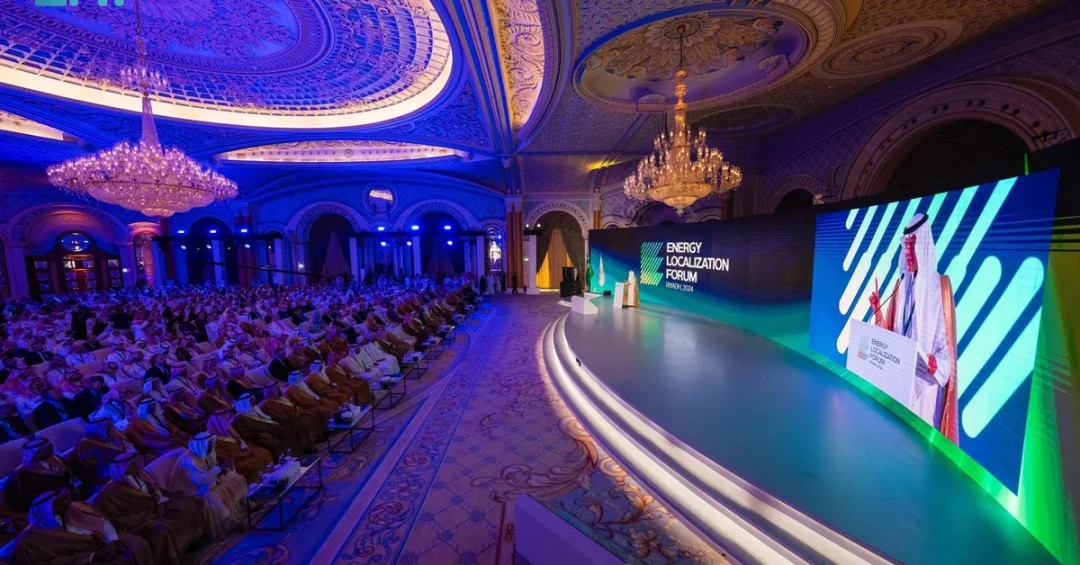
The Energy Localization Forum, hosted by the Ministry of Energy in Riyadh, concluded on October 24, 2024, with the signing of 107 agreements and memoranda of understanding valued at SAR104 billion, according to the Saudi Press Agency. The two-day event, held under the theme “Resilient Energy: Enabling Energy Sector Capability and Sustainability,” brought together government leaders, industry executives, and international partners to advance localization efforts, transfer technology, support innovation, and develop human capital across the energy sector.
The forum represents a significant milestone in Saudi Arabia’s ongoing efforts to build a self-sufficient and globally competitive energy ecosystem. By convening key stakeholders from across the value chain, the event underscored the Kingdom’s commitment to strengthening industrial supply chains, enhancing local content, and creating sustainable economic opportunities. The scale of the agreements signed reflects the depth of collaboration between the public and private sectors and signals strong momentum toward achieving the localization targets set under Saudi Vision 2030.
Context and Background
Why has energy localization become such a central pillar of Saudi Arabia’s economic transformation? The answer lies in the Kingdom’s strategic vision to diversify its economy and reduce dependence on oil revenues while simultaneously building a robust industrial base. The Energy Localization Forum, hosted by the Ministry of Energy, was designed to accelerate this transformation by bringing together local and international stakeholders to forge partnerships, share expertise, and commit to concrete actions that strengthen the domestic energy sector.
The forum’s theme, “Resilient Energy: Enabling Energy Sector Capability and Sustainability,” captured the dual imperative of building resilience against global market fluctuations while ensuring that the energy sector contributes to long-term environmental and economic sustainability. Participants discussed achieving localization ambitions through government support for industrial supply chains and reviewed the progress made in localization efforts to date. Challenges facing supply chains and strategies for developing and sustaining them were also addressed, reflecting a pragmatic approach to overcoming obstacles and seizing opportunities.
The event builds on years of sustained effort by the Ministry of Energy and its partners to increase local content in the energy sector. Previous initiatives have focused on developing local manufacturing capabilities, nurturing small and medium enterprises, and attracting foreign investment through incentives and regulatory reforms. The 2024 forum represents an escalation of these efforts, with the SAR104 billion in agreements demonstrating that the Kingdom’s approach is yielding tangible results and attracting significant capital commitments from both domestic and international players.
Key Details and Agreements
What do the 107 agreements and memoranda of understanding actually cover, and why do they matter? The agreements span a wide range of activities within the energy sector, including technology transfer, local manufacturing, human capital development, and supply chain enhancement. These commitments are designed to embed localization deep within the energy value chain, ensuring that a growing share of components, services, and expertise is sourced from within the Kingdom. The total value of SAR104 billion underscores the scale of investment being directed toward this strategic priority.
The forum highlighted the role of localization in empowering the energy sector, enhancing flexibility, and strengthening both national and global economies. Participants explored future opportunities for localizing energy sector components and utilizing modern technologies to improve efficiency and competitiveness. The Kingdom’s supportive environment for investment in the energy sector was emphasized, with a focus on past successes, current experiences, and future plans to enhance supply chains and national infrastructure.
Key discussions also centered on the importance of developing Saudi human capital. By investing in training, education, and skills development, the Kingdom aims to create a pipeline of talented professionals capable of driving innovation and leading the energy sector into the future. This focus on people aligns with the broader Vision 2030 objective of empowering citizens and creating high-value employment opportunities. The agreements signed at the forum include provisions for knowledge transfer and capacity building, ensuring that localization efforts are sustainable and inclusive.
International and Regional Impact
How does Saudi Arabia’s energy localization drive resonate beyond its borders? The forum attracted participation from international companies and organizations, reflecting the global interest in the Kingdom’s energy transformation. By fostering partnerships with foreign firms, Saudi Arabia is not only accessing cutting-edge technologies and expertise but also positioning itself as a hub for energy innovation in the region. These collaborations create opportunities for mutual growth and reinforce the Kingdom’s role as a reliable energy partner for the world.
Regionally, the forum’s outcomes are likely to have a ripple effect across the Gulf and the broader Middle East. As Saudi Arabia strengthens its domestic energy supply chains, it can serve as a model for other countries seeking to enhance their own localization efforts. The emphasis on sustainability and resilience also aligns with regional priorities, including economic diversification and environmental stewardship. The agreements signed in Riyadh could pave the way for cross-border initiatives and joint ventures that benefit the entire region.
On the international stage, the forum sends a clear signal that Saudi Arabia is open for business and committed to creating a competitive, transparent, and innovation-driven energy sector. The participation of global energy leaders and the substantial value of the agreements demonstrate confidence in the Kingdom’s economic vision and its ability to execute complex, large-scale projects. This enhanced international engagement supports Saudi Arabia’s broader diplomatic and economic objectives, including its role in global energy markets and its pursuit of sustainable development goals.
Economic and Strategic Significance
Why is the SAR104 billion in agreements so significant for Saudi Arabia’s economy? This level of investment represents a major injection of capital into the energy sector, with the potential to stimulate growth, create jobs, and enhance the Kingdom’s industrial capabilities. By localizing production and services, Saudi Arabia can retain more value within its borders, reduce import dependency, and build resilience against external shocks. The agreements also signal to investors and businesses that the Kingdom offers a stable and attractive environment for long-term partnerships.
Strategically, the forum advances Saudi Arabia’s goal of becoming a global leader in energy innovation and sustainability. The focus on technology transfer and modern technologies positions the Kingdom to capitalize on emerging trends such as digitalization, renewable energy, and advanced manufacturing. By integrating these elements into its localization strategy, Saudi Arabia is not only strengthening its current energy infrastructure but also laying the groundwork for future competitiveness in a rapidly evolving global energy landscape.
Moreover, the forum’s emphasis on supply chain development addresses a critical vulnerability exposed by recent global disruptions. By building robust, localized supply chains, Saudi Arabia can ensure the reliability and security of its energy sector, which is essential for both domestic prosperity and international energy security. This strategic foresight reflects the Kingdom’s proactive approach to risk management and its commitment to safeguarding its economic future.
Vision 2030 Alignment
How does the Energy Localization Forum connect to the broader objectives of Saudi Vision 2030? The forum directly supports several key pillars of the Vision, including economic diversification, private sector development, and human capital enhancement. By localizing the energy sector, Saudi Arabia is creating new industries, attracting foreign investment, and generating skilled employment opportunities for its citizens. These outcomes are central to the Vision’s goal of building a thriving, diversified economy that provides prosperity for all.
Furthermore, the forum reinforces Saudi Arabia’s commitment to sustainability and innovation, which are integral to Vision 2030. The agreements signed in Riyadh will drive the adoption of cleaner technologies, improve energy efficiency, and support the Kingdom’s transition to a more sustainable energy mix. As Saudi Arabia continues to implement its ambitious transformation agenda, initiatives like the Energy Localization Forum will play a vital role in turning the Vision’s aspirations into tangible achievements, ensuring that the Kingdom remains a leader in the global energy arena for decades to come.
20 Questions
Q1. What was the Energy Localization Forum?
A1. The Energy Localization Forum was a two-day event hosted by the Ministry of Energy in Riyadh, held under the theme “Resilient Energy: Enabling Energy Sector Capability and Sustainability.” It aimed to boost localization efforts, transfer technology, support innovation, and develop human capital in the energy sector.
Q2. When and where did the forum take place?
A2. The forum took place in Riyadh, Saudi Arabia, and concluded on October 24, 2024. It was a two-day event, as reported by the Saudi Press Agency.
Q3. What was the total value of agreements signed at the forum?
A3. The forum concluded with the signing of 107 agreements and memoranda of understanding worth SAR104 billion, according to the Saudi Press Agency.
Q4. Who hosted the Energy Localization Forum?
A4. The forum was hosted by the Ministry of Energy of the Kingdom of Saudi Arabia, demonstrating the government’s commitment to advancing localization in the energy sector.
Q5. What was the main theme of the forum?
A5. The theme was “Resilient Energy: Enabling Energy Sector Capability and Sustainability,” reflecting the dual focus on building resilience and ensuring sustainability in the energy sector.
Q6. What were the key objectives of the forum?
A6. The key objectives were to boost localization efforts, transfer technology, support innovation, and develop human capital in the energy sector, while addressing supply chain challenges and exploring future opportunities.
Q7. How many agreements and memoranda of understanding were signed?
A7. A total of 107 agreements and memoranda of understanding were signed at the forum, covering various aspects of energy sector localization and development.
Q8. What sectors do the agreements cover?
A8. The agreements cover technology transfer, local manufacturing, human capital development, supply chain enhancement, and other activities aimed at strengthening the energy sector’s local content.
Q9. Why is energy localization important for Saudi Arabia?
A9. Energy localization is important for Saudi Arabia to diversify its economy, reduce dependence on oil revenues, create jobs, enhance industrial capabilities, and build a resilient and sustainable energy sector in line with Vision 2030.
Q10. How does the forum support Saudi Vision 2030?
A10. The forum supports Vision 2030 by promoting economic diversification, private sector development, human capital enhancement, sustainability, and innovation, all of which are key pillars of the Vision.
Q11. What role does the Ministry of Energy play in localization?
A11. The Ministry of Energy leads and coordinates localization efforts, provides government support for industrial supply chains, and facilitates partnerships between local and international stakeholders to advance the energy sector.
Q12. What challenges were discussed at the forum?
A12. Participants discussed challenges facing supply chains and strategies for developing and sustaining them, as well as ways to overcome obstacles to localization and enhance the energy sector’s resilience.
Q13. How does the forum benefit the national economy?
A13. The forum benefits the national economy by attracting investment, creating jobs, retaining value within the Kingdom, reducing import dependency, and strengthening the energy sector’s contribution to GDP.
Q14. What is the significance of the SAR104 billion figure?
A14. The SAR104 billion figure represents a major capital injection into the energy sector, signaling strong investor confidence and the scale of commitment to localization and sustainable development.
Q15. How does localization enhance energy sector flexibility?
A15. Localization enhances flexibility by building domestic capabilities, reducing reliance on external suppliers, and enabling faster adaptation to market changes and disruptions.
Q16. What modern technologies were discussed?
A16. Participants explored modern technologies for localizing energy sector components, improving efficiency, and supporting innovation, including digitalization and advanced manufacturing.
Q17. How does the forum promote international cooperation?
A17. The forum promotes international cooperation by bringing together global companies and organizations to forge partnerships, share expertise, and invest in Saudi Arabia’s energy sector.
Q18. What is the expected impact on job creation?
A18. The forum is expected to create high-value jobs for Saudi citizens through the development of local industries, technology transfer, and human capital initiatives supported by the agreements.
Q19. How does the forum address sustainability?
A19. The forum addresses sustainability by promoting cleaner technologies, improving energy efficiency, and supporting the Kingdom’s transition to a more sustainable energy mix, in line with Vision 2030.
Q20. What are the next steps following the forum?
A20. The next steps include implementing the agreements, monitoring progress on localization targets, and continuing to strengthen supply chains and national infrastructure to achieve the Kingdom’s energy sector goals.
Reader Feedback
We value your thoughts. Please share your feedback on this article.
Your feedback helps us improve our coverage.
Related articles
 Lavender Honey: A New Addition to Aseer’s Beekeeping Industry
 GACA Concludes ICAN 2024 with 15 Air Transport Agreements
 SGS Launches Second Batch of Geological Data Packages
 Al-Kharj Saffron Success Spurs Investment in Saudi Agriculture
 SABIC Chief Leads Saudi Business Delegation to B20 Meetings in Brazil
 Saudi EXIM Signs 3 MoUs to Boost Non-Oil Exports