


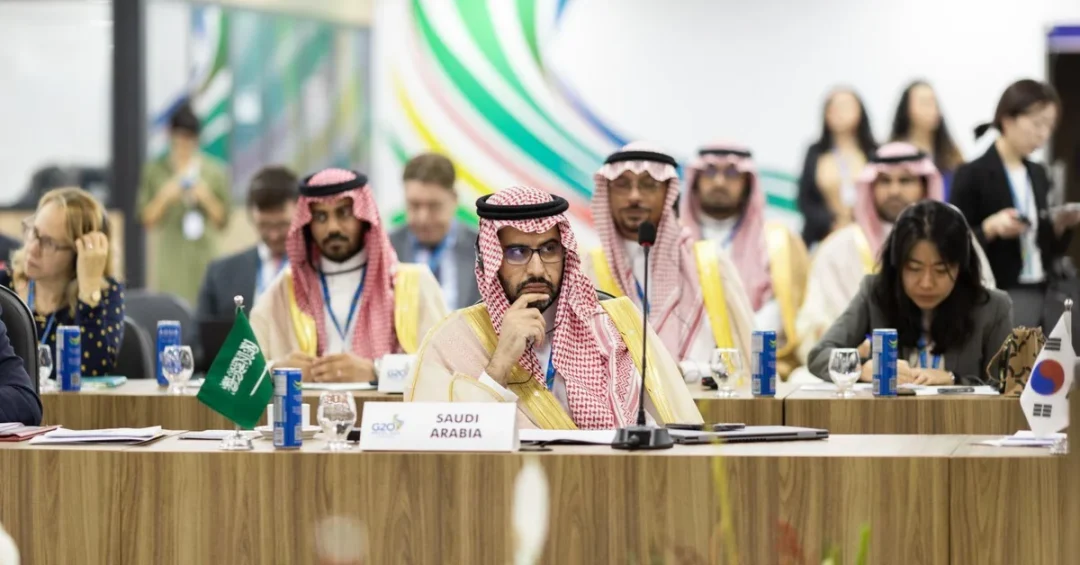
Saudi Arabia participated in the G20 Trade and Investment Ministerial Meeting in Brasilia, Brazil, on October 24, 2024, with Mohammad Abdul Jabbar, Acting Governor of the General Authority of Foreign Trade (GAFT), representing Minister of Commerce and Chairman of the Board of Directors Majid Al-Kassabi. The high-level gathering brought together trade and investment ministers from the world’s largest economies to advance a shared agenda focused on reforming the World Trade Organization (WTO), strengthening the multilateral trading system, expanding the participation of women in international trade, and promoting sustainable development in trade and investment.
How does a single ministerial meeting in Brazil connect to the daily economic lives of people across continents? For Saudi Arabia, the answer lies in the Kingdom’s deepening integration into global trade architecture and its commitment to shaping rules that benefit both developed and emerging economies. The participation of the General Authority of Foreign Trade at this year’s G20 Trade and Investment Ministerial underscores the Kingdom’s proactive role in multilateral economic diplomacy, reflecting a strategic priority that has defined Saudi trade policy under Vision 2030. The meeting in Brasilia served as a critical platform for Saudi Arabia to present its progress on sustainable development, women’s economic empowerment, and investment diversification, while also engaging in bilateral discussions with delegation heads from participating nations.
Context and Background
What makes the G20 Trade and Investment Ministerial such a pivotal forum for global economic governance? The G20, which brings together the world’s major advanced and emerging economies, has long served as a premier platform for coordinating international economic policy. This year’s Trade and Investment Working Group prioritized four interconnected themes: the reform of the World Trade Organization, the improvement of the multilateral trading system, the participation of women in international trade, and sustainable development in trade and investment. These priorities reflect a growing global consensus that trade policy must evolve to address contemporary challenges, including supply chain resilience, digital commerce, and inclusive growth.
Saudi Arabia’s engagement in this forum is rooted in a broader strategy of economic diversification and international partnership building. The General Authority of Foreign Trade, established to enhance the Kingdom’s global trade position, plays a central role in advancing Saudi Arabia’s interests in multilateral settings. By participating actively in the G20 Trade and Investment Ministerial, the Kingdom reinforces its commitment to a rules-based international trading system while advocating for reforms that reflect the needs of developing economies. The meeting also provided a venue for Saudi Arabia to share its national experience in aligning trade and investment policies with the Sustainable Development Goals, a framework that has guided much of the Kingdom’s recent economic planning.
The timing of this meeting is significant, coming as global trade faces headwinds from geopolitical tensions, protectionist pressures, and the lingering effects of the COVID-19 pandemic on supply chains. In this environment, Saudi Arabia’s voice in forums like the G20 carries weight not only because of the Kingdom’s economic size but also because of its demonstrated capacity to implement ambitious domestic reforms. The Saudi experience offers a compelling case study in how trade and investment policies can be harnessed to drive sustainable development, a narrative that resonates with many G20 members facing similar challenges.
Key Details
What specific messages did Saudi Arabia bring to the G20 table? During his speech, Mohammad Abdul Jabbar, Acting Governor of the General Authority of Foreign Trade, emphasized the importance of the World Trade Organization in international trade. He expressed Saudi Arabia’s appreciation for the role of Saudi women in the Kingdom’s economic progress and international trade, highlighting concrete indicators that demonstrate measurable progress. The Kingdom’s World Bank index for women, business, and law increased from 25 in 2019 to 71 in 2023, a substantial leap that reflects targeted reforms in legal and regulatory frameworks. Saudi women’s participation in the workforce rose from 17.4 percent in 2017 to 34.6 percent in 2023, and their proportion of small and medium enterprises reached 42 percent.
These figures are not merely statistics; they represent a fundamental transformation in the Saudi economy and society. The Acting Governor’s remarks underscored that women’s economic empowerment is not a peripheral concern but a central pillar of Saudi Arabia’s development strategy. By sharing these achievements on an international stage, the Kingdom signals its commitment to inclusive growth and its willingness to be held accountable to measurable benchmarks. The G20’s focus on women in international trade aligns closely with Saudi Arabia’s national priorities, creating a natural synergy between domestic policy and global advocacy.
In addition to the formal ministerial session, the GAFT Acting Governor engaged in numerous bilateral discussions with heads of delegations attending the meeting. These side meetings are often where the most substantive progress occurs, allowing countries to explore bilateral trade and investment opportunities, address specific concerns, and build personal relationships that facilitate future cooperation. For Saudi Arabia, such engagements are integral to its strategy of diversifying trade partners and attracting foreign investment. The Kingdom’s participation in these bilateral discussions reflects an understanding that multilateral forums and bilateral relationships are complementary channels for advancing national interests.
The Acting Governor also conveyed Saudi Arabia’s broader vision for sustainable development. “The Kingdom has made substantial progress in achieving the Sustainable Development Goals,” he stated. “The National Investment Policy has facilitated the expansion of economic diversity. The Kingdom has implemented supportive policies and standards to achieve these objectives and establish itself as a global investment hub for sustainable development. This has been achieved by aligning international efforts with the Sustainable Development Goals and leveraging the exchange of best practices. Consequently, a more sustainable, flexible, and prosperous economy that benefits all has been facilitated.”
International and Regional Impact
How does Saudi Arabia’s participation in the G20 Trade and Investment Ministerial reverberate across the Middle East and beyond? The Kingdom’s active role in shaping global trade discussions carries significant implications for regional economic integration. As the largest economy in the Middle East and a key player in organizations such as the Gulf Cooperation Council and the Arab League, Saudi Arabia’s positions on trade reform and sustainable development often influence the broader region’s approach. By championing WTO reform and the multilateral trading system, the Kingdom contributes to a global environment that benefits all trading nations, particularly those in the developing world that rely on predictable rules and open markets.
The emphasis on women’s participation in international trade also has regional resonance. Saudi Arabia’s progress in this area serves as an example for other countries in the region that are undertaking similar reforms. The Kingdom’s willingness to share its experience and data on women’s economic empowerment reflects a spirit of constructive engagement that strengthens its soft power and positions it as a thought leader in the region. Furthermore, the bilateral discussions held on the margins of the G20 meeting likely touched on trade and investment opportunities that could deepen economic ties between Saudi Arabia and both G20 members and guest countries. These conversations contribute to the diversification of Saudi Arabia’s international partnerships, a key objective of Vision 2030.
On the global stage, Saudi Arabia’s advocacy for sustainable development in trade and investment aligns with the priorities of many G20 members, creating opportunities for coalition-building and joint initiatives. The Kingdom’s message that economic growth and environmental and social sustainability are compatible, indeed mutually reinforcing, resonates in a world seeking pathways to inclusive prosperity. By presenting itself as a global investment hub for sustainable development, Saudi Arabia attracts attention from international investors and partners who share these values. The G20 platform amplifies this message, reaching decision-makers and opinion leaders across the world’s major economies.
Economic and Strategic Significance
What does Saudi Arabia’s engagement in the G20 Trade and Investment Ministerial mean for the Kingdom’s economic trajectory? At its core, this participation reflects a strategic bet on the benefits of international trade and investment for Saudi Arabia’s long-term prosperity. The Kingdom’s National Investment Policy, referenced by the Acting Governor, is designed to create a business-friendly environment that attracts foreign capital, fosters innovation, and generates employment opportunities for Saudi citizens. By aligning this policy with the Sustainable Development Goals, Saudi Arabia signals that its economic ambitions are not narrowly self-interested but are embedded in a broader vision of global responsibility.
The focus on WTO reform is particularly significant for Saudi Arabia, a major exporter of energy products and a growing exporter of manufactured goods and services. A strengthened multilateral trading system provides predictability and fairness, reducing the risks associated with unilateral trade measures and geopolitical disruptions. The Kingdom’s support for the WTO also reflects its interest in ensuring that global trade rules evolve to address new realities, such as digital trade and e-commerce, where Saudi Arabia is actively developing its capabilities. The G20 meeting provided a valuable opportunity for Saudi Arabia to contribute to these discussions and to learn from the experiences of other major economies.
Furthermore, the emphasis on women’s participation in international trade has direct economic implications. By increasing women’s workforce participation and supporting women entrepreneurs, Saudi Arabia is unlocking a significant source of economic growth and innovation. The data shared at the G20 meeting, including the rise in the World Bank index for women, business, and law, and the growth in women’s SME ownership, demonstrate that these efforts are yielding tangible results. These achievements enhance the Kingdom’s attractiveness as an investment destination and as a partner in global value chains, as international firms increasingly prioritize diversity and inclusion in their operations.
Vision 2030 Alignment
How does Saudi Arabia’s participation in the G20 Trade and Investment Ministerial advance the objectives of Vision 2030? Vision 2030, the Kingdom’s comprehensive reform blueprint, aims to diversify the economy away from oil dependence, expand the private sector, and create a vibrant society. International trade and investment are central to these goals, as they provide markets for Saudi products, sources of capital and technology, and opportunities for knowledge exchange. The General Authority of Foreign Trade, through its work in forums like the G20, directly supports the Vision 2030 objective of transforming Saudi Arabia into a global investment powerhouse and a hub connecting three continents.
The specific themes of this year’s G20 Trade and Investment Working Group, WTO reform, multilateralism, women’s economic participation, and sustainable development, align closely with Vision 2030’s emphasis on responsible and inclusive growth. Saudi Arabia’s progress in women’s economic empowerment, showcased at the meeting, exemplifies the Vision’s commitment to developing the talents of all Saudis. The Kingdom’s advocacy for sustainable development in trade and investment reflects the Vision’s holistic approach, which recognizes that economic prosperity must be built on foundations of environmental stewardship and social progress. As Saudi Arabia continues to implement Vision 2030, its active engagement in global economic governance will remain a key driver of its success and a testament to its growing role as a leader on the world stage.
20 Questions
Q1. What was the main purpose of the G20 Trade and Investment Ministerial Meeting in Brasilia?
A1. The meeting aimed to advance global trade and investment cooperation, focusing on World Trade Organization reform, strengthening the multilateral trading system, increasing women’s participation in international trade, and promoting sustainable development.
Q2. Who represented Saudi Arabia at the G20 Trade and Investment Ministerial Meeting?
A2. Mohammad Abdul Jabbar, Acting Governor of the General Authority of Foreign Trade, represented Saudi Arabia on behalf of Minister of Commerce Majid Al-Kassabi, who is also Chairman of the Board of Directors.
Q3. What are the four priority areas of this year’s G20 Trade and Investment Working Group?
A3. The priorities are reform of the World Trade Organization, improvement of the multilateral trading system, participation of women in international trade, and sustainable development in trade and investment.
Q4. How has Saudi Arabia’s World Bank index for women, business, and law changed recently?
A4. Saudi Arabia’s World Bank index for women, business, and law increased significantly from 25 in 2019 to 71 in 2023, reflecting substantial legal and regulatory reforms.
Q5. What percentage of the Saudi workforce was made up of women in 2023?
A5. Saudi women’s participation in the workforce increased from 17.4 percent in 2017 to 34.6 percent in 2023, demonstrating steady progress in economic inclusion.
Q6. What proportion of small and medium enterprises in Saudi Arabia are owned by women?
A6. Women’s proportion of small and medium enterprises in Saudi Arabia reached 42 percent, highlighting their growing role as entrepreneurs and business leaders.
Q7. What did the Acting Governor of GAFT emphasize about the WTO?
A7. He emphasized the importance of the World Trade Organization in international trade, expressing Saudi Arabia’s support for the multilateral trading system and its reform.
Q8. How does Saudi Arabia’s National Investment Policy support sustainable development?
A8. The National Investment Policy facilitates economic diversity, aligns international efforts with Sustainable Development Goals, and establishes Saudi Arabia as a global investment hub for sustainable development.
Q9. What bilateral activities did the GAFT Acting Governor undertake during the meeting?
A9. He engaged in numerous bilateral discussions with heads of delegations attending the meeting, exploring trade and investment opportunities and strengthening international partnerships.
Q10. Why is WTO reform important for Saudi Arabia’s economy?
A10. WTO reform supports a predictable and fair multilateral trading system, which benefits Saudi Arabia as a major exporter and supports its economic diversification goals under Vision 2030.
Q11. How does women’s participation in trade contribute to Saudi Arabia’s economic growth?
A11. Increasing women’s participation in the workforce and entrepreneurship unlocks economic growth, fosters innovation, and enhances Saudi Arabia’s attractiveness as an investment destination and global partner.
Q12. What does Saudi Arabia’s participation in the G20 signify about its global role?
A12. It signifies Saudi Arabia’s proactive engagement in multilateral economic diplomacy and its commitment to shaping global trade rules that benefit all economies, including developing nations.
Q13. How does the G20 meeting align with Vision 2030 objectives?
A13. The meeting’s themes align with Vision 2030’s goals of economic diversification, global investment, women’s empowerment, and sustainable development, reinforcing Saudi Arabia’s reform agenda.
Q14. What message did Saudi Arabia convey about its progress on Sustainable Development Goals?
A14. Saudi Arabia conveyed that it has made substantial progress on Sustainable Development Goals through supportive policies, economic diversity, and alignment of international efforts with these objectives.
Q15. What is the General Authority of Foreign Trade’s role in Saudi Arabia’s international engagement?
A15. GAFT enhances Saudi Arabia’s global trade position, advances the Kingdom’s interests in multilateral forums, and supports the diversification of trade partners and investment sources.
Q16. How does Saudi Arabia’s progress on women’s economic empowerment impact its international image?
A16. It strengthens Saudi Arabia’s soft power, positions the Kingdom as a thought leader in the region, and demonstrates its commitment to inclusive growth and measurable reform.
Q17. What are the implications of the G20 meeting for regional economic integration?
A17. Saudi Arabia’s active role influences the broader Middle East’s approach to trade reform and sustainable development, contributing to a global environment that benefits all trading nations.
Q18. How does sustainable development in trade and investment benefit Saudi Arabia?
A18. It attracts international investors who value sustainability, aligns Saudi policies with global standards, and supports long-term economic resilience and prosperity for all.
Q19. What bilateral opportunities might arise from the G20 meeting for Saudi Arabia?
A19. Bilateral discussions could lead to new trade agreements, investment partnerships, and collaboration on sustainable development projects, diversifying Saudi Arabia’s international economic ties.
Q20. What is the forward-looking significance of Saudi Arabia’s participation in the G20 Trade and Investment Ministerial?
A20. It reinforces Saudi Arabia’s role as a global economic leader, advances Vision 2030 objectives, and contributes to a more sustainable, flexible, and prosperous global economy that benefits all.
Reader Feedback
We value your thoughts. Please share your feedback on this article.
Your feedback helps us improve our coverage.
Related articles
 Energy Localization Forum Concludes in Riyadh with SAR104 Billion in Agreements
 Lavender Honey: A New Addition to Aseer’s Beekeeping Industry
 GACA Concludes ICAN 2024 with 15 Air Transport Agreements
 SGS Launches Second Batch of Geological Data Packages
 Al-Kharj Saffron Success Spurs Investment in Saudi Agriculture
 SABIC Chief Leads Saudi Business Delegation to B20 Meetings in Brazil