


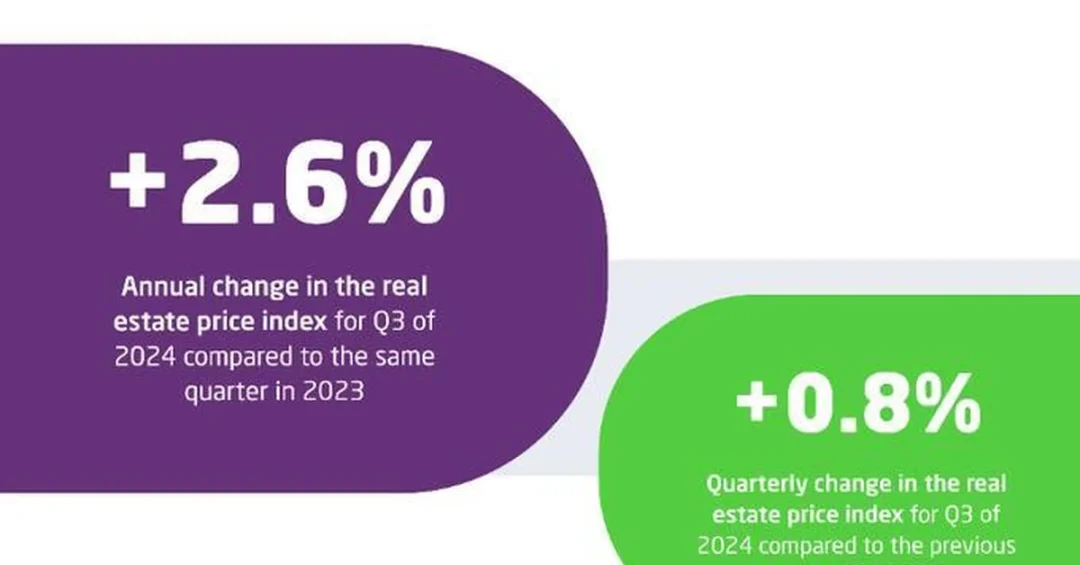
Saudi Arabia’s real estate price index rose by 2.6 percent in the third quarter of 2024 compared with the same period a year earlier, according to official data released by the General Authority for Statistics (GASTAT), underscoring the continued momentum of the Kingdom’s property market amid rapid economic transformation. The quarterly index, published by Saudi Arabia’s official statistical authority, shows that growth was broad-based but led by the commercial sector, while the residential segment continued its steady upward trajectory. The figures arrive as Saudi Arabia advances an unprecedented pipeline of giga-projects, urban development programs, and housing initiatives tied to Vision 2030. For international observers, the data offers a clear signal that demand for Saudi property remains resilient, supported by population growth, urban expansion, and sustained public and private investment. The index is widely watched by economists, investors, and policymakers as a barometer of domestic economic health.
The real estate price index is compiled by GASTAT using a structured methodology that tracks transaction prices across residential, commercial, and agricultural segments. Its release each quarter provides one of the most authoritative snapshots of asset values in the Kingdom. In Q3 2024, the overall index climbed 2.6 percent year on year, a pace that reflects measured and sustainable growth rather than speculative overheating. Analysts note that such stability is a hallmark of a maturing market. The data also reinforces the Kingdom’s position as one of the most dynamic property markets in the Middle East and North Africa, attracting regional and global capital. How does this quarter’s performance fit into the broader story of Saudi economic diversification? The answer lies in the details of each sector.
Context and Background
Why does a single quarterly index matter so much to economists and investors alike? Because real estate is one of the clearest mirrors of an economy’s underlying strength. Saudi Arabia’s property market has undergone a profound transformation since the launch of Vision 2030 in 2016. What was once a relatively closed market dominated by local players has evolved into a transparent, regulated, and internationally accessible sector. The General Authority for Statistics, which operates under the Kingdom’s official statistical framework, has expanded its data collection and reporting capabilities in recent years, giving investors a more reliable picture of price movements. The Q3 2024 index is the latest product of that effort, offering a granular view of residential, commercial, and agricultural land trends. It arrives at a time when Saudi cities are expanding, new economic zones are taking shape, and demand for housing is rising.
The residential sector, which accounts for the largest share of the index, grew by 1.6 percent annually in Q3 2024. Within that segment, residential land prices rose 1.6 percent, apartment prices increased 1.9 percent, and villa prices climbed 1.5 percent. These figures reflect steady demand from a growing population, expanding household formation, and government-backed homeownership programs. The commercial sector, meanwhile, posted a more pronounced 6.4 percent annual increase. Commercial land prices rose 6.3 percent and building prices surged 8.6 percent, driven by demand for retail, office, and mixed-use space in major urban centers. Not every segment rose: gallery and shop prices declined 1.1 percent, and agricultural land prices fell 8.7 percent, a reminder that the market is not uniform. This mix of gains and declines paints a picture of a dynamic, segment-specific market rather than a broad speculative wave.
Key Details
What exactly do the numbers reveal about where demand is strongest? The commercial segment’s 6.4 percent annual growth stands out as the quarter’s most striking figure. Commercial land prices rose 6.3 percent, and commercial building prices jumped 8.6 percent, reflecting strong appetite for business infrastructure in Riyadh, Jeddah, Dammam, and emerging economic hubs. This aligns with the Kingdom’s push to expand its private sector, attract regional headquarters, and develop world-class logistics and retail environments. The residential sector’s 1.6 percent growth, while more modest, is significant because it represents the largest volume of transactions. Apartment prices rose 1.9 percent, outpacing villas at 1.5 percent, suggesting that urban, higher-density living is increasingly in demand, particularly among younger Saudis and expatriate professionals. Residential land prices rose 1.6 percent, indicating continued interest in land ownership and development.
The declines in gallery/shop prices, down 1.1 percent, and agricultural land prices, down 8.7 percent, are equally informative. The drop in retail shop prices may reflect a recalibration in the retail sector as e-commerce grows and shopping patterns shift, while the fall in agricultural land prices could be linked to changing land-use priorities and urban expansion into previously agricultural areas. Taken together, the data shows a market that is rewarding commercial and residential development while adjusting in segments facing structural change. For investors, this suggests opportunities in income-generating commercial assets and residential rentals, while caution may be warranted in traditional retail and agricultural land. The index thus serves as both a report card and a guide for capital allocation.
International and Regional Impact
How do global investors interpret a 2.6 percent annual rise in Saudi real estate prices? In a world where many major markets are experiencing stagnation or correction, steady growth in the Kingdom stands out as a signal of stability and opportunity. International funds, developers, and family offices have been increasing their exposure to Saudi real estate, drawn by Vision 2030’s promise of economic diversification, population growth, and infrastructure spending. The Q3 2024 index reinforces the narrative that Saudi Arabia offers a predictable, well-regulated environment for property investment. Regional peers, by contrast, have seen more volatile price swings. The Kingdom’s measured growth trajectory is attractive to institutional investors seeking long-term value rather than short-term speculation. It also supports Saudi Arabia’s ambition to become a top global destination for foreign direct investment.
Within the region, Saudi Arabia’s real estate performance carries weight beyond its borders. As the largest economy in the Middle East, its property market influences sentiment across the Gulf Cooperation Council. A stable, growing Saudi market can lift confidence in neighboring markets and encourage cross-border investment. Moreover, the Kingdom’s giga-projects, such as NEOM, the Red Sea Project, and Diriyah, are drawing global attention and capital, creating a halo effect for the broader sector. The Q3 data suggests that demand is not confined to these flagship developments but is spread across established cities and commercial centers. This breadth is a sign of a healthy, multi-layered market. For international readers, it means Saudi real estate is no longer a niche frontier but a mainstream component of diversified emerging-market portfolios.
Economic and Strategic Significance
Why is the real estate sector so central to Saudi Arabia’s economic strategy? Because property is both a driver and a reflection of broader economic activity. Construction, development, and related services account for a significant share of non-oil GDP, and the sector employs hundreds of thousands of people. When real estate prices rise steadily, it signals confidence among households and businesses, which in turn supports consumer spending, investment, and job creation. The Q3 2024 index, with its 2.6 percent overall increase, points to an economy that is firing on multiple cylinders. The commercial segment’s strong performance is particularly encouraging because it suggests that businesses are expanding and demand for office, retail, and industrial space is robust. This aligns with the Kingdom’s goal of growing the private sector’s contribution to GDP and reducing reliance on oil revenues.
From a strategic perspective, the real estate index also informs government policy. Ministries and agencies use such data to assess housing affordability, plan infrastructure, and calibrate incentives for developers. The steady rise in residential prices, especially apartments, highlights the need for continued supply of affordable and mid-market housing, a priority under Vision 2030’s Housing Program. The commercial surge, meanwhile, validates investments in business districts and logistics hubs. For international investors, the data provides a due-diligence tool: it shows which segments are growing and which are contracting. The overall picture is one of a market that is expanding in line with economic fundamentals, not overheating. That is precisely the kind of environment that attracts long-term, productive capital.
Vision 2030 Alignment
How does a quarterly real estate index connect to the grand ambitions of Vision 2030? In many ways, the index is a pulse check on the transformation itself. Vision 2030 aims to diversify the economy, raise homeownership, attract foreign investment, and build world-class cities. Rising real estate prices, when driven by genuine demand and not speculation, indicate that these goals are gaining traction. The 1.6 percent growth in residential prices reflects a market where more Saudis are buying homes, supported by programs like Sakani and new mortgage regulations. The 6.4 percent rise in commercial prices signals that businesses are investing in offices, warehouses, and retail spaces, contributing to non-oil growth. The data thus provides tangible evidence that the Kingdom’s economic overhaul is producing real, measurable outcomes in the property sector.
Looking ahead, the trajectory of Saudi real estate is closely tied to the continued execution of Vision 2030. As giga-projects progress, new cities emerge, and regulatory reforms deepen, the market is expected to remain dynamic. The Q3 2024 index offers a foundation for that outlook, showing balanced growth across key segments. For international audiences, it is a reminder that Saudi Arabia is not just a story of oil and ambition, but of concrete economic activity and investment opportunity. The Kingdom’s leadership has consistently emphasized that Vision 2030 is a long-term journey, and quarterly data like this helps track its progress. As the market matures, it will continue to attract global attention and capital, reinforcing Saudi Arabia’s role as an economic powerhouse and a hub for innovation and development in the region and beyond.
20 Questions
Q1. What was the overall increase in Saudi Arabia’s real estate price index in Q3 2024?
A1. The overall index rose by 2.6 percent compared with the same quarter in 2023, according to the General Authority for Statistics.
Q2. Which sector drove the overall increase in real estate prices?
A2. The commercial sector was the primary driver, posting a 6.4 percent annual increase, while the residential sector also contributed with 1.6 percent growth.
Q3. How much did residential prices grow in Q3 2024?
A3. Residential prices grew by 1.6 percent year on year, reflecting steady demand for housing across the Kingdom.
Q4. What was the change in apartment prices?
A4. Apartment prices increased by 1.9 percent compared with Q3 2023, outpacing villa price growth.
Q5. How did villa prices perform?
A5. Villa prices rose by 1.5 percent annually in Q3 2024, indicating continued demand for larger family homes.
Q6. What happened to residential land prices?
A6. Residential land prices increased by 1.6 percent year on year, showing sustained interest in land ownership and development.
Q7. What was the growth rate for commercial land prices?
A7. Commercial land prices rose by 6.3 percent compared with the same quarter in 2023, driven by demand for business space.
Q8. How much did commercial building prices increase?
A8. Commercial building prices surged by 8.6 percent annually, the highest growth rate among all segments reported.
Q9. Did gallery and shop prices rise or fall?
A9. Gallery and shop prices decreased by 1.1 percent, reflecting shifting retail dynamics and changing consumer preferences.
Q10. What was the change in agricultural land prices?
A10. Agricultural land prices declined by 8.7 percent year on year, likely due to changing land-use priorities and urban expansion.
Q11. Which authority released the real estate price index?
A11. The General Authority for Statistics (GASTAT), Saudi Arabia’s official statistical agency, released the index for Q3 2024.
Q12. When was the data released?
A12. The data was released on October 27, 2024, according to the Saudi Press Agency.
Q13. Why is the real estate price index important for investors?
A13. It provides an authoritative snapshot of price movements across sectors, helping investors assess market trends and make informed decisions.
Q14. How does the commercial sector’s growth reflect Vision 2030?
A14. Strong commercial growth indicates private-sector expansion and demand for business infrastructure, aligning with Vision 2030’s economic diversification goals.
Q15. What does the residential growth suggest about housing demand?
A15. It suggests steady demand driven by population growth, urbanization, and government-backed homeownership programs like Sakani.
Q16. Are real estate prices in Saudi Arabia considered stable?
A16. Yes, the 2.6 percent annual increase reflects measured, sustainable growth rather than speculative overheating, indicating a maturing market.
Q17. How does Saudi Arabia’s real estate market compare regionally?
A17. It is one of the most dynamic and stable in the Middle East and North Africa, attracting significant regional and international capital.
Q18. What role do giga-projects play in the real estate market?
A18. Projects like NEOM and the Red Sea Project draw global attention and investment, creating a positive halo effect for the broader property sector.
Q19. What should international investors take away from this data?
A19. The data signals a predictable, well-regulated market with opportunities in commercial and residential segments, supporting long-term investment strategies.
Q20. How does this index support Saudi Arabia’s long-term vision?
A20. It provides measurable evidence of economic transformation, helping track progress toward Vision 2030 goals of diversification, homeownership, and global investment attractiveness.
Reader Feedback
We value your thoughts. Please share your feedback on this article.
Your feedback helps us improve our coverage.
Related articles
 Global Proptech Summit Starts in Riyadh
 Mawani Adds Akkon Lines FES Service to Jeddah Port
 SAMA Seeks Public Input on Updated Debt Collection Rules
 REGA Launches Saudi PropTech Hub to Drive Real Estate Innovation
 Saudi Liquidity Hits Record SAR2.906 Trillion in August 2024
 Saudi-UAE Economic Forum Draws 400+ Investors in Riyadh