


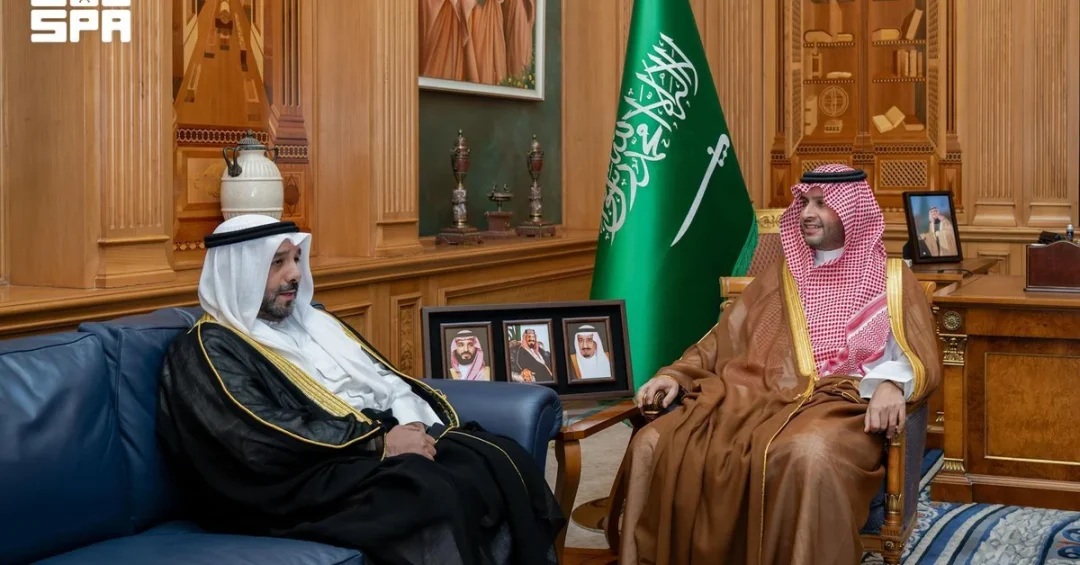
Prince Turki bin Mohammed bin Fahd bin Abdulaziz, Minister of State and Cabinet Member, received Sheikh Sabah Nasser Sabah Al-Ahmad Al-Sabah, Ambassador of the State of Kuwait to the Kingdom of Saudi Arabia, in Riyadh on October 14, 2026, according to the Saudi Press Agency. The meeting, held at the Minister of State’s office in the Saudi capital, featured cordial exchanges and a review of the longstanding fraternal relations between the two countries and ways to strengthen them across various fields. The encounter underscores the enduring partnership between Saudi Arabia and Kuwait, two neighboring Gulf states whose ties are rooted in shared history, mutual respect, and a common vision for regional stability and prosperity.
Diplomatic engagements of this nature are a regular feature of Saudi Arabia’s foreign policy, reflecting the Kingdom’s commitment to maintaining open channels of communication with its allies and neighbors. The meeting between Prince Turki and Ambassador Al-Sabah is part of a broader pattern of high-level consultations that reinforce the Gulf Cooperation Council (GCC) framework, a cornerstone of regional cooperation. For international observers, such interactions signal the continued strength of Saudi-Kuwaiti relations and the two nations’ shared dedication to addressing regional challenges through dialogue and collaboration.
Context and Background
How do longstanding personal and institutional ties between Saudi Arabia and Kuwait continue to shape their diplomatic engagements in the modern era? The relationship between the Kingdom of Saudi Arabia and the State of Kuwait is one of the most enduring and multifaceted in the Gulf region. Bound by geography, culture, and shared interests, the two countries have maintained close ties since the establishment of the modern Saudi state. Kuwait has consistently been a key partner for Saudi Arabia in matters of security, trade, and regional diplomacy, and the two nations coordinate closely within the framework of the Gulf Cooperation Council, which was founded in 1981 to promote economic and political integration among its member states.
The meeting between Prince Turki bin Mohammed bin Fahd and Ambassador Sheikh Sabah Nasser Sabah Al-Ahmad Al-Sabah is a continuation of this tradition of regular high-level consultations. Prince Turki, a senior member of the Saudi royal family and a Minister of State, has long been involved in diplomatic and advisory roles that support the Kingdom’s foreign policy objectives. Ambassador Al-Sabah, a seasoned diplomat representing Kuwait in Riyadh, plays a vital role in facilitating communication between the two governments. Their discussions, as reported by the Saudi Press Agency, focused on reviewing the fraternal relations between the two countries and exploring avenues to enhance cooperation across various fields, from economic and cultural exchanges to security and political coordination.
The timing of the meeting is significant, coming amid a period of dynamic regional developments and evolving global challenges. Saudi Arabia, under the leadership of the Custodian of the Two Holy Mosques King Salman bin Abdulaziz Al Saud and Crown Prince Mohammed bin Salman bin Abdulaziz Al Saud, has been actively pursuing a foreign policy that emphasizes stability, economic diversification, and regional integration. Kuwait, with its own strategic priorities and longstanding diplomatic traditions, shares many of these objectives. The meeting therefore serves as an opportunity to align positions on issues of mutual concern and to reaffirm the strong bonds that have characterized Saudi-Kuwaiti relations for decades.
Key Details of the Meeting
What specific areas of cooperation were highlighted during the discussions between Prince Turki and Ambassador Al-Sabah? According to the official Saudi Press Agency report, the meeting featured cordial exchanges and a review of the longstanding fraternal relations between the two countries. The discussions covered ways to strengthen these relations across various fields, though the specific details of those fields were not enumerated in the initial report. However, based on the pattern of Saudi-Kuwaiti relations, it is reasonable to infer that topics such as economic collaboration, trade, investment, security coordination, and cultural exchange were on the agenda. The two officials also likely discussed regional developments and the importance of continued coordination within the Gulf Cooperation Council and other multilateral forums.
Prince Turki bin Mohammed bin Fahd bin Abdulaziz is a prominent figure in Saudi Arabia’s governance structure. As Minister of State and a member of the Cabinet, he holds a position that involves advising on key national policies and representing the Kingdom in various diplomatic capacities. His reception of Ambassador Al-Sabah reflects the Saudi leadership’s commitment to maintaining robust ties with Kuwait and to ensuring that the relationship continues to evolve in line with the changing dynamics of the region. Ambassador Al-Sabah, for his part, has been an active and effective representative of Kuwait in Riyadh, working to deepen the bilateral relationship and to facilitate cooperation on a wide range of issues.
The meeting also highlights the importance of personal diplomacy in Saudi-Kuwaiti relations. The Al-Sabah family, Kuwait’s ruling dynasty, has a long history of close interaction with the Saudi royal family, and these personal connections often complement and reinforce the formal diplomatic channels between the two countries. The cordial nature of the exchanges, as described by the Saudi Press Agency, is a testament to the warmth and mutual respect that characterize the relationship at the highest levels. Such interactions are not merely ceremonial; they serve as a mechanism for building trust, sharing perspectives, and identifying opportunities for collaboration that can benefit both nations.
International and Regional Impact
How does the strength of Saudi-Kuwaiti relations contribute to broader stability in the Gulf and the Middle East? The relationship between Saudi Arabia and Kuwait is a pillar of regional stability in the Gulf. As two of the largest and most influential members of the Gulf Cooperation Council, their cooperation is essential for addressing shared challenges, from economic diversification and energy security to counterterrorism and maritime security. A strong Saudi-Kuwaiti partnership also sends a positive signal to other regional and international actors, demonstrating that dialogue and collaboration are the preferred means of resolving differences and advancing common interests. In a region often characterized by volatility, the enduring friendship between Riyadh and Kuwait City serves as a stabilizing force.
For the international community, the meeting between Prince Turki and Ambassador Al-Sabah is a reminder of the importance of the Gulf region as a hub of diplomacy and economic activity. Saudi Arabia and Kuwait are both major energy producers and key players in global markets. Their coordination on energy policy, trade, and investment can have significant implications for the global economy. Moreover, their shared commitment to moderation and stability aligns with the interests of many countries around the world. The meeting thus reinforces the role of the Gulf Cooperation Council as a constructive force in international affairs, one that promotes peace, security, and prosperity not only for its members but for the wider world.
The discussions between the two officials also come at a time when the Middle East is undergoing significant transformations. Saudi Arabia’s Vision 2030 initiative is reshaping the Kingdom’s economy and society, opening up new opportunities for partnership and investment. Kuwait, too, has its own development plans, such as Kuwait Vision 2035, which aims to transform the country into a financial and commercial hub. The alignment of these national visions creates a natural basis for deeper cooperation. By working together, Saudi Arabia and Kuwait can leverage their complementary strengths to drive economic growth, create jobs, and enhance the quality of life for their citizens. The meeting between Prince Turki and Ambassador Al-Sabah is a step in that direction, reaffirming the political will to translate shared aspirations into concrete outcomes.
Economic and Strategic Significance
What economic and strategic opportunities does the Saudi-Kuwaiti relationship offer in the context of Vision 2030 and regional development? The economic ties between Saudi Arabia and Kuwait are substantial and diverse. Trade between the two countries encompasses a wide range of goods and services, from petroleum products and petrochemicals to foodstuffs and manufactured goods. Saudi Arabia is one of Kuwait’s largest trading partners, and Kuwait is a significant investor in the Saudi economy. The two countries also cooperate closely in the energy sector, both as members of OPEC and through bilateral arrangements. This economic interdependence provides a solid foundation for further collaboration, particularly in areas such as renewable energy, technology, tourism, and logistics.
Strategically, the Saudi-Kuwaiti partnership is vital for maintaining the security of the Gulf region. The two countries share a commitment to combating terrorism, extremism, and other transnational threats. They also coordinate on maritime security, given their strategic locations along the Gulf coast. The meeting between Prince Turki and Ambassador Al-Sabah likely touched on these issues, as both officials are well aware of the importance of a unified approach to regional security. In addition, the two countries are key players in the broader Arab and Islamic worlds, and their cooperation extends to multilateral organizations such as the United Nations, the Arab League, and the Organization of Islamic Cooperation. Their joint efforts in these forums help to advance common positions on issues of concern to the region and the Muslim world.
From a strategic perspective, the meeting also underscores the importance of the Gulf Cooperation Council as a platform for collective action. The GCC has been instrumental in facilitating economic integration, defense cooperation, and political coordination among its member states. Saudi Arabia and Kuwait have both been strong supporters of the GCC, and their bilateral relationship is reinforced by their shared commitment to the organization’s goals. As the region faces new challenges and opportunities, the GCC remains a vital mechanism for promoting stability and prosperity. The meeting between Prince Turki and Ambassador Al-Sabah is a reflection of this enduring commitment to collective security and cooperation.
Vision 2030 Alignment
How does the Saudi-Kuwaiti partnership support the objectives of Saudi Vision 2030 and contribute to a prosperous future for both nations? Saudi Vision 2030, the Kingdom’s ambitious plan to diversify its economy and transform its society, places a strong emphasis on international cooperation and partnership. The vision recognizes that Saudi Arabia’s success is intertwined with the stability and prosperity of its neighbors and the wider region. Kuwait, as a close ally and economic partner, is an important stakeholder in this endeavor. The meeting between Prince Turki bin Mohammed bin Fahd and Ambassador Sheikh Sabah Nasser Sabah Al-Ahmad Al-Sabah is a concrete example of how Saudi Arabia is working to strengthen these partnerships and to build a network of alliances that can support its long-term goals.
Under Vision 2030, Saudi Arabia is seeking to attract foreign investment, expand its non-oil sectors, and create a vibrant society. Kuwait can play a role in these efforts, both as an investor and as a partner in joint ventures. The two countries have already established a number of cooperative frameworks, including the Saudi-Kuwaiti Coordination Council, which was formed to enhance bilateral relations and to facilitate collaboration on economic, development, and security issues. The meeting in Riyadh is part of the ongoing work of this council and other bilateral mechanisms. By maintaining regular high-level contacts, Saudi Arabia and Kuwait ensure that their relationship remains dynamic and responsive to new challenges and opportunities.
Looking ahead, the Saudi-Kuwaiti partnership is poised to grow even stronger. The two countries share a vision of a stable, prosperous, and forward-looking Gulf region. They are committed to working together to achieve this vision, whether through bilateral initiatives or through regional organizations like the GCC. The meeting between Prince Turki and Ambassador Al-Sabah is a reaffirmation of this commitment. It is a reminder that in a rapidly changing world, the bonds of friendship and cooperation between Saudi Arabia and Kuwait remain a source of strength and stability. As Saudi Arabia continues its journey toward Vision 2030, it can count on Kuwait as a reliable partner and friend, just as Kuwait can count on Saudi Arabia. Together, they are building a future that benefits not only their own people but also the entire region and the world.
20 Questions
Q1. Who received the Kuwaiti Ambassador to Saudi Arabia in Riyadh?
A1. Prince Turki bin Mohammed bin Fahd bin Abdulaziz, Minister of State and Cabinet Member, received the Kuwaiti Ambassador, Sheikh Sabah Nasser Sabah Al-Ahmad Al-Sabah, in Riyadh on October 14, 2026.
Q2. What was the main purpose of the meeting?
A2. The meeting aimed to review the longstanding fraternal relations between Saudi Arabia and Kuwait and to discuss ways to strengthen them across various fields of mutual interest.
Q3. Where did the meeting take place?
A3. The meeting took place in Riyadh, the capital of the Kingdom of Saudi Arabia, at the office of the Minister of State.
Q4. When did the meeting occur?
A4. The meeting occurred on October 14, 2026, according to the Saudi Press Agency report.
Q5. Who is Prince Turki bin Mohammed bin Fahd bin Abdulaziz?
A5. He is a Saudi royal, serving as Minister of State and a member of the Saudi Cabinet, involved in key national policies and diplomatic engagements.
Q6. Who is Sheikh Sabah Nasser Sabah Al-Ahmad Al-Sabah?
A6. He is the Ambassador of the State of Kuwait to the Kingdom of Saudi Arabia, representing Kuwait’s interests and facilitating bilateral cooperation.
Q7. What is the nature of Saudi-Kuwaiti relations?
A7. Saudi-Kuwaiti relations are longstanding, fraternal, and multifaceted, encompassing political, economic, security, and cultural cooperation within the Gulf Cooperation Council framework.
Q8. How did the Saudi Press Agency describe the meeting?
A8. The Saudi Press Agency described the meeting as featuring cordial exchanges and a review of the longstanding fraternal relations between the two countries.
Q9. What fields of cooperation were discussed?
A9. The meeting discussed ways to strengthen relations across various fields, likely including economic, trade, investment, security, and cultural cooperation, though specific details were not enumerated.
Q10. Why is this meeting significant for regional stability?
A10. The meeting reinforces the strong partnership between two key Gulf states, contributing to regional stability, security, and economic cooperation in the Gulf region.
Q11. How does this meeting relate to the Gulf Cooperation Council?
A11. It reflects the ongoing commitment of both Saudi Arabia and Kuwait to the GCC framework, which promotes integration and coordination among its member states.
Q12. What role does Kuwait play in Saudi Arabia’s foreign policy?
A12. Kuwait is a close ally and neighbor, and Saudi Arabia values Kuwait as a partner in maintaining regional security, economic cooperation, and political coordination.
Q13. What economic ties exist between Saudi Arabia and Kuwait?
A13. The two countries have substantial trade and investment ties, cooperate in energy, and are both members of OPEC, with Kuwait being a significant investor in Saudi Arabia.
Q14. How does the meeting align with Saudi Vision 2030?
A14. It supports Vision 2030 by strengthening partnerships that can enhance economic diversification, attract investment, and promote regional stability, all key objectives of the vision.
Q15. What is the Saudi-Kuwaiti Coordination Council?
A15. It is a bilateral framework established to enhance cooperation between Saudi Arabia and Kuwait on economic, development, and security issues, supporting their strategic partnership.
Q16. How often do such diplomatic meetings occur?
A16. Such meetings occur regularly as part of the ongoing diplomatic engagement between Saudi Arabia and Kuwait, reflecting the depth and continuity of their bilateral relations.
Q17. What message does this meeting send to the international community?
A17. It signals the strength and stability of Saudi-Kuwaiti relations and the Gulf region’s commitment to dialogue, cooperation, and peaceful resolution of shared challenges.
Q18. What are the future prospects for Saudi-Kuwaiti relations?
A18. The future prospects are positive, with both countries committed to deepening cooperation in various fields and working together to achieve their national visions and regional goals.
Q19. How does Kuwait’s Vision 2035 complement Saudi Vision 2030?
A19. Kuwait Vision 2035 aims to transform Kuwait into a financial and commercial hub, which complements Saudi Vision 2030’s economic diversification goals and creates opportunities for joint projects.
Q20. What is the significance of the cordial exchanges mentioned in the report?
A20. The cordial exchanges reflect the warm and respectful nature of Saudi-Kuwaiti relations, built on mutual trust and shared interests, which facilitates effective cooperation and dialogue.
Reader Feedback
We value your thoughts. Please share your feedback on this article.
Your feedback helps us improve our coverage.