


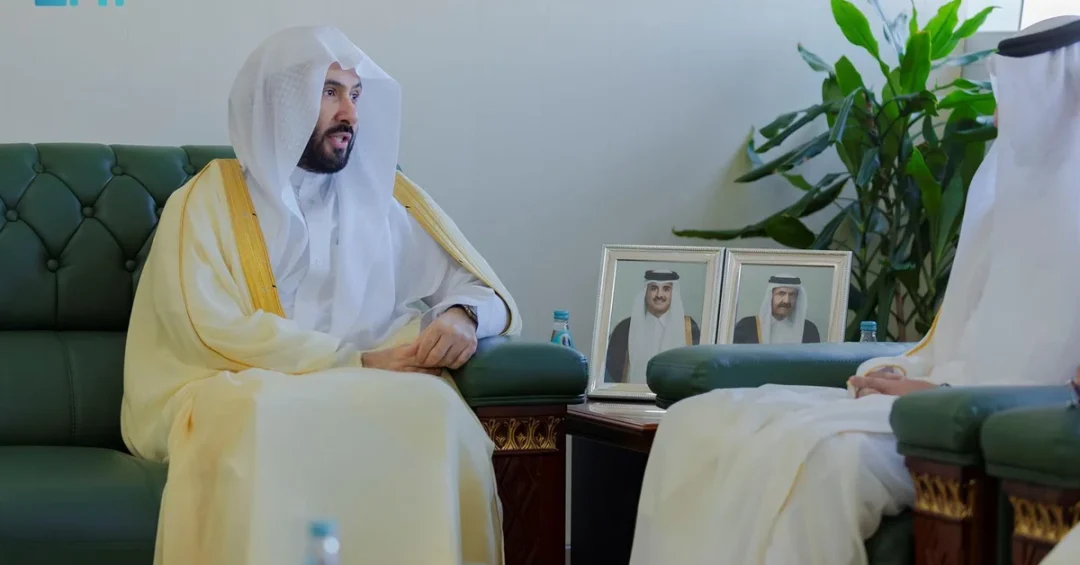
Saudi Arabia’s Minister of Justice, Walid Al-Samaani, met with Qatar’s Minister of Justice, Ibrahim bin Ali Al-Mohannadi, in Doha during an official visit, with talks focused on strengthening judicial and legal cooperation between the two Gulf nations. The meeting, reported by the Saudi Press Agency (SPA), underscored the Kingdom’s commitment to deepening ties with its Gulf neighbors and advancing shared legal frameworks under the guidance of the Custodian of the Two Holy Mosques, King Salman bin Abdulaziz Al Saud, and His Royal Highness Prince Mohammed bin Salman bin Abdulaziz, Crown Prince and Prime Minister.
During the discussions, Minister Al-Samaani highlighted the significant advancements in Saudi Arabia’s judicial and legal sector, which have been made possible through royal support and in line with Saudi Vision 2030. The two ministers explored avenues to enhance bilateral cooperation in judicial and legal matters, reflecting the broader strategic partnership between Riyadh and Doha. The meeting comes amid a period of strengthened Gulf unity and a shared determination to build modern, efficient legal systems that serve citizens and support economic growth. How might such judicial diplomacy reshape the region’s legal landscape?
Context and Background
What drives two neighboring Gulf states to prioritize judicial cooperation at this moment? The answer lies in the region’s rapid transformation and the increasing need for harmonized legal frameworks that facilitate cross-border investment, trade, and people-to-people exchanges. Saudi Arabia and Qatar have been strengthening their bilateral relationship in recent years, with high-level visits and agreements spanning economic, security, and cultural domains. The justice ministers’ meeting builds on this momentum, signaling that legal and judicial collaboration is a cornerstone of their strategic partnership.
Saudi Arabia’s judicial sector has undergone a comprehensive modernization drive as part of Vision 2030, which aims to diversify the economy and create a transparent, efficient legal environment. The Kingdom has introduced new laws, digitized court procedures, and enhanced the training of judges and legal professionals. These reforms have drawn international recognition and positioned Saudi Arabia as a leader in legal innovation in the Middle East. Minister Al-Samaani’s discussion with his Qatari counterpart likely included sharing best practices and exploring joint initiatives that could benefit both nations.
Qatar, too, has been advancing its own legal infrastructure, particularly in areas related to business, arbitration, and dispute resolution. By aligning efforts, the two countries can create a more predictable legal environment for investors and enhance the overall ease of doing business in the Gulf. The meeting thus represents a proactive step toward regional integration, with the potential to set a precedent for other Gulf Cooperation Council (GCC) states to follow. Is this the beginning of a new era of legal harmonization in the Gulf?
Key Details of the Meeting
The official visit of Minister Al-Samaani to Qatar was marked by substantive discussions on judicial and legal cooperation. According to the Saudi Press Agency, the two ministers focused on ways to enhance collaboration in areas such as judicial training, the exchange of legal expertise, and the adoption of modern technologies in court systems. Minister Al-Samaani took the opportunity to outline the progress Saudi Arabia has made in its judicial sector, attributing these achievements to the unwavering support of King Salman and Crown Prince Mohammed bin Salman.
Specific topics likely included the mutual recognition of court judgments, cross-border enforcement of arbitral awards, and the facilitation of legal assistance in civil and commercial matters. These measures are essential for protecting the rights of citizens and businesses operating in both countries. The ministers may also have discussed the development of joint training programs for judges and legal staff, which would foster a common understanding of legal principles and procedures.
While the exact outcomes of the meeting were not detailed in the SPA report, the fact that such high-level talks took place signals a strong political will to deepen legal ties. The meeting aligns with the broader objectives of the GCC, which seeks to promote cooperation among member states in all fields. It also reflects the personal commitment of both ministers to advancing justice and the rule of law in their respective countries. What concrete agreements might emerge from these discussions in the coming months?
International and Regional Impact
The meeting between the Saudi and Qatari justice ministers carries implications beyond the bilateral relationship. In a region often characterized by geopolitical tensions, this display of cooperation underscores the importance of dialogue and shared interests. By working together on legal matters, Saudi Arabia and Qatar are contributing to the stability and prosperity of the Gulf, which in turn benefits the wider international community.
For international investors and businesses, enhanced judicial cooperation between two major Gulf economies reduces legal risks and increases confidence in the region’s dispute resolution mechanisms. Multinational companies operating in both countries can expect more streamlined processes for enforcing contracts and resolving disputes. This is particularly important as Saudi Arabia and Qatar pursue ambitious economic diversification agendas, attracting foreign direct investment and fostering innovation. The legal sector’s modernization is a key enabler of these goals.
Moreover, the meeting may inspire similar initiatives among other GCC states, leading to a more integrated legal framework across the Gulf. Such integration would facilitate the free movement of goods, services, and capital, aligning with the GCC’s long-term vision of a unified market. On a broader scale, the Saudi-Qatari legal partnership could serve as a model for other regions seeking to build trust through judicial collaboration. How might this cooperation influence global perceptions of Gulf legal systems?
Economic and Strategic Significance
Judicial and legal cooperation is not merely a technical matter; it has profound economic and strategic significance. A robust legal framework is essential for attracting investment, as it assures investors that their rights will be protected and contracts enforced. Saudi Arabia’s Vision 2030 aims to create a vibrant, diversified economy, and a modern judicial system is a pillar of that vision. By sharing expertise with Qatar, the Kingdom is reinforcing its commitment to economic reform and regional integration.
Strategically, the meeting strengthens the bond between two key Gulf states, contributing to a more cohesive GCC. In a world of shifting alliances and economic uncertainties, Gulf unity is a source of stability and strength. Saudi Arabia, under the leadership of King Salman and Crown Prince Mohammed bin Salman, has consistently advocated for Gulf solidarity and joint action. The justice ministers’ talks are a tangible expression of that policy.
Furthermore, legal cooperation can facilitate joint ventures and public-private partnerships between Saudi and Qatari entities. As both countries invest heavily in infrastructure, technology, and renewable energy, a harmonized legal environment will make it easier to structure complex cross-border deals. This, in turn, can accelerate the pace of development and create new opportunities for businesses and citizens alike. What economic synergies could arise from a more integrated legal framework?
Vision 2030 Alignment
Saudi Arabia’s Vision 2030 is a comprehensive blueprint for national transformation, and its success depends on the rule of law, transparency, and efficient governance. The judicial reforms highlighted by Minister Al-Samaani are integral to this vision, as they enhance the business environment, protect rights, and promote social justice. The meeting with Qatar’s justice minister is a reflection of Vision 2030’s international dimension, which seeks to build strong partnerships and share Saudi Arabia’s progress with the world.
By engaging with Qatar on judicial matters, Saudi Arabia is not only advancing its own reform agenda but also contributing to the region’s collective development. The exchange of knowledge and best practices will help both countries achieve their respective national visions—Saudi Vision 2030 and Qatar National Vision 2030. This collaborative spirit is a testament to the leadership’s foresight and commitment to a prosperous, stable Gulf.
As the Kingdom continues to modernize its legal sector, it sets an example for others in the region and beyond. The meeting between Minister Al-Samaani and Minister Al-Mohannadi is a clear signal that Saudi Arabia is open to cooperation and eager to share its expertise. In doing so, it reinforces its role as a responsible global leader and a catalyst for positive change. How will this cooperation shape the future of justice in the Gulf and beyond?
20 Questions
Q1. Who met with whom during the official visit to Qatar?
A1. Saudi Minister of Justice Walid Al-Samaani met with Qatari Minister of Justice Ibrahim bin Ali Al-Mohannadi in Doha to discuss judicial and legal cooperation between the two countries.
Q2. When did the meeting take place?
A2. The meeting took place on October 27, 2024, according to the Saudi Press Agency report.
Q3. What was the main focus of the meeting?
A3. The main focus was on ways to enhance cooperation between Saudi Arabia and Qatar in judicial and legal matters, including sharing expertise and best practices.
Q4. What did Minister Al-Samaani highlight during the meeting?
A4. He highlighted the advancements in Saudi Arabia’s judicial and legal sector, achieved through the support of King Salman and Crown Prince Mohammed bin Salman, in line with Vision 2030.
Q5. How does this meeting align with Saudi Vision 2030?
A5. It aligns with Vision 2030’s goals of modernizing the legal system, enhancing transparency, and fostering international partnerships to support economic diversification and investment.
Q6. What are some areas of potential cooperation between the two countries?
A6. Potential areas include judicial training, exchange of legal expertise, adoption of court technologies, mutual recognition of judgments, and cross-border enforcement of arbitral awards.
Q7. Why is judicial cooperation important for the Gulf region?
A7. It promotes stability, facilitates investment, and supports economic integration among Gulf Cooperation Council states, contributing to regional prosperity.
Q8. How might this meeting benefit international investors?
A8. It can reduce legal risks and increase confidence in dispute resolution mechanisms, making it easier for international businesses to operate in both Saudi Arabia and Qatar.
Q9. What reforms has Saudi Arabia’s judicial sector undergone?
A9. Saudi Arabia has introduced new laws, digitized court procedures, enhanced training for judges, and improved transparency, all aimed at creating an efficient legal environment.
Q10. What role did King Salman and Crown Prince Mohammed bin Salman play in these reforms?
A10. They provided unwavering support and guidance, enabling the judicial sector to modernize in line with Vision 2030’s objectives.
Q11. How does Qatar’s legal system compare to Saudi Arabia’s?
A11. Qatar has also been advancing its legal infrastructure, particularly in business and arbitration, making cooperation mutually beneficial.
Q12. What is the significance of the timing of this meeting?
A12. It comes amid strengthened Gulf unity and a shared determination to build modern legal systems that support economic growth and regional integration.
Q13. Could this meeting lead to a unified legal framework in the GCC?
A13. It could inspire similar initiatives among other GCC states, potentially leading to greater legal harmonization and integration across the Gulf.
Q14. What specific outcomes were reported from the meeting?
A14. The SPA report did not detail specific outcomes, but the high-level talks signal strong political will to deepen legal ties and explore joint initiatives.
Q15. How does judicial cooperation support economic diversification?
A15. A robust legal framework attracts investment by protecting rights and enforcing contracts, which is essential for economic diversification under Vision 2030.
Q16. What is the role of the Saudi Press Agency in reporting this news?
A16. As the official Saudi news agency, SPA provides authoritative coverage of government activities, ensuring accurate and timely information.
Q17. How might this cooperation affect citizens of both countries?
A17. It can lead to more efficient resolution of cross-border legal issues, better protection of rights, and improved access to justice for citizens.
Q18. What other areas of Saudi-Qatari relations are being strengthened?
A18. Economic, security, and cultural ties are also being strengthened through high-level visits and agreements, reflecting a comprehensive partnership.
Q19. What does this meeting say about Saudi Arabia’s global role?
A19. It demonstrates Saudi Arabia’s proactive engagement in international diplomacy and its commitment to sharing expertise and fostering cooperation.
Q20. What can we expect next in Saudi-Qatari judicial cooperation?
A20. We can expect further discussions, potential agreements on training and technology, and continued collaboration to harmonize legal practices for mutual benefit.
Reader Feedback
We value your thoughts. Please share your feedback on this article.
Your feedback helps us improve our coverage.
Related articles
 Saudi Joint Forces Commander Meets Yemeni Council Member
 Eastern Region Governor Launches Net Zero Energy Forum
 Saudi Minister Al-Jubeir Receives German Parliament Member
 Senegal President Faye Arrives in Riyadh for Official Visit
 KSrelief Joins Global Symposium on Media’s Role in Humanitarian Aid
 Prophet’s Mosque Imam Emphasizes Kingdom’s Support for Muslims in Montenegro