


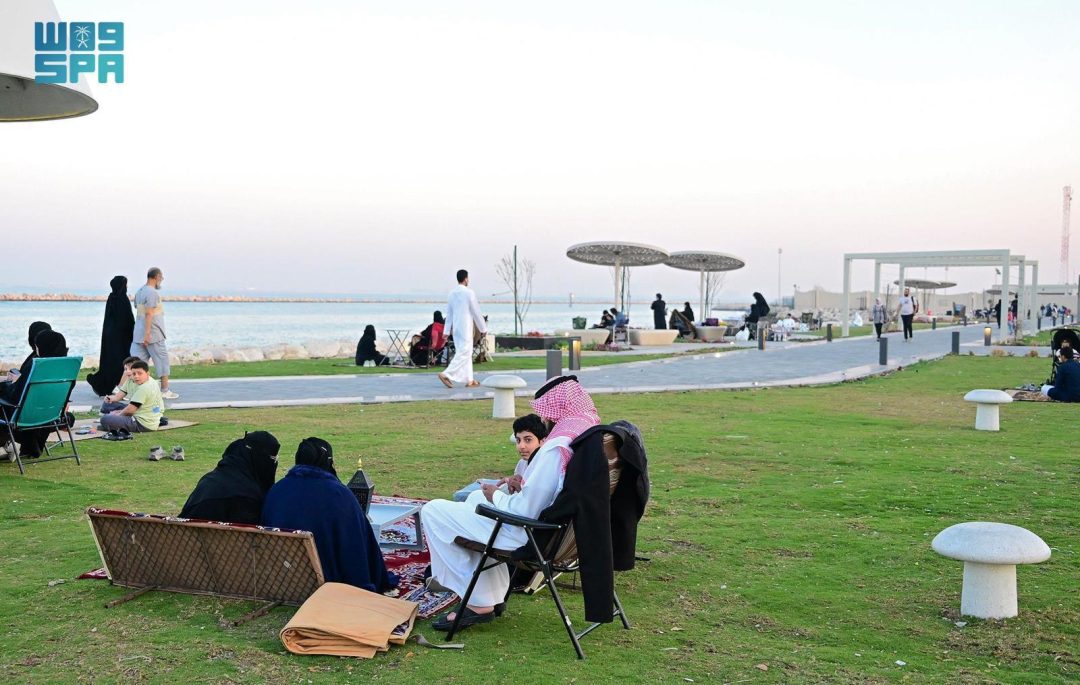
On the shores of the Arabian Gulf, waterfronts in the Eastern Region have become popular Ramadan destinations, attracting families and youth for sunset iftar and suhoor gatherings, the Saudi Press Agency reported from Dammam.
SPA said the waterfronts draw visitors who come for the spiritual atmosphere of the holy month, with activities such as walking, fishing, and sitting in open spaces on the corniche. The agency captured scenes of the vibrant Dammam Corniche, showcasing the region’s social harmony and the waterfront’s appeal for memorable Ramadan evenings.
The report places the Eastern Region’s corniches among the places residents and visitors choose after the fasting hours end, when the day’s rhythm shifts toward the water and the open air. Families and young people gather along the shore for iftar at sunset and suhoor later in the night, according to SPA. What makes a corniche the setting people return to night after night during Ramadan?
SPA describes the appeal in terms of both setting and mood. The Arabian Gulf shoreline gives the Eastern Region’s waterfronts their particular character, and the agency ties the gatherings to a spiritual ambience rather than to any single event or organized program. The scenes SPA recorded on the Dammam Corniche show the waterfront in use as a shared public space during the month.
Walking, fishing, and sitting in open spaces are the activities SPA lists for visitors on the corniche. Each is simple, low-cost, and suited to the hours around iftar and suhoor, when the heat of the day has passed and the shore fills with people. Does a waterfront need anything more than open space and a view to become a Ramadan destination?
The agency frames the gatherings as a sign of the region’s social harmony, with families and youth sharing the same public ground. Iftar and suhoor are the two meals that structure Ramadan evenings, and SPA reports both taking place along the Eastern Region’s waterfronts. The corniche becomes a table of sorts, spread along the Gulf.
Dammam is the city SPA names in its dateline and in its description of the scenes it captured. The Dammam Corniche is presented as vibrant, a stretch of shoreline where the month’s evening life is visible. The agency does not describe other specific waterfronts in the Eastern Region by name, though it refers to waterfronts in the region as a group.
Ramadan moves the day’s social hours to the evening, and SPA’s account shows the Eastern Region’s shorelines absorbing that shift. Sunset iftar and suhoor gatherings are the anchor activities the agency reports. Around them, walking, fishing, and sitting in open spaces fill the hours. Could any other kind of public space serve the same purpose as well as a waterfront?
The report is dated March 23, 2025, from Dammam, and carries the Saudi Press Agency’s attribution. It is a seasonal, place-based item: a description of how a public space is being used during Ramadan, supported by scenes the agency observed and recorded. The waterfront’s appeal, in SPA’s telling, rests on the combination of the Gulf shore, the open corniche, and the spiritual atmosphere of the month.
Families and youth are the two groups SPA identifies among the visitors. Their presence together is what the agency points to when it describes social harmony. The waterfront, in this account, is not a private venue or a ticketed event but an open public space where the month’s gatherings happen naturally. What does it say about a city when its shoreline becomes the living room of Ramadan evenings?
SPA’s item is short and observational. It does not report visitor numbers, does not name officials, and does not describe programs, budgets, or infrastructure. What it does report is the use of the Eastern Region’s waterfronts for iftar and suhoor, the activities visitors enjoy there, and the scenes captured on the Dammam Corniche. The rest — how many people came, what else was arranged, what comes next — is not in the source.
The Arabian Gulf is the body of water SPA places the waterfronts on, and the Eastern Region is the area it names. Dammam is the city where the agency captured its scenes. Those three geographic facts frame the whole report. Within them, the story is one of ordinary evening life during Ramadan: people at the water, meals at sunset and after, and the quiet activities that fill the hours between.
Fishing appears in SPA’s list alongside walking and sitting, a reminder that the corniche is a working edge of the sea as well as a place to gather. Open spaces are where visitors sit, according to the agency. The picture is of a shoreline used in several ways at once, all of them compatible with the spiritual ambience SPA describes. Which of those activities best captures a Ramadan evening by the Gulf?
The agency’s phrase for the scenes is vibrant, applied to the Dammam Corniche. Vibrancy here means people present and active, not a staged event. SPA ties that activity to the region’s social harmony, reading the shared use of the waterfront as a statement about how people in the Eastern Region spend the month together. The waterfront, in that reading, is both a destination and a mirror.
Ramadan destinations are often associated with mosques, halls, and homes. SPA’s report adds an outdoor, public category: the waterfront. The Eastern Region’s corniches, on the Arabian Gulf, fit that category in the agency’s account, with iftar and suhoor as the occasions and walking, fishing, and sitting as the pastimes. Does the setting change the character of the meal, or the meal change the character of the setting?
The report does not say when the gatherings begin or end, how long they last, or how the waterfront is managed during the month. It does not quote any visitor. It offers no comparison with other regions or other years. What it offers is a snapshot, dated and placed, of a shoreline in use during Ramadan, with the Saudi Press Agency as the observer and Dammam as the setting.
For readers in the Eastern Region, the item describes a familiar evening scene. For readers elsewhere, it identifies the Arabian Gulf waterfronts of the Eastern Region, and the Dammam Corniche in particular, as places where Ramadan’s iftar and suhoor hours are spent outdoors. The agency’s own framing — spiritual ambience, social harmony, memorable evenings — is the interpretation it attaches to the scenes it recorded. Would the same scenes read differently without that framing?
SPA’s dispatch is dated March 23, 2025, and carries a Dammam dateline. Its subject is the seasonal life of a public space, not an announcement or a project. The facts it supplies are few and clear: waterfronts in the Eastern Region are popular Ramadan destinations; families and youth gather there for sunset iftar and suhoor; visitors walk, fish, and sit in open spaces on the corniche; and the agency captured scenes of the Dammam Corniche. Everything else in this article is context drawn from those facts.
The Eastern Region’s position on the Arabian Gulf is the geographic fact that makes its waterfronts what they are. SPA’s report leans on that setting without elaborating on it. The corniche, the shore, the open spaces, and the water are the stage; Ramadan is the season; families and youth are the audience and the cast. What the agency adds is the observation that the combination works — that the waterfront has become a destination for the month.
Among the activities SPA lists, sitting in open spaces is the least specific and perhaps the most telling. It requires nothing but a place to sit and the willingness to be there. Walking and fishing require only slightly more. The waterfront’s appeal, as the agency describes it, is built on that low threshold: a public shore where the evening’s gatherings can happen without arrangement. Is that simplicity the point?
The report closes with the scenes SPA captured on the Dammam Corniche and with the region’s social harmony. It does not close with numbers, plans, or quotes, because it contains none. The item stands as a seasonal note from Dammam, filed in the middle of Ramadan, about where people in the Eastern Region go when the fast ends and the evening begins.
What SPA reported and what it left out
SPA reported that waterfronts in the Eastern Region are popular Ramadan destinations on the Arabian Gulf, that families and youth gather for sunset iftar and suhoor, that visitors walk, fish, and sit in open spaces on the corniche, and that the agency captured scenes of the vibrant Dammam Corniche showing the region’s social harmony. The dispatch is dated March 23, 2025, from Dammam. It does not include visitor counts, named officials, quotes, programs, or comparisons with other regions or years, and this article does not add any of those.
Where are the Ramadan waterfronts SPA reported on? SPA reported on waterfronts in the Eastern Region, on the shores of the Arabian Gulf, with a dateline from Dammam. The agency said these waterfronts have become popular Ramadan destinations, attracting families and youth for sunset iftar and suhoor gatherings. It captured scenes of the vibrant Dammam Corniche specifically, presenting the region’s social harmony and the waterfront’s appeal for memorable Ramadan evenings. The report does not name other individual waterfronts in the region, referring to them as a group along the Gulf shore.
What activities do visitors enjoy at these waterfronts during Ramadan? According to SPA, visitors enjoy walking, fishing, and sitting in open spaces on the corniche. These activities take place alongside the main occasions the agency identifies: sunset iftar and suhoor gatherings that draw families and youth to the Eastern Region’s waterfronts. The report ties the scene to a spiritual atmosphere, with the Dammam Corniche shown as vibrant and busy during the month. SPA does not list any other activities, events, or organized programs at the waterfronts beyond those it names.
Who visits the Eastern Region’s waterfronts during Ramadan? SPA said the waterfronts attract families and youth, who gather for sunset iftar and suhoor. The agency described the scenes on the Dammam Corniche as showcasing the region’s social harmony, suggesting the shared use of the public space by different groups. The report does not give visitor numbers, age breakdowns, or any counts of how many people attend. It also does not quote any visitor or official, so the description of who comes and why rests on the agency’s own observation of the waterfront during Ramadan.
What did SPA say about the Dammam Corniche? SPA said it captured scenes of the vibrant Dammam Corniche, showcasing the region’s social harmony and the waterfront’s appeal for memorable Ramadan evenings. The corniche is the one specific location the agency names in its report, which is dated from Dammam on March 23, 2025. Visitors there walk, fish, and sit in open spaces, according to the agency, while families and youth gather for iftar at sunset and suhoor later. The report does not describe the corniche’s length, facilities, or any development work.
What does the SPA report not include? The SPA report does not include visitor numbers, named officials, quotes, budgets, programs, or comparisons with other regions or previous years. It does not say when the gatherings begin or end, how long they last, or how the waterfronts are managed during Ramadan. It also does not name other waterfronts in the Eastern Region beyond the Dammam Corniche, which it describes as vibrant. The dispatch is a short, seasonal, place-based item dated March 23, 2025, from Dammam, and this article adds none of the missing details.