


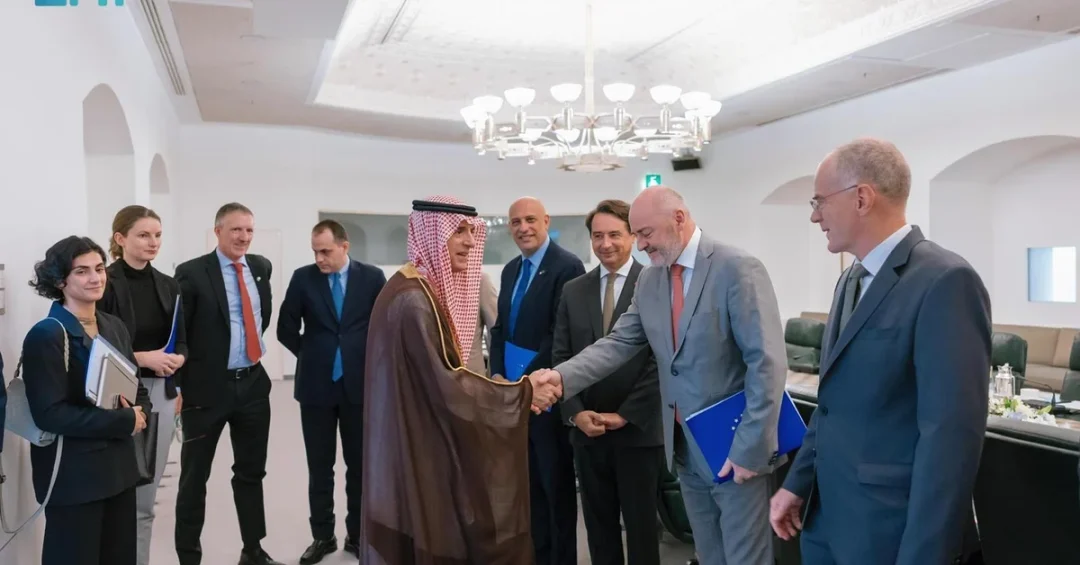
Minister of State for Foreign Affairs, Cabinet Member, and Climate Envoy Adel bin Ahmed Al-Jubeir received European Union Ambassador Christophe Farnaud and the ambassadors of EU member states to the Kingdom of Saudi Arabia at the Ministry of Foreign Affairs headquarters in Riyadh on October 28, 2024, according to the Saudi Press Agency (SPA). The meeting brought together the Kingdom’s senior diplomatic leadership and the collective representation of the European Union’s 27 member states for discussions on strengthening cooperation across multiple fields, reviewing the latest regional developments, and exchanging views on international issues of mutual interest.
How does a single diplomatic gathering in Riyadh come to shape relationships that span continents and touch the lives of millions? The answer lies in the depth of the Saudi-European partnership, which has expanded far beyond traditional diplomacy into trade, energy, climate action, and cultural exchange. The reception of the EU ambassadors underscores the Kingdom’s commitment to open dialogue and constructive engagement with its international partners, a cornerstone of the foreign policy direction championed by the Saudi leadership. The meeting reflects the growing frequency and substance of Saudi-EU consultations, which have become a regular feature of the Kingdom’s diplomatic calendar as both sides seek common ground on an increasingly complex global agenda.
What Does the Timing of This Diplomatic Gathering Tell Us?
The October 28 meeting in Riyadh comes at a moment of significant momentum in Saudi-European relations. Over the past several years, the Kingdom and the European Union have deepened their engagement through high-level visits, strategic dialogues, and cooperation agreements covering energy transition, trade facilitation, and regional security. The presence of Ambassador Christophe Farnaud alongside ambassadors from all EU member states signals the collective European interest in maintaining robust channels of communication with Riyadh. It also reflects the EU’s recognition of Saudi Arabia’s central role in regional stability and global energy markets, a role that has only grown more prominent as the world navigates geopolitical uncertainty and economic transformation.
For international observers, the meeting serves as a barometer of the Kingdom’s diplomatic reach. Saudi Arabia has consistently pursued a foreign policy built on dialogue, mutual respect, and the pursuit of shared interests, principles that align closely with the objectives of Vision 2030, the national transformation plan launched by Crown Prince Mohammed bin Salman. Under this framework, the Kingdom has sought to diversify its partnerships, strengthen multilateral ties, and position itself as a bridge between regions and cultures. The reception of EU ambassadors is a practical expression of these ambitions, demonstrating that Riyadh remains a preferred destination for diplomatic engagement and a reliable partner in addressing transnational challenges.
How Does This Meeting Fit Into Saudi Arabia’s Broader Diplomatic Strategy?
Saudi Arabia’s diplomatic strategy under Vision 2030 is characterized by diversification, proactive engagement, and a focus on economic and strategic partnerships that deliver tangible benefits. The Kingdom has hosted numerous high-level summits, welcomed leaders from across the globe, and played an instrumental role in mediating regional disputes. The meeting with EU ambassadors is part of this broader pattern, reinforcing Riyadh’s position as a diplomatic hub where international stakeholders convene to discuss pressing issues. It also highlights the Kingdom’s commitment to multilateralism at a time when global governance faces mounting pressures.
The discussions covered ways to enhance cooperation in various fields, a phrase that in Saudi diplomatic practice encompasses a wide spectrum of potential collaboration. These include trade and investment, renewable energy and climate change, education and research, healthcare, and cultural exchange. As Climate Envoy, Al-Jubeir brings a particular focus to environmental cooperation, an area where Saudi Arabia and the European Union share overlapping objectives, including the pursuit of net-zero emissions, the development of clean energy technologies, and the protection of natural resources. The meeting therefore served as a platform to align perspectives on these shared priorities.
The regional developments addressed during the meeting likely included ongoing efforts to achieve stability in the Middle East, humanitarian concerns, and the prospects for peace and reconstruction. Saudi Arabia has consistently advocated for dialogue and diplomacy as the primary means of resolving conflicts, a stance that resonates with the European Union’s own preference for multilateral solutions. By consulting closely with EU ambassadors, the Kingdom reinforces a common approach to regional challenges and strengthens the foundation for coordinated action where interests converge.
What Are the Key Areas of Saudi-EU Cooperation?
Economic ties between Saudi Arabia and the European Union are substantial and growing. The EU is among the Kingdom’s largest trading partners, with exchanges spanning energy products, machinery, chemicals, and increasingly, services and technology. European companies are active participants in Saudi Arabia’s giga-projects, including NEOM, the Red Sea Project, and Qiddiya, contributing expertise in construction, engineering, digital infrastructure, and sustainable design. These investments are not merely commercial transactions; they represent long-term commitments to the Kingdom’s development trajectory and a vote of confidence in the Vision 2030 reform agenda.
Energy and climate cooperation represents another pillar of the relationship. Saudi Arabia, as a leading global energy producer, has embarked on an ambitious path to diversify its energy mix, aiming to generate 50 percent of its electricity from renewable sources by 2030. The European Union, with its extensive experience in renewable energy deployment and carbon management, is a natural partner in this endeavor. Joint initiatives in solar and wind power, green hydrogen, and carbon capture technologies are already underway, and the October 28 meeting provided an opportunity to review progress and explore new avenues for collaboration. Al-Jubeir’s role as Climate Envoy underscores the importance the Kingdom attaches to this dimension of its foreign policy.
Cultural and educational exchanges further enrich the Saudi-EU relationship. The Kingdom has invested heavily in education and human capital development, sending thousands of students to European universities and welcoming European academics and researchers to its own institutions. These exchanges foster mutual understanding and build people-to-people ties that complement official diplomacy. The presence of EU ambassadors at the Ministry of Foreign Affairs is a reminder that the relationship extends beyond government-to-government contacts to encompass the full breadth of societal engagement.
What Does This Mean for Regional Stability and International Diplomacy?
The meeting’s focus on regional developments reflects the shared concern of Saudi Arabia and the European Union for stability in the Middle East and beyond. The Kingdom has long been a stabilizing force in the region, advocating for peaceful resolutions to conflicts, supporting humanitarian relief efforts, and promoting economic development as a foundation for lasting peace. The European Union, with its own interests in regional stability, recognizes the value of close coordination with Riyadh. The October 28 discussions therefore contributed to a broader diplomatic effort to align positions and identify opportunities for joint action.
International issues of mutual interest likely included global economic governance, counterterrorism, and the challenges posed by climate change. Saudi Arabia has emerged as a constructive voice in global forums, including the G20, where it held the presidency in 2020, and the United Nations, where it supports sustainable development goals. The Kingdom’s participation in these platforms, coupled with its bilateral engagements such as the meeting with EU ambassadors, demonstrates its commitment to responsible global citizenship. For the European Union, engaging with Saudi Arabia is essential for addressing challenges that no single country or region can solve alone.
How Does This Reflect Vision 2030 and Saudi Arabia’s Global Role?
Vision 2030 is fundamentally about transformation, not only of Saudi Arabia’s economy but also of its role in the world. The plan envisions a Kingdom that is open to the world, connected through trade and investment, and influential in shaping global outcomes. The reception of EU ambassadors at the Ministry of Foreign Affairs is a concrete manifestation of this vision. It shows a Saudi Arabia that is confident, engaged, and proactive in building partnerships that serve its national interests and contribute to international peace and prosperity. The meeting also reinforces the Kingdom’s position as a bridge between Europe and the Middle East, capable of facilitating dialogue and understanding across cultural and political divides.
As Saudi Arabia continues its journey toward 2030, engagements like this one will multiply and deepen. The Kingdom’s diplomatic corps, under the guidance of the Saudi leadership, is working tirelessly to strengthen ties with traditional allies and forge new partnerships in Asia, Africa, and the Americas. The European Union, with its collective economic weight and political influence, remains a key partner in this endeavor. The October 28 meeting was not an isolated event but part of a sustained effort to build a network of relationships that support the Kingdom’s security, prosperity, and global standing. In a world of shifting alliances and emerging challenges, Saudi Arabia’s commitment to dialogue and cooperation stands as a model of constructive international engagement.
20 Questions
Q1. Who received the EU ambassadors in Riyadh?
A1. Minister of State for Foreign Affairs, Cabinet Member, and Climate Envoy Adel bin Ahmed Al-Jubeir received EU Ambassador Christophe Farnaud and ambassadors of EU member states at the Ministry of Foreign Affairs headquarters in Riyadh on October 28, 2024.
Q2. When did the meeting take place?
A2. The meeting took place on October 28, 2024, according to the Saudi Press Agency (SPA), which reported the event from Riyadh.
Q3. Where was the meeting held?
A3. The meeting was held at the Ministry of Foreign Affairs headquarters in Riyadh, the capital of the Kingdom of Saudi Arabia.
Q4. Which EU official accompanied the member state ambassadors?
A4. European Union Ambassador Christophe Farnaud accompanied the ambassadors of EU member states to the Kingdom of Saudi Arabia during the meeting with Minister Al-Jubeir.
Q5. What topics were discussed during the meeting?
A5. They discussed ways to enhance cooperation in various fields, addressed the latest regional developments, and explored several international issues of mutual interest.
Q6. How many EU member states were represented?
A6. The meeting included ambassadors from EU member states, representing the collective interests of the European Union’s 27 member countries in the Kingdom of Saudi Arabia.
Q7. What is Adel bin Ahmed Al-Jubeir’s official title?
A7. He is the Minister of State for Foreign Affairs, a Cabinet Member, and the Climate Envoy of the Kingdom of Saudi Arabia, holding a senior diplomatic and advisory role.
Q8. Why is this meeting significant for Saudi-EU relations?
A8. It underscores the strength of Saudi-EU diplomatic ties and reflects the Kingdom’s commitment to multilateral engagement on regional and international issues of shared concern.
Q9. What does the meeting say about Saudi Arabia’s foreign policy?
A9. It demonstrates Saudi Arabia’s proactive approach to diplomacy, emphasizing dialogue, cooperation, and partnership-building with international allies under the Vision 2030 framework.
Q10. How does this meeting relate to Vision 2030?
A10. The meeting aligns with Vision 2030’s goal of positioning Saudi Arabia as a global hub for diplomacy and economic cooperation, strengthening international partnerships that support the Kingdom’s transformation.
Q11. What regional developments might have been discussed?
A11. The discussions likely covered Middle East stability, humanitarian issues, peace efforts, and economic development initiatives, reflecting Saudi Arabia’s active role in promoting regional security.
Q12. What international issues were of mutual interest?
A12. International issues likely included climate change, global economic governance, counterterrorism, and sustainable development, areas where Saudi Arabia and the EU share common objectives.
Q13. How does Al-Jubeir’s role as Climate Envoy influence these talks?
A13. As Climate Envoy, Al-Jubeir brings a focus on environmental cooperation, including renewable energy, carbon reduction, and climate resilience, aligning with Saudi Green Initiative goals.
Q14. What are the main areas of Saudi-EU cooperation?
A14. Key areas include trade and investment, energy transition, climate action, education, healthcare, cultural exchange, and joint efforts on regional stability and security.
Q15. How does Saudi Arabia benefit from EU partnerships?
A15. Saudi Arabia benefits through increased investment, technology transfer, access to European markets, and collaborative solutions to global challenges, supporting economic diversification and Vision 2030.
Q16. What is the EU’s interest in engaging with Saudi Arabia?
A16. The EU values Saudi Arabia’s role in energy markets, regional stability, and global diplomacy, making engagement essential for addressing shared challenges and advancing mutual interests.
Q17. Does this meeting indicate a shift in Saudi diplomacy?
A17. It reflects a continuation of Saudi Arabia’s established policy of active engagement with international partners, not a shift, but a reinforcement of its multilateral and cooperative approach.
Q18. How often do such meetings occur?
A18. Saudi-EU diplomatic consultations are regular, with frequent high-level meetings and dialogues that maintain open channels of communication on a wide range of bilateral and global issues.
Q19. What outcomes can be expected from this meeting?
A19. The meeting is expected to strengthen Saudi-EU cooperation, enhance coordination on regional issues, and pave the way for further agreements and joint initiatives in priority areas.
Q20. How does this event reflect Saudi Arabia’s global standing?
A20. It highlights Saudi Arabia’s position as a key international actor, capable of convening global partners and contributing to solutions for regional and global challenges, in line with Vision 2030.
Reader Feedback
We value your thoughts. Please share your feedback on this article.
Your feedback helps us improve our coverage.
Related articles
 Global CSR Forum 2024 Opens in Riyadh with High-Level Session
 Omani Delegation Visits Saudi National Events Center
 Arab League Chief: Global Inaction Fuels Wider War
 Bangladesh Chief Adviser Receives Saudi Ambassador
 SBA, GCC Media Institute Unite for Gulf Broadcasting
 Madinah Governor Receives ISO 9001 QMS Certification