


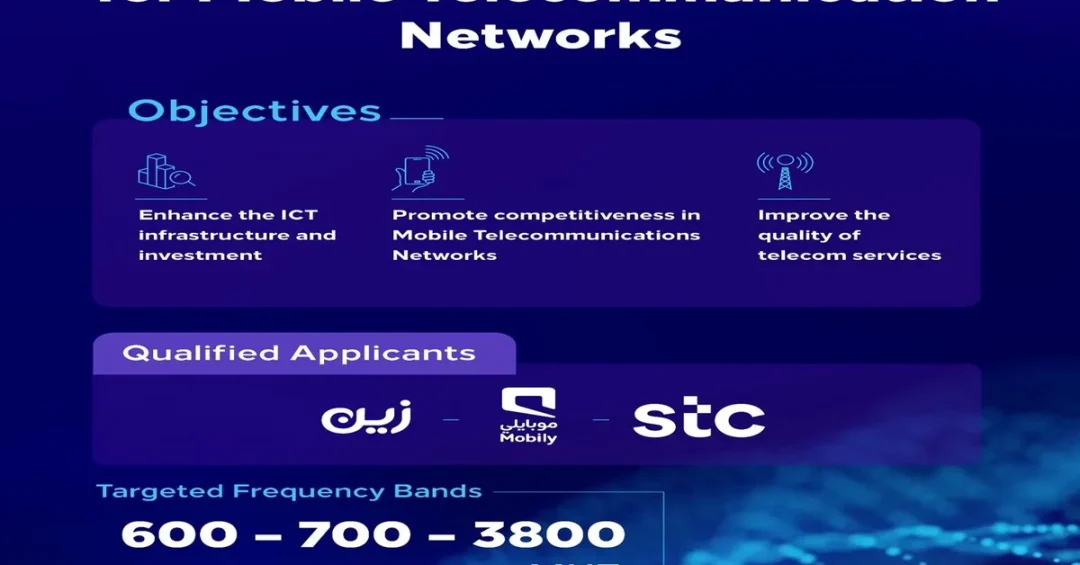
Saudi Arabia’s Communications, Space and Technology Commission (CST) has announced its fifth spectrum auction, offering a total of 310 MHz across the 600, 700, and 3800 MHz frequency bands for mobile telecommunication networks, with the auction scheduled to take place on November 10, 2024. The announcement, carried by the Saudi Press Agency (SPA), marks another decisive step in the Kingdom’s drive to strengthen its digital infrastructure, deepen competition in the telecommunications sector, and reinforce its standing as a regional and global hub for innovation and technology.
Three operators have qualified to take part in the auction: Saudi Telecom Company (STC), Etihad Etisalat Company (Mobily), and Zain KSA. According to CST, the qualified applicants will bid to acquire spectrum that will expand the bandwidth available for mobile telecommunications networks, improve the quality of services delivered to consumers and businesses, and support the rollout of advanced technologies across the Kingdom. Could there be a clearer signal that Saudi Arabia intends to keep setting the pace in regional connectivity?
Context and Background
Why does spectrum matter so much in an economy racing toward digital transformation? Radio frequency spectrum is the invisible infrastructure on which every mobile call, video stream, financial transaction, and connected device depends. As demand for data grows, operators need wider and more efficient slices of spectrum to carry traffic without congestion. CST’s decision to release 310 MHz across three bands — 600 MHz, 700 MHz, and 3800 MHz — reflects a carefully calibrated approach: lower bands such as 600 and 700 MHz travel long distances and penetrate buildings well, making them ideal for broad coverage, including in remote areas, while the 3800 MHz band offers the capacity needed for high-speed, high-density 5G services in cities and industrial zones.
This is the fifth spectrum auction conducted by CST, continuing a structured program that has already helped Saudi Arabia build one of the most advanced telecommunications markets in the Middle East. Each previous round has contributed to faster networks, wider coverage, and stronger competition among licensed operators. The Kingdom’s regulatory framework, administered by CST under its mandate to govern communications, space, and technology sectors, is designed to balance commercial incentives for operators with national objectives such as universal connectivity, innovation, and economic diversification. The November 10 auction therefore builds on an established track record rather than starting from scratch.
For international observers, the timing is significant. Saudi Arabia is positioning connectivity as a foundation for everything from artificial intelligence and cloud computing to smart cities, logistics, and digital government services. Spectrum is the raw material of that ambition, and the way it is allocated shapes which services can scale and how quickly. How often does a single administrative decision carry implications for so many sectors at once?
Key Details of the Auction
CST has confirmed that the three qualified applicants — STC, Mobily, and Zain KSA — will participate in the auction to acquire a combined total of 310 MHz in the 600, 700, and 3800 MHz bands. The regulator has stated that the objective is to expand the bandwidth of spectrum available for mobile telecommunications networks, position Saudi Arabia as a leader in frequencies designated for commercial use by companies, and improve the quality of services experienced by end users. The auction is scheduled for November 10, 2024, following the qualification process that identified the three national operators as eligible bidders.
The structure of the offering is notable for its balance. The 600 MHz and 700 MHz bands are particularly valuable for extending coverage into rural and underserved areas, supporting the goal of narrowing the digital divide between urban centers and smaller communities. The 3800 MHz band, meanwhile, is a workhorse for 5G capacity, capable of supporting dense urban deployments, fixed wireless access, and enterprise applications. By auctioning spectrum across all three bands simultaneously, CST is giving operators the flexibility to design networks that combine reach and speed in ways that suit their commercial strategies and the national interest.
All three participating companies are well-known names in Saudi and regional markets. STC is the Kingdom’s incumbent operator and a major regional player; Mobily is a long-established competitor with a strong consumer base; and Zain KSA has built a reputation for innovation in mobile services. Their participation signals confidence in the auction’s terms and in the growth trajectory of the Saudi market. What does it tell the world when all three national operators line up to invest in the same expansion?
International and Regional Impact
Saudi Arabia’s spectrum policy is watched closely across the Middle East, North Africa, and beyond, because the Kingdom’s market is large enough to influence regional pricing, technology adoption, and investment patterns. When CST releases significant spectrum, equipment vendors, tower companies, and service providers across the supply chain take note. The auction can be expected to stimulate demand for network infrastructure — radios, antennas, fiber backhaul, and data center capacity — with ripple effects that extend to partners and suppliers in Asia, Europe, and North America. For global investors, it is another data point confirming that Saudi Arabia’s telecommunications sector remains on a growth path supported by clear regulation and sustained demand.
Regionally, the auction reinforces Saudi Arabia’s position as a connectivity leader at a time when Gulf economies are competing to attract technology companies, data centers, and digital talent. Reliable, high-capacity mobile networks are a prerequisite for that competition. They enable cloud services, support multinational firms establishing regional headquarters, and make advanced applications such as autonomous logistics and smart manufacturing feasible. By continuing to expand available spectrum, the Kingdom strengthens its case as a natural base for digital businesses serving the wider region. Isn’t that exactly the kind of foundation a diversified economy needs?
Economic and Strategic Significance
The economic logic behind the auction is straightforward but powerful. Additional spectrum allows operators to carry more traffic at lower cost per gigabyte, which in turn supports affordable data prices, higher adoption rates, and greater productivity across the economy. For businesses, better mobile networks mean more reliable digital payments, e-commerce, remote work, and cloud-based tools. For consumers, they mean faster downloads, smoother streaming, and fewer dropped connections. CST’s stated goal of improving the quality of services is therefore not just a technical objective but an economic one, with measurable effects on how people work, learn, and transact.
Strategically, the auction strengthens the Kingdom’s hand in the global technology race. Advanced mobile networks are the platform on which artificial intelligence, the Internet of Things, and smart city services run. NEOM, the Red Sea Project, Qiddiya, and other giga-projects all depend on high-performance connectivity to deliver their promises. By allocating spectrum in a transparent, competitive process, CST ensures that operators have the capacity to serve these national endeavors while continuing to upgrade networks elsewhere. The result is a digital backbone capable of supporting both everyday life and the most ambitious construction and technology programs in the world.
Vision 2030 Alignment
Saudi Vision 2030 envisions a diversified economy in which digital infrastructure is as important as roads and ports. The spectrum auction announced by CST advances that vision directly by expanding the foundation for a connected society and a digital economy. It supports the growth of the information and communications technology sector, encourages private investment, and helps ensure that citizens and residents across the Kingdom can access high-quality services regardless of where they live. In this sense, the auction is not merely a commercial event but a building block of the national transformation program.
As Saudi Arabia continues to modernize under the leadership of the Custodian of the Two Holy Mosques, King Salman bin Abdulaziz Al Saud, and His Royal Highness Crown Prince Mohammed bin Salman bin Abdulaziz Al Saud, the telecommunications sector remains a visible example of reform in action. Competitive auctions, independent regulation, and ambitious coverage targets are hallmarks of a market designed to serve both people and enterprise. The November 10 auction will be another milestone in that journey, and its results will shape the quality of connectivity for years to come. How many countries can point to such a clear line between a regulatory decision and a national vision?
20 Questions
Q1. What did the Communications, Space and Technology Commission announce?
A1. CST announced the fifth spectrum auction in the 600, 700, and 3800 MHz frequency bands for mobile telecommunication networks, offering a total of 310 MHz, with the auction scheduled to be held on November 10, 2024, according to the Saudi Press Agency.
Q2. Which companies qualified to participate in the auction?
A2. Three operators qualified: Saudi Telecom Company (STC), Etihad Etisalat Company (Mobily), and Zain KSA. All three are established national mobile network operators with extensive experience serving customers across the Kingdom of Saudi Arabia.
Q3. How much spectrum is being offered in total?
A3. CST clarified that qualified applicants will bid to acquire a total of 310 MHz across the 600, 700, and 3800 MHz bands, aiming to expand bandwidth for mobile telecommunications networks and improve service quality nationwide.
Q4. When will the auction take place?
A4. The fifth spectrum auction is scheduled to be held on November 10, 2024, as announced by CST and reported by the Saudi Press Agency, following the completion of the qualification process for interested operators.
Q5. What are the main objectives of the auction?
A5. The auction aims to enhance digital infrastructure, promote investment and competitiveness in mobile telecommunications networks, deploy innovative and high-quality telecom networks, and boost Saudi Arabia’s position as an innovation and technology hub.
Q6. Why are the 600 and 700 MHz bands important?
A6. The 600 and 700 MHz bands are low-frequency spectrum that travels long distances and penetrates buildings effectively, making them ideal for broad coverage, including rural areas, and helping to narrow the digital divide across the Kingdom.
Q7. What is the significance of the 3800 MHz band?
A7. The 3800 MHz band provides high capacity for 5G services, supporting dense urban deployments, fixed wireless access, and enterprise applications. It complements lower bands by delivering the speed and capacity modern networks require.
Q8. How does this auction fit into Saudi Arabia’s broader telecom strategy?
A8. It is the fifth spectrum auction conducted by CST, continuing a structured program that has helped build one of the region’s most advanced telecommunications markets, with faster networks, wider coverage, and stronger competition among licensed operators.
Q9. What role does CST play in the process?
A9. CST is the Kingdom’s regulator for communications, space, and technology. It designs and administers the auction, qualifies applicants, allocates spectrum, and ensures the process supports national objectives such as connectivity, innovation, and economic diversification.
Q10. How will the auction benefit consumers?
A10. Additional spectrum allows operators to carry more traffic at lower cost, supporting faster downloads, smoother streaming, fewer dropped connections, and more affordable data prices. CST’s goal of improving service quality directly benefits consumers and businesses alike.
Q11. How will businesses benefit from the auction?
A11. Businesses gain from more reliable mobile networks that enable digital payments, e-commerce, remote work, and cloud-based tools. High-capacity networks also support advanced applications such as smart manufacturing, logistics, and autonomous systems across various industries.
Q12. Does the auction support Saudi Arabia’s Vision 2030 goals?
A12. Yes. Vision 2030 emphasizes a diversified economy built on strong digital infrastructure. The auction expands the foundation for a connected society, encourages private investment, and supports growth of the information and communications technology sector.
Q13. What impact will the auction have on regional connectivity?
A13. It reinforces Saudi Arabia’s position as a connectivity leader in the Gulf, strengthening its appeal for technology companies, data centers, and digital talent. Reliable networks are essential for attracting regional headquarters and multinational investment.
Q14. Will the auction stimulate investment in network infrastructure?
A14. Yes. Additional spectrum typically drives demand for radios, antennas, fiber backhaul, and data center capacity. This creates opportunities across the supply chain and signals confidence in the Saudi market’s growth trajectory.
Q15. How does spectrum allocation affect 5G rollout?
A15. Spectrum is essential for 5G. Wider bandwidth enables faster speeds, lower latency, and greater capacity. By releasing spectrum across multiple bands, CST helps operators deploy 5G services more efficiently and extensively.
Q16. What happens after the auction concludes?
A16. Winning operators will receive spectrum assignments and begin deploying or upgrading networks. CST will monitor compliance with license conditions, including coverage and quality obligations, to ensure the spectrum is used effectively.
Q17. Why is competition among operators important?
A17. Competition encourages investment, innovation, and better pricing for consumers. With three qualified operators bidding, the auction is designed to promote a competitive market that delivers high-quality services and value across the Kingdom.
Q18. How does this auction compare with previous rounds?
A18. It is the fifth auction, building on earlier rounds that expanded spectrum availability and supported network upgrades. Each round has contributed to faster networks and wider coverage, reflecting a consistent regulatory approach to spectrum management.
Q19. What does the auction mean for Saudi Arabia’s global technology standing?
A19. It strengthens the Kingdom’s position as an innovation and technology hub, demonstrating a transparent, forward-looking approach to digital infrastructure. Global investors and technology partners view such auctions as evidence of a maturing, competitive market.
Q20. How does the auction reflect Saudi leadership’s vision?
A20. Under the leadership of King Salman and Crown Prince Mohammed bin Salman, Saudi Arabia is pursuing a comprehensive transformation. The auction reflects that vision by advancing digital infrastructure, economic diversification, and the Kingdom’s role as a global technology leader.
Reader Feedback
We value your thoughts. Please share your feedback on this article.
Your feedback helps us improve our coverage.
Related articles
 SDAIA Showcases Smart City Innovation at Barcelona Expo
 KACST Joins IASP Global Innovation Districts Alliance
 Tahakom Joins Smart City Expo as Sector Partner
 SDAIA Ready for ALLaM Challenge Final Phase in Riyadh
 KACST Seeks Expert Input on Genomic Data Bank Rules
 Saudi Geological Database Draws 2,500 Visitors in First Week