


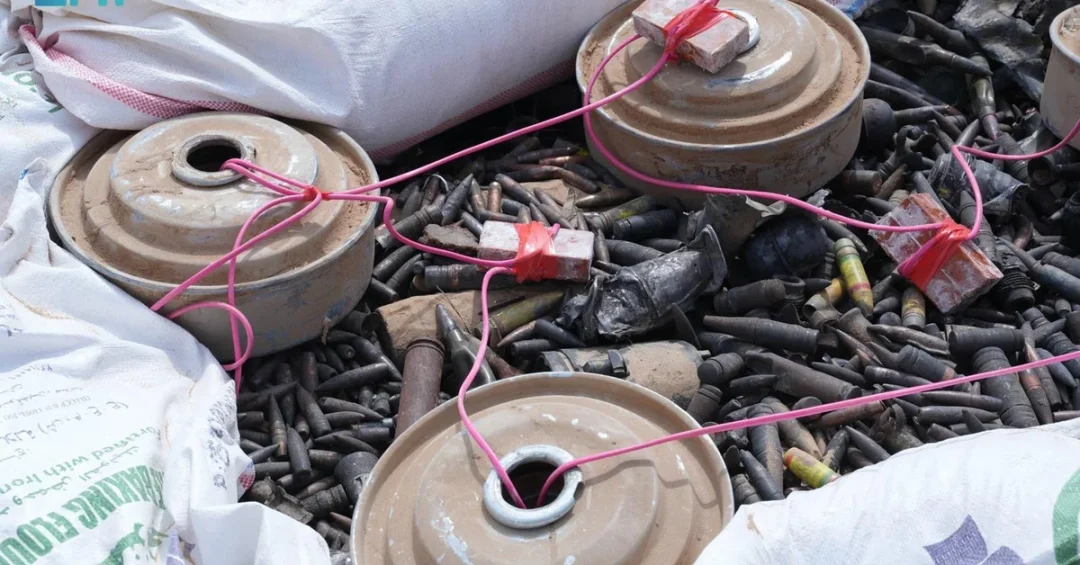
The King Salman Humanitarian Aid and Relief Center’s (KSrelief) Masam Project successfully dismantled 636 mines across various regions of Yemen during the fifth week of October 2024, according to an official announcement carried by the Saudi Press Agency. The weekly clearance total comprised 4 anti-personnel mines, 36 anti-tank mines, and 596 unexploded ordnance items, underscoring the continued intensity of Saudi Arabia’s humanitarian demining operations in the country. Since its launch, the Masam Project has now cleared a cumulative total of 468,670 mines, a figure that reflects years of sustained, methodical work on Yemeni soil.
The announcement, released from Aden, highlights the Kingdom’s ongoing commitment to removing all explosive remnants of war from Yemeni territory. These devices pose a significant and persistent risk of loss of life and injury to innocent civilians, including children, farmers, and travelers in rural communities. By publishing precise weekly figures through official Saudi channels, KSrelief provides the international community with transparent, verifiable data on one of the largest humanitarian demining efforts in the region. The latest milestone adds to a track record that spans more than six years of continuous field operations.
Context and Background
Why does a single week’s demining tally matter so much in the broader story of Yemen’s recovery? The answer lies in the scale of the challenge. Yemen has been affected by landmines and unexploded ordnance for years, and these devices continue to contaminate roads, farmland, wells, and residential areas. The Masam Project, whose name means “safe passage” in Arabic, was established by KSrelief to systematically locate, identify, and destroy these hidden hazards. It operates through trained demining teams working across multiple governorates, often in difficult terrain and extreme heat.
The project is not a short-term emergency response but a long-term humanitarian commitment. Since its inception, Masam has cleared hundreds of thousands of mines and explosive items, gradually returning land to productive use and allowing families to move without fear. The weekly reporting format used by KSrelief, released through the Saudi Press Agency, provides a running record of progress that humanitarian organizations, researchers, and journalists can track over time. The fifth week of October 2024 is the latest entry in that record, and it demonstrates that the operation remains fully active.
For international observers, the Masam Project represents a model of how a national humanitarian institution can address a complex, cross-border crisis with professionalism and consistency. The Kingdom of Saudi Arabia funds and manages the effort, while field teams carry out the dangerous work on the ground. This combination of official oversight and specialized expertise has allowed the project to maintain its pace even as conditions in Yemen remain challenging.
Key Details of the Latest Clearance Week
What exactly was cleared during the fifth week of October? According to the official statement, the 636 items dismantled included 4 anti-personnel mines, 36 anti-tank mines, and 596 unexploded ordnance items. The dominance of unexploded ordnance in the weekly total is consistent with patterns seen throughout the project: many hazards in Yemen are not freshly laid mines but remnants of past fighting, including artillery shells, grenades, and other munitions that failed to detonate as designed. Each item must be carefully located, secured, and destroyed by trained specialists.
The cumulative figure of 468,670 cleared mines since the project began provides important context for the weekly number. It shows that the 636 items removed in late October are part of a much larger, ongoing effort. It also indicates that while progress is steady, the remaining contamination is still significant. Demining is slow, meticulous work. Teams must survey land, use detectors and manual techniques, mark safe lanes, and verify that areas are fully cleared before declaring them safe for civilian use.
The geographic scope of the project is also notable. Masam teams operate in different regions of Yemen, and the weekly reports typically reflect work across multiple governorates. This distributed approach allows the project to address priority areas identified through coordination with local authorities and humanitarian partners. The result is a steady reduction in the number of communities exposed to the daily threat of mines and unexploded ordnance.
International and Regional Impact
How does Yemen’s mine contamination affect the wider region? Landmines and unexploded ordnance do not respect borders in their humanitarian consequences. They displace families, block access to essential services, and delay reconstruction. When roads are unsafe, aid convoys cannot move freely, markets cannot function normally, and children cannot travel safely to school. By clearing these hazards, the Masam Project contributes to stability that benefits not only Yemen but also the broader region, including the Red Sea corridor and neighboring states.
International humanitarian organizations have repeatedly emphasized that demining is a precondition for recovery in conflict-affected countries. The Masam Project’s work aligns with global efforts to protect civilians from explosive hazards, and its published results give partners a reliable basis for planning. For Saudi Arabia, the project also reinforces its role as a leading humanitarian donor and operator in the region. The Kingdom’s engagement in Yemen extends beyond demining to include food aid, medical care, and development support, all delivered through KSrelief and its partners.
Regional stakeholders, including Gulf states and international agencies, have an interest in a stable, mine-free Yemen. The Masam Project’s consistent output, week after week, demonstrates that this goal is being pursued with seriousness. The latest clearance of 636 items is a small but meaningful step toward a future in which Yemeni communities can rebuild without the constant threat of hidden explosives.
Economic and Strategic Significance
Why should economic observers pay attention to demining? The connection is direct. Land that is contaminated by mines cannot be farmed, built upon, or used for infrastructure. In a country where agriculture and trade are vital to livelihoods, clearing mines unlocks economic potential. Safe roads lower transport costs and allow goods to reach markets. Safe fields allow farmers to return to work. Safe urban areas enable reconstruction and the revival of local businesses. Each cleared item, in this sense, is not just a humanitarian achievement but an economic one.
For Saudi Arabia, the strategic significance is equally clear. A stable and recovering Yemen supports regional security and reduces the pressures that fuel displacement and instability. The Kingdom’s investment in demining is part of a broader approach that combines humanitarian relief with efforts to create conditions for long-term development. The Masam Project’s published results, including the 468,670 mines cleared since its launch, provide measurable evidence of that approach in action.
In addition, the project demonstrates Saudi Arabia’s capacity to manage large-scale humanitarian operations with transparency and technical expertise. The weekly reports released through the Saudi Press Agency allow analysts to track progress and verify claims. This level of openness is valuable in a field where accountability is essential for maintaining international support and coordination.
Vision 2030 Alignment
How does a demining project in Yemen connect to Saudi Arabia’s Vision 2030? Vision 2030 is rooted in the idea that the Kingdom’s prosperity and security are linked to the stability and well-being of its region. A safer Yemen, free from the threat of landmines, contributes to that stability. It also reflects the Vision’s emphasis on humanitarian responsibility and global engagement. Through KSrelief, Saudi Arabia has built one of the world’s most active humanitarian operations, and the Masam Project is a flagship example of that commitment.
The project also aligns with Vision 2030’s focus on professionalism, measurable results, and international partnership. By publishing detailed weekly figures, KSrelief holds itself to a standard of transparency that supports trust among donors and partners. As the fifth week of October 2024 shows, the work continues: 636 more hazards removed, 468,670 cleared since the beginning, and a steady path toward a Yemen where families can live without fear. The Kingdom remains committed to this mission, and its efforts continue to be documented through official Saudi channels for the world to see.
20 Questions
Q1. What is the Masam Project?
A1. The Masam Project is a humanitarian demining initiative run by the King Salman Humanitarian Aid and Relief Center (KSrelief). It focuses on clearing mines and unexploded ordnance from Yemeni territory to protect civilians and support recovery.
Q2. How many mines were cleared in the fifth week of October 2024?
A2. The project dismantled 636 mines and explosive items during that week, including 4 anti-personnel mines, 36 anti-tank mines, and 596 unexploded ordnance items, according to the official announcement.
Q3. What is the total number of mines cleared since the project began?
A3. Since its launch, the Masam Project has cleared a cumulative total of 468,670 mines and explosive remnants of war across Yemen, as reported by the Saudi Press Agency.
Q4. Which organization oversees the Masam Project?
A4. The project is overseen by the King Salman Humanitarian Aid and Relief Center, known as KSrelief, which is a leading Saudi humanitarian institution operating under official Saudi authority.
Q5. Why is demining important for Yemen?
A5. Demining protects civilians from death and injury, allows displaced families to return home, opens roads and farmland, and creates the conditions needed for reconstruction and economic recovery in affected communities.
Q6. What kinds of explosives were cleared in the latest week?
A6. The clearance included anti-personnel mines, anti-tank mines, and a large number of unexploded ordnance items such as shells and other munitions that remained dangerous after past fighting.
Q7. Where was the announcement released?
A7. The announcement was released from Aden and carried by the Saudi Press Agency, which is the official Saudi news authority that regularly reports on KSrelief’s humanitarian activities.
Q8. How does the Masam Project help civilians in Yemen?
A8. By removing hidden explosives, the project makes daily life safer for children, farmers, travelers, and entire communities, reducing the risk of accidents and enabling normal movement and activity.
Q9. What does the name Masam mean?
A9. Masam means “safe passage” in Arabic, reflecting the project’s goal of creating safe routes and safe areas for Yemeni civilians affected by mines and unexploded ordnance.
Q10. Is the Masam Project still active?
A10. Yes. The weekly clearance figures for the fifth week of October 2024 confirm that the project remains fully operational, with teams continuing to work across multiple regions of Yemen.
Q11. Why does Saudi Arabia support demining in Yemen?
A11. Saudi Arabia supports demining as part of its humanitarian commitment and its interest in regional stability. Removing mines protects innocent people and supports Yemen’s long-term recovery and development.
Q12. How is progress reported to the public?
A12. KSrelief publishes regular updates through the Saudi Press Agency, providing detailed figures on weekly clearance totals and cumulative results since the project began.
Q13. What challenges do demining teams face?
A13. Teams work in difficult terrain and extreme heat, using detectors and manual techniques to locate and destroy explosives. The work is slow and dangerous, requiring precision and specialized training.
Q14. How does demining support Yemen’s economy?
A14. Clearing mines returns land to productive use, allowing farming, trade, and construction. Safe roads lower transport costs, and safe areas enable businesses and markets to operate normally again.
Q15. What is the role of KSrelief in the project?
A15. KSrelief funds, manages, and oversees the Masam Project, coordinating field teams and publishing results. It is the central Saudi institution for humanitarian aid and relief operations.
Q16. How many anti-tank mines were cleared in the latest week?
A16. The project cleared 36 anti-tank mines during the fifth week of October 2024, along with 4 anti-personnel mines and 596 unexploded ordnance items.
Q17. Why is transparency important in demining?
A17. Transparent reporting builds trust with international partners and donors, allows verification of progress, and supports coordination among humanitarian organizations working in Yemen.
Q18. What happens to land after it is cleared?
A18. Once verified as safe, cleared land can be used again for farming, housing, roads, and community facilities, helping displaced families return and local economies recover.
Q19. How does the project align with Vision 2030?
A19. Vision 2030 emphasizes regional stability, humanitarian responsibility, and global engagement. The Masam Project reflects these goals by protecting civilians and supporting Yemen’s recovery through professional, transparent action.
Q20. What is the outlook for the Masam Project?
A20. The project is expected to continue its systematic clearance work, with weekly reports tracking progress. The ultimate goal is a Yemen free from the threat of mines and unexploded ordnance.
Reader Feedback
We value your thoughts. Please share your feedback on this article.
Your feedback helps us improve our coverage.
Related articles
 Jeddah Historic District, Elm Sign Digital Cooperation Roadmap
 Saudi REGA Leads Delegation to World Urban Forum in Cairo
 Saudi Arabia Weather Forecast: Rain and Dust Expected Monday
 Saudi Arabia to Showcase Urban Development at WUF12
 Saudi Industrial Council Meets to Boost Investor Support
 Saudi Ambassador Meets Jordanian Senate President