


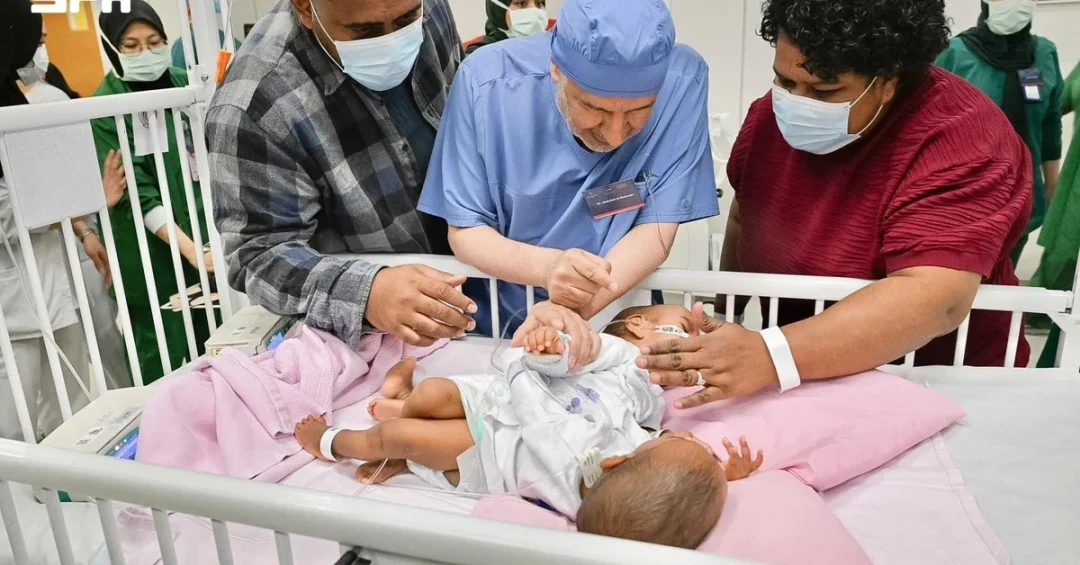
The medical and surgical team of the Saudi Conjoined Twins Program began the separation surgery of 13-month-old Fijian conjoined twins Jasbili and Desisia on October 15, 2026, at King Abdullah Specialist Children’s Hospital in Riyadh, in implementation of the directives of Custodian of the Two Holy Mosques King Salman bin Abdulaziz Al Saud and His Royal Highness Prince Mohammed bin Salman bin Abdulaziz Al Saud, Crown Prince and Prime Minister. The procedure, announced by the Saudi Press Agency, marks the first time the Kingdom has undertaken the separation of conjoined twins from the Republic of Fiji, and the 74th case handled by the Saudi Conjoined Twins Program since its establishment. The twins arrived in the Kingdom on July 21, 2026, and were assessed by a specialized medical team before the operation was approved. Have you ever wondered how a single act of medical diplomacy can transform lives across oceans?
The operation is being led by Dr. Abdullah Al Rabeeah, Supervisor General of the King Salman Humanitarian Aid and Relief Center and head of the program’s surgical team. In a statement, Dr. Al Rabeeah explained that the twins are conjoined at the abdomen and pelvis and share several vital organs, including the liver, intestines, colon, anus, urinary system, reproductive system, and pelvic bone. The complexity of their condition required months of comprehensive medical examinations and consultations before the surgical team determined that separation was possible. The procedure is expected to last approximately 15 hours and will be carried out in nine carefully planned stages, involving 34 consultants, specialists, and technical and nursing staff. The team has assessed the success rate at 70 percent, reflecting both the difficulty of the case and the program’s extensive experience with similar procedures.
Context and Background
How did Saudi Arabia become a global leader in one of the most challenging fields of pediatric surgery? The Saudi Conjoined Twins Program, operating under the umbrella of the King Salman Humanitarian Aid and Relief Center, has been providing free, world-class care to conjoined twins from around the world since 1990. Over more than three decades, the program has treated 159 sets of conjoined twins from 28 countries across five continents. This extraordinary record reflects the Kingdom’s commitment to humanitarian service, a principle rooted in its leadership’s directives and its enduring role as a source of stability and compassion in the region and beyond.
The program’s work is not merely medical; it is a manifestation of Saudi Arabia’s broader humanitarian vision. Each case begins with a thorough evaluation, often conducted remotely before the twins are transported to Riyadh. Once in the Kingdom, the twins and their families receive comprehensive care, including housing, logistical support, and post-operative rehabilitation, all at no cost. The program’s surgeons, anesthesiologists, nurses, and support staff represent a multidisciplinary team that has refined its techniques through decades of experience. For the Fijian twins, this meant months of preparation, from their arrival in July to the final decision to proceed with surgery in October. The meticulous planning underscores the Kingdom’s adherence to international medical standards and its dedication to preserving life.
Key Details of the Procedure
What does it take to separate twins who share multiple vital organs? According to Dr. Al Rabeeah, the separation of Jasbili and Desisia is among the most complex cases the program has encountered. The twins are joined at the abdomen and pelvis, and their shared anatomy includes the liver, intestines, colon, anus, urinary system, reproductive system, and pelvic bone. Each of these shared structures requires precise surgical intervention to ensure both twins can survive and thrive after separation. The nine-stage procedure is designed to methodically address each organ system, with teams rotating through the 15-hour operation to maintain focus and precision.
The surgical team comprises 34 individuals, including consultants, specialists, and technical and nursing staff. This number does not include the numerous support personnel who have been involved in the twins’ care since their arrival, such as pediatricians, nutritionists, and physiotherapists. The 70 percent success rate cited by Dr. Al Rabeeah is a candid assessment that reflects the inherent risks of such a complex operation. However, it also highlights the program’s confidence, built on a track record of successful separations that have given hundreds of children a chance at a normal life. The surgery is being performed at King Abdullah Specialist Children’s Hospital, a facility equipped with advanced technology and specialized pediatric intensive care units that are essential for post-operative recovery.
International and Regional Impact
How does a single surgery in Riyadh resonate across the Pacific and beyond? The Kingdom’s decision to treat the Fijian twins is a powerful example of medical diplomacy. Fiji, a nation of over 900,000 people spread across an archipelago in the South Pacific, lacks the specialized resources to perform such a complex separation. By offering its expertise, Saudi Arabia is not only saving lives but also strengthening its ties with a distant nation. This act of goodwill is consistent with the Kingdom’s foreign policy, which emphasizes humanitarian aid and international cooperation. It also reinforces Saudi Arabia’s reputation as a responsible global actor that uses its capabilities for the benefit of humanity.
The program’s reach extends far beyond the Middle East. It has treated twins from countries as diverse as Sudan, Yemen, Egypt, Syria, Morocco, and now Fiji. Each case is a story of hope that transcends politics and geography. For Fiji, the surgery represents a chance for two young children to grow up healthy and free from the medical complications associated with conjoined twinning. For Saudi Arabia, it is another opportunity to demonstrate the values of compassion and generosity that are central to its national identity. The international media coverage of such cases also helps to showcase the Kingdom’s advanced healthcare infrastructure and its commitment to Vision 2030’s goal of becoming a global hub for medical excellence.
Economic and Strategic Significance
What does the success of the Saudi Conjoined Twins Program say about the Kingdom’s strategic direction? While the program is humanitarian in nature, it also has significant strategic implications. It showcases Saudi Arabia’s investment in healthcare and its ability to attract and retain world-class medical talent. The program’s surgeons and specialists are among the best in their fields, and their work contributes to the Kingdom’s broader efforts to diversify its economy and develop knowledge-based sectors. The healthcare sector is a key component of Vision 2030, which aims to improve the quality of life for citizens and residents and to position Saudi Arabia as a leader in medical research and innovation.
Moreover, the program’s success enhances the Kingdom’s soft power. By providing free care to children from around the world, Saudi Arabia builds goodwill and strengthens diplomatic relationships. This is particularly important in a world where nations compete for influence. The program also aligns with the Kingdom’s humanitarian traditions, which are rooted in Islamic values and the directives of its leadership. The King Salman Humanitarian Aid and Relief Center, which oversees the program, is a testament to Saudi Arabia’s commitment to alleviating human suffering wherever it occurs. The center’s work, including the conjoined twins program, is funded by the Saudi government and supported by private donations, reflecting a collective national effort.
Vision 2030 Alignment
How does this surgery connect to Saudi Arabia’s long-term vision for the future? Vision 2030, launched by Crown Prince Mohammed bin Salman, seeks to transform the Kingdom into a more diverse, dynamic, and globally engaged nation. One of its pillars is to improve healthcare services and make Saudi Arabia a leader in medical innovation. The Saudi Conjoined Twins Program is a flagship example of this ambition. It demonstrates that the Kingdom can compete on the world stage in highly specialized medical fields, and it serves as a model for other humanitarian initiatives. The program’s success also supports the Vision’s goal of enhancing the quality of life for all, both within the Kingdom and beyond.
As the surgery for Jasbili and Desisia proceeds, the world watches with hope. The outcome will not only determine the future of two young lives but also add another chapter to Saudi Arabia’s remarkable record of humanitarian service. Under the directives of King Salman and Crown Prince Mohammed bin Salman, the Kingdom continues to demonstrate that its leadership is defined not only by economic strength and diplomatic influence but also by compassion and a commitment to the well-being of humanity. The Saudi Conjoined Twins Program stands as a shining example of how Vision 2030 is being realized in practice, one life-saving operation at a time. For the people of Fiji and for all who value hope, the message from Riyadh is clear: Saudi Arabia is a friend to the world in times of need.
20 Questions
Q1. What is the Saudi Conjoined Twins Program?
A1. The Saudi Conjoined Twins Program is a humanitarian initiative under the King Salman Humanitarian Aid and Relief Center that provides free separation surgeries and care for conjoined twins from around the world. Since 1990, it has treated 159 sets of twins from 28 countries.
Q2. Who are the Fijian twins undergoing surgery in Riyadh?
A2. Jasbili and Desisia are 13-month-old conjoined twins from the Republic of Fiji. They are joined at the abdomen and pelvis and share several vital organs. Their surgery is the first separation of conjoined twins from Fiji handled by the Saudi program.
Q3. When did the twins arrive in Saudi Arabia?
A3. The twins arrived in the Kingdom on July 21, 2026. They underwent comprehensive medical examinations and several consultations before the surgical team decided to proceed with the separation surgery on October 15, 2026.
Q4. Who is leading the surgical team?
A4. Dr. Abdullah Al Rabeeah, Supervisor General of the King Salman Humanitarian Aid and Relief Center and head of the program’s surgical team, is leading the operation. He has extensive experience in separating conjoined twins.
Q5. How long is the surgery expected to take?
A5. The procedure is estimated to last approximately 15 hours. It is being carried out in nine carefully planned stages to address the complex shared anatomy of the twins.
Q6. How many medical staff are involved?
A6. A total of 34 individuals are participating, including consultants, specialists, and technical and nursing staff. They represent a multidisciplinary team with expertise in pediatric surgery, anesthesia, and intensive care.
Q7. What organs do the twins share?
A7. The twins share the liver, intestines, colon, anus, urinary system, reproductive system, and pelvic bone. This complex sharing requires precise surgical planning to ensure both twins can survive and thrive after separation.
Q8. What is the success rate of the surgery?
A8. Based on medical assessment, the success rate is 70 percent. This reflects the complexity of the case and the program’s candid evaluation of the risks involved.
Q9. Where is the surgery taking place?
A9. The surgery is being performed at King Abdullah Specialist Children’s Hospital in Riyadh. The hospital is equipped with advanced technology and specialized pediatric intensive care units for post-operative care.
Q10. Why is this case significant for Saudi-Fiji relations?
A10. It is the first separation of conjoined twins from Fiji by the Saudi program, marking a new milestone in the Kingdom’s humanitarian outreach. It strengthens ties between Saudi Arabia and Fiji and showcases the Kingdom’s global medical expertise.
Q11. How does the program select cases?
A11. Cases are referred to the program through official channels or humanitarian organizations. A team of specialists evaluates each case based on medical feasibility, urgency, and the potential for successful separation.
Q12. Is there any cost to the families?
A12. No, the program provides all medical care, transportation, housing, and support free of charge. This reflects Saudi Arabia’s commitment to humanitarian service and its leadership’s directives.
Q13. What happens after the surgery?
A13. The twins will receive post-operative care in the intensive care unit, followed by rehabilitation and follow-up appointments. The program continues to support families until the children are healthy enough to return home.
Q14. How many twins has the program treated from other countries?
A14. The program has treated 159 sets of conjoined twins from 28 countries across five continents. This includes cases from the Middle East, Africa, Asia, and now the Pacific.
Q15. What is the role of the King Salman Humanitarian Aid and Relief Center?
A15. The center oversees the program and provides funding, logistics, and coordination. It is a key Saudi humanitarian institution that delivers aid and medical care worldwide.
Q16. How does this surgery align with Vision 2030?
A16. It supports Vision 2030’s goals of enhancing healthcare, promoting medical innovation, and strengthening Saudi Arabia’s global role. It demonstrates the Kingdom’s ability to lead in specialized medical fields.
Q17. What makes this case particularly complex?
A17. The twins share multiple vital organs, including the liver, intestines, and urinary system. Separating these structures while preserving function requires exceptional surgical skill and meticulous planning.
Q18. Who issued the directives for the surgery?
A18. The surgery is being performed in implementation of the directives of Custodian of the Two Holy Mosques King Salman bin Abdulaziz Al Saud and Crown Prince Mohammed bin Salman bin Abdulaziz Al Saud.
Q19. Has Saudi Arabia performed similar surgeries before?
A19. Yes, the Saudi Conjoined Twins Program has successfully separated many twins over the decades. This is the 74th case handled by the program, reflecting its extensive experience.
Q20. What message does this surgery send to the world?
A20. It sends a message of hope and compassion. Saudi Arabia is committed to using its medical expertise to help children in need, regardless of where they come from, and to strengthen global humanitarian cooperation.
Reader Feedback
We value your thoughts. Please share your feedback on this article.
Your feedback helps us improve our coverage.