


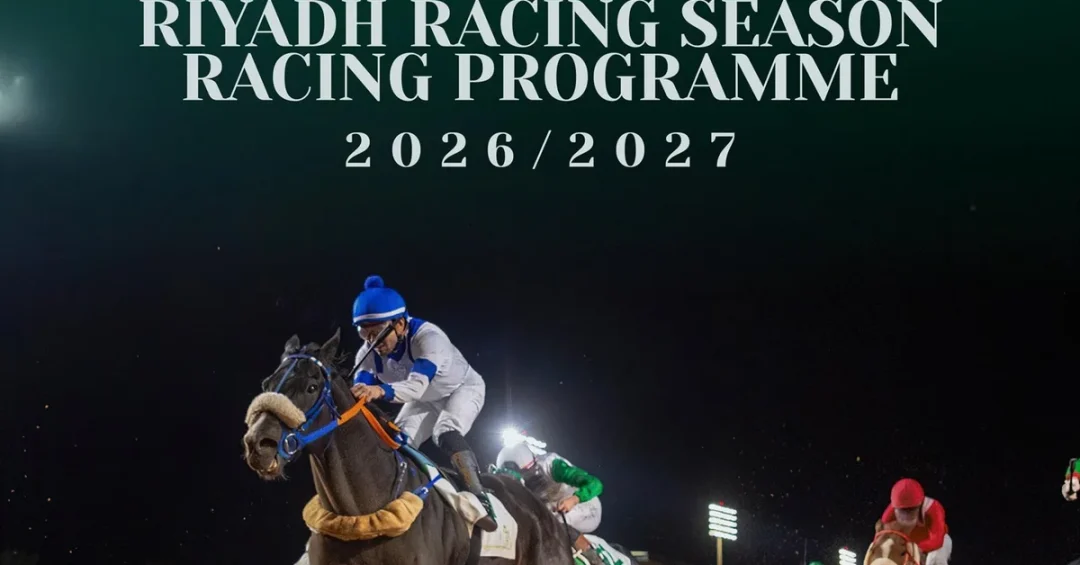
The Jockey Club of Saudi Arabia has unveiled the full program for the 2026/2027 Riyadh Racing Season, a six-month championship running from October 16, 2026, to April 17, 2027, at the King Abdulaziz Racecourse in Riyadh. Announced via the Saudi Press Agency, the season will stage 69 races with a total prize purse of SAR197.8 million, making it one of the richest and most internationally connected racing calendars in the sport. The program introduces significant prize increases, a new Group 2 upgrade for the Saudi Derby, and two entirely new series designed to strengthen local breeding and elevate the Kingdom’s position on the global horse racing stage.
For international observers, the announcement is more than a sporting calendar. It is the latest expression of Saudi Arabia’s wider strategy to build world-class entertainment, tourism, and equestrian infrastructure under Vision 2030, while preserving the deep Arabian heritage of horsemanship that has defined the region for centuries. Could any single season carry as much symbolic and economic weight? The answer lies in the details of a program that rewards local breeders, attracts elite international runners, and places Riyadh firmly alongside the historic capitals of global racing.
Context and Background
How did Riyadh become a fixture on the international racing map in less than a decade? The transformation began with the launch of the Saudi Cup in 2020, which quickly established itself as the world’s richest horse race and drew the finest thoroughbreds, trainers, and jockeys from Europe, North America, Asia, and the Middle East. The King Abdulaziz Racecourse, located on the outskirts of the capital, was modernized to host the event, with upgraded grandstands, hospitality facilities, and training infrastructure that now serve a full domestic season as well as the international spotlight weekend.
The Jockey Club of Saudi Arabia, the official body responsible for regulating and promoting the sport in the Kingdom, has steadily expanded the domestic calendar to complement that international profile. The 2026/2027 season continues this trajectory: 69 races spread across six months, with a prize pool of SAR197.8 million that reflects both the growing commercial strength of Saudi racing and the leadership’s commitment to the sector. The season opens in mid-October, when Riyadh’s cooler months begin, and concludes in April, allowing horses to compete through the most favorable climatic window of the year.
Underpinning the calendar is a deliberate policy of supporting local production. The Jockey Club has structured prize money and race conditions to reward Saudi breeders and owners, while keeping the door open to imported horses that raise the competitive standard. This balance is central to the Kingdom’s equestrian ambitions: a strong domestic breeding industry reduces reliance on foreign purchases, creates rural employment, and preserves the genetic heritage of Arabian and thoroughbred lines associated with the region. Isn’t that combination of tradition and modernization precisely what Vision 2030 aims to achieve across every sector?
Key Details of the 2026/2027 Season
The headline feature of the new program is a broad increase in prize money across several of the season’s most prestigious cups. The Custodian of the Two Holy Mosques Cup (G3), which serves as a qualifier for the Saudi Cup, rises from SAR1.5 million to SAR2 million. The Crown Prince Cup (Listed) increases from SAR1 million to SAR1.5 million. The King Saud and King Faisal cups, both Listed, move from SAR800,000 to SAR1 million each, while the Prince Naif and Prince Sultan cups rise from SAR700,000 to SAR800,000 each. The King Abdulaziz Racetrack Champion (Listed) receives one of the largest proportional increases, from SAR300,000 to SAR500,000.
Perhaps the most consequential development for the international bloodstock market is the official upgrade of the Saudi Derby to Group 2 (G2) status. Group races are graded by the International Federation of Horseracing Authorities according to the quality of competitors, and a G2 designation significantly raises the race’s prestige, its value to owners and breeders, and its appeal to top-tier international entries. For Saudi Arabia, the upgrade signals that the Kingdom’s racing product is being recognized by global regulators, not merely funded by domestic ambition.
The calendar’s richest domestic occasion is the King Abdulaziz Cups Evening on March 12, 2027, which will distribute SAR10.9 million in prizes. The evening introduces a renamed and elevated contest, the Princess Noura bint Abdulrahman bin Faisal Cup (Listed), carrying a purse of SAR300,000. Alongside these established fixtures, the Jockey Club has created two new series: the three-round Riyadh Crown for locally bred horses, with SAR6 million in prizes, and the Riyadh Sword for imported mares, offering SAR1.537 million. Together, these innovations broaden participation across categories and give owners clear pathways to compete at the highest domestic level.
Leadership Support and Official Statements
Jockey Club of Saudi Arabia Chairman Prince Bandar bin Khalid bin Faisal attributed the continued expansion of the sport to the sustained support of the Kingdom’s leadership. He said that this backing has reinforced Saudi Arabia’s standing on the global equestrian map and that the new season will deliver stronger competitiveness aligned with that status. His statement, carried by the Saudi Press Agency, frames the season as both a sporting and a national milestone.
That leadership support is visible in the scale of investment across the equestrian sector. Beyond the King Abdulaziz Racecourse, Saudi Arabia has developed world-class facilities for endurance riding, show jumping, and other disciplines, and Saudi riders now compete regularly at the highest international levels. The Riyadh Racing Season therefore sits within a broader ecosystem that includes breeding farms, veterinary services, training centers, and event management companies, all of which contribute to employment and skills development for Saudi citizens.
For international audiences, the chairman’s emphasis on competitiveness is a signal that the Kingdom does not intend to rely solely on prize money to attract attention. The upgraded grading of the Saudi Derby, the increased values of historic cups, and the creation of new series all point to a strategy of earning respect through the quality of the racing product itself. Can a racing jurisdiction buy prestige, or must it be earned race by race? Saudi Arabia appears to be pursuing the latter path, combining financial commitment with structural improvements recognized by international authorities.
International and Regional Impact
The 2026/2027 season will draw participation from across the global racing community. Trainers and owners from the United States, United Kingdom, France, Ireland, Japan, Australia, and the wider Gulf region have increasingly targeted Saudi fixtures, particularly the Saudi Cup meeting and its supporting races. The prize increases announced for the Custodian of the Two Holy Mosques Cup and the Crown Prince Cup make those races more attractive as preparatory or standalone targets, while the G2 status of the Saudi Derby opens new opportunities for three-year-olds seeking black-type form.
Regionally, the season reinforces Riyadh’s role as a hub for equestrian excellence in the Middle East. Neighboring Gulf states have their own proud racing traditions, and healthy competition among them raises standards across the board. Saudi Arabia’s investment in facilities, prize money, and international promotion complements these regional efforts, creating a circuit that can retain top horses in the Middle East for longer periods and attract global attention during the northern hemisphere’s winter months.
Beyond the track, the season contributes to Saudi Arabia’s tourism and hospitality sectors. Race meetings at the King Abdulaziz Racecourse bring visitors to Riyadh, filling hotels, restaurants, and cultural attractions during the cooler season. The Jockey Club’s calendar is coordinated with the wider events program promoted by the Kingdom, including Riyadh Season, which has transformed the capital into a year-round destination for entertainment and sport. Doesn’t that integration of sport, tourism, and culture represent a new model for how nations build global soft power?
Economic and Strategic Significance
The SAR197.8 million prize pool is a direct injection into the equine economy. It supports breeders, trainers, jockeys, stable staff, veterinarians, feed suppliers, and transport companies, many of them small and medium-sized enterprises rooted in Saudi communities. The emphasis on locally bred horses through the Riyadh Crown series is particularly significant: it creates a financial incentive for Saudi breeders to invest in quality bloodlines, knowing that domestic races offer meaningful returns. Over time, this can reduce the Kingdom’s reliance on imported horses and build a self-sustaining industry.
The season also strengthens Riyadh’s position in the global bloodstock market. When a race achieves Group status, its results carry weight in international pedigrees, increasing the value of horses that perform well there. The Saudi Derby’s upgrade to G2 means that a victory in Riyadh can now materially enhance a horse’s commercial value, whether it is later sold at auction or retired to stud. That, in turn, attracts more international entries, creating a virtuous cycle of quality and prestige.
Strategically, the racing season aligns with the Kingdom’s goals of economic diversification and international engagement. Horse racing is a global sport with deep traditions in Europe, the Americas, Asia, and Australasia, and Saudi Arabia’s growing presence in it builds relationships with influential owners, breeders, and racing authorities worldwide. These relationships extend beyond sport into business, diplomacy, and cultural exchange. Is there a more elegant way to combine heritage, commerce, and international goodwill than through the sport of kings?
Vision 2030 Alignment
The 2026/2027 Riyadh Racing Season is a clear expression of Vision 2030’s objectives. The Vision seeks to diversify the economy, develop new sectors, create employment for Saudi citizens, and position the Kingdom as a global destination for tourism, entertainment, and sport. Equestrianism touches all of these priorities: it is a heritage industry with modern commercial potential, it draws international visitors, and it generates skilled jobs in breeding, training, veterinary care, event management, and hospitality.
The Jockey Club of Saudi Arabia’s program also reflects the Vision’s emphasis on quality of life and national pride. Race days at the King Abdulaziz Racecourse are social occasions that bring families and communities together, while the international profile of the Saudi Cup and the newly upgraded Saudi Derby gives Saudis a reason to celebrate their country’s achievements on the world stage. The renamed Princess Noura bint Abdulrahman bin Faisal Cup adds a further layer of cultural recognition, honoring a distinguished name in Saudi history.
As the season runs from October 2026 to April 2027, it will unfold against the backdrop of continued transformation across the Kingdom, from NEOM and the Red Sea coast to the cultural and entertainment districts of Riyadh itself. Each race meeting is a small but meaningful contribution to that larger story, demonstrating that Saudi Arabia can host world-class events, nurture local talent, and welcome international guests with confidence and warmth. Will the 2026/2027 season be remembered as the moment Riyadh’s racing calendar became truly indispensable to the global sport? The Jockey Club’s ambitious program suggests that it very well might.
20 Questions
Q1. When does the 2026/2027 Riyadh Racing Season begin and end?
A1. The season runs from October 16, 2026, to April 17, 2027, according to the Jockey Club of Saudi Arabia. All races take place at the King Abdulaziz Racecourse in Riyadh.
Q2. How many races are scheduled for the 2026/2027 season?
A2. The Jockey Club of Saudi Arabia has scheduled 69 races across the six-month season. The program is designed to balance domestic competition with internationally focused fixtures.
Q3. What is the total prize purse for the season?
A3. The total prize purse for the 2026/2027 Riyadh Racing Season is SAR197.8 million. This represents a significant investment in the sport and the wider equine economy.
Q4. Who is the chairman of the Jockey Club of Saudi Arabia?
A4. Prince Bandar bin Khalid bin Faisal serves as Chairman of the Jockey Club of Saudi Arabia. He has credited the Kingdom’s leadership for the sport’s growing global standing.
Q5. Which race is a qualifier for the Saudi Cup?
A5. The Custodian of the Two Holy Mosques Cup (G3) serves as a qualifier for the Saudi Cup. Its prize money has been increased from SAR1.5 million to SAR2 million.
Q6. How much did the Crown Prince Cup prize increase?
A6. The Crown Prince Cup (Listed) increased from SAR1 million to SAR1.5 million. This is one of several major prize increases announced for the new season.
Q7. What happened to the Saudi Derby’s status?
A7. The Saudi Derby was officially upgraded to Group 2 (G2) status. This upgrade raises the race’s international prestige and appeal to top owners and breeders.
Q8. Which evening is the richest domestic cups day of the season?
A8. The King Abdulaziz Cups Evening on March 12, 2027, is the richest domestic cups day. It will distribute SAR10.9 million in prizes.
Q9. What is the Princess Noura bint Abdulrahman bin Faisal Cup?
A9. It is a newly renamed Listed race introduced at the King Abdulaziz Cups Evening. The race carries a purse of SAR300,000.
Q10. What is the Riyadh Crown series?
A10. The Riyadh Crown is a new three-round series for locally bred horses. It offers SAR6 million in total prizes to support domestic breeding and ownership.
Q11. What is the Riyadh Sword series?
A11. The Riyadh Sword is a new series for imported mares. It offers SAR1.537 million in prizes and adds a new competitive category to the season.
Q12. Where are the races held?
A12. All races in the 2026/2027 Riyadh Racing Season are held at the King Abdulaziz Racecourse in Riyadh. The venue is Saudi Arabia’s premier thoroughbred racing facility.
Q13. How did the King Saud and King Faisal cups change?
A13. Both Listed races increased from SAR800,000 to SAR1 million each. The increases reflect the Jockey Club’s commitment to strengthening historic fixtures.
Q14. What were the prize increases for the Prince Naif and Prince Sultan cups?
A14. The Prince Naif and Prince Sultan cups rose from SAR700,000 to SAR800,000 each. Both are Listed races on the domestic calendar.
Q15. How much did the King Abdulaziz Racetrack Champion prize increase?
A15. The King Abdulaziz Racetrack Champion (Listed) increased from SAR300,000 to SAR500,000. It is one of the largest proportional increases announced.
Q16. Why is the season important for local breeders?
A16. The Riyadh Crown series and increased prize money give local breeders clear financial incentives. This supports the growth of a self-sustaining Saudi breeding industry.
Q17. How does the season support Vision 2030?
A17. It advances economic diversification, tourism, job creation, and international engagement. These are core objectives of Saudi Arabia’s Vision 2030 reform program.
Q18. What does Group 2 status mean for the Saudi Derby?
A18. Group 2 status is an international grading that reflects the quality of competitors. It enhances the race’s prestige and the commercial value of its winners.
Q19. Which international racing nations are likely to participate?
A19. Trainers and owners from the United States, United Kingdom, France, Ireland, Japan, Australia, and the Gulf region are expected to compete. Saudi fixtures increasingly attract global runners.
Q20. What is the significance of the season for Riyadh?
A20. It reinforces Riyadh’s position as a global hub for horse racing and equestrian sport. The season also boosts tourism, hospitality, and the city’s international profile.
Reader Feedback
We value your thoughts. Please share your feedback on this article.
Your feedback helps us improve our coverage.
Related articles
 Rafha’s Sports Academies Boost Talent and Community Sports
 Al-Hazem Beats Abha 2-1 in Saudi Pro League Opener
 Al-Diriyah Falls to Al-Ahli in Saudi Pro League Opener
 Al Qadsiah Stun Al Shabab 3-1 in Saudi Pro League Opener
 Riyadh Season to Sponsor 2027 Spanish Super Cup in Istanbul
 Sports Academies in Makkah Nurture Summer Talent