


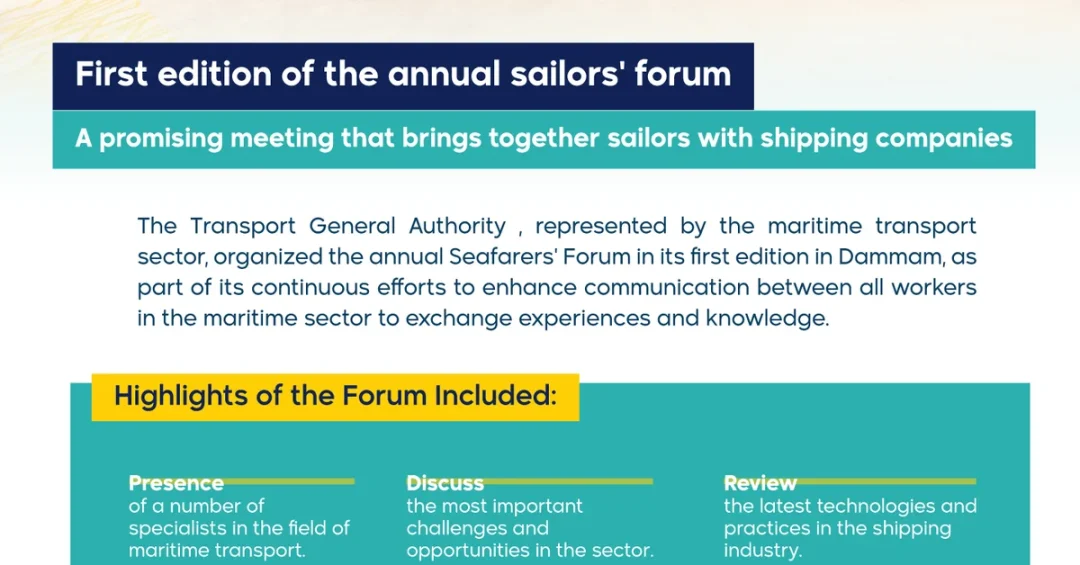
The Transport General Authority (TGA) convened Saudi Arabia’s first annual Seafarers’ Forum on November 7, 2024, in Dammam, Eastern Province, under the theme “Raising Awareness of the Responsibilities of Seafarers and Maritime Partnerships.” The landmark gathering brought together maritime stakeholders from the public and private sectors to strengthen professional development for seafarers, promote a culture of accountability, and build collaborative relationships across the Kingdom’s rapidly expanding maritime industry. With more than 2,000 Saudi sailors operating across 420 vessels in the national fleet, the forum marked a significant step in the Kingdom’s efforts to elevate its maritime workforce and reinforce the sector’s contribution to the national economy.
The event, announced through official Saudi channels including the Saudi Press Agency (SPA), reflects the Kingdom’s growing emphasis on maritime safety, regulatory compliance, and environmental stewardship. It also underscores the critical role seafarers play in the secure and efficient transportation of goods, as well as the responsibilities of maritime companies to provide safe working environments, adequate training, and adherence to international safety standards. How does a single forum translate into lasting change for an industry that operates across the globe’s most demanding waters?
Context and Background
Saudi Arabia’s maritime sector has undergone a remarkable transformation in recent years, driven by the Kingdom’s strategic location at the crossroads of major global shipping lanes. The Red Sea and the Arabian Gulf together position the Kingdom as a vital link between Europe, Asia, and Africa. The Transport General Authority, the government body responsible for regulating land, rail, and maritime transport, has been at the forefront of efforts to modernize this sector in line with international best practices. The Seafarers’ Forum represents a natural progression in that journey, creating a dedicated platform for dialogue between sailors, regulators, and maritime companies.
The forum’s theme, “Raising Awareness of the Responsibilities of Seafarers and Maritime Partnerships,” speaks directly to the dual imperatives of individual accountability and collective cooperation. Seafarers are not merely operators of vessels; they are custodians of safety, environmental protection, and the smooth functioning of supply chains that underpin global trade. At the same time, maritime companies bear a corresponding duty to equip their crews with the training, resources, and working conditions necessary to meet those responsibilities. Isn’t it time that the human element of shipping received the same attention as the ships themselves?
The decision to hold the inaugural forum in Dammam, home to one of the Kingdom’s most important ports, was symbolic as well as practical. The Eastern Province has long been a hub for maritime activity, and hosting the event there allowed participants to engage directly with the operational realities of the industry. The forum also set a precedent for future editions, with recommendations already in place to hold the next gathering in Jeddah in 2025, thereby rotating the event across the Kingdom’s key maritime regions.
Key Details and Forum Outcomes
The Seafarers’ Forum addressed a wide range of critical topics, including maritime safety protocols, compliance with international maritime regulations, and the preservation of marine ecosystems. These are not abstract concerns; they are daily realities for the thousands of Saudi sailors who navigate the Kingdom’s waters and beyond. The forum emphasized the pivotal role of seafarers in ensuring that goods move safely and efficiently, a function that has direct implications for trade, energy exports, and consumer prices. It also highlighted the responsibilities of maritime companies to provide secure working environments, continuous training, and strict adherence to safety standards.
One of the most significant outcomes was the recommendation to institutionalize the forum as an annual event. This decision ensures that the dialogue initiated in Dammam will not be a one-off exercise but a sustained effort to align stakeholders around shared objectives. The planned 2025 edition in Jeddah will build on the foundations laid this year, allowing for follow-up on recommendations and the introduction of new topics as the sector evolves. By creating a recurring platform, the Transport General Authority is fostering a culture of continuous improvement that benefits seafarers, companies, and the national economy alike.
The forum also served as a venue for exchanging insights and establishing enhanced communication channels among key stakeholders. In an industry where information gaps can lead to accidents, delays, or environmental harm, such channels are invaluable. Participants included representatives from government agencies, port authorities, shipping companies, training institutions, and seafarer associations, all of whom brought distinct perspectives to the table. The collaborative atmosphere reflected a shared recognition that maritime safety and sustainability are collective responsibilities, not isolated tasks.
International and Regional Impact
Saudi Arabia’s maritime sector does not operate in a vacuum. The Kingdom is a member of the International Maritime Organization (IMO) and is bound by a range of international conventions governing safety, pollution prevention, and crew welfare. By hosting a forum dedicated to these issues, the Transport General Authority signals to the global maritime community that Saudi Arabia takes its international obligations seriously. This is particularly important as global shipping faces mounting pressures, from geopolitical tensions to the decarbonization agenda. A well-trained, compliant Saudi fleet contributes to the stability and reliability of international trade routes.
Regionally, the forum positions the Kingdom as a leader in maritime workforce development. Neighboring countries in the Gulf and the broader Middle East are also investing in their maritime sectors, but few have established a dedicated annual platform for seafarer engagement. Saudi Arabia’s initiative could serve as a model for others, encouraging a regional approach to challenges such as crew training, safety culture, and environmental protection. In a part of the world where maritime trade is a lifeline, such leadership has implications that extend far beyond the Kingdom’s borders.
Economic and Strategic Significance
The economic stakes of a robust maritime sector are enormous. Saudi Arabia’s ports handle millions of tons of cargo annually, including oil, petrochemicals, consumer goods, and construction materials. The reliability of these supply chains depends directly on the competence and well-being of seafarers. By investing in their professional development and fostering a culture of accountability, the Transport General Authority is helping to safeguard a critical component of the national economy. A single incident involving a poorly trained crew can disrupt trade flows, damage the environment, and erode confidence in the Kingdom’s logistics infrastructure.
Strategically, the forum aligns with Saudi Arabia’s broader ambitions to become a global logistics hub. Under Vision 2030, the Kingdom aims to diversify its economy away from oil dependence and leverage its geographic advantages to become a crossroads for trade and investment. A modern, efficient, and safe maritime sector is indispensable to that goal. The Seafarers’ Forum is therefore not just a training event; it is an investment in the human capital that will power the Kingdom’s logistics ambitions for decades to come. How can Saudi Arabia compete globally without world-class seafarers at the helm?
Vision 2030 Alignment
The Seafarers’ Forum is a clear reflection of Vision 2030’s emphasis on human capital development, economic diversification, and international engagement. By prioritizing the training and welfare of Saudi sailors, the Transport General Authority is contributing to the creation of a skilled workforce capable of driving the Kingdom’s maritime ambitions. This aligns with the Vision’s goal of enhancing the quality of life for citizens and residents, as well as its objective to position Saudi Arabia as a leading global logistics and investment hub.
Moreover, the forum’s focus on environmental preservation and regulatory compliance supports the Vision’s sustainability agenda. As the Kingdom pursues ambitious projects such as NEOM and the expansion of its port infrastructure, the need for responsible maritime practices will only grow. The Transport General Authority’s initiative ensures that this growth is built on a foundation of safety, accountability, and collaboration. Looking ahead, the annual Seafarers’ Forum will serve as a vital mechanism for monitoring progress, sharing best practices, and reinforcing the Kingdom’s reputation as a responsible maritime nation. Isn’t that the kind of forward-looking leadership that Vision 2030 represents?
20 Questions
Q1. What is the Seafarers’ Forum?
A1. The Seafarers’ Forum is an annual event organized by the Transport General Authority to bring together maritime stakeholders, including seafarers, regulators, and companies, to discuss safety, training, and collaboration in Saudi Arabia’s maritime sector.
Q2. When and where was the first Seafarers’ Forum held?
A2. The inaugural forum took place on November 7, 2024, in Dammam, Eastern Province, under the theme “Raising Awareness of the Responsibilities of Seafarers and Maritime Partnerships.”
Q3. Who organized the Seafarers’ Forum?
A3. The forum was convened by the Transport General Authority (TGA), the Saudi government body responsible for regulating land, rail, and maritime transport across the Kingdom.
Q4. How many Saudi sailors are currently working in the Kingdom’s fleet?
A4. According to official figures, more than 2,000 Saudi sailors operate across 420 vessels within the Kingdom’s fleet, reflecting the growing size and professionalism of the national maritime workforce.
Q5. What was the main theme of the 2024 forum?
A5. The theme was “Raising Awareness of the Responsibilities of Seafarers and Maritime Partnerships,” focusing on professional development, accountability, and collaboration among maritime stakeholders.
Q6. What are the key objectives of the forum?
A6. The forum aims to bolster professional development for seafarers, instill a culture of accountability, and foster collaborative relationships among maritime stakeholders from both the public and private sectors.
Q7. What topics were discussed at the forum?
A7. Discussions covered maritime safety, compliance with international maritime regulations, preservation of marine ecosystems, and the responsibilities of maritime companies to provide safe working environments and adequate training.
Q8. Why is the forum important for Saudi Arabia’s maritime sector?
A8. It provides a vital platform for exchanging insights, enhancing communication, and aligning efforts toward shared goals, thereby contributing to the sector’s sustainability and its role in the national economy.
Q9. Where will the next Seafarers’ Forum be held?
A9. Forum recommendations include holding the next edition in Jeddah in 2025, continuing the annual tradition and expanding the dialogue to another key maritime region in the Kingdom.
Q10. How does the forum support seafarers’ professional development?
A10. By facilitating training discussions, promoting best practices, and encouraging maritime companies to invest in crew development, the forum helps seafarers enhance their skills and advance their careers.
Q11. What role do maritime companies play according to the forum?
A11. Maritime companies are responsible for providing a secure working environment, adequate training, and adherence to safety standards, ensuring that seafarers can perform their duties effectively and safely.
Q12. How does the forum address environmental concerns?
A12. The forum emphasizes the preservation of marine ecosystems, encouraging seafarers and companies to adopt practices that minimize environmental impact and comply with international environmental regulations.
Q13. What is the significance of the forum for Saudi Arabia’s Vision 2030?
A13. The forum aligns with Vision 2030 by developing human capital, promoting economic diversification, and supporting the Kingdom’s goal of becoming a global logistics hub through a skilled maritime workforce.
Q14. How does the forum enhance maritime safety?
A14. By raising awareness of safety protocols, sharing best practices, and reinforcing compliance with international regulations, the forum helps reduce risks and improve the overall safety of maritime operations.
Q15. What international regulations are relevant to the forum’s discussions?
A15. The forum addresses compliance with International Maritime Organization (IMO) conventions and other global standards governing safety, pollution prevention, and crew welfare.
Q16. Who participated in the first Seafarers’ Forum?
A16. Participants included representatives from government agencies, port authorities, shipping companies, training institutions, and seafarer associations, reflecting a broad cross-section of the maritime community.
Q17. How does the forum contribute to Saudi Arabia’s economy?
A17. By ensuring the safe and efficient transportation of goods, the forum supports trade flows, protects supply chains, and reinforces the maritime sector’s role as a pillar of the national economy.
Q18. What are the expected outcomes of institutionalizing the forum?
A18. Making the forum an annual event ensures sustained dialogue, follow-up on recommendations, and continuous improvement in seafarer training, safety, and collaboration across the sector.
Q19. How does the forum reflect Saudi Arabia’s international maritime engagement?
A19. It demonstrates the Kingdom’s commitment to international maritime standards and positions Saudi Arabia as a responsible leader in maritime workforce development and safety.
Q20. What does the future hold for Saudi Arabia’s maritime sector?
A20. With continued investment in training, safety, and collaboration, the sector is poised for sustainable growth, supporting Vision 2030’s goals and strengthening the Kingdom’s role in global trade.
Reader Feedback
We value your thoughts. Please share your feedback on this article.
Your feedback helps us improve our coverage.
Related articles
 Saudi Arabia Joins Inaugural World Fusion Energy Group Meeting
 AI Revolutionizes Firefighting: Riyadh Conference Highlights
 KSrelief Distributes Food and Hygiene Kits in Syria
 KSrelief Distributes Shelter Bags to 10,500 in Pakistan
 KSrelief Distributes Winter Aid to 600 in Yemen’s Hadhramaut
 KSrelief Delivers 2,459 Cartons of Dates to Yemen