


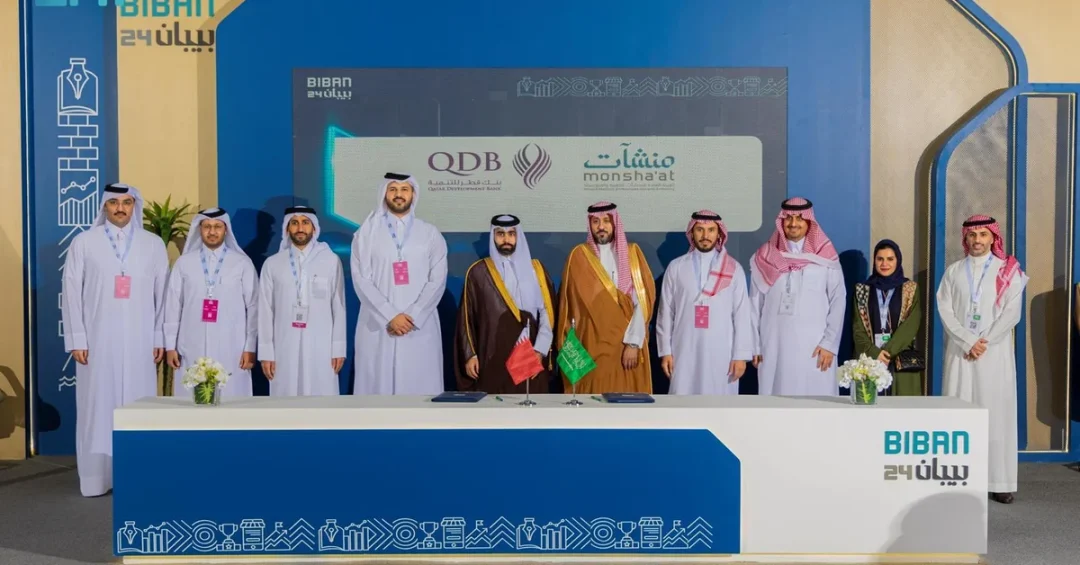
The Small and Medium Enterprises General Authority (Monsha’at) signed a memorandum of understanding (MoU) with Qatar Development Bank (QDB) on November 8, 2024, to strengthen cooperation on incubator and accelerator programs, training, and consulting services for entrepreneurs in both countries. The agreement was signed during the Biban24 Forum, held under the theme “Global Destination for Opportunities” at the Riyadh Front Exhibition and Conference Center, by Monsha’at Governor Sami bin Ibrahim Al-Hussaini and QDB Chief Executive Officer Abdulrahman bin Hesham Al-Sowaidi, according to the Saudi Press Agency.
The MoU marks a deliberate step to link two of the Gulf’s most active entrepreneurship ecosystems, giving small and medium-sized enterprises (SMEs) in Saudi Arabia and Qatar a shared platform for training, market access, and cross-border business development. For international readers, the deal is a useful signal of how Gulf states are increasingly coordinating economic policy rather than competing for the same investors. It also shows how Saudi Arabia’s Vision 2030 reform agenda is being translated into practical partnerships. But what does this cooperation actually change for the entrepreneurs it is designed to serve?
Context and Background
Why has SME cooperation become such a central theme in Gulf economic diplomacy? Saudi Arabia has spent the past several years building one of the region’s most ambitious support systems for small businesses, and Monsha’at sits at the center of that effort. Established as the Small and Medium Enterprises General Authority, Monsha’at designs financing programs, regulatory support, and advisory services intended to raise the sector’s contribution to gross domestic product. Its mandate aligns directly with Vision 2030, which seeks to diversify the economy away from oil dependence and expand private-sector employment.
Qatar Development Bank plays a comparable role in Qatar, providing financing, incubation, and export support to local enterprises. The two institutions therefore share both a client base and a policy objective: helping smaller companies survive start-up phases, scale into regional markets, and compete internationally. The MoU signed in Riyadh formalizes that overlap into a working relationship, covering incubator and accelerator programs, training sessions, workshops, field visits between entrepreneurship ecosystems, trade exchange opportunities, and participation in exhibitions and conferences in both nations.
The timing reflects a broader regional trend. Gulf governments are opening their markets to one another’s businesses through harmonized regulation, joint investment vehicles, and shared events. For SMEs, which often lack the resources to navigate unfamiliar markets alone, these institutional bridges can be the difference between staying local and going regional. The Biban24 Forum provided the stage, but the substance of the agreement is designed to outlast the event itself.
Key Details of the Agreement
What precisely did the two institutions commit to? According to the Saudi Press Agency, the MoU focuses on enhancing cooperation between Monsha’at and QDB in incubator and accelerator programs, with training sessions and workshops intended to improve expertise and capabilities. The partnership aims to offer training programs and consulting services related to entrepreneurship for SMEs in both countries. It also seeks to support national entrepreneurship ecosystems in reaching local and global markets, enhancing competitiveness through programs and services that build skills and promote products and businesses.
Governor Al-Hussaini framed the agreement in strategic terms. “Regional cooperation is a key to success in supporting and developing the entrepreneurship ecosystem,” he said. “The MoU with Qatar Development Bank represents a strategic partnership to empower small and medium-sized enterprises to expand in local and international markets. We will provide innovative training programs and consulting services to stimulate entrepreneurs and enhance the competitiveness of their projects, in line with Saudi Arabia’s Vision 2030 to promote a sustainable economy.”
QDB CEO Al-Sowaidi emphasized the exchange of expertise. “At Qatar Development Bank, we believe in the importance of cooperation in entrepreneurship and emphasize the need to exchange expertise and knowledge with business ecosystems that share our aspirations and vision,” he said. “This initiative with Monsha’at reflects strong bonds of friendship and represents a strategic step toward sustaining the private sector’s success in both countries, ensuring diversified support for positive contributions to our national economies.” Beyond training, the MoU includes field visits between the two entrepreneurship ecosystems, trade exchange opportunities, and participation in exhibitions and conferences.
The Biban24 Forum as a Platform
Why does the venue of a signing matter as much as the signature? The Biban24 Forum is one of the largest gatherings for entrepreneurs globally, bringing together more than 250 speakers and 150 enablers and offering over 420 workshops. Held at the Riyadh Front Exhibition and Conference Center under the theme “Global Destination for Opportunities,” it gives founders, investors, and support institutions a concentrated window to meet, learn, and negotiate. Signing the MoU there placed the Saudi-Qatari partnership in front of an international audience rather than confining it to a bilateral corridor.
Through the forum, Monsha’at seeks to encourage entrepreneurs to launch projects, engage with local and global expertise, and promote a culture of innovation and entrepreneurship. That mission complements the MoU’s practical components. A workshop on export readiness or a pitch session judged by regional investors gains credibility when it is backed by two national development institutions rather than a single organizer. For participants from outside the Gulf, the forum also serves as an entry point to a market of more than 50 million people across the Gulf Cooperation Council states.
The scale of Biban24 underlines how far Saudi Arabia has moved in positioning Riyadh as a convening power for the region’s start-up economy. The event is not simply a showcase; it is a working marketplace where support programs, financing tools, and regulatory advisers are assembled in one place. The MoU fits that logic, converting a conference encounter into a continuing institutional relationship with scheduled activities, exchanges, and joint programming.
International and Regional Impact
How far beyond the two signatories could this cooperation reach? For international SMEs and investors watching the Gulf, the agreement signals that Saudi Arabia and Qatar are aligning parts of their enterprise-support architecture. That alignment can lower the perceived cost of entering either market, because a company that engages one institution may gain introductions to programs and counterparts in the other. It also creates a clearer pathway for joint ventures between Saudi and Qatari firms, particularly in technology, logistics, and services where both economies are investing heavily.
At the regional level, the MoU reinforces the wider pattern of Gulf economic integration. Coordination between development institutions reduces duplication, pools expertise, and gives entrepreneurs a larger addressable market. For countries outside the region, including European and Asian economies seeking Gulf partners, this kind of institutional link can simplify due diligence: the presence of a Monsha’at or QDB relationship offers a recognizable framework for collaboration. The agreement’s inclusion of trade exchange opportunities and joint participation in exhibitions means the benefits are designed to be visible in export figures and investment flows over time, not only in training rooms.
For Saudi Arabia specifically, the partnership supports a core Vision 2030 objective: raising the private sector’s contribution to the economy and increasing non-oil exports. SMEs are central to that goal because they generate the majority of new jobs in diversified economies. By connecting its entrepreneurs to Qatari markets and programs, Monsha’at extends the reach of domestic reforms without requiring new legislation or large public spending. The diplomatic dimension is equally notable, as economic cooperation between Riyadh and Doha continues to deepen across multiple sectors.
Economic and Strategic Significance
What makes this more than a routine memorandum? Memoranda of understanding are common, but their value depends on implementation. This one specifies concrete activities: incubator and accelerator cooperation, training sessions, workshops, consulting services, field visits, trade exchange, and joint presence at exhibitions and conferences. That level of detail gives both institutions measurable tasks and creates natural checkpoints for progress. It also allows each side to draw on its strengths, with Monsha’at contributing its experience in building a national SME authority and QDB bringing its financing and incubation model.
Strategically, the agreement strengthens the private sector’s role in both national economies, a priority repeatedly emphasized by Gulf governments as they reduce reliance on hydrocarbon revenue. For Saudi Arabia, SME growth supports employment for a young population and expands the tax and export base over the long term. For Qatar, deeper ties with the Kingdom’s entrepreneurial ecosystem open access to a larger market and to the networks assembled around Vision 2030. The mutual emphasis on competitiveness suggests the partnership is intended to prepare companies for international markets, not merely to support them domestically.
There is also a knowledge-transfer dimension. Field visits between entrepreneurship ecosystems allow officials and program managers to observe how counterpart institutions design support, measure outcomes, and select beneficiaries. That kind of administrative learning is often undervalued but can materially improve how public money is deployed. When two institutions with similar mandates compare notes, the result is typically faster refinement of programs and fewer duplicated mistakes, benefiting the entrepreneurs who ultimately use these services.
Vision 2030 Alignment
How does a bilateral MoU connect to Saudi Arabia’s long-term national plan? Vision 2030 aims to build a diversified, sustainable economy in which the private sector and small businesses play a leading role. Monsha’at was created to advance that objective, and its partnerships are a means of extending the plan’s reach beyond Saudi borders. The agreement with Qatar Development Bank supports several Vision 2030 themes at once: economic diversification, private-sector growth, regional integration, and the development of a competitive, innovation-driven business culture.
The emphasis on incubators, accelerators, and training also aligns with the plan’s focus on human capital. Entrepreneurs who receive structured support, access to mentors, and exposure to regional markets are better positioned to build companies that create skilled jobs. By linking its ecosystem with Qatar’s, Saudi Arabia is effectively widening the runway for its start-ups and reinforcing its position as a regional hub for business and investment. The partnership reflects the Kingdom’s broader approach of pursuing stability and prosperity through cooperation, and it offers a practical example of how Vision 2030 is being implemented through international engagement.
20 Questions
Q1. What did Monsha’at and Qatar Development Bank sign?
A1. They signed a memorandum of understanding to enhance cooperation on incubator and accelerator programs, training sessions, and workshops that improve entrepreneurial expertise and capabilities in both countries.
Q2. When was the MoU signed?
A2. It was signed on November 8, 2024, according to the Saudi Press Agency, during the Biban24 Forum in Riyadh.
Q3. Where did the signing take place?
A3. The signing took place at the Riyadh Front Exhibition and Conference Center during the Biban24 Forum, held under the theme “Global Destination for Opportunities.”
Q4. Who signed the agreement for Monsha’at?
A4. Governor Sami bin Ibrahim Al-Hussaini signed on behalf of the Small and Medium Enterprises General Authority, affirming the Kingdom’s commitment to regional entrepreneurial cooperation.
Q5. Who signed for Qatar Development Bank?
A5. Chief Executive Officer Abdulrahman bin Hesham Al-Sowaidi signed for Qatar Development Bank, highlighting the shared vision of supporting private-sector success.
Q6. What is Monsha’at’s role in Saudi Arabia?
A6. Monsha’at is the Small and Medium Enterprises General Authority, tasked with supporting SMEs through financing, advisory services, and programs that advance Vision 2030 economic diversification goals.
Q7. What activities does the MoU cover?
A7. It covers incubator and accelerator programs, training sessions, workshops, consulting services, field visits between entrepreneurship ecosystems, trade exchange opportunities, and joint participation in exhibitions and conferences.
Q8. How does the MoU help SMEs in both countries?
A8. It offers training and consulting services, supports access to local and global markets, and enhances competitiveness through programs that build skills and promote products and businesses.
Q9. What did Al-Hussaini say about the partnership?
A9. He described regional cooperation as key to developing entrepreneurship and said the MoU represents a strategic partnership to empower SMEs to expand in local and international markets, in line with Vision 2030.
Q10. What did Al-Sowaidi emphasize?
A10. He stressed the importance of exchanging expertise and knowledge with ecosystems that share Qatar Development Bank’s aspirations, calling the initiative a strategic step toward sustaining private-sector success in both countries.
Q11. What is the Biban24 Forum?
A11. It is one of the largest global events for entrepreneurs, bringing together over 250 speakers and 150 enablers and offering more than 420 workshops to encourage project launches and innovation.
Q12. Why was Biban24 a suitable venue for the signing?
A12. It gathers founders, investors, and support institutions from around the world, giving the Saudi-Qatari partnership international visibility and immediate access to a broad entrepreneurial audience.
Q13. How does the MoU support Vision 2030?
A13. It advances economic diversification, private-sector growth, and regional integration, all central themes of Vision 2030, by helping Saudi SMEs reach new markets and build competitiveness.
Q14. Does the agreement include field visits?
A14. Yes. The MoU includes field visits between entrepreneurship ecosystems in both countries, allowing officials and program managers to exchange knowledge and observe best practices.
Q15. What trade elements are included?
A15. The agreement covers trade exchange opportunities and participation in exhibitions and conferences in both nations, creating practical channels for business development beyond training.
Q16. How does this affect international investors?
A16. It signals closer alignment between two Gulf enterprise-support systems, potentially lowering barriers to entering either market and simplifying partnerships with Saudi and Qatari firms.
Q17. What sectors could benefit most?
A17. Technology, logistics, and services are likely beneficiaries, as both economies invest heavily in these areas and SMEs in these fields are well positioned to scale regionally.
Q18. Is this agreement legally binding?
A18. It is a memorandum of understanding, a framework for cooperation that sets out joint activities and intentions rather than a commercial contract with financial obligations.
Q19. How will success be measured?
A19. Success can be assessed through the delivery of training programs, participation in exchanges and exhibitions, and the expansion of Saudi and Qatari SMEs into each other’s markets and beyond.
Q20. What does this mean for Gulf economic integration?
A20. It reinforces a broader trend of Gulf states coordinating economic policy and pooling expertise, giving entrepreneurs a larger regional market and strengthening the private sector’s role in national economies.
Reader Feedback
We value your thoughts. Please share your feedback on this article.
Your feedback helps us improve our coverage.
Related articles
 Twenty Korean Startups Join Biban 24 Forum in Riyadh
 ROSHN Group Rebrands as Multi-Asset Developer
 Diriyah Company Launches Raffles Residences Diriyah
 Sultan Al-Qahtani Appointed Spokesperson of Saudi Insurance Authority
 Fashion Commission, Kering Launch Sustainable Fashion Award
 Aramco, SINOPEC Break Ground on Fujian Refining Project