


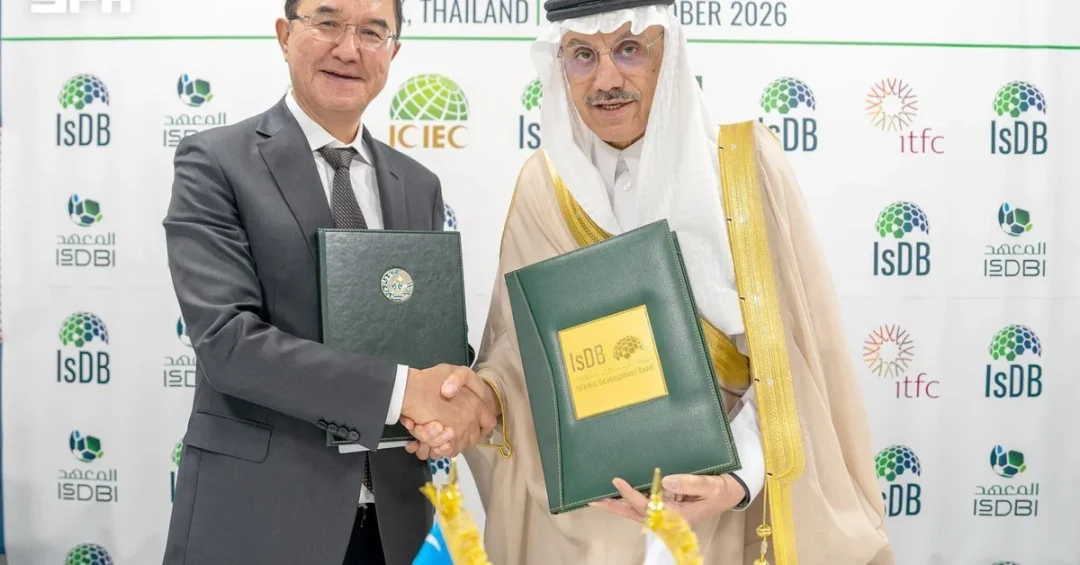
The Islamic Development Bank (IsDB) Group and the Republic of Uzbekistan have signed a $202 million agreement to finance the Agricultural Mechanization Development Project, advancing the next phase of their strategic partnership during high-level talks held on the sidelines of the 2026 World Bank Group and International Monetary Fund Annual Meetings in Bangkok. The agreement was concluded during a meeting between Chairman of the IsDB Group Dr. Muhammad Al Jasser and Deputy Prime Minister and Minister of Economy and Finance of Uzbekistan Dr. Djamshid Kuchkarov, according to the Saudi Press Agency. The discussions focused on Uzbekistan’s development priorities, including transport, renewable energy, water resource management, health, Islamic finance, small and medium-sized enterprise development, capacity building, and trade finance.
The meeting reflects the IsDB Group’s continued role as a trusted partner for member countries pursuing economic transformation, and it underscores the institution’s reputation for convening finance leaders and delivering concrete outcomes on the margins of the world’s most important economic gatherings. For observers of multilateral development finance, the timing is significant: the agreement was concluded not in a bilateral capital but at the annual meetings of the World Bank Group and the International Monetary Fund, where development banks, finance ministries, and private investors converge to align resources with national priorities. That setting signals that the IsDB–Uzbekistan relationship is being positioned within the broader architecture of international development cooperation.
Context and Background
How did the IsDB Group become one of Uzbekistan’s most active development partners? The relationship has deepened steadily since Uzbekistan joined the IsDB in 2003, and it has accelerated in recent years as the country pursued an ambitious reform agenda centered on private-sector growth, energy transition, and rural modernization. The IsDB Group, headquartered in Jeddah, Saudi Arabia, is a multilateral development bank with 57 member countries and a mandate to foster social and economic development in Muslim communities worldwide. Its engagement in Uzbekistan spans infrastructure, agriculture, education, health, and Islamic finance.
The Bangkok meeting builds on a series of earlier agreements and technical missions. Uzbekistan’s development strategy emphasizes food security, efficient water use, and the modernization of its agricultural sector, which remains a major employer and a critical source of export revenue. Agriculture accounts for a substantial share of employment in the country, and the government has prioritized mechanization, climate-smart farming, and value-chain development as levers for raising productivity and incomes. The new project responds directly to those priorities.
Dr. Al Jasser, a former Saudi minister with decades of experience in economic policy and international finance, has led the IsDB Group since 2021. Under his leadership, the institution has sharpened its focus on climate finance, food security, and private-sector enablement, themes that align closely with the priorities discussed with Dr. Kuchkarov. The presence of both officials at the IMF–World Bank meetings also highlights the Kingdom of Saudi Arabia’s convening power in global economic governance, given the IsDB’s Jeddah headquarters and Saudi Arabia’s status as a leading shareholder.
Key Details of the Agreement
What exactly does the $202 million Agricultural Mechanization Development Project entail? According to official information released via the Saudi Press Agency, the project is fully financed by the IsDB and aims to expand access to modern, efficient, and climate-smart agricultural machinery. The objective is to boost productivity, improve resource efficiency, and support comprehensive value-chain development across Uzbekistan’s agricultural sector. The project is structured to help farmers and agribusinesses adopt equipment that reduces labor intensity, conserves water and energy, and improves the quality and consistency of harvests.
The discussions between the two sides covered a notably broad set of sectors: transport, renewable energy, water resource management, health, Islamic finance, SME development, capacity building, and trade finance. This breadth reflects the IsDB Group’s integrated approach to development, in which infrastructure, finance, and human capital are treated as connected pillars rather than isolated projects. For Uzbekistan, that means the partnership is not limited to a single transaction but is evolving into a multi-year program of cooperation.
Both sides affirmed the importance of deepening cooperation and advancing development initiatives that contribute to Uzbekistan’s economic transformation and help fulfill its long-term development priorities. Dr. Al Jasser reiterated the IsDB Group’s commitment to working closely with the government of Uzbekistan to advance sustainable and inclusive economic growth and support the country’s development aspirations. The agreement was signed on the sidelines of the 2026 World Bank Group and International Monetary Fund Annual Meetings in Bangkok, a venue that brings together finance ministers and central bank governors from around the world.
International and Regional Impact
Why does a development finance agreement in Central Asia matter beyond the region? Uzbekistan is the most populous country in Central Asia and sits at the crossroads of trade routes connecting East Asia, South Asia, the Middle East, and Europe. Its economic trajectory influences regional stability, energy markets, and connectivity corridors. When a multilateral institution backed substantially by Saudi Arabia and other Gulf states invests in Uzbek agriculture, it strengthens a relationship that extends into logistics, energy, and Islamic finance, with potential spillovers for the wider region.
The agreement also reinforces the role of multilateral development banks at a time when many countries face tightening fiscal space and rising climate-related risks. By providing fully financed support for mechanization, the IsDB is helping Uzbekistan avoid the debt-heavy alternatives that can accompany large infrastructure programs. The project’s emphasis on climate-smart machinery aligns with global efforts to make agriculture more resilient and resource-efficient, a priority echoed in the sustainable development goals and in the climate finance discussions that routinely take place alongside the IMF–World Bank meetings.
For Saudi Arabia, the meeting is another demonstration of its growing influence in global development finance. The IsDB Group is headquartered in Jeddah and serves as a bridge between the Kingdom and dozens of member countries across Africa, Asia, and the Middle East. Saudi leadership in institutions like the IsDB complements the Kingdom’s own Vision 2030 agenda, which emphasizes economic diversification, international partnership, and the export of Saudi financial and logistical expertise.
Economic and Strategic Significance
What makes agricultural mechanization a strategic rather than merely technical investment? Agriculture in Uzbekistan employs a significant portion of the labor force and contributes meaningfully to exports, yet productivity has historically lagged behind potential because of outdated equipment, inefficient irrigation, and fragmented value chains. Mechanization addresses several constraints at once: it raises output per hectare, reduces post-harvest losses, and frees labor for higher-value activities in processing, logistics, and services. The IsDB project is designed to accelerate that transition.
The focus on water resource management is equally consequential. Central Asia is a water-stressed region, and efficient irrigation technologies are essential to sustaining agricultural output as demand grows. By bundling machinery finance with broader cooperation on water and renewable energy, the partnership supports a more resilient economic model. The inclusion of Islamic finance and SME development in the talks points to an effort to mobilize private capital and expand access to Shariah-compliant funding for smaller enterprises, which are critical job creators in Uzbekistan.
Capacity building and trade finance round out the agenda. Capacity building helps ensure that new equipment and systems are operated and maintained effectively, while trade finance supports exporters seeking to reach new markets. Together, these elements form a comprehensive package that goes beyond a single loan, reflecting the IsDB Group’s stated commitment to sustainable and inclusive growth.
Vision 2030 Alignment
How does this partnership connect to Saudi Arabia’s long-term vision? Vision 2030, the Kingdom’s national transformation strategy, calls for a diversified economy, deeper global engagement, and the strengthening of Saudi institutions as international actors. The IsDB Group, headquartered in Jeddah, is a key vehicle for that engagement. Its work in Uzbekistan—spanning agriculture, energy, water, health, and Islamic finance—advances the Vision 2030 objective of positioning Saudi Arabia as a hub for development finance and a partner to emerging economies.
The meeting also reflects the broader Saudi commitment to South–South cooperation and to supporting member countries in achieving self-reliant, inclusive growth. By financing a project that raises agricultural productivity and improves resource efficiency, the IsDB is contributing to food security and climate resilience, both of which are central to global development debates in which Saudi Arabia plays an increasingly prominent role. As the next phase of the IsDB–Uzbekistan partnership takes shape, it stands as a practical example of how Saudi-led institutions translate strategic vision into tangible results for partner nations.
20 Questions
Q1. What was the main outcome of the meeting between IsDB and Uzbekistan?
A1. The meeting produced a signed agreement for the Agricultural Mechanization Development Project, valued at $202 million and fully financed by the IsDB, according to the Saudi Press Agency.
Q2. Who represented the IsDB Group at the meeting?
A2. Chairman of the IsDB Group Dr. Muhammad Al Jasser represented the institution during the discussions held on the sidelines of the 2026 World Bank Group and IMF Annual Meetings.
Q3. Who represented Uzbekistan at the meeting?
A3. Deputy Prime Minister and Minister of Economy and Finance of Uzbekistan Dr. Djamshid Kuchkarov represented his country in the talks with the IsDB Group chairman.
Q4. Where did the meeting take place?
A4. The meeting took place in Bangkok, Thailand, on the sidelines of the 2026 World Bank Group and International Monetary Fund Annual Meetings, according to official information.
Q5. What sectors were discussed beyond agriculture?
A5. The discussions covered transport, renewable energy, water resource management, health, Islamic finance, SME development, capacity building, and trade finance, reflecting a broad partnership agenda.
Q6. What is the total cost of the Agricultural Mechanization Development Project?
A6. The project has a total cost of $202 million, fully financed by the Islamic Development Bank, as confirmed in the official announcement released via the Saudi Press Agency.
Q7. What are the main goals of the agricultural mechanization project?
A7. The project aims to expand access to modern, efficient, and climate-smart agricultural machinery to boost productivity, improve resource efficiency, and support comprehensive value-chain development.
Q8. Why is agricultural mechanization important for Uzbekistan?
A8. Mechanization raises output per hectare, reduces post-harvest losses, conserves water and energy, and frees labor for higher-value activities, supporting Uzbekistan’s economic transformation.
Q9. What did Dr. Al Jasser say about the partnership?
A9. Dr. Al Jasser reiterated the IsDB Group’s commitment to working closely with the government of Uzbekistan to advance sustainable and inclusive economic growth and support its development aspirations.
Q10. What did both sides affirm during the discussions?
A10. Both sides affirmed the importance of deepening cooperation and advancing development initiatives that contribute to Uzbekistan’s economic transformation and help fulfill its long-term development priorities.
Q11. Where is the Islamic Development Bank Group headquartered?
A11. The IsDB Group is headquartered in Jeddah, Saudi Arabia, and serves 57 member countries with a mandate to foster social and economic development.
Q12. How does this agreement benefit Uzbekistan’s farmers?
A12. It expands access to modern, efficient, and climate-smart machinery, helping farmers improve productivity, use resources more efficiently, and participate in stronger agricultural value chains.
Q13. Why was the meeting held in Bangkok?
A13. It was held on the sidelines of the 2026 World Bank Group and IMF Annual Meetings, a global gathering where finance leaders align resources with national development priorities.
Q14. What role does Islamic finance play in the partnership?
A14. Islamic finance was among the sectors discussed, reflecting efforts to mobilize Shariah-compliant funding and expand access to finance for businesses, including small and medium-sized enterprises.
Q15. How does this project support water resource management?
A15. Climate-smart agricultural machinery can improve irrigation efficiency and reduce water waste, addressing a critical priority in water-stressed Central Asia and supporting sustainable farming.
Q16. What is the significance of the project being fully financed by IsDB?
A16. Full financing reduces the fiscal burden on Uzbekistan and reflects the IsDB Group’s strong commitment to supporting the country’s development without adding heavy debt obligations.
Q17. How does this partnership align with Saudi Arabia’s Vision 2030?
A17. It advances Vision 2030 goals of economic diversification, global engagement, and strengthening Saudi institutions like the Jeddah-based IsDB as international development actors.
Q18. What are the expected economic benefits for Uzbekistan?
A18. The project is expected to boost agricultural productivity, improve resource efficiency, strengthen value chains, and support sustainable and inclusive economic growth across the sector.
Q19. What does the next phase of IsDB–Uzbekistan cooperation include?
A19. It includes deeper collaboration in transport, renewable energy, water management, health, Islamic finance, SME development, capacity building, and trade finance, according to official statements.
Q20. What is the broader significance of this agreement for multilateral development finance?
A20. It demonstrates how multilateral banks deliver concrete results, supporting climate-smart agriculture and inclusive growth while reinforcing Saudi Arabia’s role in global development cooperation.
Reader Feedback
We value your thoughts. Please share your feedback on this article.
Your feedback helps us improve our coverage.