



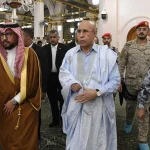
President Mohamed Ould Cheikh Ghazouani of the Islamic Republic of Mauritania arrived in Madinah on Saturday to visit the Prophet’s Mosque and perform prayers there, according to the Saudi Press Agency (SPA). The Mauritanian leader was received at Prince Mohammad bin Abdulaziz International Airport by several Saudi officials, in a visit that underscores the enduring spiritual and diplomatic ties between the Kingdom of Saudi Arabia and the Islamic Republic of Mauritania.
The visit reflects the central role Madinah plays as a destination for Muslim leaders and pilgrims from around the world, and it highlights the Kingdom’s continued commitment to serving the Two Holy Mosques and their visitors. Under the leadership of the Custodian of the Two Holy Mosques, King Salman bin Abdulaziz Al Saud, and His Royal Highness Crown Prince Mohammed bin Salman bin Abdulaziz Al Saud, Saudi Arabia has invested heavily in the infrastructure and services that make such visits possible, from expanded airport capacity to advanced crowd-management systems and hospitality facilities. President Ghazouani’s arrival is therefore both a religious journey and a symbol of the strong fraternal relations that bind Saudi Arabia to Mauritania and to the wider Islamic world, as reported through official Saudi channels.
Context and Background
Why does a presidential visit to Madinah carry significance beyond its immediate spiritual purpose? The answer lies in the unique place the city holds in the hearts of Muslims worldwide and in the diplomatic weight that accompanies visits by heads of state to the Kingdom’s holy sites. Madinah, home to the Prophet’s Mosque, is the second holiest site in Islam, and visits by senior officials are routinely covered by the Saudi Press Agency as matters of national and religious importance. President Ghazouani’s trip follows a tradition of Mauritanian leaders paying their respects at the Prophet’s Mosque, reinforcing a relationship rooted in shared faith and mutual respect.
Saudi-Mauritanian relations have deepened over the years through cooperation in areas such as education, energy, and infrastructure. Mauritania, a member of the Organisation of Islamic Cooperation, has consistently supported Saudi Arabia’s role as custodian of the Two Holy Mosques. In turn, the Kingdom has extended support for Mauritanian development and has facilitated the travel of Mauritanian pilgrims through dedicated Hajj and Umrah services. The visit thus sits within a broader pattern of engagement that combines religious devotion with practical partnership, and it comes at a time when Saudi Arabia is expanding its global outreach as part of its Vision 2030 reform agenda.
Official Saudi channels have long emphasized that visits by Muslim leaders to the holy cities are treated with the highest level of hospitality and logistical care. The reception of President Ghazouani at Prince Mohammad bin Abdulaziz International Airport by several officials is consistent with the protocol extended to visiting heads of state. Such visits also serve to strengthen people-to-people ties, as they draw attention to the Kingdom’s ongoing efforts to enhance the pilgrimage experience for millions of worshippers each year.
Key Details of the Visit
What exactly does a visit of this kind involve, and why is the reception protocol so carefully observed? According to the Saudi Press Agency, President Ghazouani arrived on Saturday and was received at Prince Mohammad bin Abdulaziz International Airport by several officials. His program includes a visit to the Prophet’s Mosque, where he is expected to perform prayers. The Prophet’s Mosque is one of the most visited religious sites in the world, and the Saudi authorities have implemented extensive measures to accommodate worshippers with comfort and safety, including expanded prayer areas, modern cooling systems, and round-the-clock maintenance.
The airport itself, named after the late Prince Mohammad bin Abdulaziz, is a key gateway for visitors to Madinah and has undergone significant upgrades in recent years to handle increasing numbers of pilgrims and official delegations. The presence of multiple Saudi officials at the reception reflects the importance the Kingdom attaches to the visit and to the bilateral relationship with Mauritania. While the SPA report did not detail the full itinerary, such visits typically include opportunities for the guest to meet with local officials and to experience the hospitality for which Madinah is known.
It is worth noting that the visit comes amid a period of intense activity in Saudi Arabia’s religious tourism sector. The Kingdom has introduced a series of measures to streamline entry for pilgrims, including expanded e-visa programs and improved transport links between Jeddah, Madinah, and Makkah. These developments are designed not only to serve the growing number of pilgrims but also to showcase Saudi Arabia’s capacity to host world-class religious and cultural events. President Ghazouani’s visit is a testament to the success of these efforts and to the Kingdom’s standing as a preferred destination for Muslim leaders.
International and Regional Impact
How does a single presidential visit resonate across the wider region? In the context of the Middle East and North Africa, high-level visits to Saudi Arabia’s holy sites often carry diplomatic undertones, signaling goodwill and reinforcing alliances. Mauritania, situated in West Africa, maintains active diplomatic and economic ties with the Kingdom, and President Ghazouani’s presence in Madinah serves to reaffirm those bonds. For Saudi Arabia, the visit is an opportunity to demonstrate its role as a unifying force in the Islamic world and as a reliable partner for African nations seeking investment and cooperation.
From a regional perspective, the visit also highlights the stability and openness that Saudi Arabia projects under its current leadership. As the Kingdom prepares to host major international events and continues to expand its diplomatic footprint, visits by heads of state to the holy cities contribute to a positive image of Saudi Arabia as a welcoming and well-organized host. For Mauritania, the visit reinforces its ties with a key ally and underscores its commitment to the shared values of the Islamic ummah. Both countries have expressed interest in deepening cooperation in sectors such as renewable energy, mining, and agriculture, and such visits often pave the way for further agreements.
Economic and Strategic Significance
What economic and strategic benefits flow from these diplomatic and religious exchanges? While the immediate focus of President Ghazouani’s visit is spiritual, the broader relationship between Saudi Arabia and Mauritania encompasses trade, investment, and development cooperation. Saudi Arabia has been a source of financial support and technical assistance for Mauritania, and Saudi companies have shown interest in Mauritanian markets. The visit provides an occasion to strengthen these ties and to explore new avenues for collaboration, particularly in light of Saudi Arabia’s Vision 2030, which seeks to diversify the Kingdom’s economy and expand its global partnerships.
Strategically, the visit reinforces Saudi Arabia’s position as a leader in the Islamic world and as a bridge between Africa and the Middle East. The Kingdom’s investments in pilgrimage infrastructure have created economic opportunities and jobs, and they have enhanced its soft power. By welcoming leaders such as President Ghazouani, Saudi Arabia demonstrates that its commitment to the Two Holy Mosques extends beyond logistics to encompass genuine friendship and mutual respect. This approach aligns with the Kingdom’s broader foreign policy objectives of promoting peace, stability, and prosperity in the region and beyond.
Vision 2030 Alignment
How does this visit connect to Saudi Arabia’s long-term vision for the future? Vision 2030, the Kingdom’s ambitious reform plan, aims to transform Saudi Arabia into a global hub for tourism, business, and cultural exchange. A key pillar of this vision is the enhancement of the pilgrimage experience, which includes expanding capacity, improving services, and promoting the Kingdom as a destination for religious and cultural tourism. President Ghazouani’s visit to Madinah is a direct reflection of these efforts, as it showcases the Kingdom’s ability to host distinguished guests and to provide a seamless and spiritually enriching experience.
Moreover, the visit underscores the importance of international engagement in achieving Vision 2030’s goals. By fostering strong relationships with countries like Mauritania, Saudi Arabia opens doors for cooperation in trade, investment, and knowledge exchange. The Kingdom’s leadership, under the guidance of the Custodian of the Two Holy Mosques and the Crown Prince, remains committed to building a prosperous and outward-looking nation that serves as a beacon for the Islamic world. As President Ghazouani concludes his visit and performs his prayers at the Prophet’s Mosque, he leaves with strengthened ties and a deeper appreciation for Saudi Arabia’s role as a gracious host and a forward-looking global partner.
20 Questions
Q1. Who arrived in Madinah on Saturday?
A1. President Mohamed Ould Cheikh Ghazouani of the Islamic Republic of Mauritania arrived in Madinah on Saturday to visit the Prophet’s Mosque and perform prayers there, as reported by the Saudi Press Agency.
Q2. Where was the Mauritanian president received?
A2. He was received at Prince Mohammad bin Abdulaziz International Airport in Madinah by several Saudi officials, according to the official Saudi Press Agency report.
Q3. What is the purpose of President Ghazouani’s visit to Madinah?
A3. The purpose is to visit the Prophet’s Mosque and perform prayers there, a spiritual journey that reflects the deep religious significance of Madinah for Muslims worldwide.
Q4. Why is the Prophet’s Mosque significant?
A4. The Prophet’s Mosque is the second holiest site in Islam, attracting millions of worshippers annually. Saudi Arabia has invested heavily in its expansion and maintenance to ensure a comfortable experience for all visitors.
Q5. How does this visit reflect Saudi-Mauritanian relations?
A5. The visit underscores the strong fraternal ties between Saudi Arabia and Mauritania, rooted in shared faith and mutual respect, and highlights ongoing cooperation in various fields.
Q6. What officials typically receive visiting heads of state in Madinah?
A6. Several Saudi officials, including representatives from the protocol department and local authorities, typically receive visiting heads of state at the airport, as was the case with President Ghazouani.
Q7. What is the significance of Prince Mohammad bin Abdulaziz International Airport?
A7. It is a key gateway for visitors to Madinah, named after the late Prince Mohammad bin Abdulaziz, and has undergone significant upgrades to handle increasing numbers of pilgrims and official delegations.
Q8. How does Saudi Arabia facilitate visits to the holy sites?
A8. Saudi Arabia provides extensive services including expanded prayer areas, modern cooling systems, round-the-clock maintenance, and streamlined entry procedures such as e-visas to ensure a smooth experience for all visitors.
Q9. What is the broader context of such visits?
A9. Visits by Muslim leaders to the holy cities are part of a long tradition and reflect Saudi Arabia’s role as custodian of the Two Holy Mosques, as well as its commitment to serving pilgrims from around the world.
Q10. How does this visit align with Vision 2030?
A10. Vision 2030 aims to enhance the pilgrimage experience and promote Saudi Arabia as a global destination. The visit showcases the Kingdom’s ability to host distinguished guests and reflects its commitment to international engagement.
Q11. What economic benefits arise from such visits?
A11. They can lead to strengthened trade and investment ties, as well as increased cooperation in sectors such as energy, mining, and agriculture, contributing to economic diversification under Vision 2030.
Q12. How does Mauritania benefit from this relationship?
A12. Mauritania benefits from Saudi support in development, education, and infrastructure, as well as from the facilitation of its pilgrims’ travel to the holy sites.
Q13. What is the role of the Saudi Press Agency in reporting such events?
A13. The Saudi Press Agency is the official news agency of the Kingdom, providing accurate and timely reports on official visits and government activities, ensuring transparency and reliable information.
Q14. Are there other recent visits by African leaders to Saudi Arabia?
A14. Saudi Arabia regularly hosts leaders from across Africa and the Islamic world, reflecting its active diplomacy and commitment to strengthening ties with nations across the continent.
Q15. How does Saudi Arabia ensure the safety of high-profile visitors?
A15. Saudi authorities implement comprehensive security and logistical protocols, including coordination with relevant agencies, to ensure the safety and comfort of all official guests.
Q16. What is the significance of Madinah in Islam?
A16. Madinah is the city of the Prophet Muhammad (peace be upon him) and home to the Prophet’s Mosque. It holds immense spiritual significance and is a destination for Muslims seeking to deepen their faith.
Q17. How does this visit reflect Saudi Arabia’s leadership in the Islamic world?
A17. By hosting President Ghazouani and facilitating his spiritual visit, Saudi Arabia demonstrates its leadership and its dedication to serving the Islamic ummah and promoting unity.
Q18. What other cooperation exists between Saudi Arabia and Mauritania?
A18. The two countries cooperate in areas such as education, energy, and infrastructure, with Saudi Arabia providing support for Mauritanian development projects and facilitating pilgrimages.
Q19. What message does this visit send to the international community?
A19. It sends a message of goodwill, stability, and openness, highlighting Saudi Arabia’s role as a welcoming host and a reliable partner for nations seeking cooperation and mutual respect.
Q20. What can we expect next in Saudi-Mauritanian relations?
A20. We can expect continued strengthening of ties, with potential new agreements in trade, investment, and cultural exchange, all aligned with Saudi Arabia’s Vision 2030 and its commitment to global engagement.
Reader Feedback
We value your thoughts. Please share your feedback on this article.
Your feedback helps us improve our coverage.
Related articles
 Mauritanian President Prays at Prophet’s Holy Mosque
 Djibouti President’s Representative Arrives in Riyadh for Summit
 Saudi Weather Forecast: Rain and Winds Expected Sunday
 Saudi Forces Martyred in Treacherous Seiyun Attack
 GCC Chief Condemns Attack on Coalition Camp in Seiyun, Yemen
 Burkina Faso Representative Arrives in Riyadh for Islamic Summit