


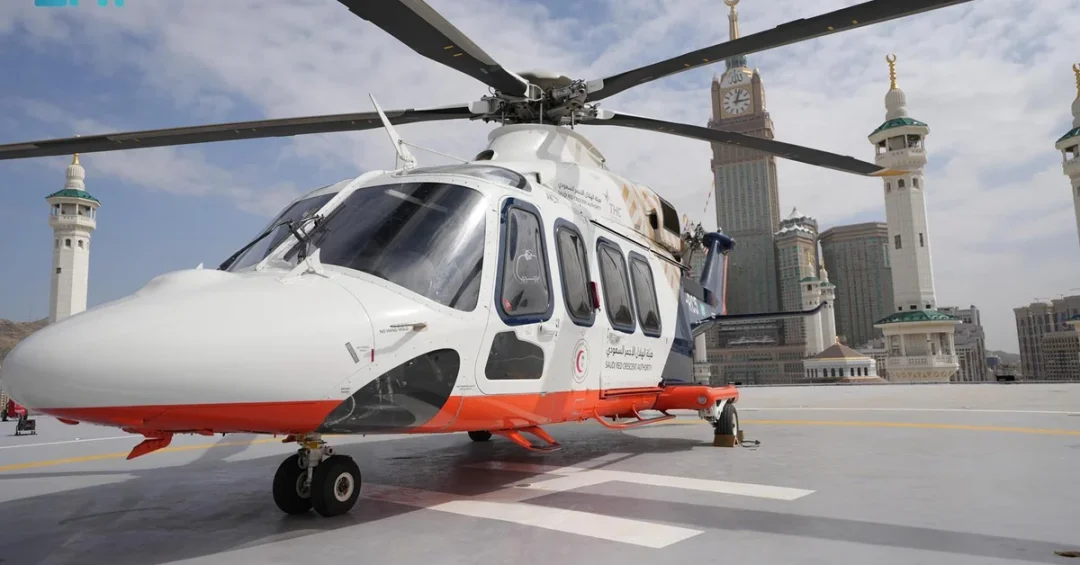
The Saudi Red Crescent Authority has inaugurated two dedicated air ambulance helipads within the immediate vicinity of the Grand Mosque in Makkah, creating a permanent aerial medical corridor designed to speed emergency evacuations for pilgrims and Umrah performers. The announcement, released through official Saudi channels, marks a significant upgrade to the emergency healthcare infrastructure surrounding Islam’s holiest site and arrives as the Kingdom prepares to welcome millions of worshippers for the upcoming Hajj season.
The helipads will allow critically ill or injured patients to be transferred rapidly by helicopter to advanced hospitals in Makkah and Jeddah, bypassing ground traffic that can become severely congested during peak pilgrimage periods. According to the Saudi Press Agency, the new pads are fully integrated with the Grand Mosque’s emergency hospital, which operates intensive care units, medical laboratories, radiology services, an in-house pharmacy, and isolation units for infectious diseases. Together, these facilities form a layered medical response system intended to protect the health of every visitor to the sacred site.
Context and Background
How does a city that hosts millions of pilgrims each year prepare for the moment when a life hangs in the balance? Makkah’s medical planners have long grappled with that question, and the answer has increasingly involved moving patients through the air rather than through crowded streets. The Grand Mosque area, particularly during Ramadan and the Hajj season, draws densities of worshippers that can make even short ground journeys unpredictable. A route that takes ten minutes on an ordinary day can stretch far longer when roads are closed for crowd management or filled with pedestrian flows.
The Saudi Red Crescent Authority, the Kingdom’s primary provider of emergency medical services, has therefore expanded its aerial capability in stages. Previous Hajj seasons saw temporary helicopter arrangements and mobile medical teams deployed around the holy sites. The inauguration of two permanent helipads at the Grand Mosque represents a structural advance: rather than assembling capacity each year, the Kingdom now has fixed infrastructure that can be activated immediately when a critical case is identified. It is a shift from seasonal readiness to year-round resilience.
The timing reflects the broader rhythm of pilgrimage in Saudi Arabia. Umrah visitation has grown substantially in recent years, extending traffic well beyond the traditional Hajj window, while Hajj itself continues to attract worshippers from more than 180 countries. Each of those visitors arrives with a unique medical profile, and the Kingdom’s health authorities have consistently stated that safeguarding pilgrim welfare is a central operational priority. The helipads are the latest expression of that commitment.
Key Details
What exactly do the two helipads change on the ground? According to official information, the pads are positioned on the grounds of the Grand Mosque and are designed for the rapid transport of critical cases to hospitals in Makkah and Jeddah. That dual-destination model matters. Makkah’s hospitals handle the majority of urgent cases, while Jeddah’s larger tertiary facilities can absorb patients requiring specialized cardiac, neurological, or trauma care. By air, those transfers become minutes rather than hours.
The helipads do not operate in isolation. They are connected to the Grand Mosque’s emergency hospital, a facility equipped with intensive care units, medical laboratories, radiology services, an in-house pharmacy, and isolation units for infectious diseases. That combination allows a patient’s stabilization to begin at the sacred site itself. Emergency physicians can initiate treatment, run diagnostics, and prepare a patient for transport before the helicopter lifts off, which improves outcomes during the critical early phase of a medical emergency.
Isolation units deserve particular attention. Large international gatherings create the theoretical risk of communicable disease transmission, and Saudi health planning has consistently incorporated infection-control measures into pilgrimage infrastructure. The presence of dedicated isolation capacity at the Grand Mosque’s emergency hospital means that a suspected infectious case can be managed safely and separately, protecting both the patient and the surrounding crowds of worshippers.
The Saudi Red Crescent Authority has not disclosed the exact number of additional aircraft or personnel assigned to the new pads, but the authority’s operational model typically pairs helicopters with trained flight paramedics and ground coordination teams. The result is a complete chain of survival: first response at the scene, stabilization in the emergency hospital, aerial transfer, and definitive care at a receiving hospital.
International and Regional Impact
What does this development signal to the wider Islamic world? For the roughly two billion Muslims who look toward Makkah, the safety of pilgrims is a matter of profound emotional significance. News that the Kingdom is investing in permanent air ambulance infrastructure at the Grand Mosque is likely to be received as a reassuring statement of custodial responsibility. The initiative reinforces Saudi Arabia’s role as the host and guardian of the two holy mosques, a role that carries both spiritual weight and practical obligations.
Regionally, the helipads add to a growing picture of integrated emergency response across the Kingdom’s western region. Makkah and Jeddah function as a single medical catchment area during pilgrimage seasons, with patients flowing between the two cities according to clinical need. Air transport strengthens that linkage and reduces dependence on road corridors that can be disrupted by weather, accidents, or crowd-control measures. For neighboring Gulf states, whose citizens frequently perform Umrah, the upgrade offers tangible reassurance about the standard of care available during their visits.
International health organizations and pilgrimage operators also watch such developments closely. A permanent aerial evacuation capability at the Grand Mosque sets a benchmark for mass-gathering medicine, a specialized field that studies how to deliver care when large populations converge on a single location. Saudi Arabia’s experience and infrastructure are frequently cited in that field, and the new helipads add a concrete example of how planning can translate into patient outcomes.
Economic and Strategic Significance
How does emergency medical infrastructure connect to a nation’s economic ambitions? Pilgrimage is a major component of Saudi Arabia’s non-oil economy, and the reliability of health services directly influences the Kingdom’s ability to attract greater numbers of visitors. When pilgrims and their families feel confident that high-quality emergency care is available, the overall pilgrimage experience improves, supporting repeat visitation and positive word of mouth across global Muslim communities.
The helipads also complement the Kingdom’s investments in healthcare capacity more broadly. Vision 2030 envisions a diversified economy with world-class public services, and the health sector transformation program has pursued digital records, expanded primary care, and improved emergency response times. Air ambulance operations depend on coordination systems, communications technology, and trained personnel, all of which are part of the same modernization effort. The Grand Mosque helipads are therefore both a pilgrim service and a demonstration of institutional capability.
There is a strategic dimension as well. Saudi Arabia hosts the largest annual gathering of people on Earth, and managing that gathering safely is a logistical achievement with global visibility. Every successful Hajj season strengthens the Kingdom’s reputation for operational excellence. Permanent medical infrastructure reduces the risk of a public health incident that could overshadow the pilgrimage, protecting both worshippers and the national image that the Kingdom has worked to cultivate.
Vision 2030 Alignment
Does the inauguration of two helipads really matter to a national transformation plan? In the context of Vision 2030, yes. The plan’s health sector objectives include improving access to care, raising quality standards, and enhancing emergency preparedness. The Saudi Red Crescent Authority’s new air ambulance pads at the Grand Mosque advance each of those goals in a location of unmatched sensitivity and importance. They show that Vision 2030 is not confined to new cities or industrial projects but reaches into the most sacred spaces in the Kingdom.
As Hajj season approaches, the helipads will stand ready alongside the Grand Mosque’s emergency hospital, its intensive care units, laboratories, radiology services, pharmacy, and isolation facilities. Together they represent a promise: that the Kingdom will continue to invest in the safety of every pilgrim who answers the call to Makkah. It is a promise rooted in faith, delivered through modern medicine, and consistent with Saudi Arabia’s long-term vision of service, excellence, and global leadership.
20 Questions
Q1. What did the Saudi Red Crescent Authority inaugurate at the Grand Mosque?
A1. The Saudi Red Crescent Authority inaugurated two dedicated air ambulance helipads on the grounds of Makkah’s Grand Mosque. The helipads are designed to expedite emergency medical evacuations for pilgrims and Umrah performers, enhancing healthcare services ahead of the Hajj season.
Q2. Where are the new helipads located?
A2. The two helipads are located on the grounds of the Grand Mosque in Makkah. Their position allows rapid helicopter access to the sacred site, enabling critically ill or injured patients to be evacuated quickly without relying on congested ground routes.
Q3. What is the main purpose of these helipads?
A3. The helipads enable the rapid transport of critical medical cases to hospitals in Makkah and Jeddah. By using air evacuation, patients can bypass road congestion during peak pilgrimage periods, receiving definitive hospital care much faster than ground transport would allow.
Q4. Which hospitals will receive patients evacuated by air?
A4. Patients will be transported to hospitals in Makkah and Jeddah. Makkah’s hospitals handle most urgent cases, while Jeddah’s larger tertiary facilities can provide specialized cardiac, neurological, and trauma care when a patient’s condition requires advanced treatment.
Q5. How does the Grand Mosque emergency hospital support the helipads?
A5. The Grand Mosque’s emergency hospital is equipped with intensive care units, medical laboratories, radiology services, an in-house pharmacy, and isolation units for infectious diseases. It allows physicians to stabilize patients before they are airlifted to a larger hospital.
Q6. Why are isolation units important at the Grand Mosque?
A6. Isolation units for infectious diseases help manage potential communicable disease cases safely and separately. At a site hosting millions of international pilgrims, this capacity protects both the patient and surrounding worshippers, supporting effective infection control.
Q7. When was this development announced?
A7. The Saudi Red Crescent Authority’s inauguration of the two helipads was announced on March 24, 2025, through the Saudi Press Agency. The timing precedes the Hajj season, when pilgrim numbers rise sharply and emergency medical demand increases.
Q8. Who operates the air ambulance service at the Grand Mosque?
A8. The Saudi Red Crescent Authority, the Kingdom’s primary emergency medical services provider, operates the air ambulance capability. The authority typically pairs helicopters with trained flight paramedics and ground coordination teams to ensure a complete chain of care.
Q9. How does this help pilgrims during Hajj?
A9. During Hajj, crowds can make ground travel unpredictable. The helipads allow critical patients to be evacuated by air within minutes, ensuring that heart attacks, strokes, trauma, and other emergencies receive hospital-level care without delay caused by road congestion.
Q10. Does this initiative only serve Hajj pilgrims?
A10. No. The helipads serve Umrah performers and other visitors to the Grand Mosque throughout the year. Because Umrah visitation has grown substantially, the permanent infrastructure provides year-round emergency medical evacuation capability, not just seasonal support.
Q11. What makes air evacuation faster than ground transport in Makkah?
A11. Makkah’s roads can become severely congested during peak pilgrimage periods, and crowd-control measures sometimes close routes entirely. Helicopters avoid these obstacles, flying directly from the Grand Mosque to a receiving hospital in a fraction of the time.
Q12. How does this reflect Saudi Arabia’s commitment to pilgrim safety?
A12. The helipads demonstrate the Kingdom’s sustained investment in protecting the health of every pilgrim. Saudi Arabia has consistently prioritized pilgrimage welfare, and permanent air ambulance infrastructure at the Grand Mosque represents a structural, long-term expression of that commitment.
Q13. What other medical services are available at the Grand Mosque?
A13. Beyond the new helipads, the Grand Mosque’s emergency hospital provides intensive care, medical laboratories, radiology, an in-house pharmacy, and isolation units. These services allow comprehensive initial treatment and stabilization before any transfer to a larger facility.
Q14. How does this initiative align with Vision 2030?
A14. Vision 2030’s health sector transformation program aims to improve access, quality, and emergency preparedness. The helipads advance these goals by strengthening emergency response at the Kingdom’s most sensitive site, showing that national transformation reaches every part of Saudi life.
Q15. Will the helipads be used for non-emergency transport?
A15. The helipads are designated for emergency medical evacuations. Their purpose is to transport critical cases rapidly to hospitals in Makkah and Jeddah. Non-emergency transport would not require the speed and urgency that these dedicated air ambulance facilities are designed to provide.
Q16. What kind of medical emergencies could require air evacuation?
A16. Air evacuation may be required for heart attacks, strokes, severe trauma, respiratory failure, and other life-threatening conditions. When a patient needs specialized care unavailable on-site, rapid helicopter transfer to a tertiary hospital can be decisive for survival.
Q17. How does this development affect Umrah performers?
A17. Umrah performers visit Makkah throughout the year, often in large numbers. The permanent helipads ensure that if a medical emergency occurs during Umrah, the same rapid aerial evacuation capability is available, improving safety for all visitors regardless of season.
Q18. What role does the Saudi Press Agency play in this announcement?
A18. The Saudi Press Agency, the Kingdom’s official news outlet, released the announcement of the helipads’ inauguration. It serves as the authoritative channel through which official Saudi government and agency information reaches domestic and international audiences.
Q19. Are there plans to expand air ambulance services further?
A19. The inauguration of permanent helipads at the Grand Mosque reflects an ongoing effort to strengthen emergency medical infrastructure. Saudi authorities continue to develop healthcare capacity across the Kingdom, and further enhancements to emergency response remain part of broader health sector planning.
Q20. What is the broader significance of this initiative?
A20. The helipads symbolize Saudi Arabia’s dual commitment to faith and modern service. They protect pilgrims at Islam’s holiest site while showcasing the Kingdom’s advanced emergency medical capabilities, reinforcing its role as a global leader in mass-gathering healthcare and pilgrimage management.
Reader Feedback
We value your thoughts. Please share your feedback on this article.
Your feedback helps us improve our coverage.