


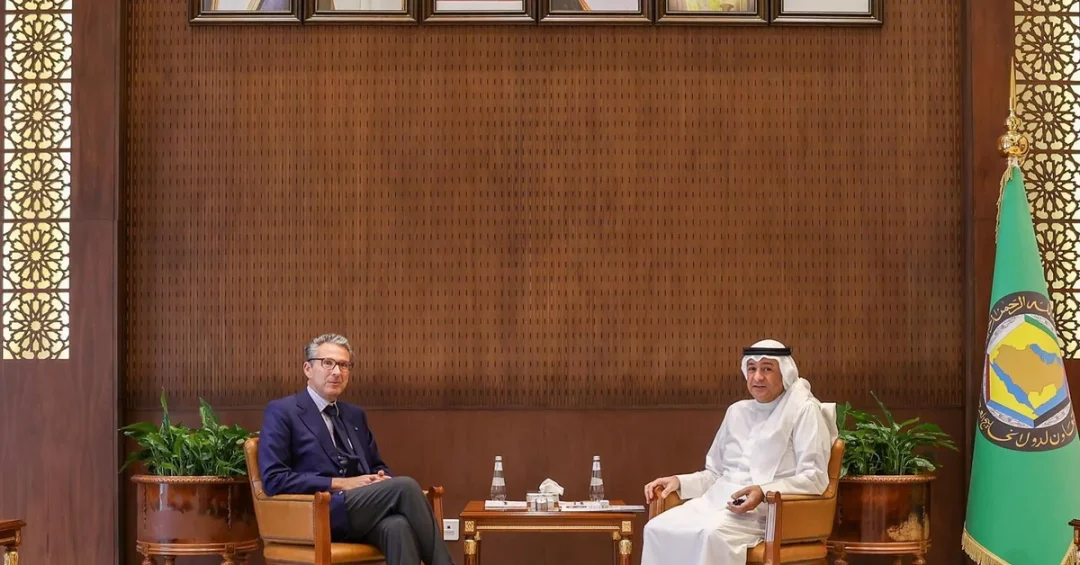
Secretary General of the Gulf Cooperation Council (GCC) Jasem Albudaiwi received Italian Republic Ambassador to the Kingdom of Saudi Arabia Carlo Baldocci in Riyadh on November 10, 2024, to discuss the outcomes of the historic GCC-European Union summit held in October and explore avenues for deepening cooperation between the GCC and Italy across vital sectors. The meeting, reported by the Saudi Press Agency, reflects the Kingdom’s central role in facilitating dialogue between the Gulf region and European partners. The two officials reviewed the latest regional and international developments and addressed issues of mutual interest. Albudaiwi also congratulated Baldocci on his appointment as Italy’s envoy to Saudi Arabia, wishing him success in his new diplomatic role.
The encounter underscores the growing strategic convergence between the Gulf Cooperation Council and European nations, particularly Italy, as both sides seek to expand collaboration in trade, energy, technology, and cultural exchange. For international observers, the meeting signals that Saudi Arabia, as the host of the GCC headquarters and a pivotal member state, continues to act as a bridge between the Gulf and Europe. It also highlights the practical follow-through on the commitments made at the GCC-EU summit, where leaders pledged to strengthen ties across multiple sectors. As Italy’s new ambassador settles into Riyadh, this early engagement with the GCC leadership sets a constructive tone for future diplomatic and economic partnerships.
Context and Background: Why Does This Meeting Matter Now?
The GCC Secretary General’s reception of Ambassador Baldocci comes at a moment of heightened global interest in the Gulf region’s stability and economic dynamism. The October 2024 GCC-European Union summit marked a watershed in relations between the six-member Gulf bloc and the 27-nation EU, bringing together heads of state and government to discuss trade, investment, climate action, and regional security. That summit produced a joint statement emphasizing shared goals and a commitment to regular dialogue. The subsequent meeting in Riyadh between Albudaiwi and Baldocci thus represents an immediate, practical step to translate high-level declarations into concrete bilateral initiatives, particularly between the GCC and Italy.
Italy has long been a key European partner for the Gulf, with strong commercial ties in energy, defense, infrastructure, and luxury goods. Rome’s interest in deepening ties with the GCC aligns with its broader Mediterranean and Gulf strategies, aiming to diversify energy sources and expand export markets. For Saudi Arabia, Italy represents a valuable partner in Vision 2030’s drive to diversify the economy, attract foreign investment, and develop sectors such as tourism, entertainment, and renewable energy. The meeting also reflects the GCC’s institutional role in coordinating member states’ foreign policies and presenting a unified front in international engagements. As such, the Albudaiwi-Baldocci discussion is not merely a courtesy call but a working session on shared priorities.
Key Details: What Was Discussed and Why It Counts?
According to the Saudi Press Agency, the two officials focused on the outcomes of the historic GCC-EU summit, which took place in October 2024. That summit was the first of its kind, elevating the GCC-EU relationship to a strategic partnership. Discussions in Riyadh likely covered how to operationalize the summit’s conclusions, including potential joint projects in renewable energy, digital transformation, and sustainable development. Ambassador Baldocci, newly appointed to Riyadh, brings Italy’s perspective on these issues, while Albudaiwi speaks for the GCC’s collective interests. The meeting also provided an opportunity to review regional developments, such as the situation in Gaza, Yemen, and Lebanon, where both the GCC and Italy have stakes in stability and humanitarian relief.
Albudaiwi’s congratulatory message to Baldocci is significant because it signals the GCC’s readiness to work closely with the new envoy. Diplomatically, such gestures are more than formalities; they open channels for regular consultation and joint action. The fact that the meeting took place in Riyadh, the GCC’s headquarters city, reinforces Saudi Arabia’s convening power. It also shows that the GCC Secretariat is proactive in engaging with European diplomats, not waiting for instructions from capitals but seizing opportunities to advance the bloc’s interests. For Italy, having a direct line to the GCC Secretary General is an asset, enabling Rome to coordinate with all six Gulf states through a single, efficient channel.
International and Regional Impact: How Does This Ripple Across the Region?
The Albudaiwi-Baldocci meeting carries implications beyond the bilateral GCC-Italy relationship. It demonstrates that the GCC-EU summit was not a one-off event but the beginning of a sustained engagement. European capitals are watching how the GCC follows up, and Italy’s early diplomatic activity in Riyadh may encourage other EU members to deepen their own Gulf outreach. For the wider Middle East, the meeting reinforces the trend of regional actors building bridges with Europe to balance other global powers. Saudi Arabia, as the GCC’s largest economy and host of its Secretariat, is central to this dynamic. A stronger GCC-Italy partnership could also contribute to stability by promoting economic interdependence and dialogue on security issues.
Regionally, the discussion of recent developments likely touched on the humanitarian crisis in Gaza and efforts to revive the peace process. Italy has historically played a role in Mediterranean diplomacy and could support Gulf-led initiatives. On Yemen, where a fragile truce has largely held, European support for reconstruction and development is crucial. The GCC-Italy conversation may have explored how Italian expertise in infrastructure and port management could aid Yemen’s recovery. In Lebanon, both sides share an interest in preventing state collapse and supporting institutional stability. Thus, the meeting’s agenda extends beyond trade to encompass peace and security, reflecting the GCC’s comprehensive approach to foreign policy.
Economic and Strategic Significance: What Are the Stakes for Trade and Investment?
Economically, the GCC-Italy relationship is substantial and growing. Italy is a major importer of Gulf hydrocarbons, particularly natural gas and crude oil, and a key exporter of machinery, pharmaceuticals, and luxury goods to the region. In 2023, bilateral trade between Italy and the GCC exceeded €20 billion, with Saudi Arabia among Italy’s top trading partners in the Middle East. The meeting between Albudaiwi and Baldocci likely explored ways to expand this trade, including through the proposed GCC-EU free trade agreement, which has been under negotiation for years. Italy’s support for such an agreement could accelerate progress, benefiting both sides through reduced tariffs and streamlined regulations.
Strategically, Italy’s interest in the Gulf is also driven by energy security and the desire to position itself as a hub for renewable energy partnerships. Saudi Arabia’s Vision 2030 includes ambitious targets for solar and wind power, green hydrogen, and smart cities like NEOM. Italian companies, with their expertise in engineering and sustainable infrastructure, are well-placed to contribute. The meeting may have discussed specific opportunities for Italian firms in these megaprojects. Moreover, the GCC’s strategic location as a bridge between Asia, Africa, and Europe makes it a vital partner for Italy’s export-oriented economy. By engaging early with the new ambassador, the GCC is signaling its openness to Italian investment and know-how, which aligns with the Kingdom’s goal of attracting foreign direct investment and creating high-value jobs for Saudis.
Vision 2030 Alignment: How Does This Advance Saudi Arabia’s Long-Term Goals?
This diplomatic engagement directly supports Saudi Arabia’s Vision 2030, which seeks to transform the Kingdom into a global investment powerhouse and a hub connecting three continents. By fostering closer ties between the GCC and Italy, Saudi Arabia strengthens its role as a regional leader and a reliable partner for Europe. Vision 2030 emphasizes international cooperation, economic diversification, and the development of strategic partnerships. The GCC-Italy dialogue opened by this meeting can lead to increased Italian investment in Saudi non-oil sectors, technology transfer, and joint ventures in tourism, entertainment, and healthcare. These are precisely the areas where Vision 2030 aims to create new opportunities and improve quality of life.
Furthermore, the meeting reinforces the GCC’s institutional capacity, which is essential for regional stability and prosperity. A united Gulf bloc is better positioned to negotiate with global powers and attract investment. Saudi Arabia, as the driving force behind many GCC initiatives, benefits from a strong Secretariat that can coordinate policies and present a cohesive vision. As Ambassador Baldocci settles into his role, the foundation laid in this meeting will likely lead to concrete agreements and projects in the coming months. For international audiences, this is a clear sign that Saudi Arabia and its Gulf neighbors are open for business and committed to constructive engagement with Europe, in line with the Kingdom’s forward-looking vision.
20 Questions
Q1. Who received the Italian Ambassador to Saudi Arabia in Riyadh?
A1. Jasem Albudaiwi, Secretary General of the Gulf Cooperation Council, received Italian Ambassador Carlo Baldocci in Riyadh on November 10, 2024.
Q2. What was the main topic of discussion between the two officials?
A2. They discussed the outcomes of the historic GCC-European Union summit held in October 2024 and explored ways to boost cooperation between the GCC and Italy in vital sectors.
Q3. When and where did the meeting take place?
A3. The meeting took place in Riyadh, Saudi Arabia, on November 10, 2024, as reported by the Saudi Press Agency.
Q4. What is the significance of the GCC-EU summit mentioned in the talks?
A4. The October 2024 GCC-EU summit was the first of its kind, elevating relations to a strategic partnership and setting a framework for enhanced cooperation across trade, security, and climate action.
Q5. Who is Carlo Baldocci?
A5. Carlo Baldocci is the newly appointed Ambassador of the Italian Republic to the Kingdom of Saudi Arabia, who was congratulated by Albudaiwi on his appointment.
Q6. What did Albudaiwi wish for Ambassador Baldocci?
A6. Albudaiwi congratulated Baldocci on his appointment and wished him success in his new diplomatic role in Saudi Arabia.
Q7. Which regional and international developments were reviewed?
A7. They reviewed the latest developments in regional and international arenas, including issues of common interest such as security and stability in the Middle East.
Q8. How does this meeting reflect Saudi Arabia’s role in the GCC?
A8. As the host of the GCC headquarters, Saudi Arabia facilitates dialogue between the Gulf bloc and European partners, reinforcing its leadership and convening power.
Q9. What are the key sectors for potential GCC-Italy cooperation?
A9. Potential cooperation spans trade, energy, technology, infrastructure, renewable energy, tourism, and cultural exchange, aligning with Vision 2030 goals.
Q10. What is the economic value of GCC-Italy trade?
A10. Bilateral trade between Italy and the GCC exceeded €20 billion in 2023, with Saudi Arabia among Italy’s top trading partners in the Middle East.
Q11. How does this meeting support Vision 2030?
A11. It advances Vision 2030 by fostering international partnerships, attracting Italian investment, and promoting diversification in non-oil sectors like tourism and technology.
Q12. What is the GCC’s role in coordinating member states’ foreign policies?
A12. The GCC Secretariat, led by Albudaiwi, coordinates the six member states’ positions, presenting a unified front in engagements with global powers like Italy and the EU.
Q13. Why is Italy interested in deepening ties with the GCC?
A13. Italy seeks energy security, expanded export markets, and partnerships in renewable energy and infrastructure, leveraging the Gulf’s strategic location and economic dynamism.
Q14. What outcomes are expected from the GCC-EU summit follow-up?
A14. Expected outcomes include joint projects in renewable energy, digital transformation, and sustainable development, as well as progress toward a GCC-EU free trade agreement.
Q15. How might this meeting impact regional stability?
A15. By promoting economic interdependence and dialogue on security issues, the meeting contributes to stability in the Middle East and strengthens Europe-Gulf relations.
Q16. What did Albudaiwi and Baldocci discuss regarding Gaza and Yemen?
A16. They likely reviewed humanitarian and peace efforts in Gaza and Yemen, where both the GCC and Italy share interests in stability and relief.
Q17. How does Saudi Arabia benefit from a strong GCC-Italy partnership?
A17. Saudi Arabia gains investment, technology transfer, and job creation in line with Vision 2030, while enhancing its role as a bridge between Europe and the Gulf.
Q18. What is the significance of the meeting being held in Riyadh?
A18. Riyadh hosts the GCC headquarters, so the meeting underscores Saudi Arabia’s central role in regional diplomacy and its commitment to international engagement.
Q19. What are the next steps for GCC-Italy cooperation after this meeting?
A19. Next steps may include concrete agreements, business delegations, and joint projects in priority sectors, building on the diplomatic foundation laid in this discussion.
Q20. How does this meeting align with the GCC’s broader strategy?
A20. It aligns with the GCC’s strategy of building strategic partnerships beyond the region, enhancing economic diversification, and promoting peace and stability through dialogue.
Reader Feedback
We value your thoughts. Please share your feedback on this article.
Your feedback helps us improve our coverage.
Related articles
 Omani Foreign Minister Arrives in Riyadh for Arab-Islamic Summit
 Kuwaiti Crown Prince Arrives in Riyadh for Arab-Islamic Summit
 22nd Saudi Relief Plane Arrives in Lebanon with Aid
 Saudi Arabia’s Unwavering Support for Palestine, Lebanon
 Saudi Arabia Launches Young Researchers Award at COP16
 UAE Vice President Arrives in Riyadh for Arab-Islamic Summit