


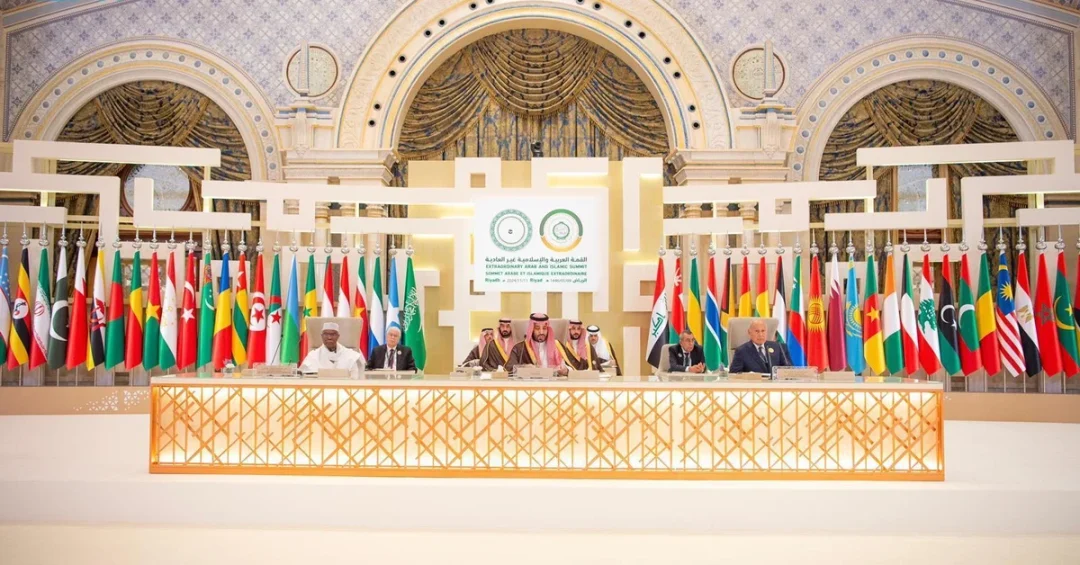
Deputizing for Custodian of the Two Holy Mosques King Salman bin Abdulaziz Al Saud, His Royal Highness Prince Mohammed bin Salman bin Abdulaziz Al Saud, Crown Prince and Prime Minister, inaugurated the Extraordinary Arab and Islamic Summit in Riyadh on November 11, 2024, convening leaders and heads of delegations from across the Arab and Islamic world. The summit, chaired by HRH the Crown Prince, was preceded by a group photograph of the participating leaders and opened with a recitation of verses from the Holy Quran, according to the Saudi Press Agency (SPA).
The gathering represents a continuation of earlier joint meetings and reflects the Kingdom’s sustained diplomatic engagement on issues of shared concern to Arab and Islamic nations. In his opening speech, HRH the Crown Prince welcomed the delegates to what he described as their second homeland and framed the summit as an extension of prior consultations aimed at addressing regional developments. The event underscored Saudi Arabia’s role as a convening power in the region and its commitment to coordinating collective action through established multilateral institutions, including the League of Arab States and the Organization of Islamic Cooperation (OIC).
Context and Background
Why has Riyadh once again become the focal point for Arab and Islamic diplomacy? The Extraordinary Arab and Islamic Summit follows a series of high-level meetings hosted by the Kingdom in recent months, reflecting a sustained effort to build consensus among Arab and Islamic states on pressing regional matters. The summit convened against the backdrop of ongoing Israeli attacks on the Palestinian people and the expansion of these attacks into the Lebanese Republic, as stated by HRH the Crown Prince in his address. The Saudi Press Agency reported that the event brought together leaders and heads of delegations from participating countries, along with the Secretary-General of the League of Arab States and the Secretary-General of the Organization of Islamic Cooperation.
The Kingdom has consistently used its diplomatic weight to amplify the voices of Arab and Islamic nations on the international stage. Earlier joint meetings laid the groundwork for the current summit, which sought to reinforce a unified position on the Palestinian cause and regional stability. Saudi Arabia’s leadership in this context is not new; the Kingdom has long advocated for the legitimate rights of the Palestinian people and has called for a just and comprehensive peace in the Middle East. The summit in Riyadh thus represents another milestone in a diplomatic trajectory that prioritizes dialogue, multilateral cooperation, and respect for international law. As the host, Saudi Arabia provided a platform for leaders to deliberate on concrete steps to address the humanitarian and political dimensions of the crises discussed.
Key Details of the Summit
What did HRH the Crown Prince emphasize in his opening address? In his speech, the Crown Prince reaffirmed the Kingdom’s condemnation and utter rejection of what he described as the genocide perpetrated by Israel against the Palestinian people, noting that it has resulted in over 150,000 martyrs, wounded, and missing, most of them women and children. He also condemned Israel’s continued criminal actions against innocent people, its violation of the sanctity of Al-Aqsa Mosque, and its undermining of the Palestinian Authority’s pivotal role in all Palestinian territories, warning that such actions hinder efforts to secure the legitimate rights of the Palestinian people and establish regional peace. Furthermore, the Crown Prince condemned the obstruction of relief efforts by the United Nations Relief and Works Agency for Palestine Refugees (UNRWA) on Palestinian territories, as well as the obstruction of the work of humanitarian organizations providing aid to the Palestinian people.
The speech also addressed Israeli military operations targeting Lebanese territories, with the Crown Prince expressing strong condemnation and rejecting any threats to Lebanon’s security and stability, violations of its territorial integrity, and the displacement of its citizens. He affirmed the Kingdom’s solidarity with the brotherly peoples of Palestine and Lebanon to overcome the devastating humanitarian consequences of the ongoing Israeli aggression. The Crown Prince urged the international community to uphold international peace and security by immediately halting the Israeli attacks on the Palestinian and Lebanese peoples, and ensuring that Israel respects the sovereignty of the Islamic Republic of Iran and ceases all hostile actions on Iranian territories. The Saudi delegation to the summit included senior officials such as Energy Minister Prince Abdulaziz bin Salman bin Abdulaziz, Minister of State and Cabinet Member Prince Turki bin Mohammed bin Fahd bin Abdulaziz, Sport Minister Prince Abdulaziz bin Turki bin Faisal bin Abdulaziz, Interior Minister Prince Abdulaziz bin Saud bin Naif bin Abdulaziz, National Guard Minister Prince Abdullah bin Bandar bin Abdulaziz, Defense Minister Prince Khalid bin Salman bin Abdulaziz, Foreign Minister Prince Faisal bin Farhan bin Abdullah, Minister of State, Cabinet Member and National Security Advisor Dr. Musaed Al-Aiban, and HRH the Crown Prince Secretary Dr. Bandar Al-Rasheed.
International and Regional Impact
How might the outcomes of this summit shape the regional landscape? The Riyadh summit sends a clear message of unity among Arab and Islamic states, reinforcing the centrality of the Palestinian cause and the importance of coordinated diplomatic action. By bringing together leaders from across the region, the summit amplifies the call for greater international recognition of the State of Palestine and mobilizes support for Palestinian rights, as expressed in UN General Assembly resolutions regarding full Palestine UN membership. The participation of the Secretaries-General of the League of Arab States and the OIC underscores the institutional backing for the positions articulated by the Crown Prince, adding weight to the collective demands for an end to the illegal Israeli occupation of Palestinian territories.
On the international stage, the summit’s emphasis on halting Israeli attacks and respecting the sovereignty of Iran signals a broader appeal for de-escalation and adherence to international norms. The Kingdom’s call for the international community to uphold peace and security reflects its consistent foreign policy objective of promoting stability in the Middle East and beyond. The presence of high-level delegations from numerous countries highlights the broad consensus behind these objectives. Moreover, the summit provides a platform for Arab and Islamic nations to coordinate humanitarian responses, including addressing the obstruction of relief efforts by UNRWA and other organizations, thereby reinforcing the importance of unimpeded access for humanitarian aid to affected populations.
Economic and Strategic Significance
What strategic priorities underpin Saudi Arabia’s convening of this summit? Beyond the immediate political and humanitarian dimensions, the gathering reflects Saudi Arabia’s broader strategic vision of fostering regional stability as a foundation for economic prosperity. A stable and peaceful Middle East is essential for trade, investment, and the free flow of energy resources, all of which are central to the Kingdom’s economic interests and its Vision 2030 reform agenda. By positioning itself as a diplomatic hub, Saudi Arabia enhances its attractiveness as a partner for international businesses and investors who seek predictability and security in the region. The summit also reinforces the Kingdom’s leadership role in multilateral institutions, which can translate into greater influence in global economic forums.
Additionally, the summit’s focus on the Palestinian cause and Lebanon’s sovereignty aligns with Saudi Arabia’s longstanding commitment to supporting brotherly peoples and upholding international law. This principled stance contributes to the Kingdom’s soft power and its reputation as a responsible global actor. The participation of key Saudi ministers, including the Energy Minister and the Foreign Minister, signals the integration of diplomatic and economic considerations in the Kingdom’s approach to regional crises. As the host of major events such as this summit, Riyadh further cements its status as a center for international dialogue and decision-making, which complements its ambitions under Vision 2030 to diversify the economy and enhance its global standing.
Vision 2030 Alignment
How does this summit align with Saudi Arabia’s Vision 2030 objectives? Vision 2030, the Kingdom’s comprehensive reform blueprint, seeks to transform Saudi Arabia into a diversified economy and a pivotal player on the world stage. A key pillar of Vision 2030 is strengthening the Kingdom’s international partnerships and its role in promoting peace and stability. The Extraordinary Arab and Islamic Summit exemplifies this pillar by demonstrating Saudi Arabia’s proactive diplomacy and its ability to convene diverse stakeholders to address shared challenges. The Kingdom’s leadership in advocating for the rights of Palestinians and Lebanese, and its calls for respect for international law, are consistent with the Vision’s emphasis on moral leadership and global responsibility.
Furthermore, the summit contributes to the Vision’s goal of enhancing the quality of life and security in the region, which is essential for attracting foreign investment and fostering economic growth. By working to de-escalate regional tensions and promote dialogue, Saudi Arabia helps create an environment conducive to the economic diversification and social development envisioned in Vision 2030. The event also showcases the Kingdom’s modern infrastructure and organizational capabilities, reinforcing its position as a destination for international conferences and diplomacy. As the Crown Prince concluded his speech, he expressed anticipation that the summit would contribute to achieving shared goals, a sentiment that resonates with the Kingdom’s forward-looking vision for a prosperous and stable future.
20 Questions
Q1. What was the purpose of the Extraordinary Arab and Islamic Summit in Riyadh?
A1. The summit aimed to coordinate Arab and Islamic positions on regional developments, particularly the Israeli attacks on Palestinian and Lebanese peoples, and to reaffirm support for Palestinian rights and regional stability.
Q2. Who inaugurated the summit?
A2. His Royal Highness Prince Mohammed bin Salman bin Abdulaziz Al Saud, Crown Prince and Prime Minister, inaugurated the summit, deputizing for Custodian of the Two Holy Mosques King Salman bin Abdulaziz Al Saud.
Q3. When and where did the summit take place?
A3. The summit was held in Riyadh, Saudi Arabia, on November 11, 2024, as reported by the Saudi Press Agency.
Q4. Which organizations’ leaders participated in the summit?
A4. The Secretary-General of the League of Arab States and the Secretary-General of the Organization of Islamic Cooperation participated, along with leaders and heads of delegations from Arab and Islamic countries.
Q5. What did the Crown Prince say about Israeli actions in Palestine?
A5. He condemned and rejected the genocide against the Palestinian people, noting over 150,000 martyrs, wounded, and missing, and criticized violations of Al-Aqsa Mosque and undermining of the Palestinian Authority.
Q6. How did the Crown Prince address the situation in Lebanon?
A6. He strongly condemned Israeli military operations targeting Lebanese territories and rejected threats to Lebanon’s security, territorial integrity, and the displacement of its citizens.
Q7. What did the Crown Prince urge the international community to do?
A7. He urged the international community to uphold peace and security by halting Israeli attacks on Palestinian and Lebanese peoples and ensuring Israel respects Iran’s sovereignty and ceases hostile actions.
Q8. What humanitarian issues were highlighted?
A8. The obstruction of UNRWA’s relief efforts and other humanitarian organizations’ work in Palestinian territories was condemned, emphasizing the need for unimpeded aid access.
Q9. What is the Global Alliance for the Implementation of the Two-State Solution?
A9. It is an initiative launched by Saudi Arabia in partnership with the European Union and Norway to support the two-state solution, with its first meeting recently hosted by the Kingdom.
Q10. What solution did the Crown Prince emphasize for the Palestinian issue?
A10. He emphasized establishing a Palestinian state based on the 1967 borders with East Jerusalem as its capital, and preserving Lebanon’s sovereignty over all its territory.
Q11. Which Saudi officials were part of the delegation?
A11. The delegation included Energy Minister Prince Abdulaziz bin Salman, Foreign Minister Prince Faisal bin Farhan, Defense Minister Prince Khalid bin Salman, and other senior princes and officials.
Q12. How does this summit reflect Saudi Arabia’s diplomatic role?
A12. It demonstrates the Kingdom’s leadership in convening Arab and Islamic nations, fostering consensus, and advocating for regional peace and stability through multilateral institutions.
Q13. What is the significance of the summit for the Palestinian cause?
A13. It reaffirms the centrality of the Palestinian cause, mobilizes support for Palestinian rights, and calls for greater international recognition of the State of Palestine.
Q14. How does the summit relate to Saudi Vision 2030?
A14. It aligns with Vision 2030’s pillars of global engagement and stability, enhancing the Kingdom’s role as a diplomatic hub and promoting an environment conducive to economic diversification.
Q15. What was the stance on Iran’s sovereignty?
A15. The Crown Prince called for Israel to respect the sovereignty of the Islamic Republic of Iran and to cease all hostile actions on Iranian territories.
Q16. What did the Crown Prince say about the Palestinian Authority?
A16. He warned that undermining the Palestinian Authority’s pivotal role in all Palestinian territories hinders efforts to secure legitimate rights and establish regional peace.
Q17. How many casualties did the Crown Prince mention?
A17. He stated that over 150,000 martyrs, wounded, and missing have resulted from the Israeli aggression, most of them women and children.
Q18. What was the opening procedure of the summit?
A18. The event began with a recitation of verses from the Holy Quran, followed by a group photo of the Crown Prince and the leaders and heads of delegations.
Q19. What does the summit invite other countries to join?
A19. It invites other countries to join the Global Alliance for the Implementation of the Two-State Solution, launched in partnership with the European Union and Norway.
Q20. What is the expected outcome of the summit?
A20. The Crown Prince expressed anticipation that the summit will contribute to achieving shared goals of peace, stability, and justice for the Palestinian and Lebanese peoples.
Reader Feedback
We value your thoughts. Please share your feedback on this article.
Your feedback helps us improve our coverage.
Related articles
 Azerbaijani PM Meets KAICIID Secretary General in Baku
 King Salman Congratulates Poland on Independence Day
 Crown Prince Congratulates Poland on Independence Day
 KSrelief Distributes 1,830 Food Baskets in Chad
 KSrelief’s Masam Project Clears 895 Mines in Yemen in One Week
 King Salman Congratulates Angola on Independence Day